
Hong
The busy port and the busier actor
Today’s New York Times Spelling Bee letters:
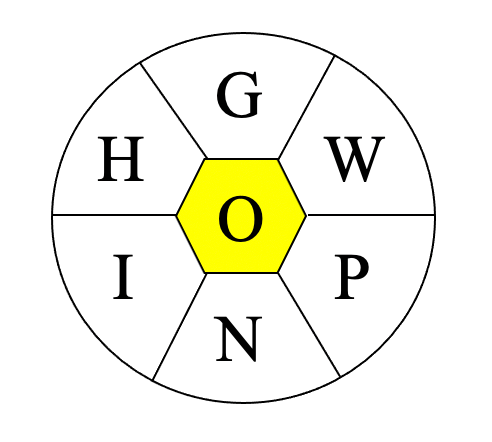
G, H, I, N, P, W, and center O (all words must include O)
Merriam-Webster says…
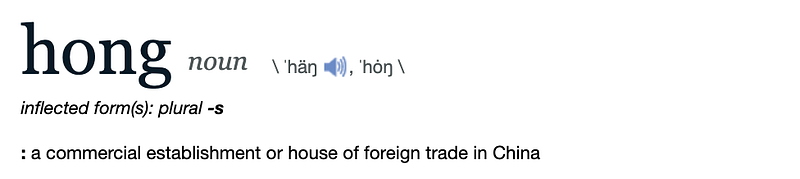
Silly little dictionary! Don’t you know hong can’t possibly be a word if the New York Times says it ain’t?
For further fascinating facts, check out the Spelling Bee Master.
What’s your favorite dord* from today’s puzzle?
My Two Cents
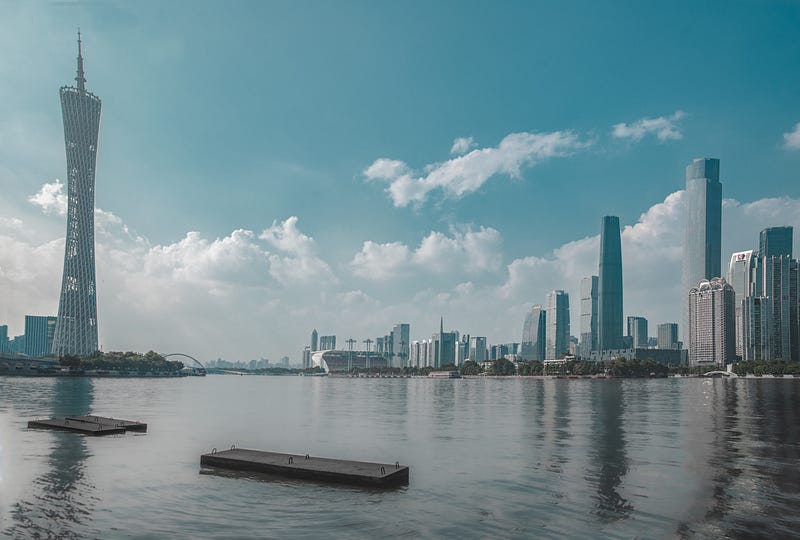
The photo at the top of today’s column show the view of the modern day Guangzhou also known as Canton, Kwongchow, or Kwangchow. It’s likely Westerners are most familiar with the name Canton. In any case, I typed “Guangzhou” into Unsplash and got this photo, among may others. So I hope I wasn’t being duped.
Canton is the capital and largest city of Guangdong province in southern China. Founded by the Pearl River, it has a long, long, history as an important trading port. It was a major stop of the maritime Silk Road, and the epicenter of opium trade and the Opium Wars fought between the Qing dynasty and Western powers in the mid-19th century.
hong with a lowercase c
Hong, also called cohong, was the guild of Chinese merchants authorized by the central government to trade with Western merchants near the Pearl River of Guangzhou (Canton) beginning in the 16th century, towards the end of the Mind dynasty. The name hong (which means both “profession” and “row” in Chinese) originally referred to the row of factories built outside of the city walls of Canton.
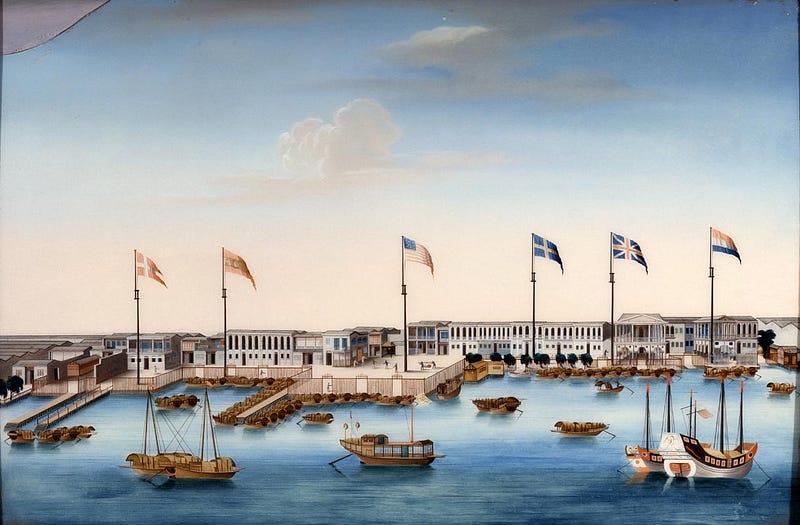
The Qing dynasty that succeeded the Mind dynasty and ruled until shortly before World War I kept this system going. It also established a neighborhood called the Thirteen Factories. These weren’t really factories at all, but offices, trading posts, and warehouses. The number also varied; it went down as low as four at one point in time.
This painting circa 1805 shows the Thirteen Factories.
The Harvard Business School Library sums it up thusly:
During the period known as the Canton trade system (1757–1842), hong merchants acted as exclusive liaisons between American traders and the Chinese. Holding the license to trade issued by the Chinese government, the hong merchants enjoyed considerable power. All foreign trade was required to be channeled through them. They purchased most of the imports, arranged for exports back to America, and made sure Westerners followed customs and duty regulations. Samuel Shaw, an American consul in Canton, described the hong merchants as “intelligent, exact accountants, punctual to their engagements . . . [who] value themselves much upon maintaining a fair character.”
Because Guangzhou became the one and only Chinese port open to foreign trade, the hong merchants were the only ones who were allowed to sell tea and silk to Westerners.
As Peter C. Perdue explains in his essay “The First Opium War”:
…Western traders… could only reside in the city in a limited space, including their warehouses; they could not bring their families; and they could not stay there more a few months of the year... Western merchants could not contact Qing officials directly, and there were no formal diplomatic relations between China and Western countries. The Qing emperor regarded trade as a form of tribute, or gifts given to him personally by envoys who expressed gratitude for his benevolent rule.
Western traders mainly conducted trade through companies like Britain’s East India Company and the Dutch VOC. Despite these restrictions, both sides learned how to make profits by cooperating with each other.
When the British started using opium instead of silver to pay for tea and porcelain, millions of Chinese got hooked on the drug. Things started to fall apart and eventually spiralled into not one, but two Opium Wars, fought between 1839–1842 and 1856–1860. You can read more about how things fell apart in Perdue’s essay:
MIT Visualizing Cultures
The Opium Wars of 1839 to 1842 and 1856 to 1860
visualizingcultures.mit.edu
Hong with an uppercase C
Did you know that longtime Hollywood movie and TV actor James Hong just turned 93 this past Tuesday? Happy belated birthday, James! (I’m on a first-name basis with him, although he doesn’t know it yet.)
This photo of Hong is from 2014, which means he was around 85 at the time, and still looking better than many people half his age.
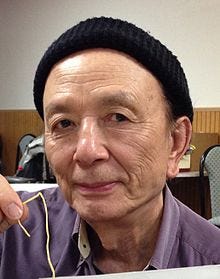
Did you know that as of last year, James has more than 650 film and television credits, including voiceovers?
And did you know that James was born in Minneapolis, Minnesota? His father emigrated from Hong Kong to the U.S. via Canada. He settled down in Chicago and opened a herb store. Hong’s paternal grandfather was from Taishan, China.
Because Hong has been working as an actor, producer, and director since the 1950s, the roles you remember him for may depend on what generation you belong to. Perhaps it was his guest appearances on TV shows between the 1950s and 1970s, such as The New Adventures of Charlie Chan, Zorro, Perry Mason, The Bob Newhart Show, Kung Fu, and Seinfeld. Or maybe you’re more familiar with his movie roles in such films as Chinatown, Big Trouble in Little China, Bladerunner, and Wayne’s World 2. Or it’s his voice that sounds familiar in animated movies and shows like Mulan, Teen Titan,s Kung Fu Panda, and Jackie Chan Adventures. Hong has even done voice work for video games.
Here are a few interesting things I learned while reading up on this everlasting actor.
§ His big break came on a TV show called “You Bet Your Life,” hosted by Groucho Marx. Hong made a noteworthy appearance by impersonated Marx himself. According to James, he “got the second-biggest fan mail ever on the Groucho Marx show”. This helped him obtain a movie agent and launch his acting career.
§ He got to act alongside such classic movie stars as Clark Gable, John Wayne, William Holden, and Jennifer Jones.
§ He served in the United States Army around the time the Korean War started. While at Camp Rucker, in Alabama, he would entertain soldiers during after his training exercises were done for the day. That may have saved Hong’s life, as the camp general told him to stay there and be in charge of the camp’s live instead of deploying overseas. As Hong explained in an interview:
I do not know if I would have liked to go to war in Korea but let’s admit it that with a G.I. cap and this face charging at the Korean army, the Koreans would try to kill me. But then if we were to retreat and I turned around and ran back the Americans would try to kill me too because they had think I am an enemy in disguise. I definitely think I would have been shot from one side and the other.
§ He began his career by re-dubbing 1950s Asian films. One of them was the classic 1956 film Godzilla, King of the Monsters!, for which Hong dubbed the voices of two characters.
§ Surprisingly, despite the number of movies he’s worked in , Hong’s Bacon number is not 0. In other words, they’ve never worked on a film together. The closest Bacon number for James Hong, according to the online Oracle of Bacon, is 3. Try it. Type in “James Hong” and see for yourself.
Now you know. You can use Hong with a capital H to talk about one of the most amazing character actors that ever lived. But don’t you dare discuss the 19th century history of Guangzhou (Canton). And that’s because the editors of the Spelling Bee decided that hong with a lowercase h is a dord*.
You can check out my previous entry on another dord* here:
What the heck is a dord, you ask? Here’s the answer: