
Ataman
A very topical word, considering the ongoing war
Today’s New York Times Spelling Bee letters:
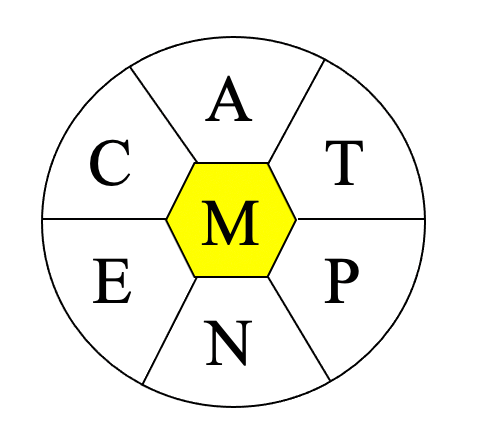
A, C, E, N, P, T, and center M (all words must include M)
Merriam-Webster says…

Silly little dictionary! Don’t you know ataman can’t possibly be a word if the New York Times says it ain’t?
For further fascinating facts, check out the Spelling Bee Master.
What’s your favorite dord* from today’s puzzle?
My Two Cents
“Never think that war, no matter how necessary, nor how justified, is not a crime.” — Ernest Hemingway, 1946
Imagine how much more horrific the crime when the war is completely unnecessary and unjustified, like the one going on now in Eastern Europe. I may have distant relatives in the Ukraine, as part of my mother’s family was from Odessa. But we lost touch with that side of the family many, many years ago.
I try to steer away from politics in this column, except, of course, when it comes to ranting about the politics of word exclusion espoused by the editors of the Spelling Bee. But finding a word today that has both Russian and Ukrainian connections was too good an opportunity to pass up.
Still, the idea of this column is not only to teach something in an entertaining way (or entertain something in a teaching way), but also to provide a brief, enjoyable distraction from the troubles and pressure we all face on a daily basis. One of my newest readers, Yolanda Nakari, gave me a fantastic compliment the other day when she said my article had cheered her up during stressful times.
With that, let’s take on our word of the day.
Attaboy? No, ataman
Okay, okay, I realize the dictionary’s definition of ataman as “hetman” is not very helpful, especially if you don’t know what hetman means. And because the dictionary entry is a screenshot, when you click on the word hetman to get to the link, all you do is magnify the screenshot on your phone. Which is frustrating, I know. Iva Reztok, my screenshotter-in-chief, apologizes profusely for his ineptitude.
So here is what you get when you’re actually able to click on hetman.
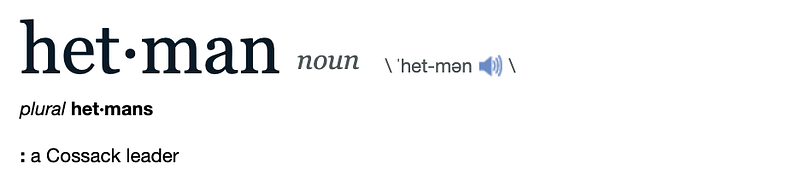
According to the dictionary and Wikipedia (and its sources), hetman is the Ukrainian equivalent of ataman. But the Encyclopedia Britannica claims it’s the other way around. (More about that later.)
The origins of both terms are still disputed today. The Russian ataman likely came from Old Russian vatamanŭ, and has a curious cognate in the Turkic (Ottoman Turks) odoman. The Ukrainian spelling of ataman in their variation of Cyrillic is отаман.
You have to remember an important thing about the region: it looked nothing like it does today, in terms of countries and borders. There was a lot fluctuation when it came to who was in charge of whom. Territories exchanged hands between Poles, Lithuanians, Russians, Finns, Ukrainians, Cossacks… the list goes on and on. Even the Republic of Genoa, a medieval republic on what is today the northwestern coast of Italy got involved. All these cultures intermixed over centuries before the countries were defined as what they are now.
Did you know that for almost a century and a half there was an independent Ukrainian Cossack state? Officially called the Zaporozhian Host, it is also known as the The Cossack Hetmanate. Yes, “hetmanate” as in hetman. This Hetmanate was founded during the Uprising of 1648–57 led by Bohdan Khmelnytsky. Here he is holding a stick with a ball of Covid in one hand and what looks like an early 20th-century rotary phone in the other hand.
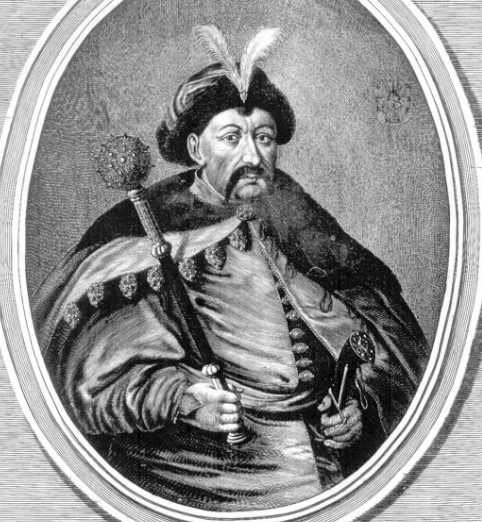
So maybe Khmelnytsky was a time traveler?
To give you an idea of how muddled nationality was back then, that Cossack state was called Little Russia by Russian diplomats, while Polish and Arab sources referred to it as Ukraine or Cossakia. The Ottoman Empire actually called it “the country of Ukraine” (Ukrayna memleketi).
Was Khmelnytsky an ataman or a hetman? Does the distinction really matter?
Hitman? No, hetman
Let’s clear this up from the get-go. The term hitman does not come from the word hetman. The first proof of that is in the fact that hitman isn’t even a word, according to our friends at Merriam-Webster. The correct spelling is “hit man”, with an all-important space between the two words. The second proof offered by the dictionary is that hetman may have come from the word in Polish meaning “commander in chief”, itself from the German hauptmann, meaning “headman” or “leader”.
I know a handful of words in Polish, and hetman is not one of them. So I checked wordreference.com and was able to confirm without a doubt that hetman in Polish translates in English as… hetman. Hooray! Oh, and in modern times it also refers to the queen piece in chess. Interesting how words can also be gender-fluid.
Furthermore, the Encyclopedia Britannica explains that the term was a “military title used in the Polish–Lithuanian state (16th–18th century); the hetman wielki (“great hetman”) was the chief of the armed forces and the commander in the field when the king was not present. In Ukraine a variation of the term, ataman, was used to designate the military leader of the Zaporozhian Cossacks (16th century) and the prince of the area east of the Dnieper River (17th–18th century).”
This is the reverse of the explanation I mentioned earlier when I said the dictionary claims hetman is the Ukrainian version of ataman.
In any case, here are some great and maybe not-so-great hetmans (hetmen?) from Poland, Lithuania, and Poland-Lithuania.
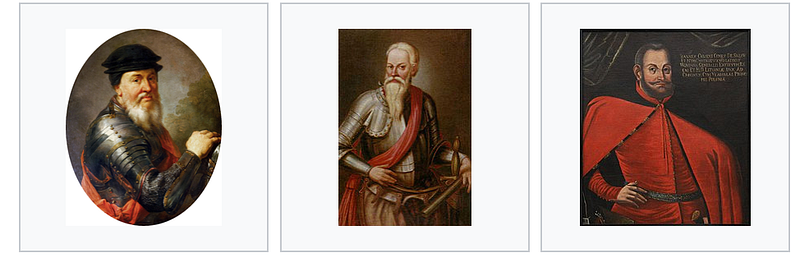
The title of Hetman was given to the leader of the Polish Army and until 1581 the it was used only during specific campaigns and wars. From 1585, the title could not be taken away without a proven charge of treachery. That created a situation in which hetmans served for life. An extreme example is that of Jan Karol Chodkiewicz (the guy above and to the right, in red), who commanded his army from his deathbed in the Khotyn Fortress while resisting a month-long siege by the Ottoman sultan. Chodkiewicz dies just a few days before the Sultan ended the siege and agreed to negotiations.
So was Chodkiewicz an ataman or a hetman? Does the distinction really matter?
What seems clear to me is that, like the words ataman and hetman, the history of Russians and Ukrainians is both intimately intertwined and full of friction. In the end, the commonality of these nations may be deeper than the differences their rulers seek to underscore. Which makes this war a civil war of sorts between people with a long, shared background. And I’m careful to say people, not governments, because it’s the latter that always go looking for excuses to start an armed conflict… and consequently are responsible for the great havoc and pain of the former.
Some of the reactions to the war in Ukraine have resulted in tough sanctions that will likely affect the Russian population, if not Putin himself. Other boycotts just seem silly and ineffective, like the ban from the Eurovision competition, or the restaurant in Argentina that decided to remove its Russian salad from the menu. And I think what the editors of the Spelling Bee did –– declare ataman a dord*–– certainly falls into the latter category.
You can check out my previous entry on another dord* here:
*What the heck is a dord, you ask? Here’s the answer: