
Galago
No resemblance at all to the 1980s arcade video game
Today’s New York Times Spelling Bee letters:
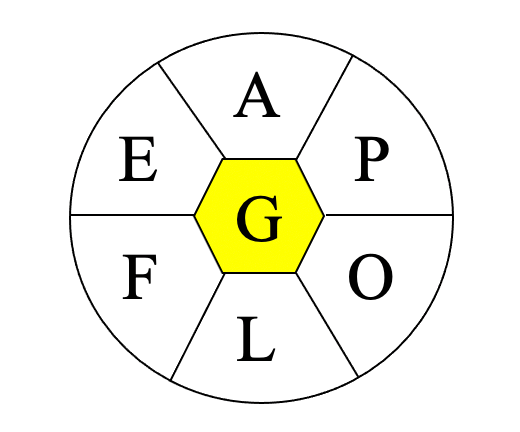
A, E, F, L, O, P, and center G (all words must include G)
Merriam-Webster says…
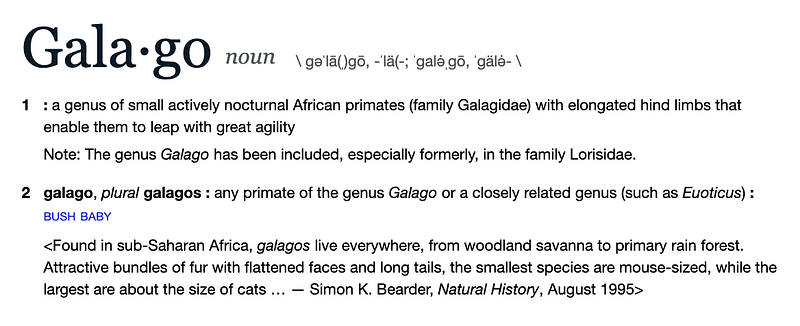
Silly little dictionary! Don’t you know galago can’t possibly be a word if the New York Times says it ain’t?
For further fascinating facts, check out the Spelling Bee Master.
What’s your favorite dord* from today’s puzzle?
My Two Cents
What are the odds that the same Spelling Bee letter combination will be published exactly a year after it first appeared? I confess I have no clue. Slim, if it’s purely by chance. Or guaranteed, if the editor of the game so desires. In any case, that did not happen today. You assumed that’s what I was leading into with that question? Remember what happens when you assume…
But it almost happened. On March 3rd, 2021, that is, a year ago tomorrow, the Spelling Bee had the letters A, E, F, G, L, O, P –– but the center letter was F. Read about feoffee, the daily dord* I picked for that day.
(As I’ve explained on a few occasions to those not familiar with the Spelling Bee, each seven-letter combination allows for seven different puzzles if one switches the center letter. The center letter is the one that every word must contain when making words.)
Jumping bush babies, batman!
Our friends at Merriam-Webster explain that galago may have come from New Latin, perhaps from Wolof golokh, meaning “monkey”. They expounded on the word further, which they don’t always do. So to honor that, I will quote them:
There are six species of galagos, small nocturnal tree-dwelling primates found in forests of sub-Saharan Africa. Galagos are gray, brown, or reddish or yellowish brown animals with large eyes and ears, soft woolly fur, and a long tail. They are active at night, feeding on fruits, insects, and small birds. Galagos have elongated hind limbs that enable them to leap with great agility. Smaller forms, such as the bush baby, are particularly active and agile. Galagos range from 4½–6 in (11–16 cm) long, excluding the 7–8-in (18–20-cm) tail, to 12–15 in (30–37 cm), excluding the 16½–18½-in (42–47-cm) tail.
I like National Geographic’s succinct description of them: “small, saucer-eyed primates that spend most of their lives in trees.”
The galago’s physical description reads like a patchwork of traits taken from a bunch of different animals: large eyes like those of a pug, the strong hind limbs of a kangaroo, a long monkey-like tail, ears similar to a bat’s… and the ability to snatch insects out of the air like a chameleon.
So, is this what you pictured?

Well, that’s actually Galaga, not a galago. Galaga was a shooter arcade video game launched in 1981 by Japanese video game company Namco, best-known for creating Pac-Man.
(Interesting side note: Pac-Man was originally called Puck-Man in Japan. The name changed was due to concerns about kids changing the P to an F on the arcade machines. Now that’s what I call putting a positive spin on negative thinking.)
This is what a galago looks like.
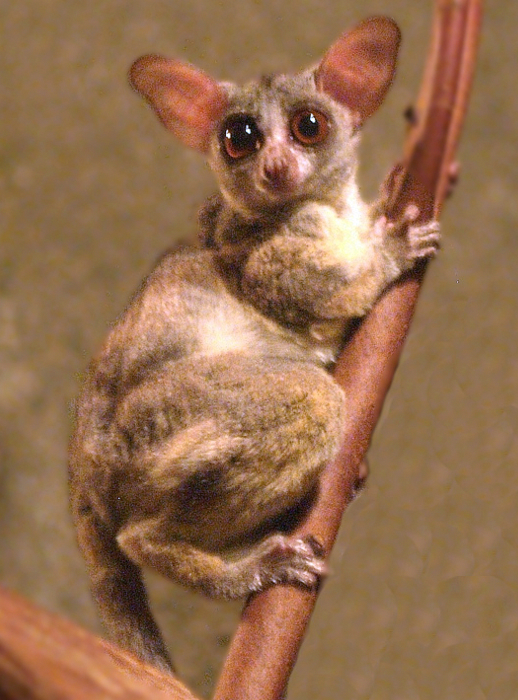
That’s the Senegal bush baby, one of several species of galago. It’s also known as the lesser bush baby, meaning the other species don’t think too highly of it, I guess.
And here is the Mohol bushbaby, who was clearly caught by surprise.
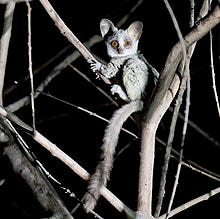
Don’t be fooled by the size of the photos. The Mohol bush baby is bigger than the Senegal bush baby. It’s just that man-in-the-mirror Iva Reztok kinda sucks when it comes to taking screenshots.
What’s with this “bush baby” thing, you ask? As National Geographic explains:
Many galago species look so similar, it’s difficult to tell them apart by sight alone. Instead, scientists often use the animal’s distinct calls — which sound like a crying newborn baby, the likely source of their name — to differentiate between closely related species.
According to an article by Adaobi Onyeakagbu, the bush baby’s cry has originated a myth in Nigeria used to scare schoolchildren so that they won’t leave their homes at night. The myth explains that although the galago sounds like a baby calling for help, anyone who goes out to help it disappears and is never heard from again.
One of the most impressive things about galagos is their jumping ability. In fact, scientists have been so impressed, they’ve actually studied and published science-y articles about jumping galagos in fancy, science-y magazines. In fact, Peter Aerts published one in the Royal Society that has really cool illustrations like this one…
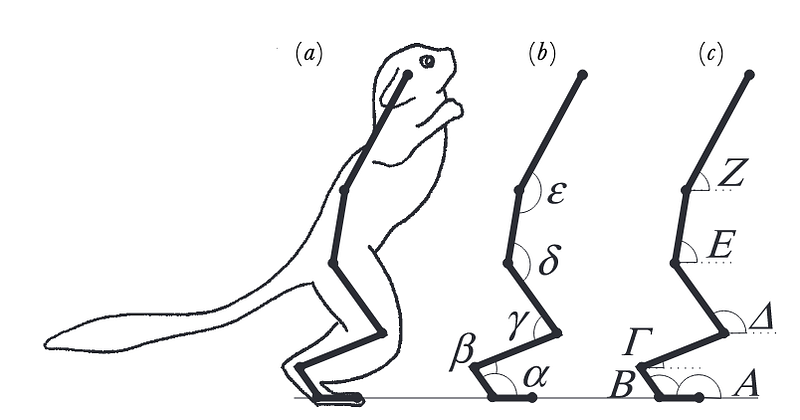
…this one…
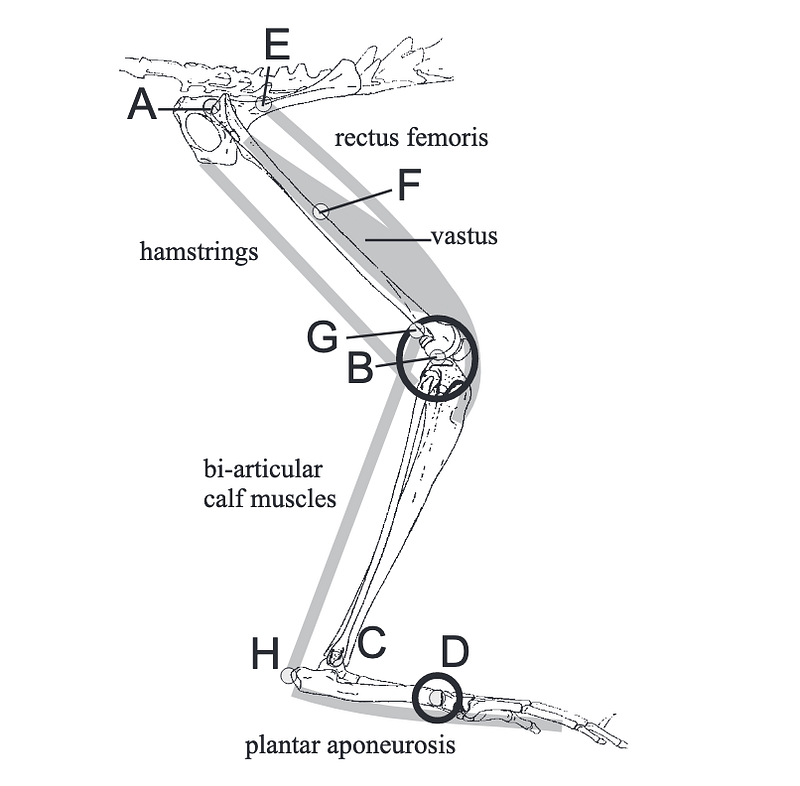
…and this one…
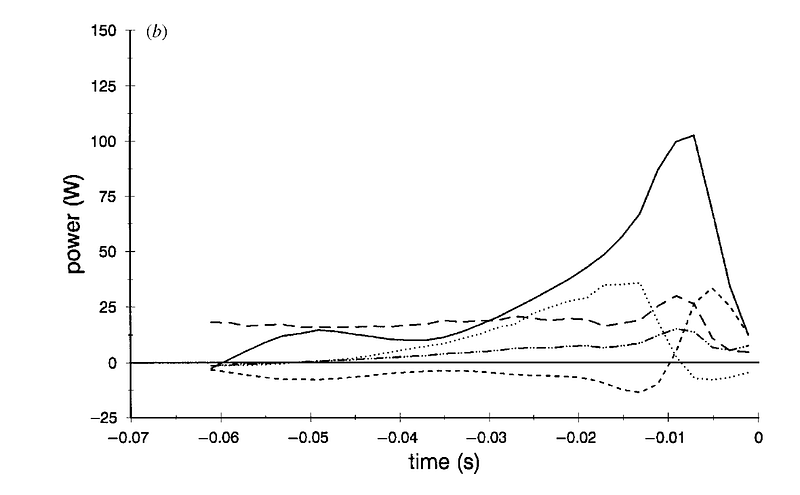
Okay, okay, maybe that last one isn’t that cool. Fine.
You can read the entire article here, if you think you’re so science-y yourself. You’ll encounter such stimulating prose as “Dynamic analysis of the vertical jumps performed by two bushbabies confirms the need for a power amplifier” and “Inverse dynamics coupled to a geometric musculo-skeletal model were used to elucidate the precise nature of the mechanism powering maximal vertical jumps.”
Yeah, good luck with that.
When the moon hits your eye
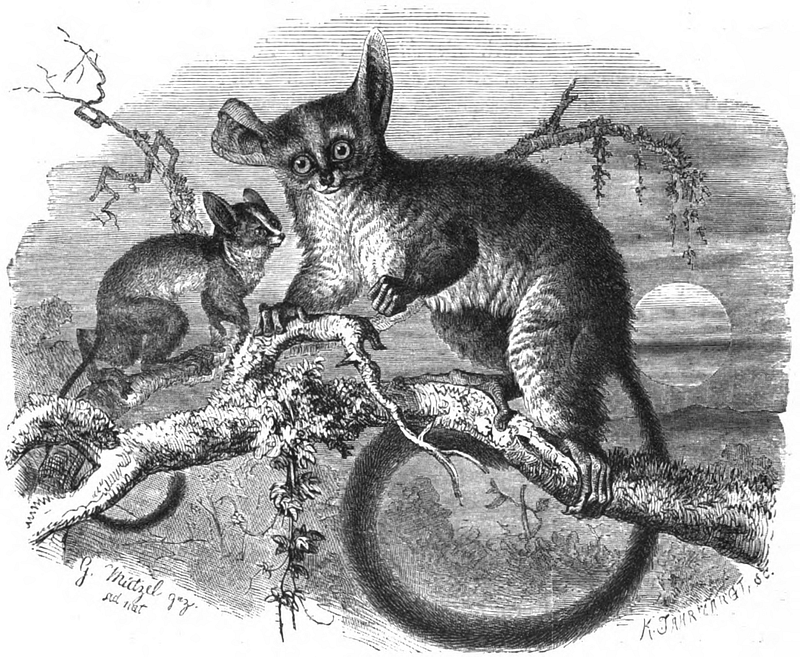
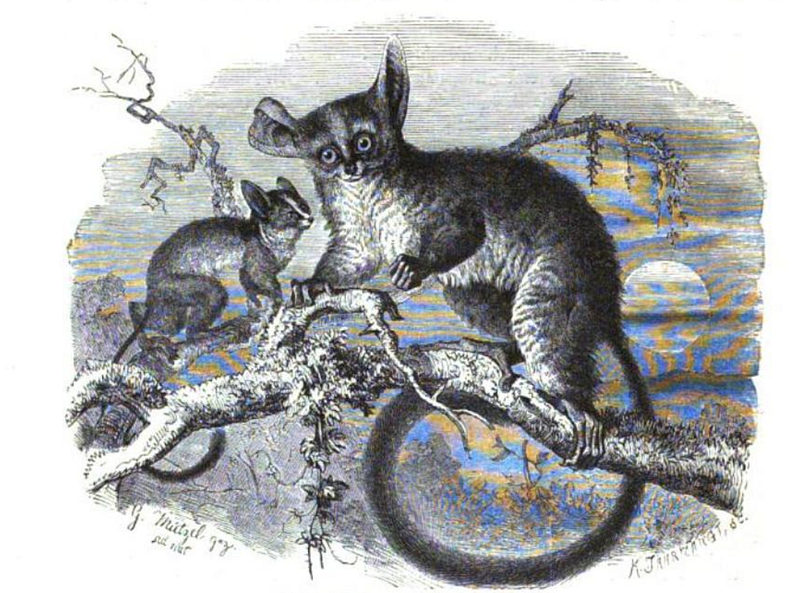
The illustration at the top of today’s column is by Gustav Mützel. Or rather was, since he died almost 130 years ago. This German artist was well-known for his illustrations of animals, particularly birds and mammals. Here is an auerhahn he painted:
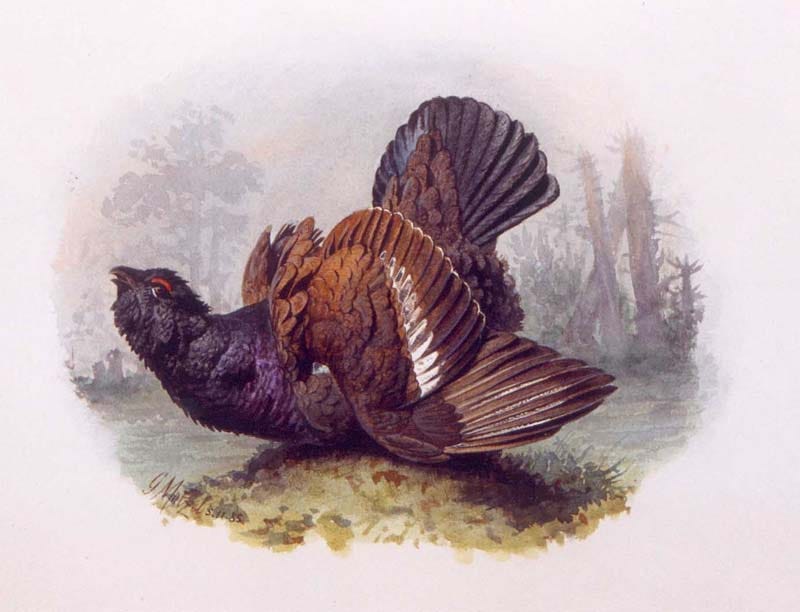
What is an auerhahn, you ask? Aue means “pasture” or “meadow”. And Hahn sounds close enough to the English word hen, which it is roughly equivalent to.
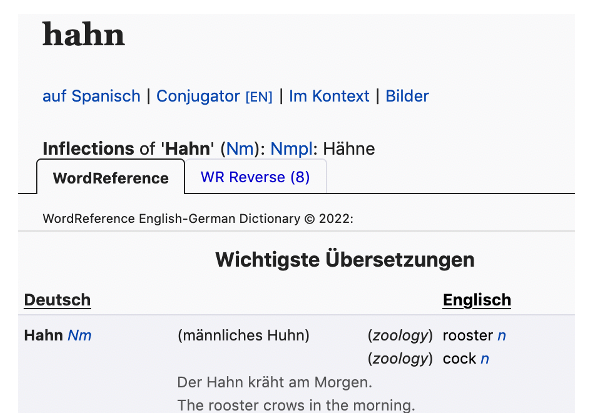
So auerhahn literally translates as “meadow cock”, which is not a rural penis. Get your mind out of the gutter! However, since Hahn also means “faucet”, maybe Mützer just happened upon a water spout in a pasture and used his imagination to turn it into an exotic bird. Mützer was clearly a romantic, as you can tell by the fact that he painted the galago with a full moon behind it. Here’s the color version, which I took from the public domain book called Brehms Tierleben: Allgemeine Kunde des Tierreichs, Volumen 1.
(That auerhahn he painted? Well, it’s the bird known in English as the wood grouse, heather cock, cock-of-the-woods, mountain cock… and other assorted phallic names.)
I don’t know how Mützer got the galagos to sit still and not jump around with their awesome scientifically-studied hind legs, but it certainly impressed Alfred Edmund Brehm, a German zoologist, writer, and director of zoos. Oh, and also the co-author of the book I mentioned earlier, Brehms Tierleben (titled Brehm’s Animal Life in English).
The book became one of the first modern popular treatises on zoology, and was considered a scientific reference book on animals for many decades. First published in 1860, when Brehm was just 31 years old, and republished editions continued to come out in the 20th century.
Here is the frontispiece from a reprint volume of the second edition.
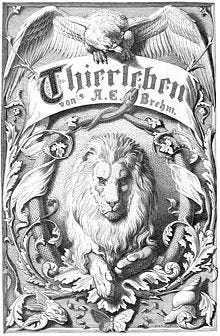
It was the second edition that incorporated Mützer’s paintings, which Charles Darwin himself said were some of the best depictions of animals he had seen.
Both Brehm and Mützer has interesting but rather short lives; Brehm died in 1884 from malaria at the age of 55, while Mützer passed away from heart and kidney disease in 1893, just shy of his 54th birthday.
Now you know. If you ever find yourself in sub-Saharan Africa and see an odd creature that looks like a cross between a bat and a koala jump directly at you with its powerful hind legs… don’t worry. It’s probably just your imagination. It certainly can’t be a galago, because the editors of the Spelling Bee decided that galago is a dord*.
You can check out my previous entry on another dord* here:
What the heck is a dord, you ask? Here’s the answer: