avatarAvi Kotzer

Free AI web copilot to create summaries, insights and extended knowledge, download it at here

2586

Abstract

spot of “g” makes all the difference. Which is <i>not</i> the same as a g spot.</p><p id="2ff3">I found the dictionary’s definition of <i>feoffee</i> a tad bit confusing, so I looked up more information online… which made it a whole lot more confusing. For example, Wikipedia started it’s explanation on the history of <i>feoffees</i> with this:</p><p id="3e26">“The practice of enfeoffing feoffees with fees…”</p><p id="33ba">Now, to me that phrase sounds more like a tongue twister akin to that of a group of picky people and their choice of <a href="https://www.tonguetwisters.pics/305172/picky-people-pick-peter-pan.php">peanut butter</a>. Except its target audience is barristers, not third-graders.</p><p id="042b">Okay, so what about that whole sneezin’ thing… I mean, the <i>seizin</i> thing.</p><p id="ae8e">Well, there are two types. “Seisin in law” happened when both parties of the deal (the <i>feoffer</i> and the <i>feoffee</i>, I guess) went close enough to see the land to be transferred and the giver declared to the recipient that possession was granted. This transfer was considered only incomplete, mostly because these were feudal times and the monarch could simply decide to take anything from anyone at any time.</p><p id="db13">Ha! Take that, you effin’ feoffers and <i>feoffees</i>!</p><p id="29b6">Now, if the two parties didn’t just do the deed while looking at the piece of land, but actually physically entered it, the transfer was called ta “seisin in deed”. Sometimes instead of walking into the parcel, a token of the land (a piece of AstroTurf, for example) would be delivered to the <i>feoffee</i> very ceremoniously. A seisin in deed gave the new owner the best legal title option available.</p><p id="52e0">Yet even then nothing was guaranteed, because… sadistic, power-hungry monarchs, that’s why.</p><p id="28f4">After consulting with several lawyers for several hours, I was finally able to determine that a <i>feoffee</i> transaction was the feudal version of the modern-day loopholes for tax avoidance. Which goes to prove that even back in the 15th century, lawyers were making people miserable with their incomprehensible legal jargon.</p><p id="a1ae">And don’t worry about those expert law firms I consulted; I’m sure my Medium earnings at the end of March will be more than enough to cover their bills.</p><h2 id="30cc">Where’s the beef?</h2><p id="2399">By now most of you are rather inclined to agree with the editors of the New York Times for rightfully excluding <i>feoffee</i> as word today. (1) It’s an obscure word from the 15th centur

Options

y, and (2) no one uses it anymore.</p><p id="8a9c">Except…</p><ol><li>Today’s Spelling Bee puzzle <b>does accept </b>the word <i>pelf</i>. Do you know what <i>pelf</i> means? Oh, you do… sorry, I guess I’m just not as smart as you are. Anyway, I didn’t, so I looked it up. It turns out that <i>pelf</i> is an archaic word from guess which century? The 14th, so <b>older</b> than <i>feoffee</i>. (By the way, it means either property or riches if you’re American, or trash or compost if you’re British.)</li><li>The term <i>feoffee</i> <b>is</b> used today, as in those trustees of estates held usually for charitable purposes. For example, the <i>feoffees</i> of St Michael’s Spurriergate (in York, England) are the trustees of a charity that helps with the restoration of churches in that city. In Ipswich, Massachusetts, right here in the good ol’ US of A, the feoffees of the Grammar School have been trustees of a piece of land donated for the use of the town since the 17th century.</li></ol><p id="581a">However, all that wasn’t good enough for the editors of the Spelling Bee, who simply decided that <i>feoffee</i> is a <a href="https://www.merriam-webster.com/words-at-play/dord-a-ghost-word"><b>dord</b></a><b>.</b>*</p><p id="ebf9">Please check out my previous entry on another <b>dord:</b></p><div id="a046" class="link-block"> <a href="https://readmedium.com/elven-b308865ddc70"> <div> <div> <h2>Elven</h2> <div><h3>An irregular plural resurrected by a regular genius</h3></div> <div><p>medium.com</p></div> </div> <div> <div style="background-image: url(https://miro.readmedium.com/v2/resize:fit:320/1*dL4JW5qvLKzy443GI3mF2Q.jpeg)"></div> </div> </div> </a> </div><p id="a0b5">*What the heck is a <b>dord, </b>anyway? Here you go:</p><div id="b311" class="link-block"> <a href="https://www.merriam-webster.com/words-at-play/dord-a-ghost-word"> <div> <div> <h2>'Dord': A Ghost Word</h2> <div><h3>One of the questions people like to ask lexicographers is this: Can you sneak something into the dictionary? Can you…</h3></div> <div><p>www.merriam-webster.com</p></div> </div> <div> <div style="background-image: url(https://miro.readmedium.com/v2/resize:fit:320/0*AvR1HFP4akfCZVL7)"></div> </div> </div> </a> </div></article></body>

Feoffee

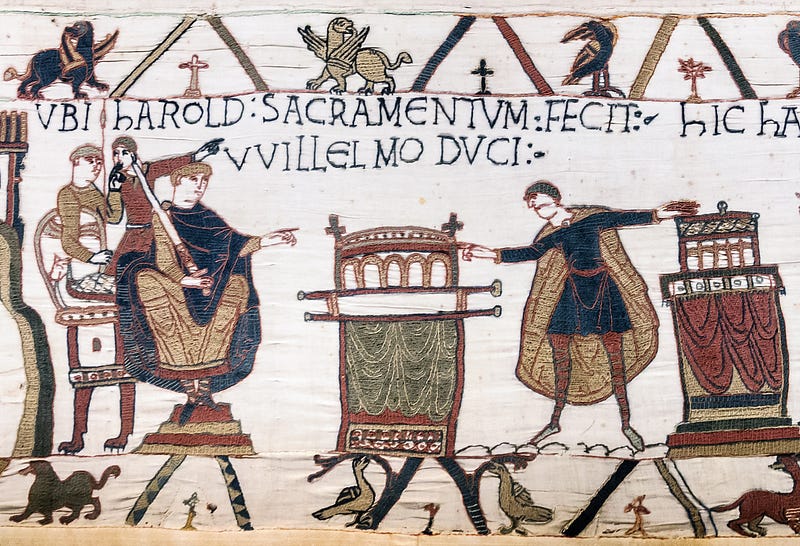
Fee fi fo fum… I smell the blood of a fiefdom
Today’s New York Times Spelling Bee letters:
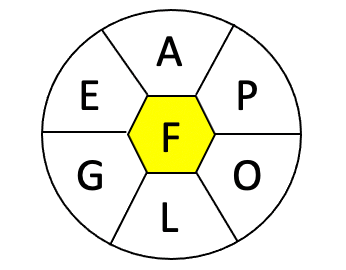
Art: Iva Reztok

A, E, G, L, O, P, and center F (all words must include F).

Merriam-Webster says…
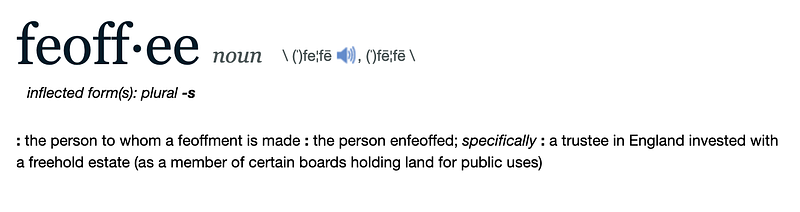
Credit: merriam-webster.com

Silly little dictionary! Don’t you know feoffee can’t possibly be a word if the New York Times says it ain’t?

For further fascinating facts, check out the Spelling Bee Master.

What’s your favorite dord* from today’s puzzle?

My Two Cents

Although feoffee is a word that seems to have been relegated to feudal times, it still has modern uses today. More on that later. Let’s discuss some legal mumbo-jumbo today.

Isn’t feoffee a fun word to look at and say? Trips off the tongue nicely enough. Helpful hint: the “o” is silent and the stress is placed on the second syllable. Sort of, like, feh-FEE.

Watcha talkin’ ’bout, Willis?

Feoffee is a noun that refers to a person who benefits from feoffment (again, silent “o”), which was the act of granting a fee or giving, as the dictionary explains, “a freehold estate by actual delivery of possession originally by livery of seizin.” Got that?

By the way, Merriam and Webster are not just being fashionably cool by spelling seizin without a “g”. Yes, the origin of the word seizin is basically the same as the verb seizing, and here’s the etymological cascade: Middle English saisen, seisen, sesen, from Old French saisir, from Medieval Latin sacire, to effect legal possession, to assign; of Germanic origin; similar to the Gothic word satjan, to set.

But whereas seizing is a verb, seizin is a noun. A spot of “g” makes all the difference. Which is not the same as a g spot.

I found the dictionary’s definition of feoffee a tad bit confusing, so I looked up more information online… which made it a whole lot more confusing. For example, Wikipedia started it’s explanation on the history of feoffees with this:

“The practice of enfeoffing feoffees with fees…”

Now, to me that phrase sounds more like a tongue twister akin to that of a group of picky people and their choice of peanut butter. Except its target audience is barristers, not third-graders.

Okay, so what about that whole sneezin’ thing… I mean, the seizin thing.

Well, there are two types. “Seisin in law” happened when both parties of the deal (the feoffer and the feoffee, I guess) went close enough to see the land to be transferred and the giver declared to the recipient that possession was granted. This transfer was considered only incomplete, mostly because these were feudal times and the monarch could simply decide to take anything from anyone at any time.

Ha! Take that, you effin’ feoffers and feoffees!

Now, if the two parties didn’t just do the deed while looking at the piece of land, but actually physically entered it, the transfer was called ta “seisin in deed”. Sometimes instead of walking into the parcel, a token of the land (a piece of AstroTurf, for example) would be delivered to the feoffee very ceremoniously. A seisin in deed gave the new owner the best legal title option available.

Yet even then nothing was guaranteed, because… sadistic, power-hungry monarchs, that’s why.

After consulting with several lawyers for several hours, I was finally able to determine that a feoffee transaction was the feudal version of the modern-day loopholes for tax avoidance. Which goes to prove that even back in the 15th century, lawyers were making people miserable with their incomprehensible legal jargon.

And don’t worry about those expert law firms I consulted; I’m sure my Medium earnings at the end of March will be more than enough to cover their bills.

Where’s the beef?

By now most of you are rather inclined to agree with the editors of the New York Times for rightfully excluding feoffee as word today. (1) It’s an obscure word from the 15th century, and (2) no one uses it anymore.

Except…

  1. Today’s Spelling Bee puzzle does accept the word pelf. Do you know what pelf means? Oh, you do… sorry, I guess I’m just not as smart as you are. Anyway, I didn’t, so I looked it up. It turns out that pelf is an archaic word from guess which century? The 14th, so older than feoffee. (By the way, it means either property or riches if you’re American, or trash or compost if you’re British.)
  2. The term feoffee is used today, as in those trustees of estates held usually for charitable purposes. For example, the feoffees of St Michael’s Spurriergate (in York, England) are the trustees of a charity that helps with the restoration of churches in that city. In Ipswich, Massachusetts, right here in the good ol’ US of A, the feoffees of the Grammar School have been trustees of a piece of land donated for the use of the town since the 17th century.

However, all that wasn’t good enough for the editors of the Spelling Bee, who simply decided that feoffee is a dord.*

Please check out my previous entry on another dord:

*What the heck is a dord, anyway? Here you go:

Spelling Bee
Language
History
Real Estate
Taxes
Recommended from ReadMedium