
Elven
An irregular plural noun resurrected by a regular genius
Today’s New York Times Spelling Bee letters:
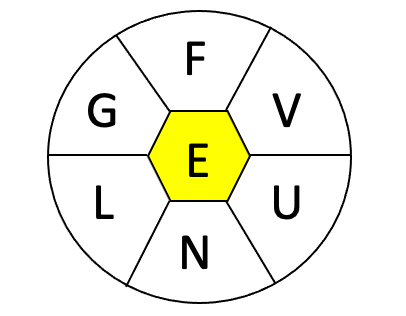
F, G, L, N, U, V, and center E (all words must include E).
Merriam-Webster says… wait, scratch, that! Today we need a British dictionary powered by the OED:
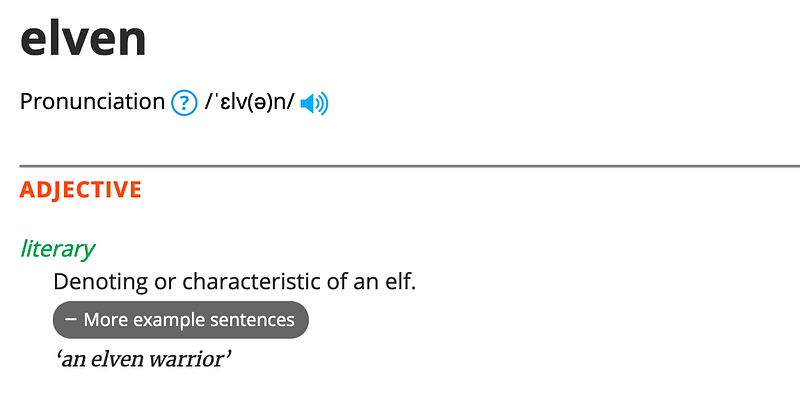
Silly little dictionary! Don’t you know elven can’t possibly be a word if the New York Times says it ain’t?
For further fascinating facts, check out the Spelling Bee Master.
What’s your favorite dord* from today’s puzzle?
My Two Cents
Today I had to resort to using a dictionary form the United Kingdom. Well, technically speaking, it’s an online dictionary pretending to be British. I mean, when I pressed the sound button to hear the word pronounced, it was spoken by a female chap with a not-so pretentious accent.
I couldn’t find elven in any of the “American” dictionaries I searched, so maybe the American chaps at the New York Times finally got it right, and this is, indeed a ghost word, or dord*.
Except… John Ronald Reuel.
Better known as J.R.R. Tolkien.
The man, the myth, the pretentious three initials
The great Sabana Grande (gotta love that name!) wrote an article about Tolkien’s rules for writing. Which I will plug here, because… Sabana Grande!
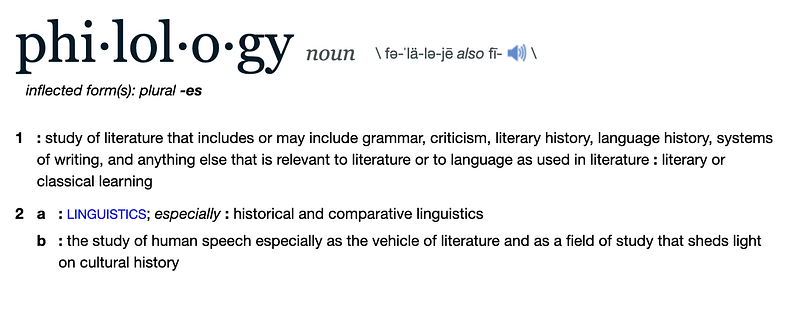
So, I’m not gonna go on a long-winded bio of Tolkien… or even a short-winded one. I will mention, however, what I consider his greatest gift: philology.
This time Merriam-Webster can provide some assistance:
Yes, John Ronald Reuel crafted the most impressive epic fantasy series in the history of epic fantasy series, and yes, it takes the average reader 17.83 years to read the trilogy and another 147.3 hours to watch all three Peter Jackson “director’s-cut” movies.
Personally, I’m more dazzled by Quenya, Angerthas, and Tengwar. The first one a language, the second and third ones scripts.
These were languages and writing systems that Tolkien invented.
Now, my first encounter with LOTR was seeing the 1978 animated film directed by Ralph Bakshi. If you can find it, check it out.
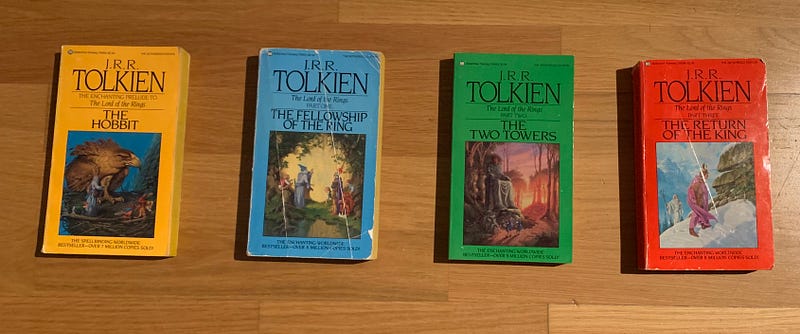
For my birthday in 1982, a family friend gave me a gift box set that included the trilogy and The Hobbit. I still have it today:
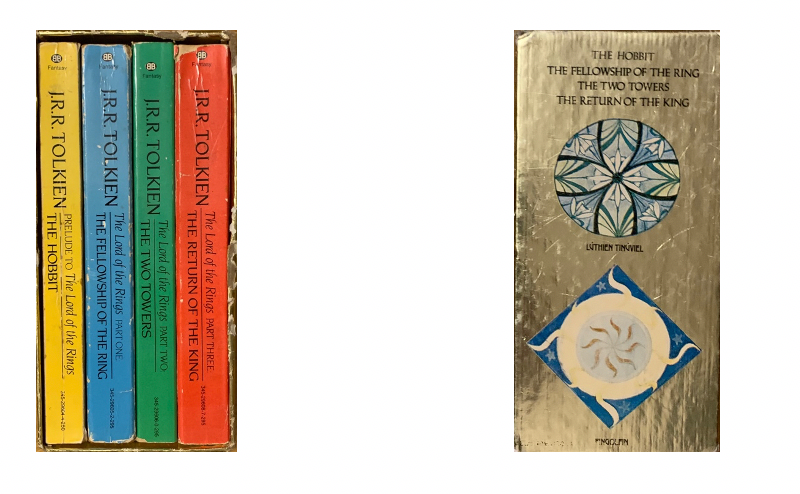
And although I’ve owned the above collection for almost four decades, I have never read the whole series. (Cue horrified gasps from nerdy readers.)
Wait! It gets worse!
I have never seen the movies. (Cue nerdy readers unfollowing me in disgust.)
Don’t despair. Or get offended. I consider myself a nerd, so I’m allowed to poke fun at them… I mean, us.
I have read The Hobbit twice. And I’ve gotten about halfway through The Lord of the Rings twice. And I haven’t sen the movies because, well… I want to read the books first!
To paraphrase Mark Twain:
“A classic is something that everybody wants to have read and nobody wants to read.”
Except LOTR is one of the classics I do want to read. I’ve always wanted to read it. The whole thing. I promise! It’s just that I never seem to get around to it. And when I do, I always find a reason to quit.
Now, although I did not get past page 279 in The Lord of the Rings (inside the novel there’s a book marker I made in 6th grade), my copy of The Return of the King is pretty worn out. Especially in the back.
That’s because the last third of that book consists of the Appendices and the Index. And in those appendixes Tolkien explains everything you wanted to know (and some stuff you didn’t) about Middle Earth.
- Appendix A: Annals of the Kinds and Rulers
- Appendix B: The Tale of Years (Chronology of the Westlands)
- Appendix C: Family Trees
- Appendix D: Shire Calendar
- Appendix E: Writing and Spelling
- Appendix F: The Languages and Peoples of the Third Age & On Translation.
It was Appendix E that fascinated me the most. Tolkien explains the details of several languages, notably Quenya, and includes its Tengwar script (used for Telerin, too) and also the Angerthas writing system.
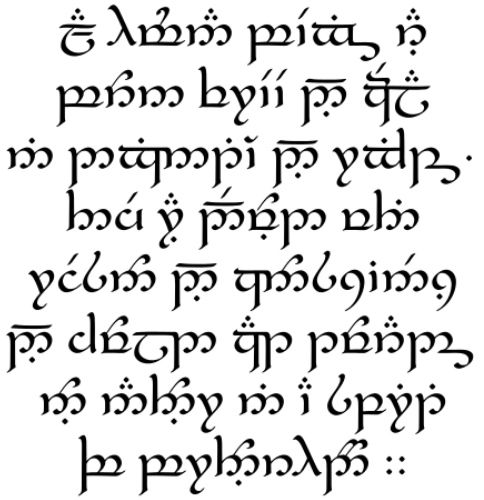
That’s the first article of the Universal Declaration of Human Rights in English, written using Tengwar script. Isn’t that beautiful?
Dawn of the dead plural
Why are we even talking about Tolkien and Quenya and Tengwar? Oh, yeah… elven.
Apparently an archaic plural for elf, as opposed to the commonly-used elves.
But Tolkien used it. Quite liberally, I may add. And I have proof! Page 505 of The Return of the King, Appendix F.
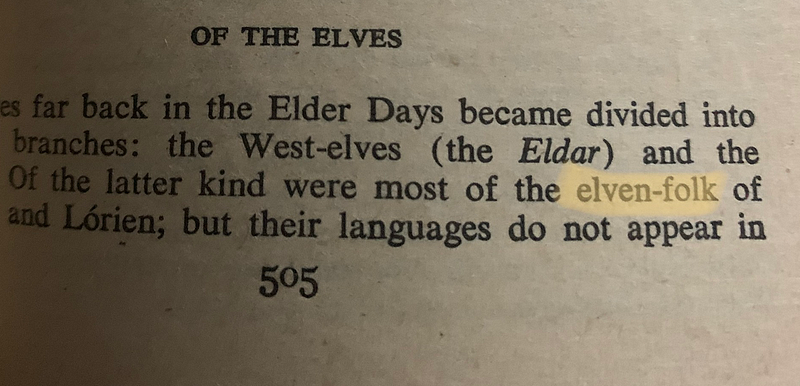
In the above example, the plural form of the noun serves as an adjective, too.
Now, if the word elven was good enough for that old philologist chap — whose books sell by the gazillions every year —to bring back from the lexicographer’s grave, it should be good enough for the editors of the Spelling Bee puzzle.
But no… they simply decided that elven is a dord.*
Oh, and in case you’re wondering who that Iva Reztok fellow mentioned in several of the photo credits is… well, he’s a reverse ego of mine.
A reverse ego is like an alter ego, except you simply spell your name backwards. Iva Reztok does a decent job with the art for spelling bee wheel at the beginning of every article. But I think he needs to work on his photography skills.
Wouldn’t you agree?
Please check out my previous entry on another dord:
*What the heck is a dord, anyway? Here you go: