
Nicotinic
I’m not just blowin’ smoke up your ass
Today’s New York Times Spelling Bee letters:
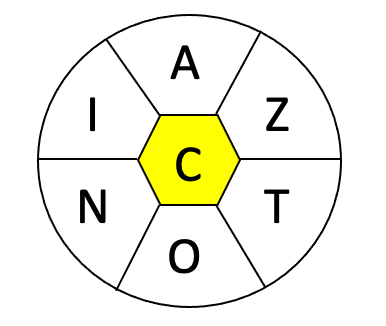
A, I, N, O, T, Z, and center C (all words must include C).
Merriam-Webster says…
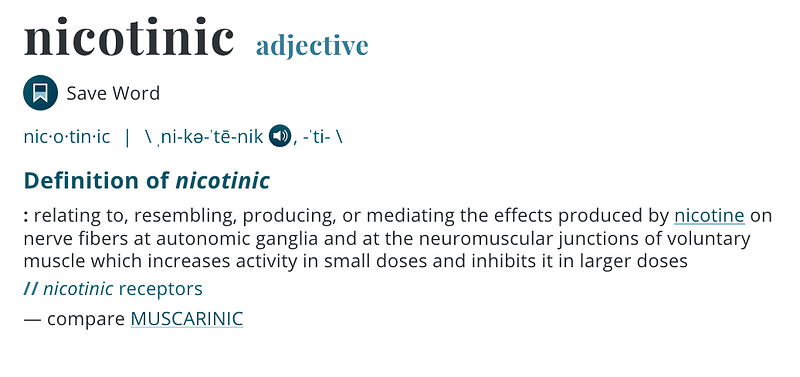
Silly little dictionary! Don’t you know nicotinic can’t possibly be a word if the New York Times says it ain’t?
For further fascinating facts, check out the Spelling Bee Master.
What’s your favorite dord* from today’s puzzle?
My Two Cents
Don’t worry, I’m not going to preach about the dangers of tobacco smoking and the evil corporations that tricked us for decades into consuming their products on an endless daily basis. And it’s not because Marlboro convinced me to become their next cig-puffing cowboy on a sixty-foot billboard in Times Square. And if you think I’m referencing a certain episode of a certain show of a certain 1990s decade… you are correct.
Plus, it would be hypocritical of me to go off on an anti-smoking rant, when I’m a card-carrying member of Cigar Rights of America. I can practically hear my future readership drop with a thud as I admit this on a public online forum.
I don’t smoke cigarettes and never have. I smoke tobacco pipes and cigars on occasion. Trust me, the two tobacco groups don’t have much in common except for… well, the tobacco itself. But the process by which they are made and how they are consumed are not only very different, they also have disparate effects on your body.
I’m not advocating that pipes and cigars are a safe alternative to cigarettes, but they are a safer choice. Emphasis on that important -er suffix. Maybe you’re thinking (or yelling at the screen): “But you’re not a doctor, Avi!!! What do you know?!!?” Well, I used to be… and so I do. Plus, there are actual studies that have proven that pipes and cigars (especially when consumed moderately) are much less dangerous than cigarettes. Again, this does not mean they are risk-free.
There were studies done in the 1960s or 70s, however, that showed that pipe smokers actually lived longer than non-smokers. The possible theory behind this had to do with the zen aspects of pipe smoking (which cigar smoking has, but to a lesser degree) and that pipe smokers — who are usually the opposite of Type-A personalities — would take a break in their hectic lives to relax and smoke while meditating on the day’s events… or reading… or watching the sun disappear behind the horizon… or all three.
Hmmm, I wonder why the results of that study weren’t widely promoted.
In any case, and as a disclaimer, I will ask any kids reading this not to drop their phones and run off to the nearest smoke shop to request a Partagas cigar or a Dunhill pipe. Please wait until your brains are fully formed around the age of 25 before you make any decisions about this.
Wow… when I started writing this piece I did not think it would veer off in this direction.
Onto the word, then!
Receivers
Not the guys who catch prolate spheroids in that game called football that is played with the hands.
Medical receivers. Receptors. Bear (or raccoon) with me, I will keep this short and simple. Although perhaps not sweet.
The word nicotinic is used as an adjective to describe some of the receptors found in your central and peripheral nervous systems and in your muscles. Also in many other tissues of many organisms, which we won’t get into.
What’s interesting is that these receptors were not made specifically to respond to nicotine. They are in reality acetylcholine receptors. Acetylcholine is a chemical your body uses as a neurotransmitter; in other words, nerve cells use it to communicate with other cells, such as cells in your central and peripheral nervous systems and in your muscles.
These acetylcholine receptors also respond to other molecules. Those that do so to nicotine are called nicotinic. Which is way easier to remember, read, and write than acetylcholine. Then again, there are those in the scientific community who like to showboat and call them “nicotinic acetylcholine receptors”, just to piss everyone else off.
Because it’s similar enough to that pesky and hard-to-pronounce acetylcholine, the nicotine molecule sticks to and works on these receptors. When it does, it creates the typical effects you’ve been hearing about since Pre-K: increased blood pressure and heart rate, narrowing of arteries, and stimulation of the brain. In the brain, nicotine increases the output of dopamine, popularly called the “pleasure drug”.
Trigger warning: incomprehensible and pretentious graphic image coming up…
I’m including it only because it might help me get this article accepted in one of the fancy science publications we have around here. (Although my earlier endorsement of pipe smoking already constitutes three strikes.)
You’ve been warned…
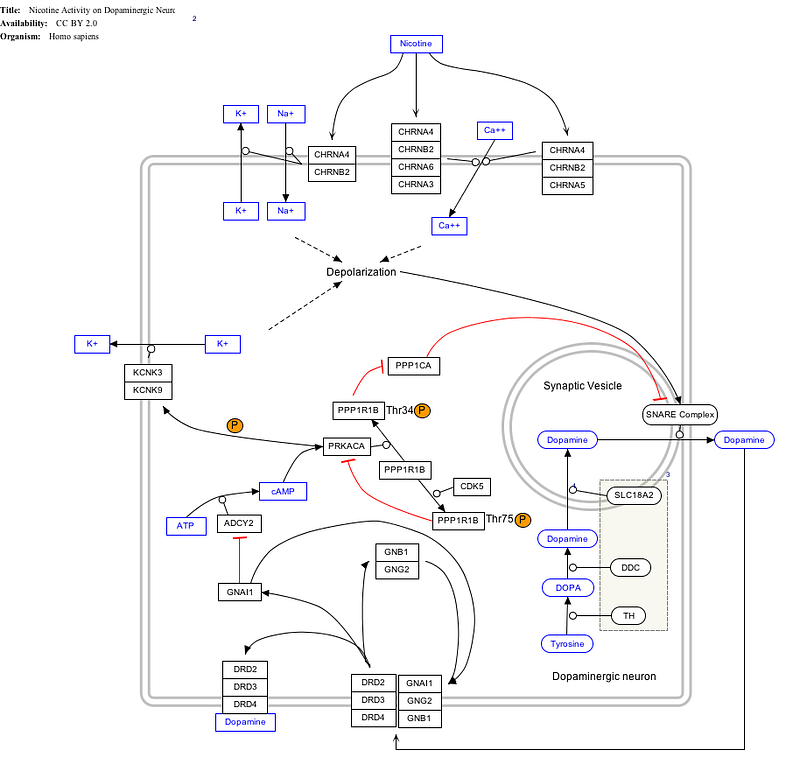
So, nicotine helps people feel better and more alert, with some studies showing they even perform better on certain tasks. And the molecule is actually being studied as a possible treatment for certain forms of depression.
Nicotine can also lower your munchies and increase your schvitzing and pooping functions — and those are the correct scientific terms, in case you’re wondering.
Then there’s a thing called “Nesbitt’s paradox”, so called because of the doctor who described it in 1969. He noticed that the effect of nicotine on smokers changed as dosage went up. One proposed explanation says that it happens because the nicotine calms down the anxiety that smokers suffer in between cigarettes.
Okay, I apologize. It wasn’t that short and simple. But I did warn you it wouldn’t be sweet. At least I got that right.
Now, the dictionary suggested that we compare nicotinic to muscarinic, so let’s.
Shroom shroom
Muscarinic receptors are the other type of acetylcholine receptors; and they respond to muscarine… duh!
Although muscarine is a natural and toxic product found in high doses in many deadly mushrooms… some smartass picked the one mushroom with low muscarine content to name the compound.
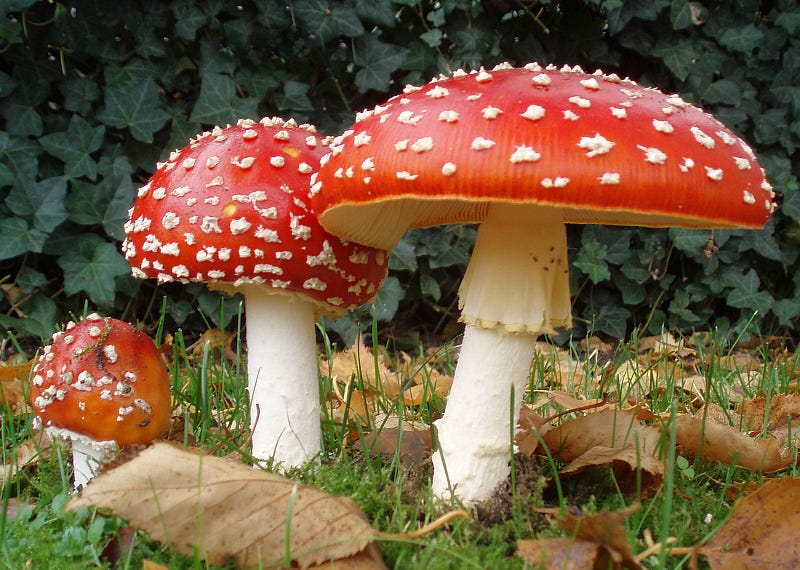
Meet the cute Amanita muscaria. Also known as the fly amanita because the pesky insects get stuck to it. Although the mushroom is toxic, parboiling it can detoxify and render it edible.
The effects of muscarine on the receptors are not as nice as those of nicotine. Two of the most dangerous are decreasing your heart rate and closing down your lungs, making it difficult to breath. Others include blurred vision, increased salivation, excessive sweating, abdominal cramping, and diarrhea.
So please don’t go around eating random mushrooms you know nothing about.
A few practical uses for muscarine are treating glaucoma and getting you to poop after you’ve had surgery on your intestines.
So this molecule is not just a one-dimensional poisonous asshole.
The point of this long-winded article was twofold. Aside from getting you to scroll down slowly to boost my paltry reading stats, I wanted to kvetch about nicotinic not being accepted by the Spelling Bee puzzle.
Here’s the thing. If nicotine is a valid word (and it is, I’ve used it in previous puzzles), why isn’t it acceptable for someone to either figure out how or randomly try to turn the noun into an adjective and score some points in the game? Why oh why, I ask.
And the only answer I can come up with is that the meanies who run the New York Times Spelling Bee simply decided that nicotinic is a dord!
Please check out my previous entry on another dord:
*What the heck is a dord anyway? Here you go: