
Maria
A cascade of meanings in both English and Spanish
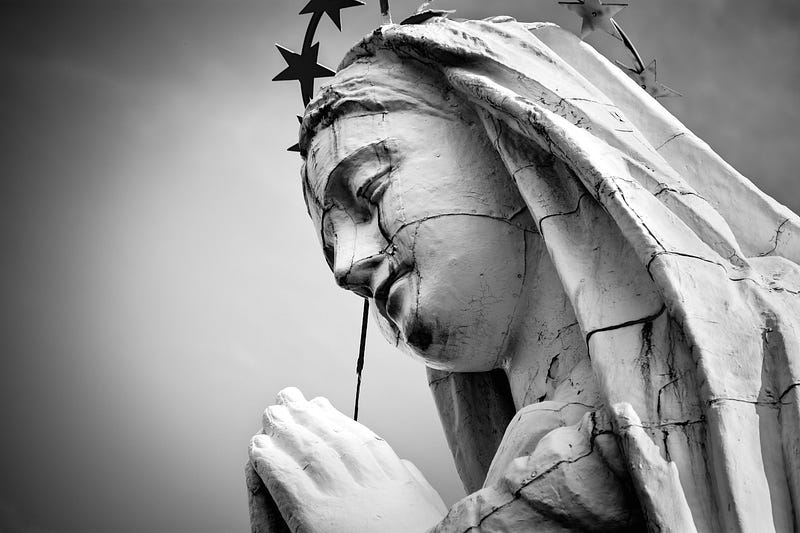
Today’s New York Times Spelling Bee letters:
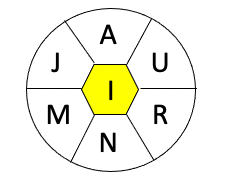
A, J, M, N, R, U, and center I (all words must include I).
Merriam-Webster says…
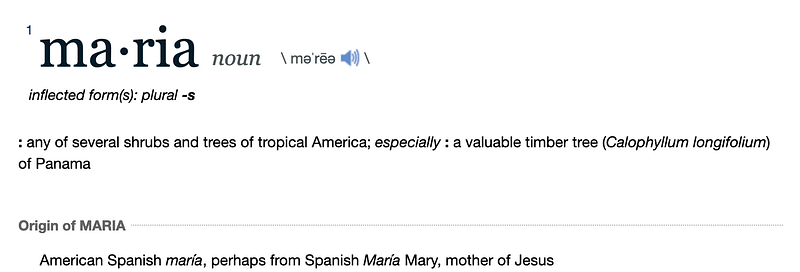

Silly little dictionary! Don’t you know maria can’t possibly be a word if the New York Times says it ain’t?
For further fascinating facts, check out the Spelling Bee Master.
What’s your favorite dord* from today’s puzzle?
My Two Cents
We’ve got a lot of ground to cover today, so please bear with me. Or raccoon with me, if you prefer a different mammal.
I’m sure many native English speakers are familiar with the name María. Spelled without an accent by most Americanized Spanish-speaking immigrants. Although the accent has made a comeback, with many baseball players now sporting their correctly-spelled names on their jerseys.
En inglés
So, when English-speakers hear “maría”, what do they think of? What should they think of? The cute daughter of that Venezuelan family that moved next door last year, escaping from the Maduro dictatorship? That hunky twenty-something Mexican guy who you keep drooling over in Econ 101 class in college? The devastating hurricane that hit Puerto Rico in 2017?
Perhaps. I doubt anyone is picturing either one of these:
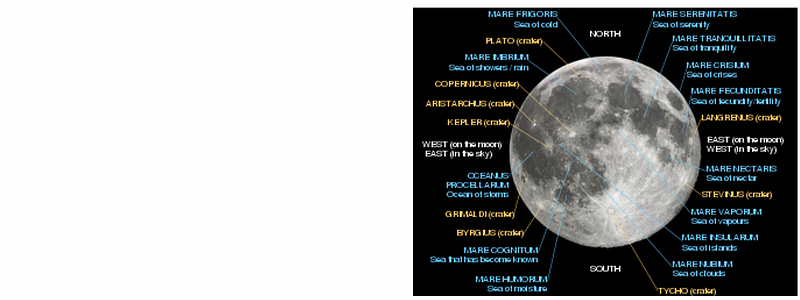
On the left is a photo of the Calophyllum longifolium. That’s right… it’s unknown to such a degree that even Wikipedia can’t provide an entry or an image for it. So, if there are any amateur or professional botanists out there who want to get some immediate fame and fortune by submitting the article, please go ahead!
On the right are a bunch of maria. No -s there, my friends. Maria is one of those fancy, exotic plurals that fancy exotic scientists (like astronomers) use to talk about more than one “mare”, which the dictionary tells us is not just (1) an evil demon that gives people nightmares or (2) a female horse, but also (3) one of several dark areas of considerable extent on the surface of either the moon or Mars.
So, if you want to sound real pretentious, next time you get together with your friends you can regale them with stories about how you saw a bunch of lunar maria with your telescope right after you returned home from a stroll through the neighborhood forest where you keenly spotted a maria tree. (And if you do indeed spot that tree, please send me a photo so I can add it to the empty space above. I promise I’ll give you credit for it.)
In Spanish
En español, María is foremost a proper noun, a first name. The equivalent of Mary in English.
Remember earlier when I mentioned both a girl and a guy named María? That’s because the name has been traditionally used for both genders, especially in Latin America. Girls were given María as the first name, followed by a middle name, as in María Mercedes or María Alejandra. For boys, María would be used as the middle name; for example, José María or Pedro María. Why? It was a way to honor Mother Mary.
Also, it was a great way to confuse population censors by naming every single person “María”.
What would end up happening is that women would simply use their middle name (because there were so many Marías) and men would use their first name. Of course, when mothers got angry and wanted you to know you were in trouble, they would use all four of your names — first, middle, and two last names — as is typical for Latin Americans and Spaniards to have.
But wait… there’s more! In Spanish, María is also known as the name of a cookie and a cooking technique. A picture’s worth a thousand words, and this time I do have both of them:
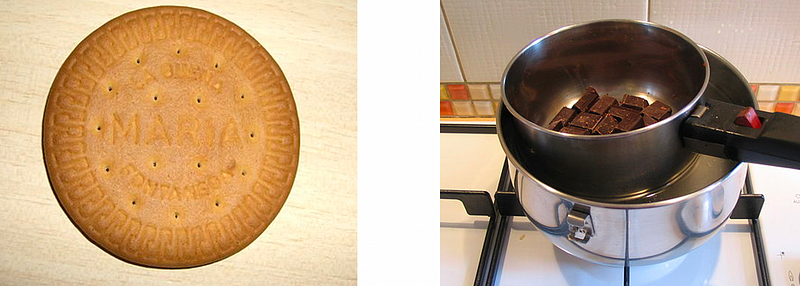
The one on the left is the cookie, in case you were wondering. Interestingly enough, it’s not named after the Venezuelan woman I was sure invented them for kids like me to dunk in their chocolate milk. Turns out the María cookie was created as a biscuit in 1874 by the London bakery Peek Freans to commemorate the marriage of the Grand Duchess Maria Alexandrovna of Russia to the Duke of Edinburgh.
In Spain the cookie became a household name after the Civil War, when bakeries produced tons and tons of them to use up a surplus of wheat. And from Spain, it was only natural they would reach Latin America… especially considering the great number of Spaniards who emigrated across the Atlantic as a result of the Civil War.
The heating technique know as “baño María” or “baño de María” (literally, María bath) is referred to as a double boiler in English. It’s used in science, industry, and your kitchen (or at least, mine) to heat materials gradually or to keep materials warm over long periods of time. The baño María can also used to melt ingredients for cooking, like the chocolate shown above, which clearly hasn’t melted yet because someone I won’t name forgot to turn on the stove — again!
Four uses for the name María, and here’s a fifth: marijuana. Like the English nickname Mary Jane, María is the preferred AKA of many Spanish-speaking grass connoisseurs.
Except when Ricky Martin used it in his 1995 hit “María”.
The coded reference there, according to many experts, was coke, not marijuana. The song is the equivalent of J. J. Cale’s “Cocaine” (famously covered by Eric Clapton), except it’s a lot more subtle because cocaine is never actually mentioned. As opposed to Cale’s song, in which the word cocaine is repeated exactly 562 times. Honest. I counted.
Ricky Martin’s song “María” was released in November of 1995, sold over five million copies (becoming the second best-selling single in the world that year) and gave Martin his first international hit single. It was so awesome that two or three versions of the song were recorded (including one in Spanglish, of course) and four different music videos were constantly shoved in people’s faces via MTV. Kids, this was back when MTV played music videos.
Man, I want my MTV… back!
Anyway, regarding the lyrics of the song “María”, here are the first three stanzas translated by yours truly into English. You be the judge.
She is a special woman, almost from another world. She is a carnal labyrinth that traps you before you know it.
That’s María, white as day. But she’s poison if you dare to fall in love.
That’s María, hot and cold. And if you drink her, surely you will die.
I don’t know about you, but I doubt Ricky Martin was referring to either a woman or marijuana.
As a reward for putting up with all this information overload about a single word, here’s a video about a different María song that you probably had no idea existed. By a fantastic Venezuelan singer called Soledad Bravo, known in English as “Lonely Anger”. Just kidding. I think…
Conclusion:
If you’re a Spanish speaker and you want to talk about your friends who eat cookies while they smoke weed and heat up some chocolate on the stove… well, you can definitely use maría.
But if you speak English and want to discuss lunar features or invisible trees, good luck with that. Because the editors of the New York Times decided that the word maria is a dord!
Please check out my previous entry on another dord:
*What the heck is a dord anyway? Here you go: