
Nancy
The lesser-known N-word and its homophobic history
Today’s New York Times Spelling Bee letters:

C, I, N, T, V, Y, and center A (all words must include A).
Merriam-Webster says…
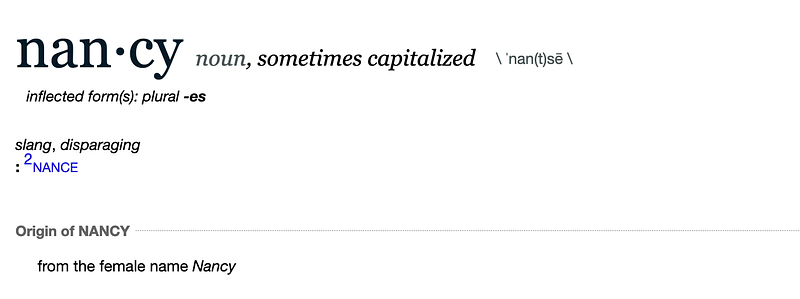
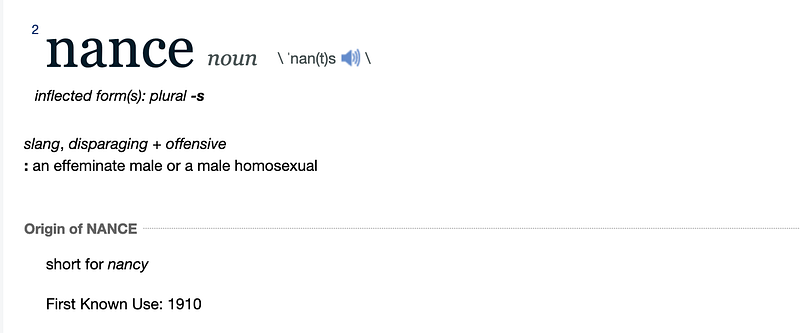
Silly little dictionary! Don’t you know nancy can’t possibly be a word if the New York Times says it ain’t?
For further fascinating facts, check out the Spelling Bee Master.
What’s your favorite dord* from today’s puzzle?
My Two Cents
As a common courtesy, I will issue a trigger warning that we will be discussing an offensive word.
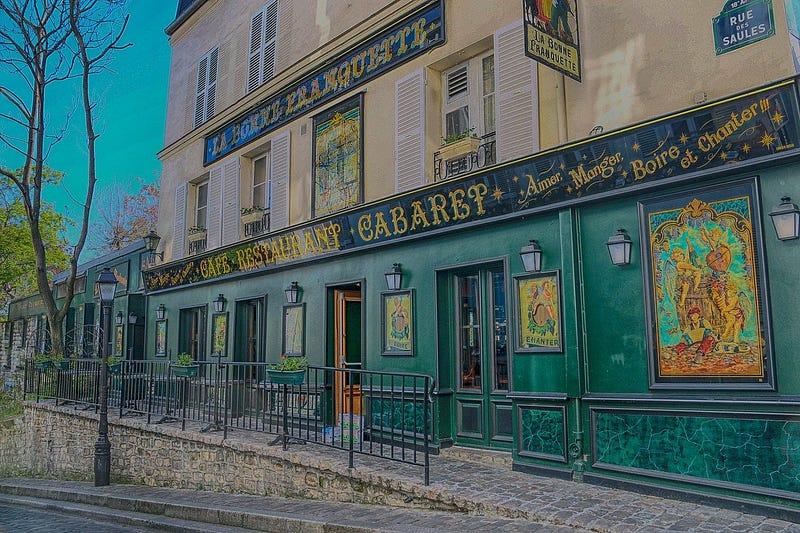
The reason I chose the photo of a cabaret is because burlesque played an important part in the infamy of the word nancy, and had a lot to do with persecution of gay men.
According to Merriam-Webster, the terms “nance” and “nancy” both refer to the female proper noun, used disparagingly to describe “an effeminate male or male homosexual”. A tree from the genus Byrsonima is referred to as “nance”, as is its fruit. There is also a South American legume plant known as “nance” in Ecuador. In both cases (the tree and the legume), the Spanish pronunciation is NAN-seh.
The dictionary also tells us that, as a slur, the first known use of the word nance was around 1910. However, Urban Dictionary explains that “Nancy-boy” was a postwar term for a gay man, consider a softer word than other epithets. The men tagged with this slur were viewed as “harmless” or not “threatening or predatory”.
So was it used before or after World War II?
Burlesque
Perhaps the play The Nance, written by Douglas Carter Beane, might help us figure our the answer to that question. Carter Beane’s play premiered on Broadway in 2013 and starred Nathan Lane. It was nominated for five Tony Awards and won three of them.
The ‘nance,’ or Nancy Boy, was a stock gay character that pranced about the stage, creating campy scenes and sketches of gay life. For the time period in which this happened — 1920s and 30s — this was an outrageous show that brought hearty laughter from the audience members, many of whom were not gay and (given the time period) were likely unsympathetic to the plight of homosexual men.
In his review of the play, Bruce Chadwick explains this:
“In the late 1930s, New York Mayor Fiorello LaGuardia, fearful of how the lurid burlesque shows would make his city look in the upcoming World’s Fair of 1939, cracked down on the houses. Part of LaGuardia’s anger was aimed at the Nance, whom critics said created audiences of lusty gay men having sex in the dark balconies of the burlesque emporiums. It was an outrage, the Mayor said, and police began swooping down on burlesque shows, closing many and forcing others to drop the nance act or greatly curb it.”
Carter Beane did a lot of research on the these crackdowns and how police operated. Officers would first screen the plays, take notes and only then raid them. The play showcases the homophobic ambiance and the injustices gay men went through at the time.
The play was taped for the PBS series Live from Lincoln Center. It’s possible it can be found online to view.
A woman’s name
It certainly appears the term got widespread around the period between both World Wars. I was wondering why the name Nancy was picked, as opposed to other female names. I doubt the flowering tree I discussed earlier came into play; as I mentioned, the word “nance” was probably used only by Spanish speakers.
I checked online for the popularity of the name Nancy (which is not very popular now), and found this graph showing the number of babies being given that name over the last 150 years or so:
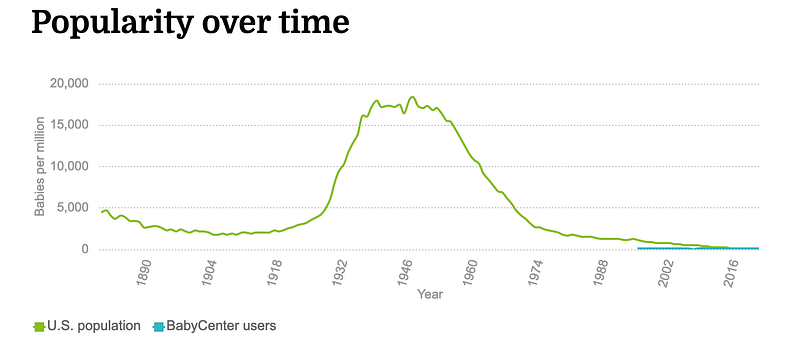
I wonder if the rising prevalence of that female name had anything to do with its disparaging use as an insult to gay men.
Maybe Nancy was the “Karen” of the 1930s and 40s.
Except I remember it being used when I was growing up in the 70s and 80s. Not just by other children who wanted to make fun of kids who seemed effeminate or were not up to the manly standards of the bullies. I distinctly remember adults, including teachers and coaches, using the term.
Even in the 21st Century its use has perdured. Those of you who were fans, like I was, of the show Scrubs (2001–2010), might remember a certain Dr. Perry Cox (played by John C. McGinley) who berated the male interns and attending physicians by calling them female names. When you think about it, that was probably insulting to both gay men and all women.
And that’s why today I will tip my hat to the editors of the New York Times, and acknowledge they used good judgement by determining that the word nance is a dord!
Please check out my previous entry on another dord:
*What the heck is a dord anyway? Here you go: