
Bulbul
“Bird” can be a double entendre in other languages, too
Today’s New York Times Spelling Bee letters:

B, G, I, L, T, Y, and center U (all words must include U).
Merriam-Webster says…
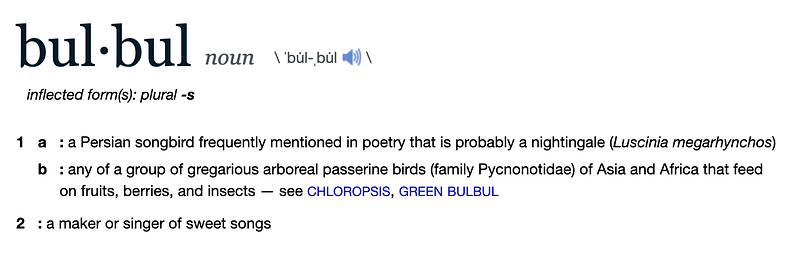
Silly little dictionary! Don’t you know bulbul can’t possibly be a word if the New York Times says it ain’t?
For further fascinating facts, check out the Spelling Bee Master.
What’s your favorite dord* from today’s puzzle?
My Two Cents
Growing up in Venezuela in the 1970s and 80s meant I had the incredible luxury of choosing between four channels to watch on television. Two of them were state-owned, one of which functioned mainly as the country’s version of the American PBS. Few, if any commercials, and a lot nature programs where week in and week out we could watch in fascinated horror as lions tore into gazelles on the African plains.
The privately-owned stations offered a typical mix of locally-made and imported shows. Anything that was not in Spanish was dubbed into that language. (Movies theaters, however, showed foreign-language films with subtitles.)
Most of my family (grandparents, uncles, aunts, cousins) lived in Israel. At that time — at least as I remember it — flying overseas, especially from South America to the Middle East, was expensive. Even making long-distance phone calls was costly, and basically consisted of family members shouting back and forth at each other because the connection was always lousy. I would hang up exhausted after getting birthday wishes from my grandparents or aunts.
When we did visit Israel, one of the treats was watching TV. For several reasons. My brother and I would tease our cousins over the fact that we had double the number of channels they did. There were only two at the time. In turn, they had color TV (it would not arrive in Venezuela until 1978, and we wouldn’t get one until a couple of years later) and American shows in English — with subtitles in both Hebrew and Arabic.
But it was one of the Israeli shows that made my brother and me laugh hysterically because it was, in our eyes very silly and extremely bizarre. It was about a kid whose nickname was “Bulbul Hakabulbul”.
You see, as far as my brother and I were concerned, bulbul was the Hebrew word for “penis”.
In other words, this boy was called Penis McPenis.
Bird is the word
As Merriam-Webster explains, bulbul is the term used to reference several species of songbirds from Africa and Asia. They belong to the order Passeriformes, which includes more then half the birds in the world. Yeah, that’s not very helpful, right? The members of the family, Pycnonotidae, includes 150 species, so that boils it down a bit.
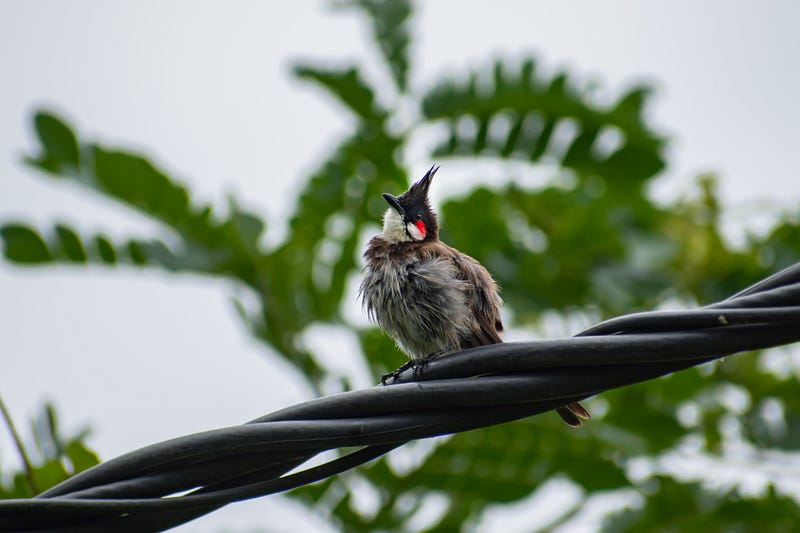
The photo at the top of this article shows an example of one of the species, the red-whiskered bulbul. I think. I’m not an expert, but it looks very similar to the photos of the other “red-whiskered bulbulsl” I searched for online. I welcome fact corrections from certified ornithologists only.
The word bulbul derives from Hindi (बुलबुल) or Persian or Arabic (بلبل) — again, we’re not getting much help from the experts — meaning nightingale, namely the Luscinia megarhynchos. But in English, bulbul now refers to the passerine birds we were discussing above.
Bulbuls are small, short-necked birds with long tails and rounded wings. Most species have elongated bills that hook slightly. Most species are usually monogamous, with the males slightly larger than their female counterparts. Some bulbuls (like the red-whiskered one at the top) have been captured for the pet trade and have thus been introduced to tropical and subtropical areas such as Florida, Hawaii, and Australia.
Birds with no feathers don’t flock at all
Bulbul has other uses and meanings.
▹ There is a village in northern Syria by that name.
▹ An Azerbaijani opera tenor (and important figure of vocal arts and national musical theater in Azerbaijan), a Bengali dancer who was the pioneer of modern dance in Bangladesh, and a current British wheelchair rugby player all used the nickname Bulbul.
▹ Bulbul was the name of a 2013 Indian film and a 2019 Nepalese movie.
▹ Cyclone Bulbul wreaked havoc in West Bengal (India) and Bangladesh in November of 2019.
Back to the earlier story about Penis McPenis. The Israeli TV show was commissioned in 1976 by the Israeli Educational Television to explain road safety content to children. There were 15 episodes made, each lasting a bare five minutes. The main character was a boy named Shmulik, nicknamed “Bulbul Hakabulbul” because he used to perform actions in a confused and illogical way. For example: combed his hair with a toothbrush or wore warm clothes in the summer.
Here I pause to explain that, in Hebrew, the word bulbulb can also mean “someone who is confused”, from bilbul, confusion.
Fearing that his strange actions would endanger Bulbul (the boy) on the road, his father devised an alarm system for the kid to wear. The system would make noise and flash lights whenever he was about to do something dangerous, like cross the street without looking both ways. That’s how the creators of the series tried to convey the message that, just as one should not comb one’s hair with a toothbrush, one should not cross the road without checking for oncoming vehicles.
What can I say, Israeli TV writers of the 1970s had a weird sense of humor.
Now, the one and only meaning my brother and I had for bulbub was “weenie”. Bulbul is slang, very much crafted for parents to use with their young children. The equivalent of the American weenie or pee-pee. My brother and I did not know this, nor did we know of any other names in Hebrew for our… birds, so to speak.
So you can imagine how quickly we ended up ROFL we first saw this kid called… Weenie McPecker. And this was about 25 years before ROFL had even been invented! My brother and I, text acronym pioneers…
Fast forward to 2008, and all of Israeli society waited with bated breath the results of the countrywide vote to pick its national bird. The two finalists: the yellow-vented bulbul and the hoopoe.
Guess who most people were probably rooting for. Who would root for, say, in a contest between the great tit and the bald eagle?
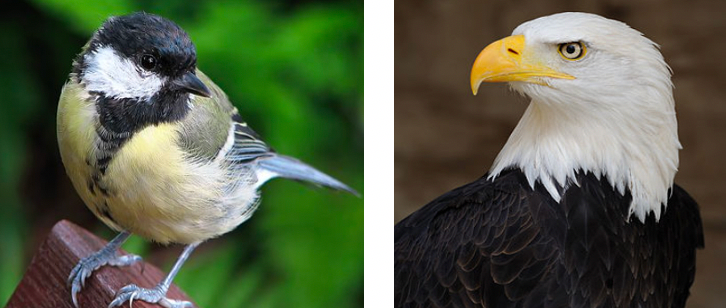
Yeah, thought so… and I agree. The great tit is much cuter. Plus, you get a good excuse to say “great tit” in random contexts.
Anyway, in Israel the hoopoe won and saved the country the embarrassment of having a national bird called “schlong”.
So now you know. You can use bulbul to talk about your pet bird. Or your other, um… pet bird.
But you’ll never hear the editors the New York Times Spelling Bee mention it. Not because they’re prudes, but because they decided that bulbul is a dord!
Please check out my previous entry on another dord:
*What the heck is a dord anyway? Here you go: