avatarAvi Kotzer

Free AI web copilot to create summaries, insights and extended knowledge, download it at here

2538

Abstract

nd the word <i>gloam</i> makes in my head as I type it out. And for some reason it also holds visual appeal to me.</p><h2 id="1469">Nouns and verbs</h2><p id="f351">Although <i>gloam</i> may seem like a noun, it’s actually the verb form of the noun <i>gloaming</i>. As a common noun,<i> gloaming</i> means “twilight” or “dusk”. Trust me, I know what the word <i>twilight</i> brings to our pop-cultured minds, but I’m not gonna go there. I will, however, recommend the greatly underrated movie <a href="https://www.imdb.com/title/tt0116367/"><i>From Dusk till Dawn</i></a>.</p><p id="bdc6">Gloaming has been used as a proper noun, too. Here are a few examples:</p><p id="5cd9">▹ The Gloaming is a contemporary Irish/American music band. One of the instruments the band uses is the hardanger fiddle, which is Norwegian. Go figure. When it comes to playing music, the band is innovative and inventive. However, when it comes to picking names for their albums, the members are… well, not so creative. Their first three recordings are called <i>The Gloaming</i>, <i>The Gloaming 2</i>, and <i>The Gloaming 3.</i></p><p id="6187">▹ Gloaming was the name of a famous thoroughbred in New Zealand that raced for several years after World War I. He still holds the Australasian record of 45 seconds for four furlongs (half a mile).</p><p id="dcec"><i>The Gloaming</i> is an Australian web television series that began last year. I have no clue what it’s about. Please ask any friendly Australian you may know.</p><p id="5a01"><i>The Gloaming</i> is the subtitle of Radiohead’s album <i>Hail to the Thief</i> and also one of its tracks.</p><p id="44f5">▹ Finally, “Roamin’ in the Gloamin’” was a popular love song at the time it was written by Harry Lauder… in 1911. It was <a href="https://www.youtube.com/watch?v=PpyXT4AYW3c">covered</a> by Bing Crosby and Rosemary Clooney in their 1965 album <i>That Travelin’ Two-Beat</i>.</p><h2 id="ee79">Back-breaking work</h2><p id="69d9">So… how did <i>gloam</i> come about?</p><p id="d469">As Merriam-Webster says, it’s a back-formation of the noun gloaming.</p><p id="d916">Typically, prefixes and suffixes are added to words to form new words. For example, the noun<i> coward</i> turning into the adjective/adverb <i>cowardly</i>; or <i>untie</i> being the opposite of the word <i>tie</i>.</p><p id="ef9d">The inverse process also applies. New words can be formed by removing part of an existing word. Mostly suffixes, in this case. One very commonly used example is the word <i>pea</i>, which actua

Options

lly came from <i>pease</i>. <i>Pease</i> was the original word for <i>pea</i>, but someone thought it was plural and starting using “pea” as the singular instead. That trended and eventually everyone forgot about the original <i>pease</i>.</p><p id="b07d"><i>Gloaming</i> originated from the Scottish dialects of English in the Middle Ages. The roots came from the Old English <i>glōm</i>, or “twilight”, derived from the verb <i>glōwan</i>, meaning “to glow.” Some clever Scotsman (or woman) decided to turn it into a verb and so now we have <i>gloam</i>.</p><p id="c936">Some other back-formation words you may have heard of include: <i>buttle</i> (the act of being a butler), <i>babysit</i>, <i>dry-clean</i> (the verb), <i>flappable</i> (a good example of a prefix being removed), <i>kidnap, moonlight </i>(the verb), <i>peeve</i> (the verb), and <i>scavenge</i>.</p><p id="f2bc">Now, most of these are verbs, and most of them are now accepted as words.</p><p id="f010">But not <i>gloam</i>. No, siree. That’s because the editors of the New York Times Spelling Bee said: “It<b></b>s a <a href="https://www.merriam-webster.com/words-at-play/dord-a-ghost-word"><b>dord</b></a>!”</p><p id="6e16">Please check out my previous entry on another <b>dord:</b></p><div id="23de" class="link-block"> <a href="https://readmedium.com/cancha-83fc1e00d53e"> <div> <div> <h2>Cancha</h2> <div><h3>Part of an iconic opening sequence in 1980s television</h3></div> <div><p>medium.com</p></div> </div> <div> <div style="background-image: url(https://miro.readmedium.com/v2/resize:fit:320/0*hNjv35lzyUsloivR.jpg)"></div> </div> </div> </a> </div><p id="b031">*What the heck is a <b>dord </b>anyway? Here you go:</p><div id="333f" class="link-block"> <a href="https://www.merriam-webster.com/words-at-play/dord-a-ghost-word"> <div> <div> <h2>'Dord': A Ghost Word</h2> <div><h3>One of the questions people like to ask lexicographers is this: Can you sneak something into the dictionary? Can you…</h3></div> <div><p>www.merriam-webster.com</p></div> </div> <div> <div style="background-image: url(https://miro.readmedium.com/v2/resize:fit:320/0*Sr7pOFlQQVrqFZBT)"></div> </div> </div> </a> </div></article></body>

Gloam

No need to go to the gym for this back formation
Photo by Lluís Domingo on Unsplash

Today’s New York Times Spelling Bee letters:
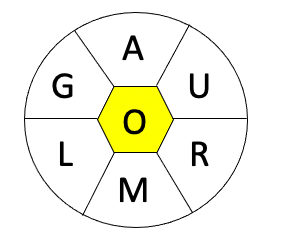
Art: Iva Reztok

A, G, L, M, R, U, and center O (all words must include O).

Merriam-Webster says…
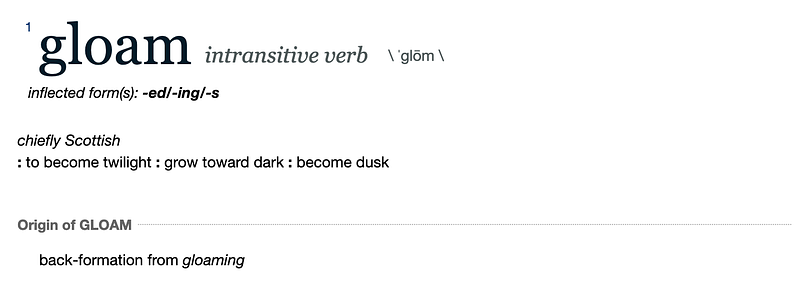
Credit: merriam-webster.com

Silly little dictionary! Don’t you know gloam can’t possibly be a word if the New York Times says it ain’t?

For further fascinating facts, check out the Spelling Bee Master.

What’s your favorite dord* from today’s puzzle?

My Two Cents

When I play the Spelling Bee puzzle, which is almost daily, there are certain words that I will try out even if I know they have been previously rejected.

One could attribute that to my illogical stubbornness. And one would be correct in doing so. But there is also a logical reason. Sometimes words that were not valid are incorporated into the puzzle after enough people kvetch. The game’s creators have provided an email address to send complaints about “missing words”.

I happen to think it’s a lot more fun to write an entire article about them.

In today’s Spelling Bee, I tried the word “gloam”. Denied! Yet again. For like the fiftieth time in the past couple of years. So I tried again, two seconds later. I told you already, I suffer from a condition called illogical stubbornness… soon to be added to the latest edition of the DSM (Diagnostic and Statistical Manual of Mental Disorders).

Also, I just like the sound the word gloam makes in my head as I type it out. And for some reason it also holds visual appeal to me.

Nouns and verbs

Although gloam may seem like a noun, it’s actually the verb form of the noun gloaming. As a common noun, gloaming means “twilight” or “dusk”. Trust me, I know what the word twilight brings to our pop-cultured minds, but I’m not gonna go there. I will, however, recommend the greatly underrated movie From Dusk till Dawn.

Gloaming has been used as a proper noun, too. Here are a few examples:

▹ The Gloaming is a contemporary Irish/American music band. One of the instruments the band uses is the hardanger fiddle, which is Norwegian. Go figure. When it comes to playing music, the band is innovative and inventive. However, when it comes to picking names for their albums, the members are… well, not so creative. Their first three recordings are called The Gloaming, The Gloaming 2, and The Gloaming 3.

▹ Gloaming was the name of a famous thoroughbred in New Zealand that raced for several years after World War I. He still holds the Australasian record of 45 seconds for four furlongs (half a mile).

The Gloaming is an Australian web television series that began last year. I have no clue what it’s about. Please ask any friendly Australian you may know.

The Gloaming is the subtitle of Radiohead’s album Hail to the Thief and also one of its tracks.

▹ Finally, “Roamin’ in the Gloamin’” was a popular love song at the time it was written by Harry Lauder… in 1911. It was covered by Bing Crosby and Rosemary Clooney in their 1965 album That Travelin’ Two-Beat.

Back-breaking work

So… how did gloam come about?

As Merriam-Webster says, it’s a back-formation of the noun gloaming.

Typically, prefixes and suffixes are added to words to form new words. For example, the noun coward turning into the adjective/adverb cowardly; or untie being the opposite of the word tie.

The inverse process also applies. New words can be formed by removing part of an existing word. Mostly suffixes, in this case. One very commonly used example is the word pea, which actually came from pease. Pease was the original word for pea, but someone thought it was plural and starting using “pea” as the singular instead. That trended and eventually everyone forgot about the original pease.

Gloaming originated from the Scottish dialects of English in the Middle Ages. The roots came from the Old English glōm, or “twilight”, derived from the verb glōwan, meaning “to glow.” Some clever Scotsman (or woman) decided to turn it into a verb and so now we have gloam.

Some other back-formation words you may have heard of include: buttle (the act of being a butler), babysit, dry-clean (the verb), flappable (a good example of a prefix being removed), kidnap, moonlight (the verb), peeve (the verb), and scavenge.

Now, most of these are verbs, and most of them are now accepted as words.

But not gloam. No, siree. That’s because the editors of the New York Times Spelling Bee said: “Its a dord!”

Please check out my previous entry on another dord:

*What the heck is a dord anyway? Here you go:

Spelling Bee
Language
Culture
History
Education
Recommended from ReadMedium