
Hoopoe
We can only hoopoe (groan!) this bird may someday be accepted by the Spelling Bee
Today’s New York Times Spelling Bee letters:
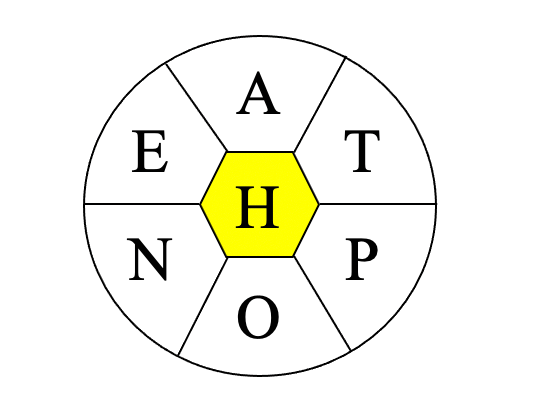
A, E, N, O, P, T, and center H (all words must include H)
Merriam-Webster says…
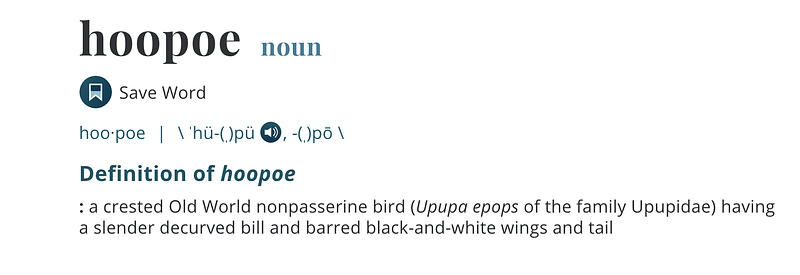
Silly little dictionary! Don’t you know hoopoe can’t possibly be a word if the New York Times says it ain’t?
For further fascinating facts, check out the Spelling Bee Master.
What’s your favorite dord* from today’s puzzle?
My Two Cents
Are you still groaning from the bad pun at the top of this column? I know, I know, that form of humor is considered the lowest notch on the totem pole… although I’ve honestly never understood why. Here is an example of an illustration that’s been going around explaining the hierarchy of humor, aptly titled…

How can scatological humor be up so high?!? And how are dumb jokes better than puns? What was Grant Snider thinking?
Anyway, back to our subject at hand: a bird that does not exist, according to the editors of the Spelling Bee.
A lot of hoopoe-la
Groan again! Sorry, I just couldn’t resist.
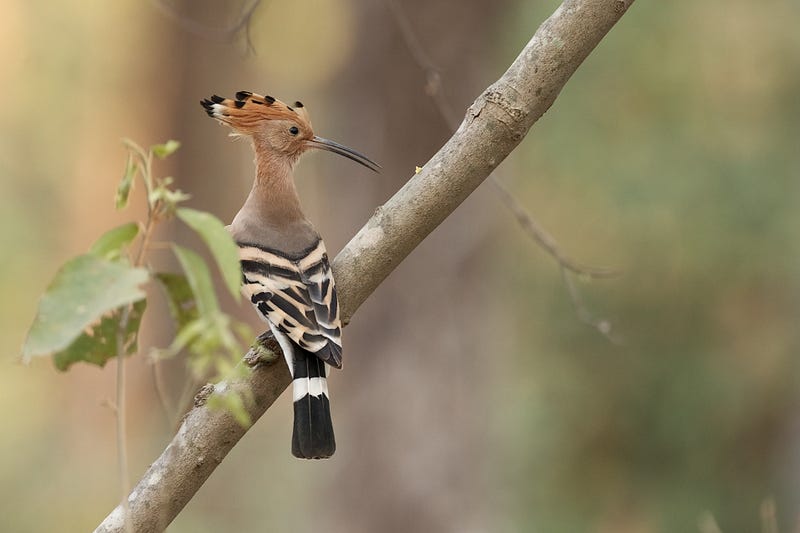
The dictionary explains that this bird’s name was first used around 1668 and may have been an “alteration of obsolete hoop, from Middle French huppe, from Latin upupa, of imitative origin”. The 1911 edition of the Encyclopedia Britannica agrees. Its article, written by Alfred Newton (an English zoologist and ornithologist, Professor of Comparative Anatomy at Cambridge University), explains that the hoopoe is “a bird long celebrated in literature, and conspicuous by its variegated plumage and its large erectile crest.”
Newton describes the hoopoe as “About the size of a thrush, with a long, pointed and slightly arched bill, its head and neck are of a golden-buff — the former adorned by the crest already mentioned, which begins to rise from the forehead and consists of broad feathers, gradually increasing in length, tipped with black and having a subterminal bar of yellowish-white. The upper part of the back is of a vinous-grey, and the scapulars and flight-feathers are black, broadly barred with white tinged in the former with buff. The tail is black with a white chevron, marking off about the distal third part of its length.”
In summary, this:
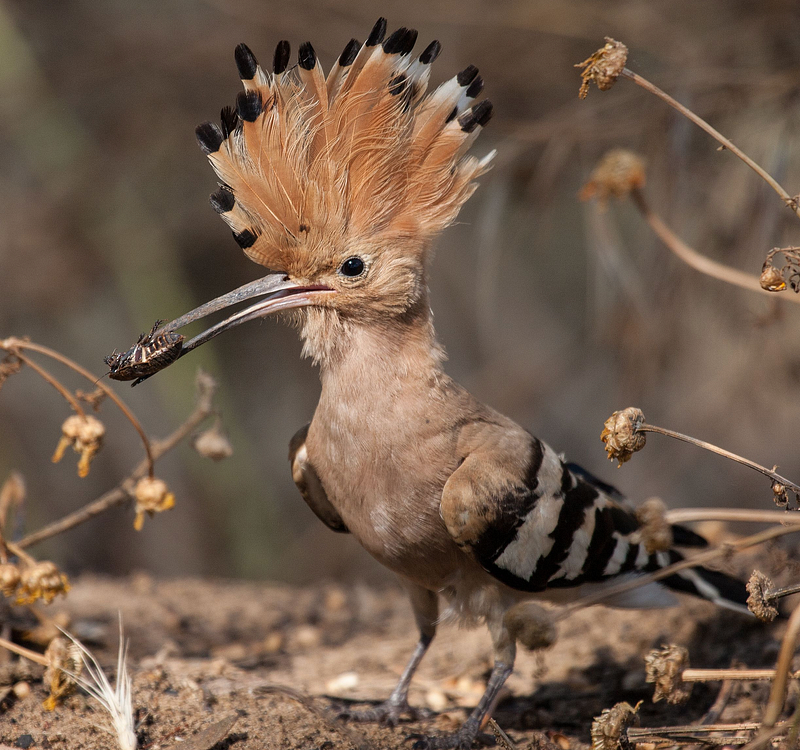
There are actually three existing species of hoopoes; the Eurasian hoopoe, or Upupa epops, the African hoopoe, (Upupa africana), and Upupa marginata, or Madagscar hoopoe. The latter two were considered subspecies of the original Eurasian one described by Newton, and their very similar looks clearly show why:
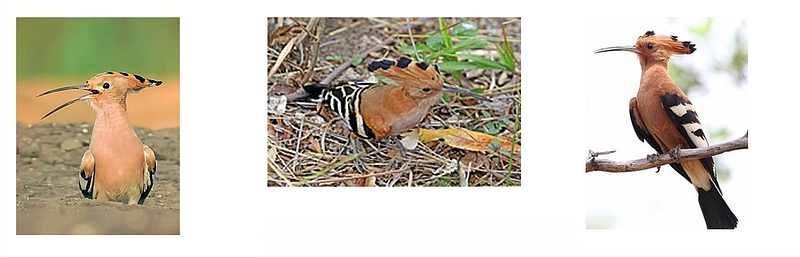
There is also an extinct species, the Saint Helena hoopoe, or giant hoopoe.
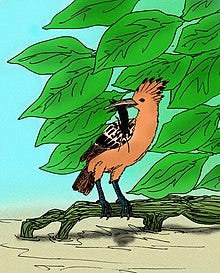
There are several theories about why this possibly flightless bird died out, one of them being that its cartoonish figure was not conducive to sexy time. And if you can’t mate, well, death is your fate.
One thing I’m definitely sure of is that the Saint Helena hoopoe was not eaten into extinction by the Jewish people. And there are two reasons I say this with confidence. One, the bird lived on Saint Helena, a remote and inaccesible tropical island…
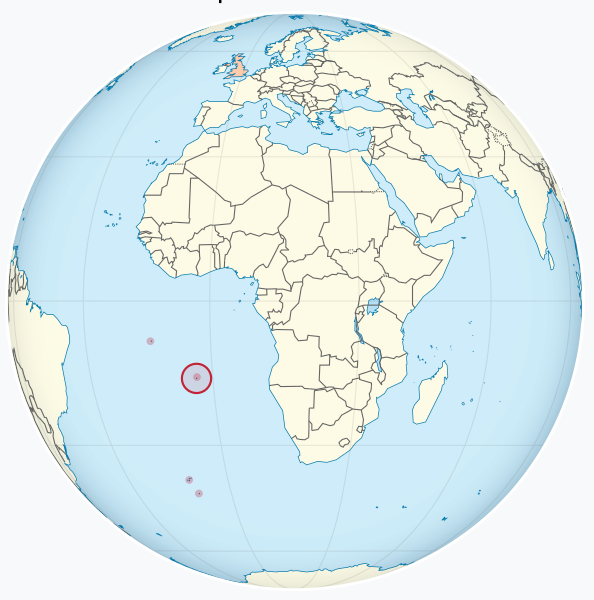
…and two, the hoopoe is not kosher. It says so right there in Leviticus chapter 11, verse 19:
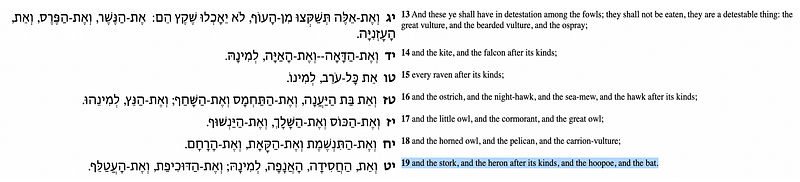
Here’s a closeup of that last line:

I’ll get into why the bat is listed among the birds another day. In any case, what’s clear is that Jews aren’t allowed to eat hoopoes. A fact that will become quite ironic in a couple of minutes if you do me the favor of reading on while scrolling really slowly.
National fowl
Americans may be familiar with the official bird of the state they live in––and when I say “state they live in”, I mean Alaska or Wyoming, not constant fear or ignorant bliss. Surely most Americans know that the eagle is the national bird of the U.S. of A. Perhaps some think The Eagles are the national rock group, but they would be wrong. That designation would logically go to, um, ahem… The National. Right?
Many countries around the world have chosen national birds. Some, like Denmark, have changed their minds (switching from the eurasian skylark to the mute swan), while others have decided one was not enough (Aruba burrowing owl is the national symbol, while its official bird is the brown-throated parakeet). Wikipedia carries a pretty comprehensive list that you can peruse here.
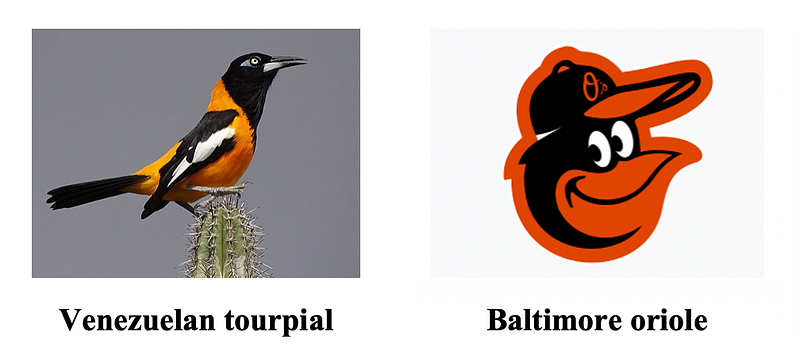
Having grown up in Venezuela, I know that this country’s national bird is the troupial. Troupials belong to the genus Icterus, also known as the “New World orioles”, which are not related to their Old World counterparts. the latter actually belong to the family Oriolidae. Both types of birds are commonly called “orioles”, as their physical features are quite similar.
Interestingly, the Maryland baseball team was always called “Orioles de Baltimore” in Venezuela, although the team’s moniker could have just as easily been translated to “Baltimore Tourpials”. They are almost identical, as you can clearly see here:
Now I live in Spain, a country that seemingly has not yet picked a national bird, although many Spaniards think either the red-legged partridge or the Spanish imperial eagle should be designated as such. Quite a study in contrast, these two feathered not-so-good-friends:
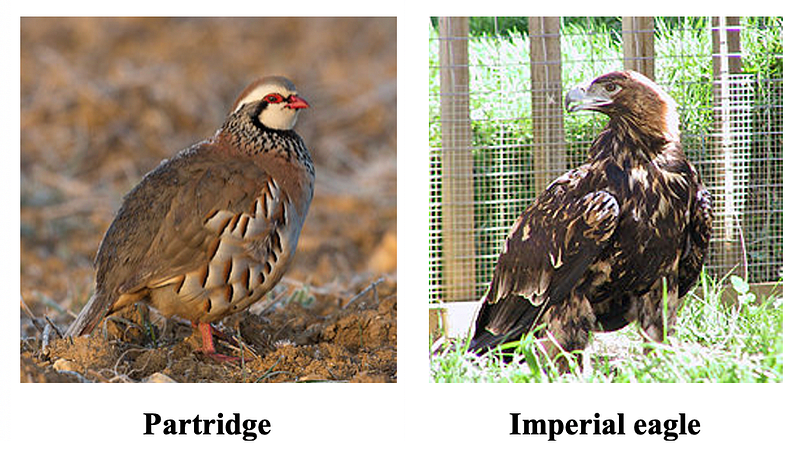
Despite Iva Reztok’s poor screenshotting abilities, I’m sure most of my savvy readers have figured out that the birds are not the same size.
What I did not know and was surprised to discover today is that the hoopoe is the national bird of Israel. After performing some intense online research for all of 20 minutes––and then giving up and asking family members who live in Israel about this––I found out the quite unsatisfying answer. In 2008, President Shimon Peres announced the winner of a nationwide election that had lasted months. It all began with a list of 50 birds that were narrowed down to the bulbul, the red falcon, the goldfinch, the biblical vulture, the spur-winged plover, the honey-sucker, the warbler, the white-chested kingfisher, the white barn owl, and the winning bird: the hoopoe.
Remember I mentioned irony earlier? Well, there you go. A non-kosher bird became the symbol of the modern Jewish homeland. According to Grant Snider and his humor hierarchy, I’ve now raised my funny game from the bottom to the third highest level. I guess Grant is not so Snider anymore. Oops! Just rolled back down again…
As far as I’m concerned, the bulbul would have been an interesting choice considering that word is also slang for “penis” in Hebrew. Perhaps the biblical vulture would have worked, too, considering it’s, well… biblical (and was Peres’s favorite from among the finalists).
Peres lamented the fact that the dove hadn’t won out. Considering the dove with an olive branch in its beak is one of the internationally-known symbols of peace, that would have been a fine choice indeed.
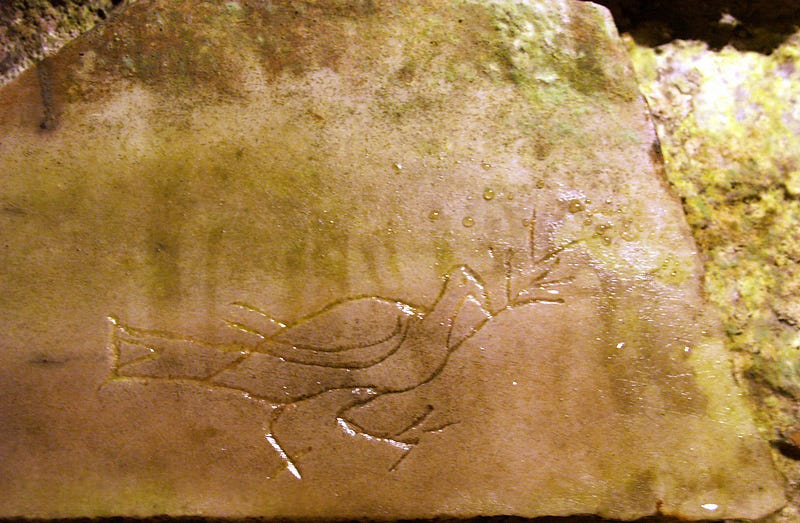
It was the hoopoe that won and became Israel’s national bird. And yet, despite this (or perhaps because of this––wink, wink) the New York Times decided that the word hoopoe should be a dord*.
You can check out my previous entry on another dord* here:
*What the heck is a dord, you ask? Here’s the answer: