
Our Civil Rights Are Not Guaranteed
What we can learn from Fannie Lou Hamer
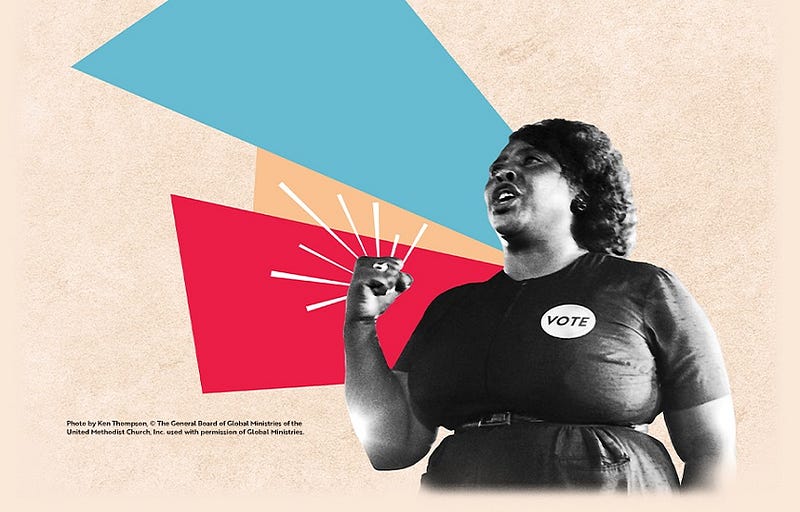
If you feel drained from a promenade down a seemingly endless dark path, and think that your feet will give out on you, remember the great ones who came before you. Let their determination light the way, and their tenacity jolt your step. You carry the hopes and dreams of your generation on behalf of the great leaders who came before us.
The American educational system does not teach Black history properly. Those who fought in wars are considered national heroes, but those same institutions failed to teach us about the advocates for equal rights and justice with the vigor and conviction these topics deserve.
White conservative historians never wanted to give voice to a strong Black woman, like Fannie Lou Hamer. Students and Americans alike must bridge the gap by acknowledging that anyone who fights for equal rights and justice is a national treasure.
Born in 1917 to sharecroppers in the Mississippi Delta, Fannie Lou Hamer became a passionate advocate for women’s voting rights, African American agency, and socioeconomic justice. We can learn from her life by acknowledging the striking similarities in the issues she fought for in the 1960s to the ones that women and Black people face today. Her work should light a fire in the hearts of modern Civil Rights Activists.
There is so much hypocrisy in this society and if we want America to be a free society, we have to stop telling lies, that’s all. Because we’re not free and you know we’re not free (Fannie Lou Hamer, 1964).
In America, history teachers tell us that the African slaves gained their freedom under Lincoln’s Emancipation Proclamation but rarely explores how chained Black people are to the shackles of history. We are not free until we have agency over our lives, our families, and our communities. Freedom, like happiness, is a journey, not a destination. Thus, it is inaccurate to say that Black people are free in America. Instead, it is more accurate to say we are in the process of freeing ourselves from oppressive governance.
We should have optimism, not because our freedom is guaranteed, but because we trust in our determination to acquire equal and just opportunities and treatment under the law. Women and Black women, in particular, should learn from Hamer’s experiences.
She endured a forced hysterectomy, which prevented her from the agency over her body. When trying to register to vote and aid other Black people to do so, she was imprisoned and beaten. The police brutality she endured is reminiscent of the brutality seen in this generation. During this time Civil Rights Advocates, like Stacy Abrams fight against voter suppression and the Voting Rights Act of 1965, have been gutted by Conservatives. We should not stumble blindly because her story of perseverance will chart a path forward.
Her Fight Against Voter Suppression
Fanny Lou Hamer became a fierce advocate for African American voting rights. She faced incarceration, physical abuse, and sociopolitical persecution to register to vote and add new Black voters to the roll in her home state of Mississippi.
While she attended school until age 12, she had to leave school to work on a plantation, picking cotton. Because she attended school, she was the only worker that could read or write. She began working as a Civil Rights activist for the Student Non-Violent Coordinating Committee (SNCC).
On August 31, 1962, she led 17 volunteers to register to vote at the Indianola, Mississippi Courthouse. Denied the right to vote due to an unfair literacy test, the group was harassed on their way home. The police stopped their bus and fined them $100 for the trumped-up charge that the bus was too yellow (Michal, 2017).
The officer’s decision to give them a ticket they could not afford demonstrates the police’s use as an extension of white-supremacist ideology. They believe that to keep white people safe, they must accost Black people. If the abuse stopped, Black people would feel overjoyed. The revenge that so many white people think Black people will enact has never had merit.
Even though her first attempt to register ended dramatically, Hamer continued to organize and fight to register Black voters in Mississippi. The plantation owner fired Mrs. Hamer after she attempted to vote. White supremacists shot into her home and much of her property was confiscated. Forced to finish the remaining six months of the harvest, her husband joined her in moving to Ruelville, a small city located in Sunflower County, Mississippi.
She successfully registered to vote in 1963. The backlash to her and the other Black women who joined her was swift. Officers arrested Hamer and the women who accompanied her. They beat her, blood-clotting her eye, damaging her kidney, and her leg. She took beatings for herself but also, so we did not have to. I think about her pain, pride, and conviction to choose a fight for equality even when her ideals fell on the fringes of American society.
Women need to realize that agency is powerful; our ancestors suffered physically and mentally to make our voices matter. We need to judge those who fail to represent us properly and never give up fighting. Even if Civil Rights and Voting Rights Acts fall, we need to commit to rebuilding our protections. While America’s constitution grants rights to its citizens equally, the country’s people fail to uphold those values. The progressive legislation passed in the 1960s helped to clarify the federal government’s position on fair and equal treatment.
American schools do not teach the truth about the Voting Rights Act and the Civil Rights Act; we did not confide them. Our struggle is not over as long as a minority of white citizens tries to control the majority. Too often, the system conditions Black people to think that voting will not matter. White colonists designed the system to disenfranchise us; sometimes, it feels hopeless. If we do not get everything in one election cycle or pass one law, many get discouraged. While their discouragement is understandable, I am asking you to rise up. Let us organize, register, and vote. Black women must continue to fight against the misogynoir that attempts to impede progress.
A Supreme Court can decimate the Civil Rights Act just as it did the Voting Rights Act. The passing of Ruth Bader Ginsberg and the Supreme Court imbalance is not only about women’s rights or healthcare — this is about our Civil Rights. Too often, white liberals focus on the impact that court decisions have on their lives, but not on the most marginalized groups — Black, Indigenous, and Hispanic people. We are the future of American democracy because we represent the majority. Still, an unbalanced court jeopardizes the freedoms of us all.
A deeply divided Supreme Court handed down a decision that in the words of Congressman John Lewis, ‘put danger in the heart of the Voting Rights Act of 1965’.
Voting rights for minority groups have faced sustained assault (Clarke & Rosenberg, 2018).
It is time to fight for fair and equal access to voting. We cannot be free if we cannot have agency, and we cannot influence if modern-day segregationists block our voting rights.
These practices range from the consolidation of polling places to make it less convenient for minority voters to vote (black voters, nationally, wait twice as long as white voters to vote), to the curtailing of early voting hours that makes it more difficult for hourly-wage workers to vote, to the disproportionate purging of minority voters from voting lists under the pretext of “list maintenance (Clarke & Rosenberg, 2018).
The Black Lives Matter movement must fight to maintain all Civil Rights, jeopardized by a conservative court that values small government intervention, even when that facilitates racism. We must remember that the fight for states’ rights is often about the states’ wanton disregard for the Federal government’s leadership regarding racial inequities. While it is true that the Federal government is responsible for facilitating slavery and turning a blind eye to Jim Crow, the statues against discrimination and hate crimes are clear. We need laws that make the states respect these decisions. It is essential to advocate for a court that respects the Civil Rights of women, Black people, and all other marginalized groups.
She Kept President Johnson Up at Night
Quiet women rarely make history, and Fannie Lou Hamer was anything but meek. She fought against the disenfranchisement that kept Black people from voting. In the Jim Crow South, Black people often suffered from physical and psychological abuse. Women like Hamer, who wanted Black people to vote, cut into the white supremacist rule. She struck fear in the heart of a United States President by the name of Lyndon Johnson.
While history teachers always inform their students that President Lyndon Johnson signed the Civil Rights Act into law in 1964, they never get into his policy positions regarding African Americans. There is an inherent assumption that he was an ally.
However, history tells a more nuanced story. The American Congress passed the Civil Rights Act of 1964 and The Voting Rights Act of 1965 because Civil Rights Activists, like Malcolm X, Martin Luther King Jr, and Fannie Lou Hamer, fought against the rigid, prejudiced system.
Johnson, who needed the support of Southern Democrats to win re-election, was beside himself. He told advisers he couldn’t take the pressure.
‘Last night, I couldn’t sleep,” he said according to the White House tapes, “About 2:30, I waked [sic] up . . . I do not believe I can physically carry the responsibilities of the world and the Negras and the South (Brown, 2020).
He felt the weight of history bearing down on him, and he had to choose to support Black people or Southern whites. All Fannie Lou Hamer wanted was to create a dynamic where Black people had agency in their country. As an American, she believed in democracy and in using it to uplift the Black community. The Mississippi Democratic Party disregarded the Black people within the state. White Southern segregationists actively fought against the Civil Rights Movement at every turn. Mrs. Hamer lived behind enemy lines but never let that stop her from bucking the system.
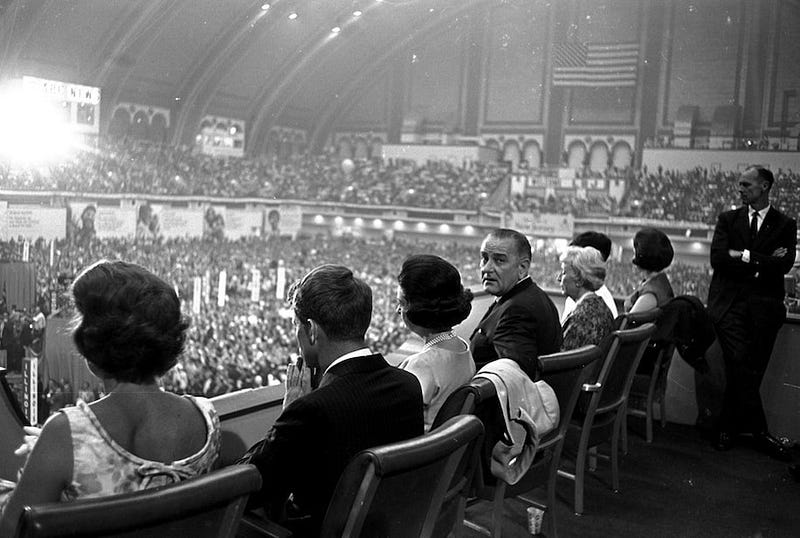
President Lyndon B. Johnson was terrified of her, terrified of her appeal she would make in 1964 before the Democratic National Committee’s credentials panel on behalf of the Mississippi Freedom Democratic Party (Brown, 2020).
White people became progressively frightened by Civil Rights Advocates who shook the branches of public sentiment, and the President was no exception to this phobia. Their irrational fear of Black people often blinded them from seeing the righteousness in the fight. Lyndon Johnson wanted to appeal to Southern white voters who believed in oppressing and abusing Black people. If this dynamic sounds familiar, it is because political parties often use Black people to gain power but dismiss their cries for justice as untimely. White moderates will often proclaim that they support Black people and respect them, but that change is too risky, inappropriate, and unconventional. As a credit to her generation, Mrs. Hamer refused to buckle under the weight of oppression or others’ apathy — she persisted.
The controversy that most characterizes the conflict between Lyndon Johnson and Fannie Lou Hamer is the lead up to her infamous speech, “I’m Sick and Tired of Being Sick and Tired,” on August 22, 1964, in Atlantic City, New Jersey.
In 1964, Hamer’s national reputation soared as she co-founded the Mississippi Freedom Democratic Party (MFDP),which challenged the local Democratic Party’s efforts to Black participation (Michals, 2017).
As part of the Democratic establishment, Johnson had disdain for this splinter group. He sent some of his closest political advisors to suggest that Mrs. Hamer refrains from making such a speech at the Democratic National Convention. However, she refused to honor his request. For her, the message which lit a fire in her heart — equality, could not be compromised.
When she refused, Johnson called an impromptu news conference to make it impossible for the national television networks to cover her testimony live (Brown, 2020).
His efforts to silence her speech infamously backfired. Her address is considered one of the most transformative of the Civil Rights Era.
In her speech, she spoke about the pain and hardships she endured as a Black woman, her pursuit to register to vote, and help others register. She suffered at the hands of officers and understood the hypocrisy of an American state that disenfranchised Black voters, most of the Mississippi population. Her speech described the need for equal educational opportunities for Black students, the state’s failure to protect Black people from extrajudicial killings at the hands of law enforcement and extremist groups, and the government’s failings to apply the Constitutional protections equally.
Later that year, in Harlem, she spoke alongside Malcolm X about their experiences. She talked about her fatigue regarding the constant struggle.
You know it takes time.” For three hundred years, we’ve given them time. And I’ve been tired so long, now I am sick and tired of being sick and tired, and we want a change. We want a difference in this society in America (Fannie Lou Hamer, 1964).
No Healthcare and Abused by Healthcare System
Our healthcare system reflects inequities in the country. Because of misogynoir, white doctors have a long history of mistreating and abusing Black women. Health care professionals who believed in Eugenics wanted to sterilize poor women, Black women, and women of color. Fannie Lou Hamer, born into an oppressive system, faced a hardship — a forced hysterectomy. This issue is particularly relevant since doctors employed by ICE allegedly used this same procedure. Each person should consider the dangers of only fighting for your homogenous group. It is far more satisfying to stand firm against all inequities to create the type of country that respects human rights.
“In 1961, Hamer received hysterectomy by a white doctor without her consent. Such forced sterilization of Black women as a way to reduce the Black population was so widespread it was dubbed, a “Mississippi Appendectomy.” Unable to have children on her own, the Hamers adopted two daughters” (Michael, 2017).
When feminists fight for reproductive rights, they should also fight against forced sterilization. It is essential to acknowledge that women’s rights should protect Black and Indigenous women who die of maternal mortality three times the white rate.
Civil Rights Advocate Harry Belafonte — The Justice League and Black Lives Matter Connection
Black History month is not a long enough period for schools to teach about Civil Rights heroes’ pantheon. There is an emphasis on educating students about Martin Luther King Jr and dismissive Malcolm X as an extremist. The American educational system’s goal is to pacify the Black youth, perpetuating a race-neutral understanding of history. It is problematic to teach apathy in the face of injustices. When one side is oppressing another, these are not equally valid perspectives.
As long as they think that peace and love will get Black people the justice they need, they will not prioritize the fight for Civil Liberties. Suppose educational institutions continue to treat Civil Rights as something accomplished in the past. In that case, they will not understand that these laws were only part of a more massive fight for liberation. The Black Lives Matter movement of today comes from a long history of Civil Rights Advocacy.
“The singer and civil rights activist Harry Belafonte, like most others, was appalled by what he saw and initiated a campaign to train the next generation of civil rights activists; the Gathering for Justice, which in turn created the Justice League, an important force in the Black Lives Matter movement” (Vitale 2018).
Harry Belafonte used his wealth to help uplift Black people. He provides a great example of what Black athletes, Hip-hop artists, and movie stars could do in 2020 to further the fight for equal rights and justice. He helped finance Fannie Lou Hamer’s plan to create 200 low-income housing units in the late 1960s. Some of these units still exist in the Sunflower country.
Harry Belefonte’s advocacy represents an intersection with her effort to help Black Mississippians, led to the movement we see today, marching in the streets for equal rights and justice. These inequities explain why education is so important. Without proper context, the Civil Rights Movement appeared to have died, but it lives on. The advocacy campaign will continue until we have liberty and justice for all people.
As We Advance
Hamer walked into the hall with determination, squeezing between men in suits who refused to make space for her (Brown, 2020).
Fannie Lou Hamer was an American hero who fought for equal rights and justice. She wanted the country to live up to its ideals, believing that we could rise out of the hypocrisy that characterizes America’s past. She took the road less traveled, leaving lights to guide us.
She suffered from discrimination as a Black woman, and her beatings caused her life-long pain. However, that pain never discouraged her.
We want to see is democracy real? We want to see this because the challenge is based on the violation of the Thirteenth, Fourteenth, and Fifteenth Amendment to the United States Constitution, which hadn’t done anything for us yet (Fannie Lou Hamer, 1964).
America claims Black people are “free,” but we are sick and tired of that label, never living up to others’ liberty. Equality is worth fighting for because every person deserves to live with dignity. Too often, America fights for the maintenance of Democratic governments while domestically depriving Black people of the justice we deserve. If Americans cannot become stewards of real democracy, they are not fit to have the world’s adoration.
American public schools fail their students when they fail to teach about the Civil Rights movement without the nuance it deserves. Martin Luther King Jr is often one of the only activists children learn in-depth about. Still, if it were not for Black women like Fannie Lou Hamer, who pushed beyond white comfortably, Lyndon Johnson may have never signed that bill. Pressure is an effective agent for change, and we must apply it readily or risk losing everything.
Author’s Note:
*African American — This term is used in this text to describe the ADOS (American Descendants of Slavery). For more information on the differences between the words Negro, Black, and African American, reference the article below:
Articles Curated in Race, Equality, Women, Feminism, Film, & Beauty:
References:
Brown, D. (2020, June 12). Civil rights crusader Fannie Lou Hamer defied men — and presidents — who tried to silence her. Retrieved September 28, 2020, from https://www.washingtonpost.com/news/retropolis/wp/2017/10/06/civil-rights-crusader-fannie-lou-hamer-defied-men-and-presidents-who-tried-to-silence-her/
Clarke, K., & Rosenberg, E. (2018, August 6). Citation Machine® — Write Smarter, Cite Accurately. Retrieved September 28, 2020, from https://www.citationmachine.net/
Hamer, F. L. (1964). I’m Sick and Tired of Being Sick and Tired — December 20, 1964. Retrieved September 28, 2020, from https://awpc.cattcenter.iastate.edu/2019/08/09/im-sick-and-tired-of-being-sick-and-tired-dec-20-1964/
Michals, E. (2017). Fannie Lou Hamer. Retrieved September 28, 2020, from https://www.womenshistory.org/education-resources/biographies/fannie-lou-hamer
Vitale, A. S. (2018). The end of policing. London, UK: Verso.


