
The Born of Optimal Context Canvas
How did I design a new knowledge canvas with a diagram?

Yesterday I designed a new knowledge canvas called Optimal Context which is based on Life Discovery Canvas and the Landscape of Opportunity.
Why did I design the Optimal Context Canvas?
In the past several weeks, some friends talked about the topic of Ecosystems with me. I recommend my 2021 book Platform for Development: The Ecology of Adult Development in the 21st Century as a reference. Here the term Platform refers to Developmental Platforms which is an intermediate concept. The book aims to offer a new perspective for understanding the “Self—Social Contexts” relationships in the age of the platform.
However, the concept of Developmental Platforms is too abstract. There is a gap between my book and my friends.
Last month, I worked on the Life Discovery Toolkit and the Life Discovery Canvas. These two things were developed for my friends who want to understand life strategy and life development in general.
Inspired by the Life Discovery Canvas, I designed the Optimal Context Canvas to expand Platform-for-Development to Ecosystem-for-Development. This article shares the design wisdom behind the process.
The Infoniche Model
The book was based on the Infoniche Model which is a sub-framework of the Ecological Practice approach. Readers may know I have been working on the Ecological Practice approach since March 2019 when I finished the draft of Curativity: The Ecological Approach to Curatorial Practice. The Ecological Practice approach is inspired by James J. Gibson’s Ecological Psychology, Roger Barker’s Behavior Settings Theory, Urie Bronfenbrenner’s Ecology of Human Development, and practice theories.
There are two goals behind the Ecological Practice approach:
- 1) Expanding Ecological Psychology from the native natural environment to the modern digital environment.
- 2) Expanding Ecological Psychology from perception-centered psychological analysis to social practice analysis.
In May 2020, I wrote the draft of After Affordance: The Ecological Approach to Human Action in which I proposed several new theoretical ideas for the above tasks. I spent one chapter introducing the Infoniche framework. After reviewing Gibson’s idea of Niche, Barker’s idea of Behavior Settings, and Urie Bronfenbrenner’s Bioecological Systems, I coined a new term Infoniche and developed an analytical framework for understanding ecological niches in the information age.
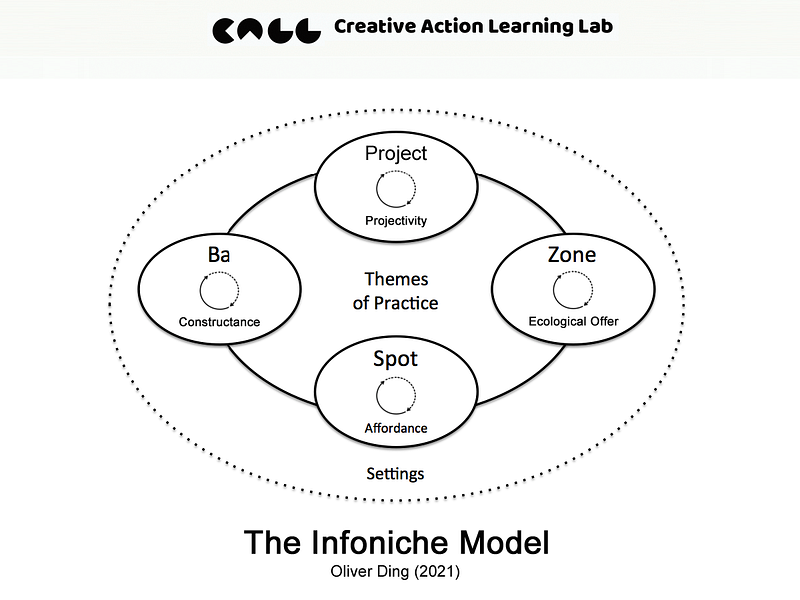
Following Gibson’s definition of niche, I coined a new term Infoniche which is defined as a set of potential action possibilities such as affordances and supportances. The part of “info” means the new version of niche aims to expand Gibson’s idea into the information age and digital environments. However, I want to claim that Infoniche doesn’t only refer to information environments or digital environments, but to both traditional environments and digital environments. Moreover, the Infoniche framework also expands Gibson’s idea from the natural environment to the social environment by working with the concept of Supportance.
Unlike Roger Barker, Gibson doesn’t develop a systematic analysis framework for his version of niche. Inspired by Barker’s work on the theory of Behavior Settings, I develop a concrete analysis framework for applying the concept of Infoniche to empirical studies.
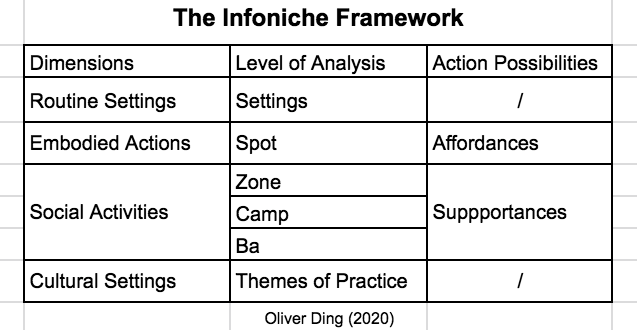
The term Spot refers to a minimal time-space scale environment which is the container of the body-level immediate situational actions. The term Zone refers to a micro-social space that contains the dyad, or two-person system of social interactions. The term Camp refers to a connected group of Zones. The term Ba refers to a large scale of social spaces such as a community, a field, a domain, etc.
After finishing the book draft of Project-oriented Activity Theory, I added a new layer called Project to expand the Infoniche framework.
The “Network — Container — Platform” Triad
The Ecological Practice approach also uses the following diagram to describe contexts.
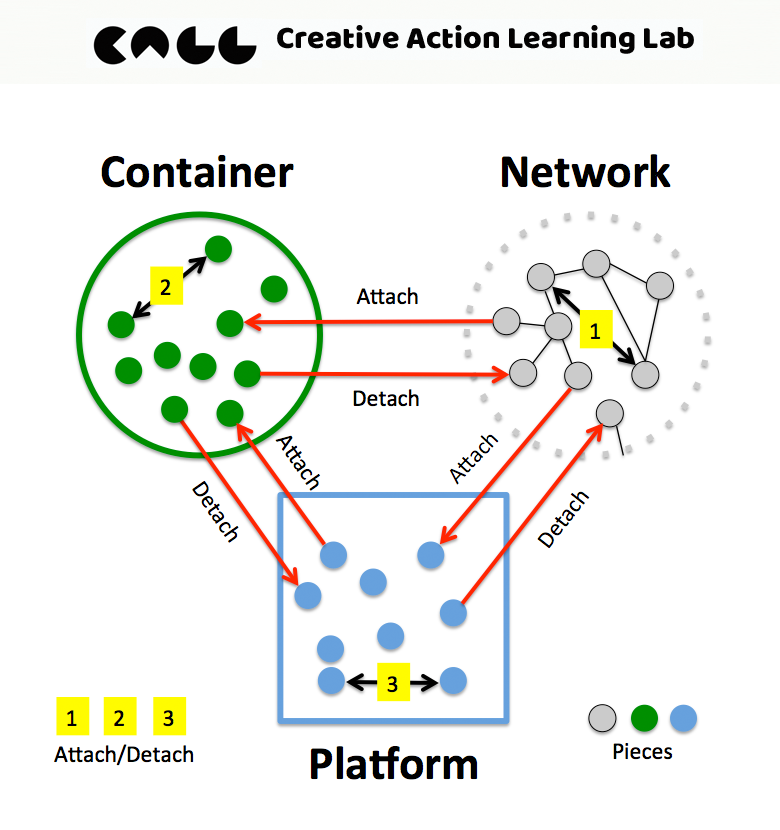
After finishing the book draft Platform for Development and editing the TOC of the book Themes of Practice, I started thinking about a new layer: Domain. In July 2021, I wrote a short document titled The Epistemology of Domain (v1.0) and used the Theory Curation method to develop a framework for understanding Domain. I adopted the following theories and curated them together:
- Activity Theory
- Events System Theory
- Network of Enterprise
- Themes of Practice
Eventually, I realized that I need to expand the triad of “Network — Container — Platform” to a tetrad of “Network — Container — Platform — Domain”.
The Landscape of Opportunity
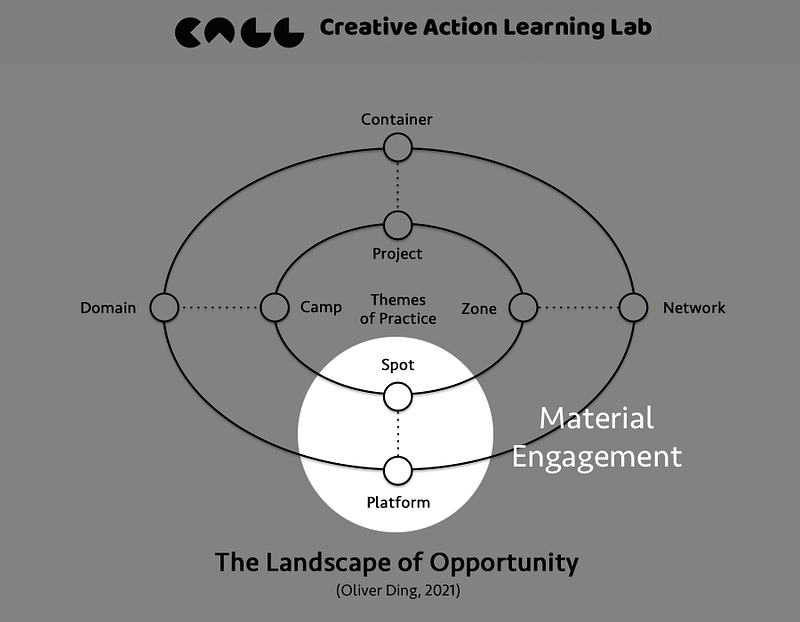
On Sept 21, 2021, I combined the Infoniche Model and the “Network — Container — Platform — Domain” tetrad and made a new diagram called Landscape of Opportunity. See the diagram below.
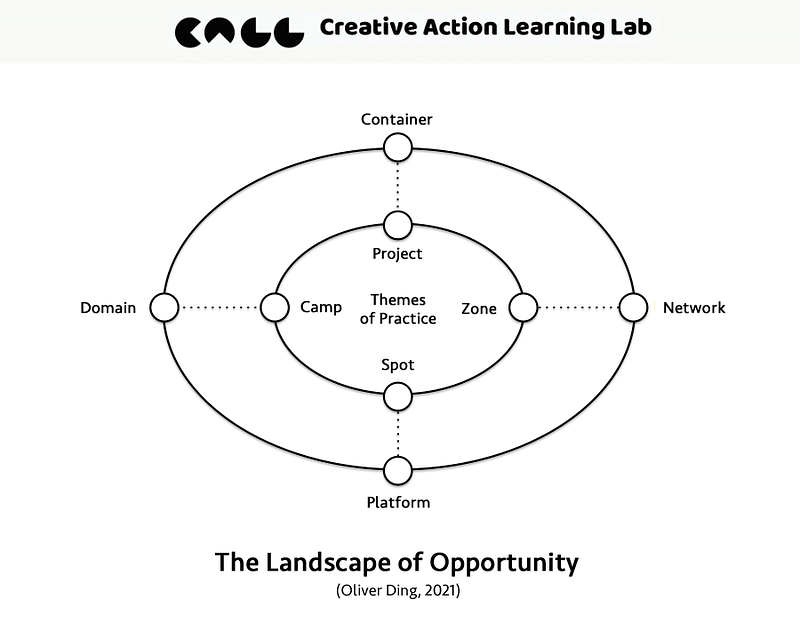
The above diagram was originally for testing the NEST Way meta-diagram. You can find more details in the original article.
I also used the above diagram to test the bottom-up approach for developing new concepts. For example, by focusing on the area of “Spot — Platform”, I got a theoretical concept called “Material Engagement”.
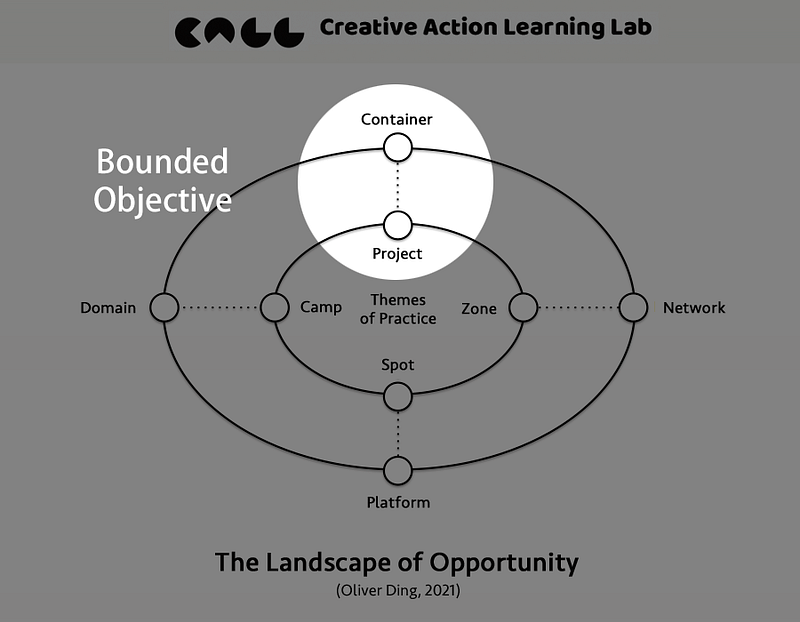
For the focus of “Project — Container”, I coined a new term “Bounded Objective” as a new theoretical concept.
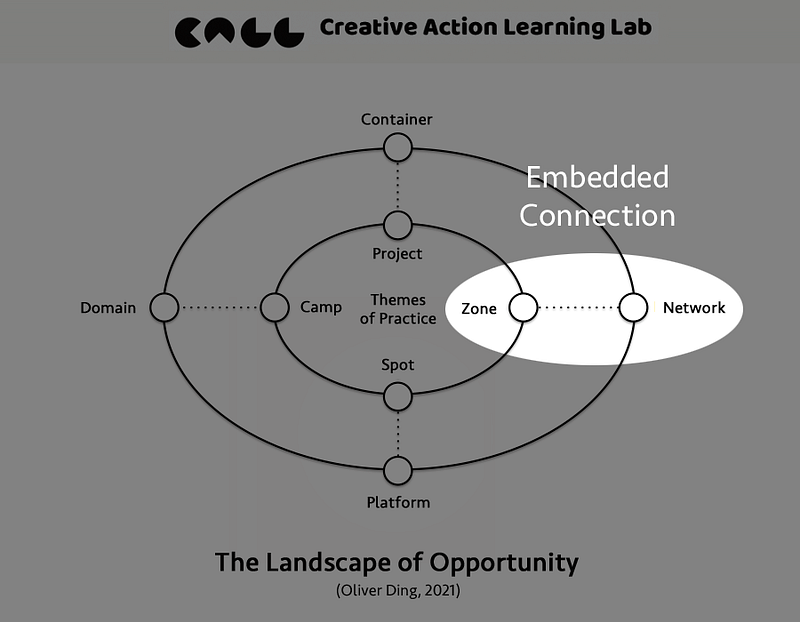
The Zone is about interpersonal interaction while the Network is about connection. So, I used “Embedded Connection” to refer to the focus of “Zone — Network”.
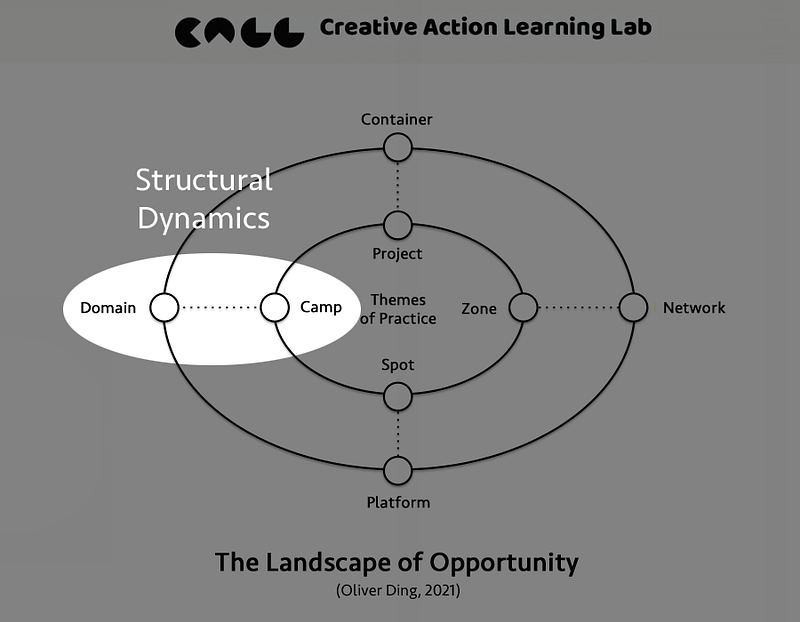
Finally, I used “Structural Dynamics” to refer to the focus of “Camp — Domain”.
A challenge of the bottom-up approach is matching the inner loop and outer loop. Each loop has four operational concepts. Without theoretical concepts, we don’t have a guide to match eight operational concepts.
If we want to match them perfectly, we need to try different configurations and discover higher-level theoretical concepts.
The Optimal Context Canvas
On March 2, 2022, I realized that I can use Life Discovery Canvas to develop a new canvas for the Landscape of Opportunity.
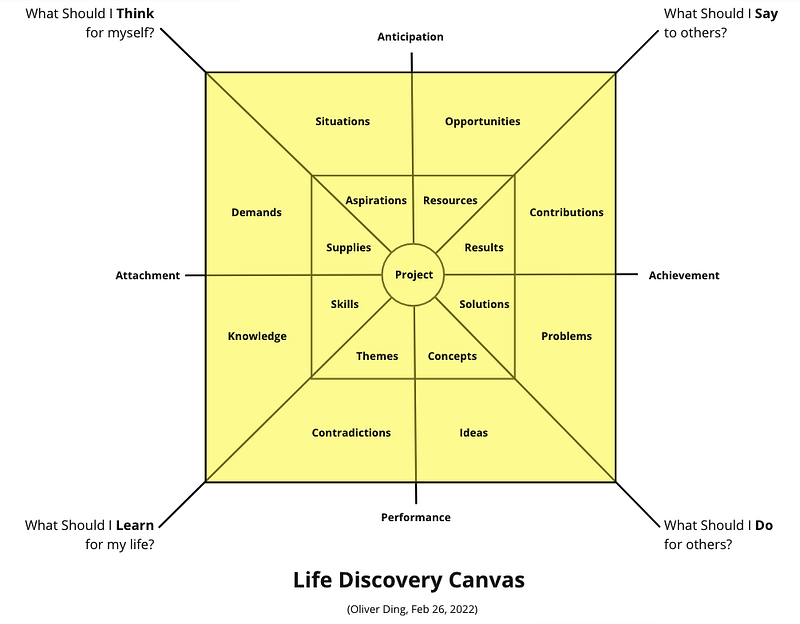
The Life Discovery Canvas was designed on Feb 26, 2022. The following articles offer details about the canvas:
- Part 1: Theoretical Background
- Part 2: Spatial Structure
- Part 3A: Concepts (THINK and LEARN)
- Part 3B: Concepts (SAY and DO)
- Part 4: Inspirations
The new canvas is called Optimal Context Canvas. Inner Space refers to Proximal Contexts while Outer Space is about Pervasive Contexts. These two types of social contexts were inspired by Self-Determination Theory (SDT).
Since the typology of social contexts is the essential core of the Optimal Context Canvas, I’d like to offer more details about it in the following section.
Proximal Contexts and Pervasive Contexts
There is a general psychological theory of human behavior and personality development: Self-Determination Theory (SDT). There are so many established motivation theories. The reason why I choose SDT for our discussion is that it is particularly concerned with how social-contextual factors support or thwart people’s thriving through the satisfaction of their basic psychological needs for competence, relatedness, and autonomy.
Richard M. Ryan and Edward L. Deci developed SDT as an empirical humanistic psychological theory. As an empirical approach, SDT is developed with empirical methods such as operational definitions, observational methods, and statistical inferences. As a humanistic approach, SDT rejects the behaviorist perspective of psychology. Unlike Behaviorism, the SDT approach accepts both “bad” and “good” environments from the dialectical stance. The concept of Developmental Platform echoes the “good” environment of SDT.
According to Ryan and Deci, there are two types of social contexts:
- Proximal social contexts
- Pervasive social contexts
Ryan and Deci point out, “…we have focused primarily on the influences of proximal social contexts — for example, families, peer groups, schools, teams, and work organizations — on the individuals’ motivation, development, and wellness. We describe these contexts as ‘proximal’ in the sense that the individuals have direct interpersonal contact with the people who make up these contexts. As SDT evidence has shown, proximal social contexts have a powerful impact on motivation, behavior, and experience, effects that are strongly mediated by basic psychological need satisfactions and frustrations.” (2017, p.561)
Pervasive social contexts refer to abstract social-cultural systems. According to Ryan and Deci, “Yet proximal social contexts are themselves embedded within broader or more encompassing social systems, both formal and informal, which influence need satisfaction and behavior in myriad ways. These pervasive contexts include the overarching cultural and religious identifications, political structures, and economic systems within which proximal social contexts are constructed and occur (Ryan & Deci, 2011).”(2017, p.562)
I have developed a typology of social contexts for the Platform-for-Development framework. The Ecosystem-for-Development framework expands the typology for understanding ecosystems.
CALL for Opportunity
The Ecosystem-for-Development framework is about affording and discovering development opportunities. For Ecosystem builders, their development depends on affording opportunities for participants in their ecosystems. For individuals, their life development depends on discovering opportunities in ecosystems.
My ideas about Opportunity are inspired by my work the Ecological Practice Approach which is based on Ecological Psychology.
Should I call the Ecological Practice Approach Opportunity Theory?
Opportunity is a general word. There is no general theory about Opportunity. We can find many theories about Opportunities from various disciplines and fields such as entrepreneurial studies. I think it is fine to claim that the Ecological Practice Approach is a theory about Opportunity because the approach takes Possible Practices seriously. The source of Possible Practices is Creative Actions in the daily life world.
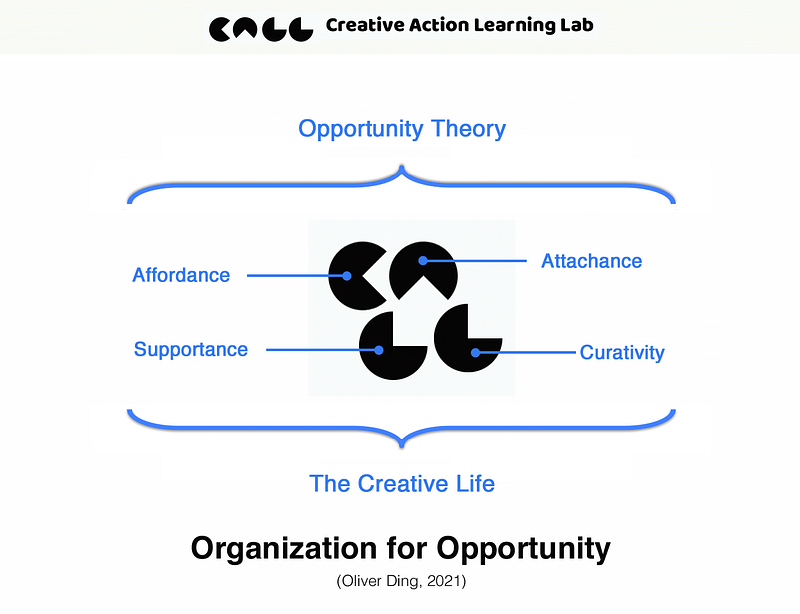
I adopt the four core concepts from the Ecological Practice approach for the canvas:
- Affordance
- Attachance
- Supportance
- Curativity
These four concepts are all about opportunities. You can find more details about these concepts in an old article: The Development of Ecological Practice Approach. I also adopted these four concepts to develop the Shaman’s Mandala diagram. See the diagram below.
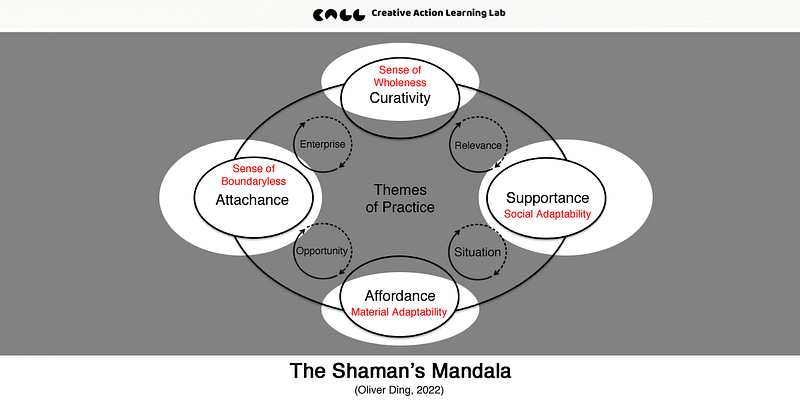
For life strategy and related issues, these four theoretical concepts have some heuristic orientations for thinking.
- Affordance: Material Adaptability
- Supportance: Social Adaptability
- Attachance: Sense of Boundaryless
- Curativity: Sense of Wholeness
These heuristic orientations refer to the benefits of learning these concepts and mastering related skills.
Material Adaptability refers to a person’s competence in the actualization of affordance and material engagement while Social Adaptability refers to a person’s competence in the actualization of supportances and human engagement. There is a gap between potential possibilities, a person has to develop his skills and capabilities to take Affordances and Supportances.
Attachance leads to a Sense of Boundaryless because actions of Attaching and Detaching reduce the boundary’s impact on a person. Curativity leads to a Sense of Wholeness because actions of turning pieces into a meaningful whole increase the skill of making sense of wholeness.
A Canvas for Affording Opportunities
There are many theories and models about ecosystems. The Ecosystem-for-Development approach focuses on the “Individuals —Opportunities — Ecosystems” relationship.
For Ecosystem builders, the Optimal Context Canvas offers a landscape view of an ecosystem with a brand-new typology of social contexts.
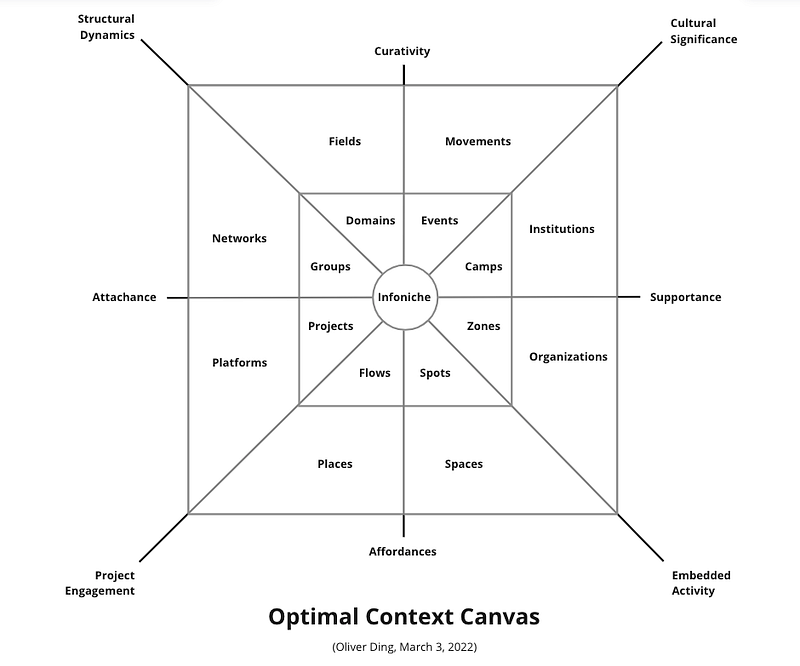
The Inner Space of the canvas refers to eight types of Proximal Contexts.
- Spots: body-scale physical environments
- Flows: screen-scale information environments
- Zones: a Zone refers to two people sharing an activity or a theme
- Camps: a Camp considers several Zones as a whole
- Projects: a Project is a social activity that has an “initiators — participants” structure
- Groups: a group is a group of people connected around common interests
- Events: an Event refers to a thing that happens, especially one of importance
- Domains: a Domain refers to a symbolic aspect of cultural environments
The Outer Space of the canvas refers to eight types of Pervasive Contexts that are abstract social-cultural systems or larger scales of proximal contexts.
- Spaces: Space is a set of Spots
- Places: a Place is a Space with information flow
- Organizations: an organization refers to a business
- Institutions: institutions refer to non-business organizations
- Platforms: a Platform refers to a marketplace or a digital platform
- Networks: a Network refers to a social network
- Movements: a Movement refers to a social movement
- Fields: a cultural field that can be considered as a Domain at a large scale
There is a rough, not accurate, one-to-one mapping between an inner block and an outer block.
A Canvas for Discovering Opportunities
From the perspective of individuals, the Optimal Context Canvas offers a landscape view of an ecosystem for discovering opportunities.
The Optimal Context Canvas can be seen as the expanded version of the Shaman’s Mandala diagram. There are eight dimensions for discovering opportunities.
The first group of dimensions is adopted from the Ecological Practice approach:
- Affordance: the “potential — actual” opportunity
- Attachance: the “attach — detach” opportunity
- Supportance: the “self — other” supportive opportunity
- Curativity: the “piece — whole” opportunity
The second group of dimensions is discovered from social aspects of ecosystems:
- Structural Dynamics: social structure
- Cultural Significance: social discourse
- Embedded Activity: situated activities.
- Project Engagement: goal-oriented projects
How does a person discover opportunities? The following Infoniche Checklist is a good starting point.
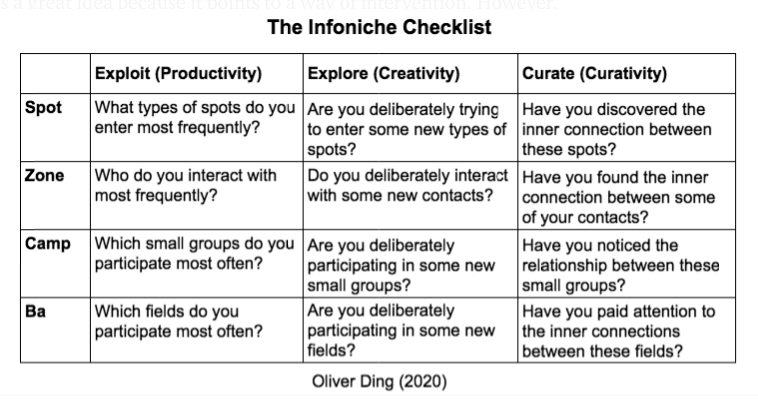
The above checklist was developed in 2020. Now we can expand its rows with the new typology of contexts from Optimal Context Canvas.
How did I design the Optimal Context Canvas?
I’d like to share all drafts of the Optimal Context Canvas with readers.
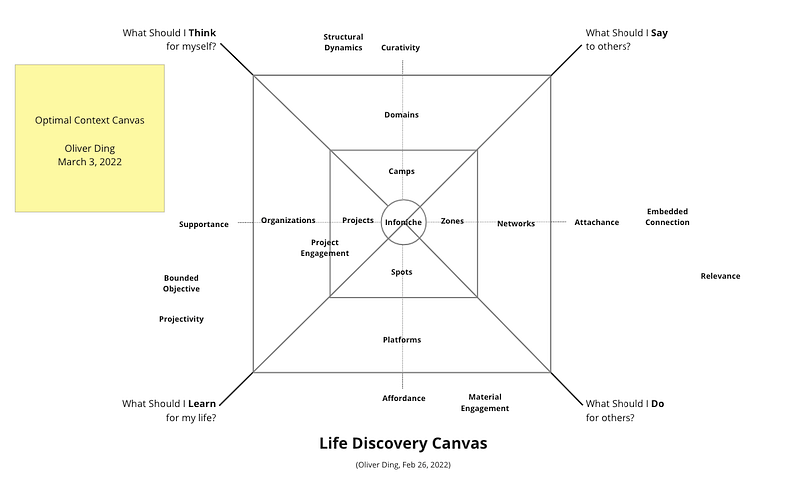
The above picture is the first draft of the canvas. I use the following pairs of themes to define four areas. I also assign four concepts to these four areas.
- Spots — Platforms | Affordance
- Domain — Camps | Curativity
- Project — Organizations |Supportance
- Zone — Networks | Attachance
I placed the concept of “Project Engagement” between Organizations and Projects and considered the concept as a mapping between inner space and outer space.
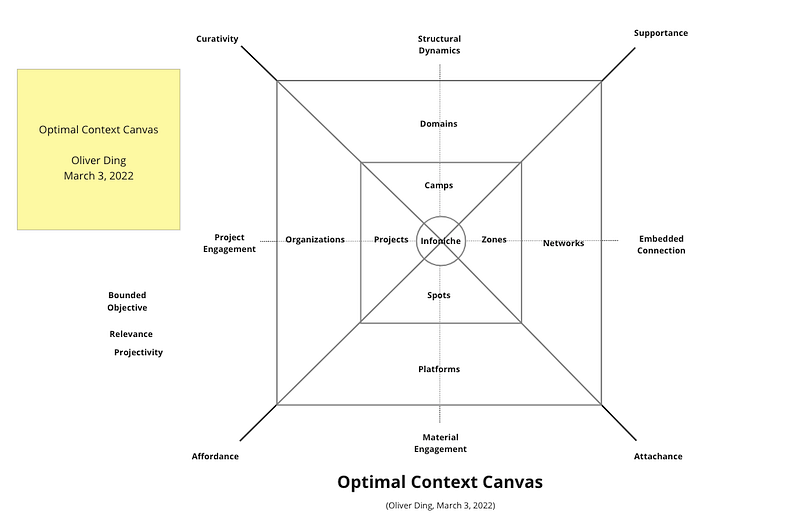
The above draft is the second draft which focuses on eight dimensions. I was trying to figure out the primary dimensions. The draft places four theoretical concepts at four corners. Later, I chose the other four concepts as primary dimensions.
The above picture is the third draft. After defining primary dimensions and secondary dimensions, I moved to develop a new typology of context. The strategy is very simple. I just divided the original four pairs of themes into eight pairs of themes. You can also use “expanded” to describe this step.
The original four pairs of themes are
- Spots — Platforms | Affordance
- Domain — Camps | Curativity
- Project — Organizations | Supportance
- Zone — Networks | Attachance
The tetrad of “Network — Container — Platform — Domain” is adopted from the Ecological Practice approach while the tetrad of “Spots — Zone — Camps — Projects” is adopted from the Infoniche model.
For the Optimal Context Canvas, I reorganized these ideas and decided to use the following mappings:
- Spots — Spaces (this is for discussing the physical aspect of environments)
- Flows — Places (this is for discussing the information flow of environments)
- Zones — Organizations (this is for discussing social organizational environments)
- Projects — Platforms (this is for discussing the “platform(project)” perspective)
- Camps — Institutions (this is for discussing non-business social contexts)
- Groups — Networks (this is for discussing human social networks)
- Domains — Fields (this is inspired by social-cultural contexts)
- Events — Movements (this is for discussing the historical developmental process of society)
The pairs of themes of “Domains — Fields” are inspired by Mihaly Csikszentmihalyi’s Social Systems Model of creativity.
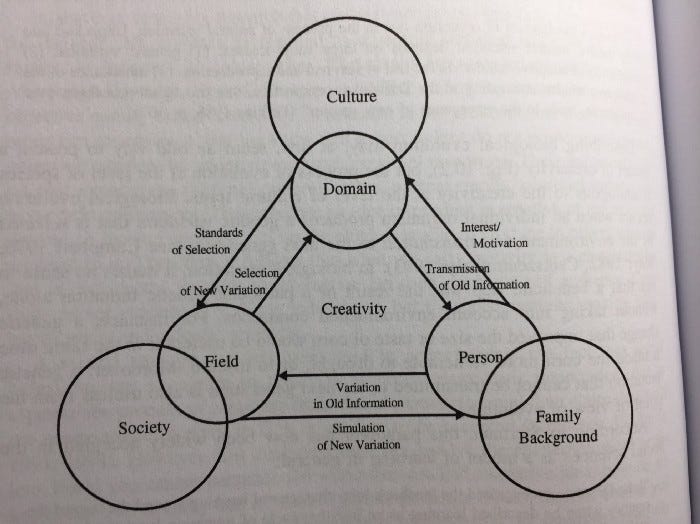
The above diagram below shows the model contains three components: person, domain, and field. Csikszentmihalyi said, “Creativity occurs at the interface of three subsystems: An Individual who absorbs information from the culture and changes it in a way that will be selected by the relevant Field of gatekeepers for inclusion into the Domain, from whence the novelty will be accessible to the next generation.” (2014, p.166) You can find more details in Platform Creativity: Domain, Field, and Person.
The pairs of themes of “Projects — Platforms” are adopted from my book Platform for Development: The Ecology of Adult Development in the 21st Century. The related dimension of “Project Engagement” is inspired by my book Project-oriented Activity Theory.
The pairs of themes of “Spots — Spaces” are inspired by Malcolm McCullough’s Digital Ground (2004) and Ambient Commons (2013).
The pairs of themes of “Groups — Networks” are inspired by Alex Pentland’s Social Physics (2015).
The term “Events” is inspired by Event System Theory.
The term “Movements” is inspired by Andy Blunden’s Hegel for Social Movements (2020).
Notes:
Domain and Field
Some scholars use the “Domain — Field” pair to refer to the “Theory-Practice” connection. The below is quoted from a paper about Activity Theory.
As in the second half of the 20th century psychology became a mass profession in developed countries, which required common standards for professional practice and education, we can no longer rely on implicit understanding of ontological questions, because the lack of integrity of theoretical base hampers both theoretical constructions and practical implementations:
“The domain is what a science is about. The field is what it does about it. [...]. The correspondence between domain and field is called validity; bereft of such correspondence, the science becomes invalid” (Engelsted 2002, p. 46).
Both the domain and the field change over time and even within the limits of a given science are not homogeneous, as mostly contemporary sciences have a multiparadigmal structure.
Thus, in regard to Physics slow dynamics processes (much slower than the speed of light) are accurately described by Newton’s mechanics, which is still the major theoretical basis for engineering tasks. Fast processes call for relativity theory. But while in Physics connections of theoretical models and fields of their implementation seem to be more or less consistent and reasonable, in psychology theoretical ap- proaches, developed for certain domains, are pretty often used for inappropriate tasks in inappropriate fields. As a matter of fact, all great theoretical schools in psychology, each built on data from investigations of a certain domain, subsequently pretended to expend their fields far beyond, thus losing their validity, as Vygotsky has shown in his Historical Meaning of the Crisis in Psychology, written in 1927 (Vygotsky 1982).
Why the issues of the domain and field of psychology matter and are they of any importance today? We believe they are, and the lack of proper answers to ontological questions might well be the cause of many methodological diseases afflicting contem- porary psychological science, which appears to many distinguished methodologists now as “fragmented, complacent, self-congratulatory and intellectually arid” (Robinson 2002, p. 7).
Source:
Activity Theories and the Ontology of Psychology: Learning from Danish and Russian Experiences (Irina Mironenko & Jens Mammen, 2015)
You are most welcome to connect via the following social platforms:
Linkedin: https://www.linkedin.com/in/oliverding Twitter: https://twitter.com/oliverding Polywork: https://www.polywork.com/oliverding Boardle: https://www.boardle.io/users/oliver-ding


