
Productivity and Mental Health
Here’s a Core Leadership Capability to Empower Writers.
How three essential points can get you started, increase your confidence, and sustain your motivation for any initiative
Purpose of the Story
This story reflects hard-learned and practical lessons. The opening statement does not intend to convey a message of regret or boasting. Its purpose is to highlight the validity and relevance of content reflecting practical experience rather than pure theory.
I want to share a useful learning construct from my leadership experience, which may be a useful tool for writers. My approach may not gel initially or may even conflict with common beliefs on motivation because even I wouldn’t believe what I said now if I read it 30 years ago.
I encapsulated a broad topic to make it digestible, but it is not an oversimplification, and the construct is solid. No rush to react promptly as your feedback after trying it is what I want to obtain.
My point is that motivation may not be what you think; therefore, it may not serve your needs. Consequently, I take the liberty of explaining it from hard-learned lessons.
This story's premise is you may need to revisit the motivation factor and correct your perceptions about commonly promoted motivation factors such as getting ready and gaining external inspiration. You may unlearn and relearn things as I did.
Motivation is misrepresented. Misunderstandings, hence, cause disappointments to many beginners in any profession. I observed the situation of many writers; therefore, I write the story within the writing context.
The common perception is that people need a lot of energy and enthusiasm to get started. You must be ready to get started and need a lot of inspiration from multiple sources. In my opinion, no, you don’t have to.
These statements sound great, but these are killer myths against our nature. I had to unlearn these myths inherited from several motivational courses and conferences that I attended in the eighties. Perfection towards initiatives was destroying me because I believed I must have been ready before starting.
There may be exceptions for some outliers and some situations. However, my focus is on the majority. Motivation does not happen as some motivational speakers present it because our hard-wired primitive brain does not motivate us to default to new initiatives. I observed that motivation gained from these contrived sources tended to fade away and died quickly.
Every worthwhile creative initiative comes with uncertainty embedded with fear and anxiety. The degree of these emotions can be different for various people, but they will always be there due to our nature. We will never be ready. It is not always possible to have exuberant energy and enthusiasm for mundane tasks. Many dull tasks are ingredients of successful outcomes.
In this post, I want to present a realistic, practical, and relevant approach to motivation leading toward productivity and sustainable success.
I simplified the approach using three keywords: act, measure, and finish.

Act with a deliberate intention
The biggest roadblocks to motivation are anxiety and fear. We cannot ever be ready for any worthwhile initiative without overcoming and mastering these two emotions.
There is no natural solution to overcome and master these two primary emotions other than action. Action is a known and proven cure for anxiety and fear. This is well documented in the body of knowledge and touted by leaders throughout history.
Have you ever seen a leader or entrepreneur who is not action-oriented? I haven’t. Why is action so essential and necessary?
Because as soon as we take action on a plan, the primitive brain is challenged by our thinking mind. The prohibitory brain chemicals may start losing power, and the other developed parts of the brain can replace them with stimulating chemicals.
This critical transition is only possible by taking action, even if it is the smallest in size, such as a small step for a mundane task. This transition is meant to take us from our comfort zone to the growth zone.
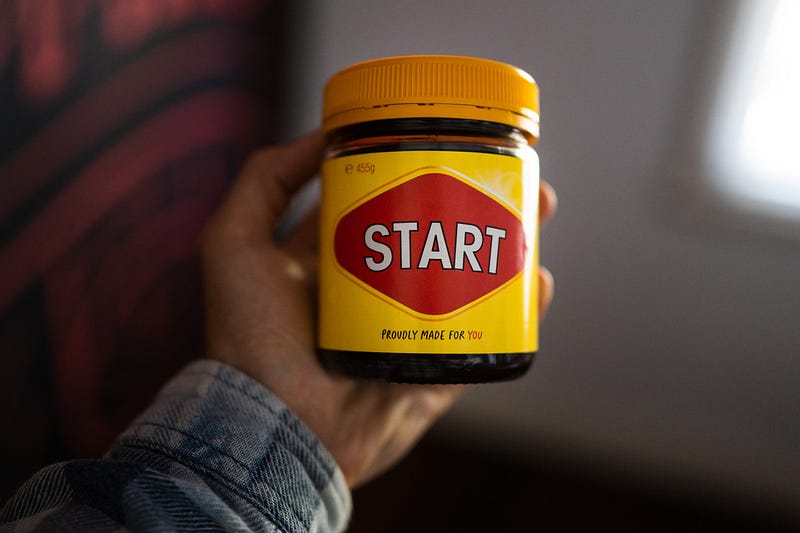
You can consider the simple analogy of pushing the start button on a device. Imagine an electronic machine. You can think about it, throw it, or bash it with swear words. Whatever you do to an electronic apparatus, the device will not start working unless you press the start button.
The transition requires the simple act of pushing the start button. Yes, it is stupidly simple, but many of us suffer from awareness of this simple approach, which manifests itself as procrastination, fatigue, and lethargy.
Any new initiative is perceived as a change in our lives. The primitive brain does not like change, especially when the initiative poses uncertainty. And we know that nothing is certain in this life.
I learned that the best way to deal with uncertainty is to start with an intentional and deliberate action despite the fear and anxiety we feel. Just pressing the start button does the magic we look for in the wrong places.
Measure progress
Data, information, and knowledge lead to experience.
Measuring the progress with feedback from the environment and actors of the initiative is essential to sustain motivation.
The feedback can be in the form of data, information, and knowledge. The feedback then forms experiences for us.
The next critical point is to finalize the action based on measured and assessed progress.
Finalize action with one of the three points
We understand the importance of starting and measuring. The next critical point is finalizing the action with an intentional decision.
We can undertake three practical actions based on the feedback we received and accepted.
1. Do it yourself.
The first and most important one is to complete the action with our capability.
We may change the approach along the way. We may deconstruct and turn them into multiple steps based on the feedback.
This action can be satisfying and give us more pleasure than the next two options.
2. Delegate it.
Based on taken measures and feedback, if we are convinced and unable to complete the initiative with our capability, we may delegate it.
Delegation requires an assessment from the pros and cons perspectives.
For example, we need to determine whether it is worthwhile to delegate it.
3. Cancel it.
If we cannot complete the initiative ourselves and if it is not feasible to complete it via delegation, the third option is to cancel it.
There is no shame in ending an initiative. If the initiative is not serving its purpose, we can end it. We shouldn’t see it as a waste of time and effort. Instead, we should see it as a lesson learned. We gained new experiences from the lesson. Experience is an investment for our future.
This fast-failed experience allows us to unlearn and relearn quickly, which are potent concepts for sustaining motivation.
Conclusions
With this new experience, we should ask: What is next? And repeat the process to keep the momentum going. The process is: act, measure, and finish. The procedures are to do it, delegate it, or cancel it.
The act, measure, and finish approach can be applied to any initiative. This simple leadership framework can help writers who want to sustain their motivation and produce desired outcomes.
Being aware of prohibitory emotions and reducing their power with action is essential. Let’s keep in mind that our primitive brain dislikes uncertainty and produces barring feelings. We will never be ready if we leave it to the primitive part of the brain.
Unless we take intentional action, these disallowing emotions will prevent us from taking the initiative. They will manifest as procrastination, fatigue, and lethargy. We wrongly start looking for solutions in the wrong places and waste our valuable time and energy without gaining the desired outcomes.
Instead of wasting our time and energy on motivation-building investments, it can be more productive to activate our dormant energy with a metaphorical start button. It can be the first small step that we take as an action to ignite motivation. As simple as the implementation of the phrase “just do it.”
In this article, I assume you are healthy and meet your basic survival requirements such as shelter, nutrition, and sleep. There are, of course, deeper issues such as self-sabotaging and cognitive dissonance. I want to touch on these types of complex problems in another post.
In the meantime, start with one task, measure it, do it, delegate it, or cancel it. Keep repeating as many tasks aligned with your goals and values.
Thank you for reading my perspectives. I wish you a healthy and happy life.
I also write about health and particularly share my independent reviews of beneficial supplements and molecules to improve our metabolic and cognitive health, including:
Boron, Urolithin, taurine, citrulline malate, biotin, lithium orotate, alpha-lipoic acid, n-acetyl-cysteine, acetyl-l-carnitine, CoQ10, NADH, TMG, creatine, choline, digestive enzymes, magnesium, hydrolyzed collagen, nootropics, pure nicotine, activated charcoal, Vitamin B12, Vitamin B1, Vitamin D, Vitamin K2, Omega-3 Fatty Acids, and other nutrients that might help to improve metabolism and mental health.
Disclaimer: Please note that this post does not include health or professional advice. I shared my reviews, observations, experience, and perspectives only for information. If you have disease symptoms, please consult your healthcare professionals. Health is the responsibility of individuals.
About the Author
Thank you for subscribing to my content. I share my health and well-being stories in my publication, Euphoria. If you are new to Medium, you may join by following this link.
You can join my publications as a writer requesting access via this weblink.
I write about health as it matters. I believe health is all about homeostasis. I share important life lessons from people in my professional and social circles compiled in the attached collection.
Insightful Life Lessons from Personal Stories
You might join my six publications on Medium as a writer by sending a request via this link. More than 16,000 writers contribute to my publications with inspiring content for readers of this platform. You might find more information about my professional background. Join Medium with my referral link


