
Notes On Toni Morrison’s “The Bluest Eye”
Did You Pick Up Her Messages?

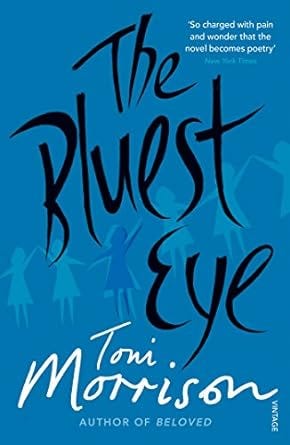
Three things really stayed with me since I read Toni Morrison’s first novel The Bluest Eye (1970). Apart from her talent as a writer, I was struck by the subtle messages she gave us that in many ways still manifest themselves in society today.
1. Beauty standards
Morrison’s messages about beauty standards — how these can be internalised and impact a person’s life, along with other things society places value on, become very clear once the characters are looked at deeply. I concluded that when we don’t see beauty or value in ourselves, this can quickly turn into self-hate.
2. External “programming”
Social programming is clear in each of the characters in Morrison’s novel, and that stayed with me; it’s almost a pandemic in society today.
3. How men learn to hate women
What we see in spaces like the “Manosphere” on YouTube, along with messages black women have received from men like Kevin Samuels and Andrew Tate, feeds into (some) men’s distaste for women. The sad part is, it’s not just the women who suffer — they may not realise it in their moments of madness and hate for women, but men also suffer, just like the male character in Morrison’s novel.
These problems are shown not just in the main character and focus of the novel — Pecola Breedlove — but also through the actions, thought processes, and experiences of her mother, Pauline Breedlove, and her father, Cholly Breedlove. If we look closely, we can observe how these character’s problems and experiences are still prominent today, even in the twenty-first century.

Pecola Breedlove : Programming from Childhood
In the viewpoint of Pecola Breedlove’s childish mind, beauty is found in having “the bluest eyes.” Literally, she wished to have these rather than her own, so she could walk though the world with the experiences of a little girl who has blue eyes, rather than her brown eyes, which she has as an African-American girl.
While the book was published in 1970, the events take place in 1940–1941, eighty-three years ago at the time of me writing this — which is important when we look closely at how Pecola’s experiences manifest today.
Pecola’s view on what is beautiful or better we see very early on, and how this viewpoint could have been created for her. In the scene where Pecola selects candy for herself at the local store, she decides to spend her three pennies on “Mary Jane’s” candy; the reasons she chooses those is not for the taste of the sweet stuff either. Morrison writes about the picture on the candy wrapper:
“Smiling white face. Blonde hair in gentle disarray, blue eyes looking out at her out of a world of clean comfort.”
From a very young age, Pecola is aware of what society deems as “beautiful” and desirable to have just via the packaging of candy for kids. She does not see herself on candy, or anyone who looks like her. What is also interesting about this is the wording Morrison used to illustrate the life experiences that a little girl with blue eyes might have — a gentle life of cleanliness and comfort. Morrison goes on to write:
“To eat the candy is somehow to eat the eyes, eat Mary Jane. Love Mary Jane. Be Mary Jane. Three pennies had bought her nine lovely orgasms with Mary Jane. Lovely Mary Jane, for whom a candy is named.”
“Smiling white face. Blonde hair in gentle disarray, blue eyes looking out at her out of a world of clean comfort.”
How Pecola’s experience has manifested in society
The “love” the world has for Mary Jane, and for little girls who look like her, is something Pecola is conscious of. If we fast forward less than ten years from the period of Pecola’s story, we can verify the authenticity of Pecola’s point of view in a study by sociologists Kenneth and Mammie Clark, published in 1947, called Racial Identification and Preference in Negro Children.
Young children were handed dolls, both black and white, then asked their opinion on them. For example, which doll was good or bad and which one would they rather play with, etc. The results showed that the majority of black children preferred the white dolls to the black ones. Their comments on the black doll generally were that it was “the bad one.”
The Clarks who carried out the study concluded that the children (who were black), had absorbed a sense of inferiority compared to white children. Or to put it more blatantly, black skin was inferior to white skin to a group of children who had not even hit adolescence yet. At the time, this study was cited to help end educational segregation in schools, in the USA.
Clearly, Pecola fell into this mix of young black children with an inferiority complex, developed from what society in all its manifestations— even candy — had fed her.
What this shows us from literature and research is
Children are very susceptible to picking up on what is deemed “valuable” by society. And how children interact with the world and view themselves is key to their well being. So parents need to instill not only the love for themselves and their black skin, but also tolerance for others into the young minds of black, brown, and minority children.
Considering how femininity is viewed for black women, which I discuss in my essay How We Take Back Control of Black Women’s Femininity, young black girls would benefit from additional teaching to appreciate the blackness they hold, and the power and beauty that comes with it. Rather than seeing it as their downfall, as Pecola did in The Bluest Eye (1970), young black girls need to be taught they are beautiful and valued.
On another part of the spectrum, looking at the challenges for young minority girls who are Korean, the teaching should include that they are not less valuable than men, as I discuss in my essay Where Culture Meets Feminism: How Patriarchy Oppresses Korean Women, as well as being shown they are loved for who they are.
Since all the children in the novel were exposed to the same social programming, Pecola’s interaction with other children did nothing but reinforce her inferiority complex, and increase her desire for blue eyes and all that she imagined would come with them.
One powerful example of internalised racism in children in Morrison’s novel
In one scene where we follow a group of young black boys teasing one of the girls, the teasing is rooted in the skin tone of the young girl, and the main reason for their attack is the girl’s family habits. Morrison writes:
“That they themselves were black, or that their father had similar relaxed habits was irrelevant. It was their contempt for their own blackness that gave the first insult its teeth…”
The message we can take from Morrison’s writing on Pecola
There’s a clear call for action for me as a reader of Morrison’s work. This call is for myself, caregivers of young black girls, and other black, brown, and minority females who interact with younger minority girls to help them to see who they are and their beauty.
Media, society, and influencers we indulge in need to be selected with care — in order to not disrupt the young developing mind of a black, brown, or minority girl to place them on a track that reduces their self-love and self-value. This is because in society, the media, etc., beauty is not often seen in anything that has any kind of melanin in it, when it comes to women. This I have discussed in The Beauty Standard Has Shifted To Black Women.
This is not to say other women are not beautiful; they certainly are! However, as a black woman in the world (even if I am on the lighter side with my skin tone), I am not blind, I am not deaf, and I do not ignore what goes on and happens to women who have a darker hue. I have noticed the mistreatment and downgrading of black women, generally, but especially those who are darker skinned. This is not acceptable — especially when it comes from within the community of black people.
Reading Morrison’s work, this is the lesson I took from her writing, as Pecola is clearly a darker skinned girl.

Pauline Breedlove: How Women Learn a Lack of Self-Love
At some point Pecola herself would go on to become a woman, we don’t fully see this in the novel that Morrison penned, because the ending is wrapped up in a summery, but we know this is likely to happen.
Based on her experiences, point of view, and mindset regarding how blue eyes and all that comes with them would be a better experience for her — rather than being who she is — Pecola’s life could pan out just like her mother’s, Pauline Breedlove. Her mother is an excellent example of how women can learn lack of self-love and value.
In the novel, Pauline has a very distorted idea about what is and is not valuable. Clearly, we are all different and everyone does hold different values. That said, Pauline Breedlove found value in:
· Men and someone to love her — she was not a whole person alone
· The white children of the family she worked for
We can see from these two areas that everything Pauline Breedlove desired and saw as valuable, was outside of herself. She didn’t show a shred of love for herself. So would it be fair to say this is a woman who lacks self-love, and is unsure of how to find herself, and isn’t confident in who she is? I’d say so. Morrison gives us a wonderful insight into how Pauline found herself here, in her experiences way before she became Mrs. Breedlove.
From the age of fifteen, Pauline was a girl who liked to, “keep house” and keep things in order. In today’s age we might see her as a very OCD person. Morrison shows us how Pauline liked to behave, which was to line up the tins of food, and have everything in a specific order. On the other hand, part of this behaviour Pauline had as a young girl could have been due to lack of control over her own life and destiny, and this is where she found control— organising tinned food in a specific order.
The other insight we gain into Pauline
As a young woman she began to see value in the opposite sex, as if they (men) were something that would validate her as a human being, rather than having her own validation. Morrison writes:
“Fantasies about men and love, and touching were drawing her mind and hands away from her work.”
We then go on to follow Pauline’s story as she starts to vividly imagine a man whom she describes as,
“a simple Presence, an all-embracing tenderness with strength and promise of rest.”
On the face of it, it seems fine to dream of a man who allows her to “rest,” however, when this man appeared in her life (Cholly Breedlove), Pauline was so lost in her lack of self-love and self-worth, she didn’t recognise that she was dealing with an emotionally and psychologically broken man.
What research shows us:
Psychology Today, in their article The Truth About Women and Self-esteem, they claim that:
“A 1991 study by the American Association of University women announced that girls “lose their self-esteem on the way to adolescence.”
Also
“In 2002, the Girl Scout Council launched a program to ‘address the critical nationwide problem of low self-esteem among adolescent and pre-adolescent girls.’ Popular books claimed that before adolescence, girls have a range of interests and strong opinions about the world. As they enter dating age, however, girls lose their ‘voice’ as they confront demands to become subservient and silent in order to be attractive to males. They stifle their opinions, personalities and interests and instead pretend to be what they think boys want them to be.”
What’s interesting is that this research was challenged later on
“The study by the American Association of University Women was refuted by subsequent studies using large samples and better measures of self-esteem. One study of over 100,000 individuals found that girls’ self-esteem does not fall precipitously at adolescence. And although girls are more anxious about their appearance than boys, there are no differences between girls’ and boys’ self-esteem in academic matters, and girls have higher self-esteem than boys in moral-ethical matters, or how they feel about their behavior.”
Also
“Claims that girls lose their voice in adolescence were based on case studies of girls seeking psychotherapy for mental health problems, and interviews with girls but not with boys.”
The two different studies offer two different findings; it’s not surprising based on who the sample of participants in the study were.
However, why the former findings are relevant in the context of Pauline Breedlove’s experiences as a young woman is because she was a woman who needed mental health support it could be well argued, based on how the author portrayed the character.
Given this, we can assume the 1991 study to be relevant to Pauline. She did have interests while younger, as Morrison noted that she was,
“Still keeping house but not as enthusiastically” When she arrived at the age of fifteen.
Pauline did lose interest in what she liked, and this turned to seeking validation outside of herself — enter Cholly Breedlove.

Her life is then set on a track of abuse, lack of self-worth, and seeing value in all that does not look like her. She preferred to keep a “good house” for the white family she worked for, while she allowed her own to fall apart.
She treated the tears of the little white girl she cared for as more important, valid, and “right” than the tears of her own black daughter. She saw no value in Pecola, or any woman who looked like her, which included herself.
We see this clearly in the scene when Pecola comes to her mother’s place of work (the white family’s home she worked in), and a simple accident happened: a pie fell on the floor. The little girl of the family Pauline cared for was startled by this and by the presence of black children.
The little girl’s tears resulted in Pecola being slapped — very hard, and the little white girl was coddled, reassured, and doted on for her tears. Pauline’s treatment of her daughter shows us her seeing no worth in any female that looked like her, even if she came from her own womb.
Modern corollaries to Pauline
What we can learn from this character in the modern day is that seeking validation as a woman can be detrimental if we seek it in men, other women who do not look like us, or their offspring, whom we hold above our own children. A woman like this ends up bitter just like Pauline, neglectful just like Pauline, and she carries on a long line of abuse towards others just like Pauline.
To draw from modern examples, we saw this in the movie Precious (2009) in the actress Mo’Nique’s ability to portray a character equivalent to Pauline Breedlove.
Considering how Pauline Breedlove’s mindset impacted her daughter and herself, along with where a woman like this would find the ammunition needed to morph into the woman Pauline became, spaces like the Manosphere, men like the late Kevin Samuels and Andrew Tate et al., should have no credibility or power to affect a woman’s self-worth.
Essentially, it was a man who would parallel these modern spaces: her husband, Cholly, whom she indirectly learned some of her behaviours from. The messages that men like Cholly Breedlove, people in the Manosphere, Kevin Samuels, Andrew Tate et al, give or gave to women must be ignored or derided as the false and destructive programming it is.

Cholly Breedlove: How Men Learn to Hate Women
Cholly Breedlove, the male character in The Bluest Eye (1970), is like an old- school member of the Manosphere, but living in the 1940s.
His learning of hatred for women possibly started when he was just a few days old, when he was abandoned by his mother. While I’m in no way saying that a man who experience this will turn into someone like Cholly Breedlove, it was at this point the author showed us that he started to see women as a problem for him.
This manifested later in his life when he had his first experience of love. He was caught with his pants down having sex with a girl by a group of white men who humiliated the couple. Cholly internalised this, and rather than having a dislike for the men, and holding malice towards them, he saw the black female as “the problem” who’d caused his humiliation. If it had not been for her, he would not have experienced what he had, according to Morrison’s storytelling, that is.
What Cholly forgot
Is that the girl he was with also experienced humiliation. He could not allow himself to see that, as black people, they were both experiencing racism, humiliation, and sub-human treatment at the hands of white men. To Cholly, the girl was the problem, even though she didn’t perpetrate the shame.
In the scene where the white men forced Cholly to continue having sex with the girl he was with, while they watched and humiliated them both, Morrison writes:
“Cholly, moving harder and faster, looked at Darleene. He hated her. He almost wished he could do it, hard, long, and painfully, he hated her that much.”
We then go on to learn that Cholly held onto his hate for this woman, that turned into hate for all women, even though he was upset with something that men did to him (and her). He took it out on the woman instead.
This kind of projection happens all the time in the modern day, as when people in the Manosphere complain about women’s standards for dating (I’m one of the women they complain about all the time; I’m cool with it, and so should you be if you’re one of these women, too).
People in the Manosphere tell women things like:
- you should expect less
- you should tolerate having less and being treated as less
- be our “ride or die” woman and clean up our mess and problems; that’s your role as a woman
- you can advocate for us, “build us up,” and even provide for us, but we won’t return that energy and protect you
- I want you to submit to me, be a traditional woman, but guess what? I don’t have a traditional man’s money, so I also need a fifty-fifty relationship (make that one make sense)
- your hard work, degree, and education mean nothing if you don’t have a man, and by the way you should take a man that has achieved less, is worth less, and can’t treat you right — but take him anyway as that’s your role as a black woman
- you’re masculine for all your achievements, and masculine because you won’t take our rubbish
Men in the Manosphere give constant and consistent messages of how they don’t see value in women — especially black women. They also hate that women these days have rights, money, and don’t need to be tied to a man who does not know how to treat them. They blame feminism for women’s refusal to be mistreated and settle for bums. They want to go back to a time when women didn’t have rights, jobs, homes, money, and independence (and all women were “traditional” women)— to control women and get away with abuse, infidelity, or however else they might want to mistreat women.
What these men forget is that women have standards now and refuse to listen to their messages, or do as they say, due to what men have done to women in the past. Women’s personal experiences of mistreatment have caused a shift in thinking, feeling, and what they actually will and will not accept.
The Manosphere and their misogynistic messages are the problem for women — not all men are like this, but we all know the ones who are. That said, the experiences women have had led them to set standards that won’t be lowered. Men need to remember that and adjust their behaviours.
How this relates to how men learn to hate women
Men like Cholly are fearful of other men; they don’t want confrontation with them, so they aggress on women — that’s where they get their kicks.
Males in the Manosphere don’t want to challenge other men about how they show up in the world, especially concerning their treatment of women — so they too blame the women and the “standards” they won’t lower, which is the girl’s code for, I’m not taking this shit anymore!
The close parallels between Cholly’s hatred for women and the modern day Manosphere are shocking. What’s mind blowing is that Morrison's novel was written over fifty years ago.
How Cholly develops as a “man”
Cholly doesn’t really go on to be a desirable man, based on the author’s storytelling. But what he does do is go on to try to find his father, and he’s deeply disappointed when he learns that his father is no better of a man than he is.
Cholly’s father has multiple children all over the place, and doesn’t give the mothers any kind of financial support; he’s a very unsavoury character. So much so, that Cholly soiled himself and fell asleep under a bridge somewhere after he finally met him.
But does he look to his father — a male who disowned him — for any part of his lack of development as a man?
Nope.
He lays it all at the feet of the women in his life: his mother, his grandmother who stayed and looked after him, and of course his wife Pauline, and their daughter Pecola.
Cholly’s downfall
Cholly takes it upon himself to rape his daughter (Pecola) towards the end of the book; it appears from the storytelling that he justified this as she appeared as innocent as his wife once did, on the riverbank where he met her.
Morrison’s message… possibly?
The message Morrison was possibly trying to give her readers is that, when it comes to men like Cholly who have a dislike for women, this disdain can disrupt their ability to remember that they are a father (Pecola’s father in this context), and their daughter is not a female to have sexual relations with. Because of their dislike for women, how a particular woman is related to these men is disregarded.
Overall, the novel “The Bluest Eye (1970)” shows us via three different narratives that:
- When a black person has a distorted view on what beauty is, and that it is not or can’t be found in themselves, it turns into self-hate.
- This can be hate for the self (like Pecola), and extend to hate for anyone who looks like the self (like Pauline).
- Morrison also showed us clearly that men who hate women often do so because they hold the women at fault for the troubles they endure, and are not willing to do the self-reflection needed to take any responsibility for those troubles, nor to hold other men accountable, since that may place them in a disadvantaged position. To me, this appears that some men are really just scared of other men.
Have you read the book, what did you take from it?
What do you think about these characters and all I’ve said?
Thanks for your readership, I hope my writing gave you something to think about. If I’ve caught you in a good mood or you’re feeling kind, you can buy me a cup of herbal tea here: https://www.buymeacoffee.com/MeAndMyMuse
For further reading
- Notes on Alice Walkers ‘The Color Purple’ Forty Years On
- How We Take Back Control of Black Women’s Femininity
- Is Feminism to Blame For Korean Women Taking Down The Patriarchy?
- Where Culture Meets Feminism: How Patriarchy Oppresses Korean Women
- How Women of The Caribbean are Devalued
For more of the good stuff, follow Fourth Wave. Have you got a story, essay, or poem that focuses on women or other disempowered groups? Submit to the Wave!


