
Blogging tips
New Ways to Get Reads and Level Up Your Audience
I bet there are some here that you haven’t heard of!

Doing well in blogging depends on finding an audience. And this is also true for books, journalism, social media, or just about anything else on the internet.
It sucks if you write great articles on Medium and nobody reads them. Fortunately, there are several easy and quick things you can do to get more eyes on your writing, from the way you layout your article to the way you share it.
Here are 15 ways for you to try.
1. Make it accessible
This is a basic, and should be done before anything else on this list. Make your blog post accessible in terms of how the text and images are formatted. Work on this when you’re new to Medium, and it will start to become automatic.
It’s important to make your article look like the sort of thing that readers are used to spending their time on.
If you don’t know what to do, an easy place to start is to look at the submission guidelines that you can find in almost every major Medium publication. Even if you don’t plan to submit to them, these are a goldmine of good advice on formatting and accessibility.
Here is one from The Orange Journal edited by Susie Pinon:
Granted, you don’t have to follow all of the guidelines and requirements of a publication if you are publishing independently.
All the same, it’s what readers are used to seeing. Just as it would look weird to see a novel without a blurb, fitting in with the norms of blog posts on Medium will help you a lot.
2. Think about how you will grab readers’ attention
Now, you’re probably thinking that attention doesn’t really matter if we haven’t already got some readers!
But before we talk about sharing your work more widely, you need to think about how you are going to grab those people who do click on your article.
Medium shows you stats for ‘visits’ and ‘reads’. These two are not the same thing; basically you want your visits to turn into reads by hooking in the visitors!
Three great ways to grab attention their include:
- A better title
- A brief opening paragraph
- A catchy intro or anecdote at the beginning to draw readers in.
Check out Khadejah’s article on how to write a kickass introduction right here:
3. Submit to publications
This is not as hard as it might sound — particularly if you have followed the steps above!
Now, publications are not a guarantee of reads. Even if they have thousands of subscribers, they also have thousands of articles, meaning that yours could get lost in the crowd.
All the same, there is a chance that yours could get featured — and at the very least, the editor is going to see and read it.
Some publications have Twitter feeds, newsletters, and other ways of getting your work in front of as many eyes as possible.
Size isn’t everything, as Edward John explains here:
In short, there are a lot of good publications out there, and each has its advantages. Some are great because they publish across a lot of topics, and others are much more niche.
Don’t assume that bigger is always better.
4. Tag people in your articles.
Now, you should be careful with this one... Use tags sparingly. People may feel like it’s just spam if they are included in a long list of tags for no good reason.
All the same, tags can (if used right) be a good way of getting views. They alert the other writer(s) to your piece, and usually they will take a look, if only to see why they have been name-checked!
I think my weekly articles recommending my picks of the weeks are a pretty good way of doing this. Often the people that I tag not only read the article but comment on it, too. And by recommending their work, it’s a good way of ‘paying it forward’ if you have enjoyed what they wrote.
Here’s an example:
5. Focus especially on publications that encourage collaboration
In many ways, this suggestion combines ideas three and four. Some publications will reject an article that tags lots of other Medium users. However, there are certain publications which not only allow it — they encourage it.
These include:
- Coffee Times: suggests that one other author is tagged with a recommended article.
- Reciprocal: requires three other authors to have their work recommended.
If you know of other pubs that take this approach, why not let me know in the comments?
6. Share your post on Twitter and your other socials
There are many ways to promote your posts across social media, but perhaps the first and most obvious step is to share it on your own Facebook profile page, Twitter, Instagram, etc.
I won’t say too much more about this, because building a social media presence is a whole different topic, and getting engagement is not easy. Also, I promised that these tips would be quick and easy!
However, whatever you have — even if it’s just a rather inactive Facebook account — you are better to share than not to share.
It’s quick. Do it.
7. Connect with communities on Twitter.
Focusing in on Twitter, there’s more to it than just dropping your links and hoping for the best. You can also reply to threads, some of which specifically ask for people to share their blogs, like this one by Kalin:
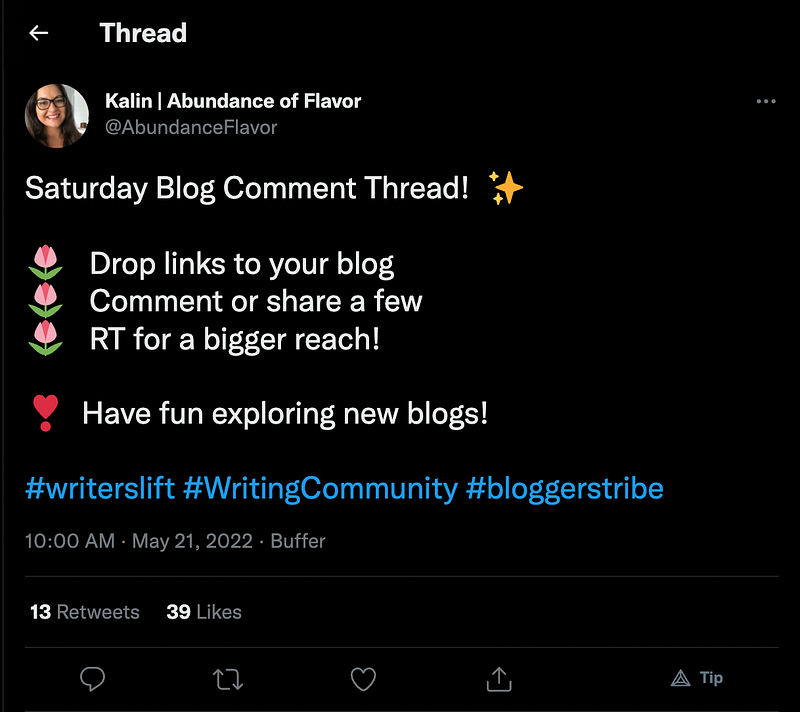
You can also use hashtags, helping people to find your post in a search. Useful ones include:
- #Bloggerstribe
- #BloggingCommunity
- #WritingCommunity
You can also share hashtags specific to your area of interest, similar to the tags you use here on Medium. If in doubt, there’s no harm in dropping one in!
Perhaps you can also find specific questions that people ask and craft articles to address those questions, as I explain here:
8. Facebook groups
As well as sharing on your own Facebook profile, you can join groups that are specifically aimed at Medium and similar sites.
Again, there are probably plenty that I don’t yet know about, but here are a few that I have used myself:
- Medium Writers & Genuine Readers
- The Medium Writers and Vocal Creators Support Group
- Medium Writers | Follow, Engage, Support
- New Writers Welcome
Typically, someone starts a post, and other people drop their link in response on a ‘read for a read’ basis. A downside is that readers are usually not focused on the same niche as you, but I have found most people to be pretty good at reciprocating!
You might want to start you own Facebook group or page, too, focused on your writing. If you do, your fans can sign up, and you can focus on your own writing and brand specifically. Here’s mine:
9. LinkedIn, Insta, etc.
I won’t go into details of every single social media channel, but similar points can be said for LinkedIn, Instagram, Pinterest, TikTok, and the rest.
Personally, I don’t tend to see much engagement from posting Medium articles on Instagram, but it probably depends how active you are. If you use it a lot and have a network, it could be the best place to share your stuff.
LinkedIn is great for certain business and work-related topics. It depends a lot on your niche.
And did you know that LinkedIn has an inbuilt newsletter platform? Read more about it here, from Kit Campoy
10. Personal newsletters
Talking of newsletters — do you have one? If so, why not share your Medium posts on there!
You probably don’t want to spam a newsletter list every time you write, but making a digest once a week and sharing it via a newsletter would be a great way of boosting reads.
And if you don’t have one, consider signing up to Substack. Or try Revue, which can be very easily connected to your Twitter account, so that anyone who sees your profile there finds out about the list.
In this article, J.J. Pryor explains a great way of organically increasing newsletter subscribers:
11. Share other people’s posts
A less obvious but still important strategy is to share other people’s posts.
Scroll up — you see, those Twitter/Facebook/LinkedIn icons at the top of the page?
They make it super easy to do!
Now, you might ask — why? This article is supposed to be about increasing my reads… 😫
However, being social is one of the best ways that you can do this, as follows:
- You share other people’s work that interests you…
- You get their attention...
- They look at your profile and read a couple of your articles…
Before you know it, you have some new friends on Medium. People that give a damn about your writing and will share your stuff in return! 🎉
So don’t hesitate — and don’t expect 100% reciprocation. Just share other writers’ work as generously as you can.
12. Read, clap and comment
In a similar way, you can get other writers’ attention and help to build a supportive community by reading and responding to their articles.
I’ve lost count of the number of times that I’ve read someone else’s work and commented on it, and then one of the very next notifications I get is that they have clapped for one of mine. I didn’t ask for it — people are probably just curious to find out who it was that read their stuff.
And don’t forget, it won’t work if you only read. They only get notification if you do one of these things:
- Clap
- Comment
- Add their story to one of your lists
So make sure you are doing these things a lot. Not randomly, and not for every article you see, of course. But if you enjoy someone’s work and it speaks to you, there’s a decent chance that they will enjoy yours too.
13. Follow people
Again, this is not something I do strategically. I largely allow my follower count to take care of itself.
However, again, I have noticed that after you follow someone, they often read and clap for one of your articles.
I suspect that this is especially true if your bio sounds relevant to them, and if they are active. So for preference, follow people who have recently clapped on the same kinds of articles that you have been reading.
It’s called networking.

14. Many Stories
This is a site that I only heard about recently via Susie Pinon: Many Stories.
If you sign up and get your account approved, you can share your work there. While I can’t yet comment from personal experience, it looks like an interesting and free way to share your articles, and it seems like Medium posts are very popular there.
This is what I currently see:
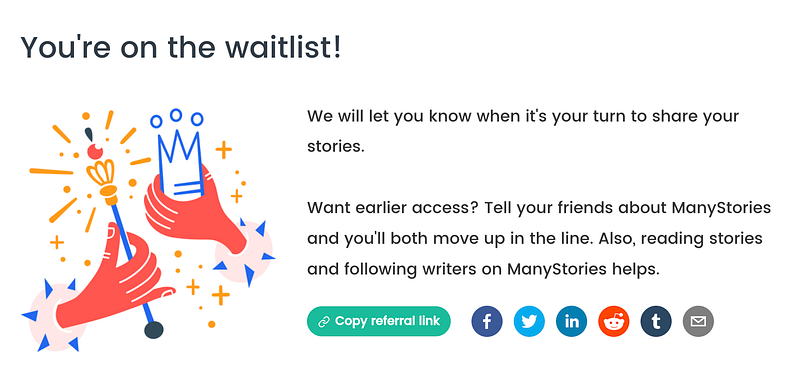
Fancy giving it a try? As the image suggests, you can join with my referral link here—there are no payments involved, but a referral will bump both of us forward in the line!
15. You could just ask…
Finally, if you’re that keen for someone to read your article, why not just ask them nicely?
I regularly see people commenting on my posts, with things like “hey, I enjoyed your article. Want to check mine out?”
I’ll be honest — I have mixed feelings about this strategy. If too many people did it, it would quickly get very spammy and annoying. But I think that a very moderate use of direct requests — especially to people whose interests are relevant to your own — is pretty reasonable.
Or do you disagree? Let me know if so!
And good luck boosting your own reader numbers.
Thanks for reading! You can get my posts direct to your inbox. Do that here! Also, if you aren’t yet a Medium member, consider supporting me and thousands of other writers by signing up for a membership with this link. Doing so will support me directly with a portion of your fee, and it won’t cost you extra. Thank you so very much!


