
EMERGENCE AND GROWTH SERIES BONUS PROMPTS
My Mark of Cain
As interpreted by Hermann Hesse in Demian
Prompt 1: What childhood event impacted your life significantly, and what have you done with it in adulthood?
It appeared in Latency, of that much I am sure, but when did I first notice it — late Latency? Early puberty? I remember thinking how odd — do I have a birthmark that I hadn’t noticed or is this discoloration some random occurrence? Anyway, I didn’t care much, actually, I could not have cared less, and when anyone asked me about what they assumed to be a burn scar of sorts, I would say, “It’s a birthmark,” which I decided it was, sometimes with a well-timed flip of the bird.
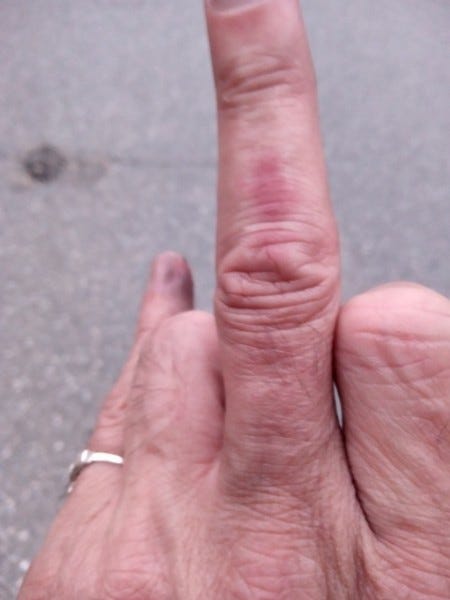
I discerned in May 2020, not two months past my cataclysm catalyzed spiritual awakening, that the universe had branded me as a child with the mark of Cain — not the mark as described in the bible — the mark and its meaning as written by my favorite and most life-influencing author of such recognized works as Siddhartha and Steppenwolf, in his early work that foreshadowed all that he would thereafter write, Demian.
How I came to know that my mark was Demian’s mark of Cain demonstrates the subtle difficulties in decoding synchronicities, in this case, a trail of tears that spanned many years. This process also inspired my day-5 response to the 30 days of poetry challenge :
Transformative signs Spiritual decoding Impulse resonates Discernment confirmation Alignment defeats bias
In 2014 or so upon discussing with my therapist, Harris, that Hermann Hesse is my favorite author, he suggested I read Demian. In April of 2020, less than a month after Lindsey’s tragic death, Harris and I are then and now friends, I re-shared with him my long since forgotten and then recalled 2013 self-portrait essay, and he remarked “I think you are a writer.” That resonated and I decided that as I had no prior writing of such style and depth, that I must have been a writer in a past life.
I further decided it was very likely that I was Hesse in a prior life. My channeler tries to persuade me that my ability stems from archetypal connections, which I then have no understanding of and I was having none of that as confirmation bias had a firm hold on my reality.
In early May 2020, I was researching Adam and Eve because I wanted to shove shit down the throat of some patriarchal and misogynistic Twitter account, and came across a YouTube video that discussed the Hesse interpretation of the mark. As I was watching it, I intuited that I was supposed to find this video and wondered whether I have the mark.
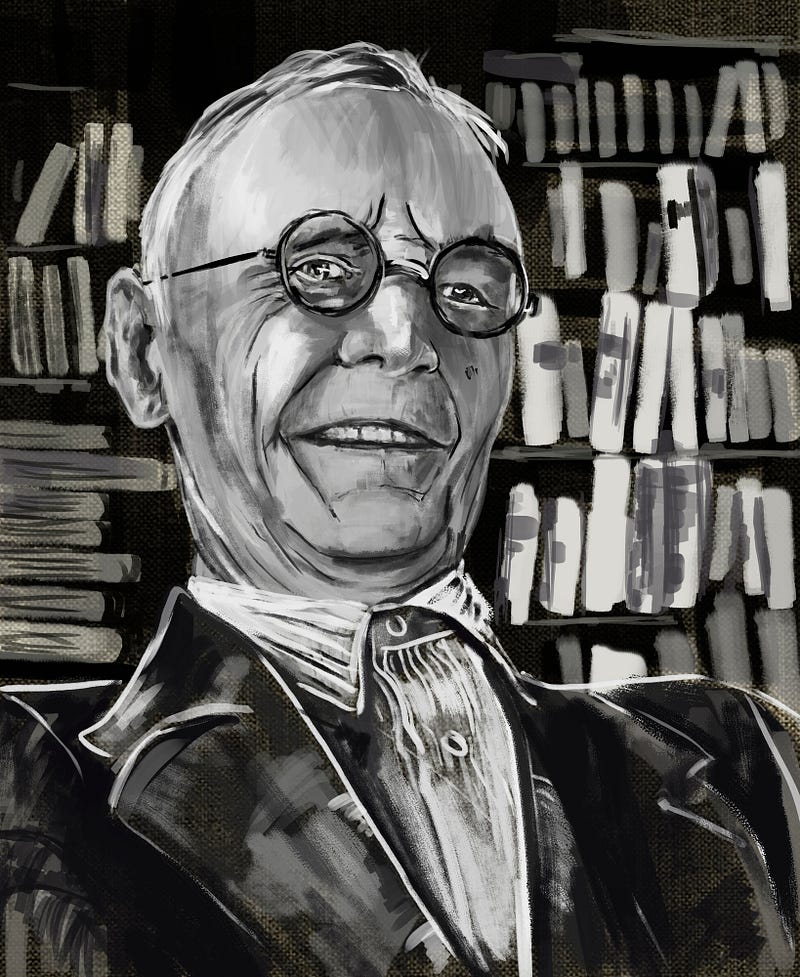
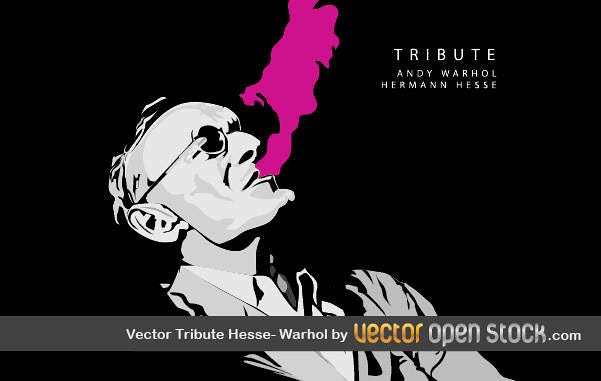
Then two Hesse images I had been viewing among hundreds popped into my head; one is the iconic image of him on the cover of Der Spiegel giving the world the middle finger; the other is the Warhol painting of Hesse blowing a puff of pink cigar smoke. It all clicked in an instant. The pink cigar smoke which resembled a Hindu Deity was the same color and shape as the mark on my middle finger.
So what is the meaning to me of the mark of Cain and how am I applying it? The Bible says God placed the mark on Cain’s forehead so that he and his family would be known in the land to which they were banished. Known for what, and why? There are of course different interpretations, and I of course shall relate the one posited by Hermann Hesse in Demian.
Demian’s interpretation is that the mark identifies the bearer as a person of great courage who has experienced both good and too much evil, and that, essentially, this person now lives under the protection of angels and messengers and spirit guides, and try as you might to harm the bearer, while you may surely cause pain, Providence will result.
I connect the diabolical darkness of my father’s attempts to psychologically destroy me to why I have my mark — I will not recount them now. Many of you know, and those who do not may discover the reasons in these stories.
That I endured 50+ years of intentional acts of sabotage by my father is relevant only in that it focuses me on the true significance to me of my mark. That leaves for discussion what the mark means to me — what it says about and signals to me about my purpose.
Prompt 2: What were you born to do?
The trail of yellow bricks in my synchronous road to purpose as yet leaves much room for interpretation. For as long as I can remember, when asked what I would do if money were no object, my answer was, “teach.” Being in front of a class with chalk in hand never resonated, and besides, my handwriting is atrocious. Being in front of a lecture hall of sapiosexual female college/grad students sounds hot, and Sitara thinks so too, but that’s enough tangenital humor — that’s a play on words, not a typo. What form of teaching? That is a layer in my multipurpose cake that the universe has yet to reveal.
I discerned in October 2020 that choosing a career to support a lifestyle is ass-backward. One should choose the career that fits who one is at their core, and then choose a lifestyle that such a career can support. At my core, I am a deep, across-multiple-disciplines thinker, which I nuanced to: I am an explorer of ideas and the mind.
In late October I wrote to my best friend:
I am at the precipice of discerning my path.
My calling will be something to which I can apply all of my strengths (general intellect, active imagination, soul awareness, strong writer, and INTP personality type, nicknamed the Logician, augmented by my also being an HSP (stupid PC term for an empath), and will have some aspect of imparting knowledge to others.
Over five months later, I realize thinking I had reached the precipice amounted to wishful thinking and impatience.
My letter to my friend continued:
Much of your advice on career is guided by your personal experience with our shared introvert trait. I am now very aware that messages from the universe can be delivered at any time and through anyone. As a result of my new receptiveness, I recently learned what many already know — there are 8 distinct introvert-personality types (and another 8 extravert-types). I took a few 10-minute tests and learned that I am an INTP. I peg you as an ISTJ, which is very different from an INTP. Here are a few hallmarks of the INTP personality type that differentiate it from ISTJ, in which you will surely recognize me and not see yourself : INTP’s “focus on ideas and concepts rather than facts and details;” INTP’s “prefer to be spontaneous and flexible rather than planned and organized;” INTP “minds are complicated and active” — we “go to great mental lengths trying to devise ingenious solutions to interesting problems;” INTP’s are” typically non-traditional, and more likely to reason out their own individual way of doing things than to follow the crowd;” non-conformity is our natural state of being — it is not something we practice to shock others or make a statement. We “tend to share thoughts that are not fully developed, using others as a sounding board for ideas and theories in a debate against themselves rather than as actual conversation partners,” making us “appear unreliable, but in reality no one is more enthusiastic and capable of spotting a problem, drilling through the endless factors and details that encompass the issue and developing a unique and viable solution — just don’t expect punctual progress reports.”
“When INTP’s are particularly excited, the conversation can border on incoherence as they try to explain the daisy-chain of logical conclusions that led to the formation of their latest idea.” I often state my conclusions without connecting the dots. This is what was happening when I was discussing that capitalism can’t work if we are part of the global economy. You brought up comparative advantage. That’s great if you want a permanent class of unemployed and underpaid, which is what we have after 40 years of neoliberalism. The conservatives were brilliant to cloak their policies with a name that evokes the opposite.
I am open-minded about career, but I very much doubt that a position as a professor is realistic nor desirable, as, besides requiring a certain curriculum vitae, generally requires navigation of faculty and administrative politics and personalities, for which I am ill-suited. One day parachuting in some place to teach a course with an ever-changing syllabus would be wonderful — having students would be nice. When that happens it will derive from other success. I believe that writing will be the springboard if not more.
By January I saw my path leading one day to a very late-blooming syndicated columnist. Since then, I see that what may set me apart on Medium is that as well as I write, I am an even better editor. I have not had a single story of mine ever chosen by Medium for further distribution. Yet as an editor, I have, and by editing I do not mean proofreading — I add meaningful content to my mentee’s work.
Where does an editor who tells the writer what’s missing from the piece, suggests the answer, and then rewrites the writer’s stab at it, fit into this analysis?
Perhaps I am an unpaid ghostwriter.
My Doula story was about what I thought was my first co-creation of a curated piece:
I did my usual EFL to English translation. I also suggested a new title and a subtitle, the latter of which the draft did not contain. I revised my title suggestion based on feedback from the writer and we agreed. We had much back and forth on the subtitle because the writer did not grasp the extent to which his piece actually contributed to the topic. He felt he had not conducted an “investigation,” but merely stated some facts. I pointed out that he researched the topic in order to state his facts and thus he did conduct an investigation of the subject. Then I asked him to draw a conclusion for the article based upon the research he had presented. He drafted a theory, I edited it for grammar and substance, and two and a half hours after we started working together, we published:
Yet I discovered today when Dr Mehmet Yildiz informed me that Esther George’s piece that I worked on with her and suggested as a direct submit to Illumination-Curated had been chosen for further distribution by Medium, and then Esther checked her stats, that we had two co-creations curated way back at the end of January and the beginning of February from KTHT no less!
I realize the second half of this story is not typical KTHT fare. Well by now you know I do not give a shit if I annoy some people, and as Esther, who is not only an ideal mentee but also a muse to me when needed reminded me tonight, if just one reader benefits from what I have written, then that will reward me for my nonconformity, which is the essence of the mark of Cain. Hesse writes in Demian:
“We who bore the mark might well be considered by the rest of the world as strange, even as insane and dangerous. We had awoken, or were awakening, and we were striving for an ever perfect state of wakefulness, whereas the ambition and quest for happiness of the others consisted of linking their opinions, ideals, and duties, their life and happiness, ever more closely with those of the herd. They, too, strove; they, too showed signs of strength and greatness. But as we saw it, whereas we marked men represented Nature’s determination to create something new, individual, and forward-looking, the others lived in the determination to stay the same. For them mankind — which they loved as much as we did — was a fully formed entity that had to be preserved and protected. For us mankind was a distant future toward which we were all journeying, whose aspect no one knew, whose laws weren’t written down anywhere.”
Thank you for allowing me to share with you.
In Rama I create,


