
My Journey From Radical Acceptance To Healthy Love
We all deserve to be loved and accepted for who we are.

The problem with not dating much as a young person and then getting married to the first person who sticks around longer than three months is that we don’t get much dating experience. By the time I emerged into the dating world, I was divorced with two kids and no idea what I was doing. I didn’t even have prior experience to draw from. I had to figure it out along the way, and I made a lot of mistakes.
I projected a lot. I took my past experiences and filtered everything through them. I couldn’t tell the difference between a healthy partner and an unhealthy one. I had only ever dealt with one kind. I didn’t know what to do with someone happy, stable, and mature.
I also ignored a lot of red flags. I would interpret them in a way that allowed me to engage in the relationship. I gave a lot of second and third chances. I let chemistry matter a lot more than compatibility, and I made so many excuses — for why they were the way they were, for why I stayed. I kept making the same mistakes, but I wasn’t learning from them.
Then, I finally got my shit together right before tripping and falling headlong into a new love story. For a little while there, I thought I had finally gotten it right. I had recognized green flag qualities. I hadn’t ignored red flags. I was standing firmer in my boundaries, and I felt like it was all coming together.
Until it all fell apart. I stopped holding the boundaries. I held onto the green flags and began to ignore the red flags that were creeping into my vision. When things changed, I held on and refused to let go. I had done the work. I had learned my lessons. Why was the one good thing I had ever let myself have falling apart?
That might have been the start of my journey to radical acceptance. Radical acceptance is a coping strategy from Dialectical Behavior Therapy (DBT) that helps us deal with painful truths without an attempt to distract from or avoid them. It’s a mindfulness practice that allows us to accept situations out of our control and make peace with them.
I was crushed when he ended the relationship, but I also completely accepted that there’s no one to blame when one person just doesn’t feel the same. I accepted his right to change his mind and end the relationship. I accepted that how much I loved him didn’t mean a damn thing if he didn’t love me back. I accepted his decision even though I hated it. Even though I wished, for a long time, that he would change his mind, I knew that he wouldn’t and made peace with it.
Radical acceptance means embracing the reality, not the fantasy. I moved forward. But I learned, too. I looked back at the relationship and saw the places where my boundaries had gotten flimsy over time. I noticed that shift when he began to pull away, and I began to work harder to keep him. I could see the places where I had given myself up to be more of what he wanted, where I had ignored my needs in favor of his, and where I had stayed when I should have admitted defeat and left.
Radical acceptance means embracing the reality, not the fantasy.
Radical Acceptance in Practice
It changed me. The next time I dated someone, I was committed to radically accepting reality. So, when there was white-hot chemistry but no compatibility, I had an honest conversation about it with the person I was seeing. We talked it out and agreed that we didn’t want the same things. We liked and appreciated each other, but we made our intentions clear to move on. It felt like growth.
Later, I would recognize red flags when dating, and I wouldn’t look away. I’d ask about them. I’d talk about how they made me feel. I would disengage with kindness when I realized that someone just wasn’t on the same page. I didn’t think poorly of them, but I also didn’t make excuses. I just accepted that they weren’t a good match for me. When other people saw pieces of my life as red flags for them, I accepted that, too, and wished them well on their search to find what they were looking for.
A Journey to Radical Acceptance
It’s a whole new perspective. It changes the way we interact with others. When we shift into radical acceptance, there are a few things we do differently.
We Quit Pointing Fingers
One of the most powerful shifts was that I stopped blaming other people — or blaming myself. It wasn’t my fault that someone I loved didn’t love me back. It wasn’t his either. It happens. I find peace in knowing there is no one to blame. Could we have handled it better? Of course. But we can’t change the past, and I’ve decided not to beat myself up anymore for the mistakes I made. I’ve apologized. I’ve learned my lesson. But I can’t find it in me to place the blame.
When someone isn’t a good match, there’s no blame there either. They might be a great match for someone else. We’re all on different healing journeys. Some people haven’t even begun to heal. Some never will. And some of us are along the path but at different points. We don’t take it personally when someone just isn’t for us.
We Find Ease
These days, there’s a certain ease in acknowledging when something is right or wrong for us. I’ll admit that I sometimes miss the person I dated with great chemistry but poor compatibility. He was funny and kind. I enjoyed his company. But I don’t let those feelings lead me to a poor decision. There’s ease in radically accepting that someone isn’t for us and moving on. He’ll find what’s right for him, I hope. I’ll do the same.
It’s also easier not to make excuses or try to force a fit. I can pay attention to what people are saying and doing and not just endlessly project my wants, needs, or traumas onto them. It might not make it any easier to find a partner, but I don’t feel like I’m working hard either. There’s a sense of getting to know someone without pressure and accepting who they are without trying to change them.
We Honor What We Need
Sometimes, I feel hurt for the person I was who was trying so hard to be worthy of love. It took a while to understand that I was always worthy of it — I was just looking for it in the wrong place. Radical acceptance at that point in my life would have meant reevaluating the relationship and admitting that it was no longer working for me. It would have meant walking away.
I wasn’t ready yet.
Now, I honor what I need. When I accept reality for what it is, I can also acknowledge when my needs aren’t being considered or met. I can take myself out of relationships that aren’t working for me in a way I could never do before. I can have those hard conversations because I know that it’s better to be single and alone than to be with someone who makes me feel alone. I radically accept my own needs and honor them with the choices I make. When I make mistakes, I forgive myself and learn to do better.
We Quit Asking Why
I will always be naturally curious about human nature. It’s why I studied psychology and worked as a therapist for a while. I wanted to know why humans did what they did — and to help them do better. So, it’s natural that I wonder why.
When radical acceptance entered the picture, I stopped asking why. Why he left. Why I had stayed. I stopped needing a list of reasons. I didn’t need to rationalize every aspect of the relationship. I didn’t need to make a diagram of what went wrong and when. I only needed to accept that he no longer wanted a relationship with me. That was it. That’s the truth and reality. It’s what I had to accept without trying to create a narrative around it.
A narrative is easy, particularly for a romance author. I could build a beautiful story. I could give empathetic motivations for everything that ever happened. It might even be true. But it doesn’t matter. All that matters is the reality we’re left to deal with, and radical acceptance is the practice of embracing it and making decisions based on reality and not fantasy. So, I stopped collecting all the whys of what happened and just accepted that it is what it is. It freed me to move on and gave me closure.
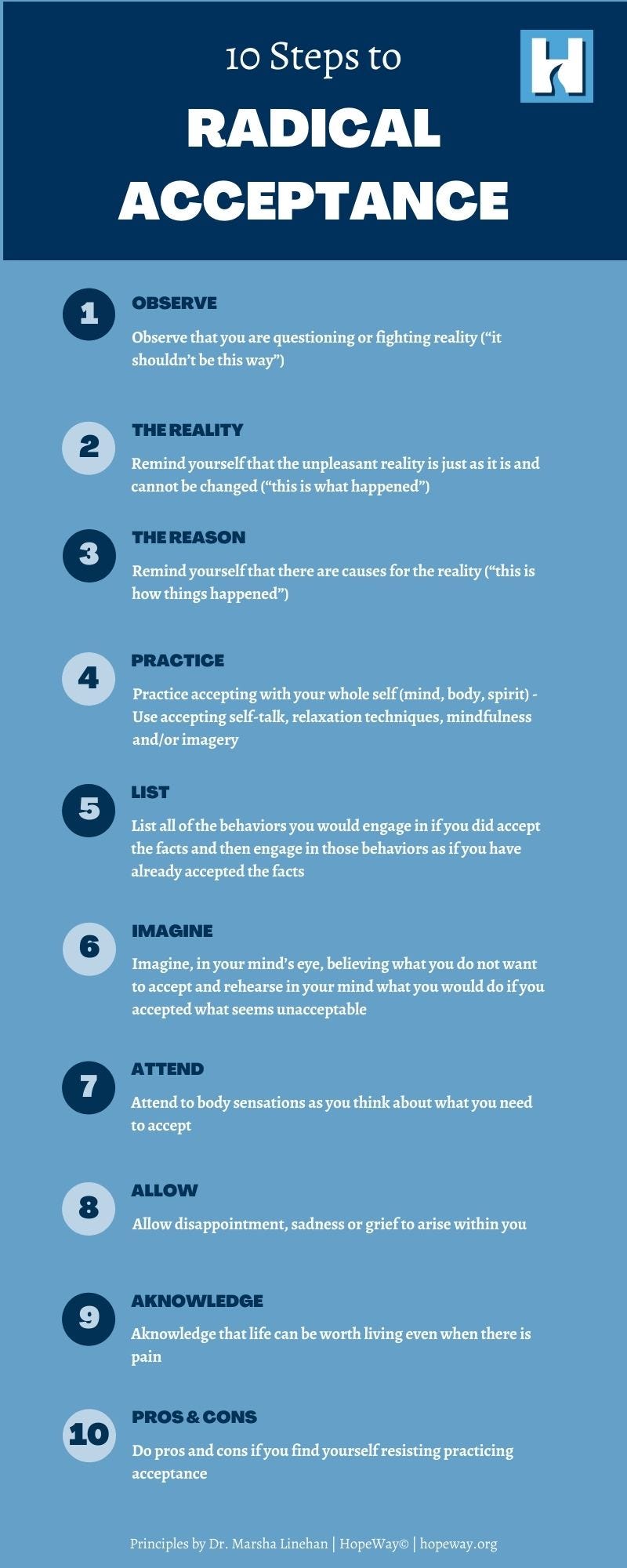
Embracing Radical Acceptance
There’s a peace in the process now that I never experienced before. I lost someone I didn’t think I could lose, and I survived it. I grew from it. I know that my ability to love is not broken by the experience. If anything, I will love the next person better because of it.
I’m not dating trying to force a fit. I’m staying open to love, but I’m not searching for it and trying to make a bad fit work because I’m lonely. In fact, these days, I don’t get as lonely as I used to. I’ve surrounded myself with friends and interests, and I’m intentional with how I spend my time. While there’s a part of me that misses sleeping with another heartbeat next to mine, I have to admit that it’s not the worst thing to sprawl out on my king-size bed bookended by a dog and two purring kittens.
Radical acceptance has many benefits. It allows room for self-compassion as well as empathy for others. It allows us to better regulate our emotions, communicate better with others, and develop healthier relationships. I don’t have to place blame or make excuses for anyone else. My only responsibility is to honor my needs. I can be open to connection without any attempt to force it. I know that radical acceptance leads to healthy relationships based on genuine love and acceptance. I welcome the ease and know that the effort made should be in nurturing one another, not in trying to make what’s wrong feel right.


