
Moths: 4 More Horror Movie Worthy Moths To Invade Your Nightmares (Part 2)
Whether you find moths fascinating or frightening, there’s no denying their ability to capture our imaginations and inspire terror in even the bravest of souls.
While I used up the most horror movie worthy of moths in part one, these 4 moths still have the ability to illicit nightmares. They each have their own brand of horror, such as; The Death’s-head Hawkmoth with a skull-like pattern on its thorax, which has led to it being associated with death and the supernatural. The Madagascan Sunset Moth with its cannibalistic larvae are cannibalistic and will eat their siblings if they are kept together. The Gypsy Moth, an invasive species that can defoliate entire forests, and its caterpillars have a habit of “ballooning” on strands of silk, which can cause them to rain down from the trees en masse.
The Death’s-head Hawkmoth
The Death’s-head Hawkmoth (Acherontia spp.) is a large moth known for its striking skull-like marking on the thorax, which has made it a popular symbol in art and pop culture. This moth is found in Europe, Africa, and Asia, and has earned a reputation for its eerie and mysterious behavior.
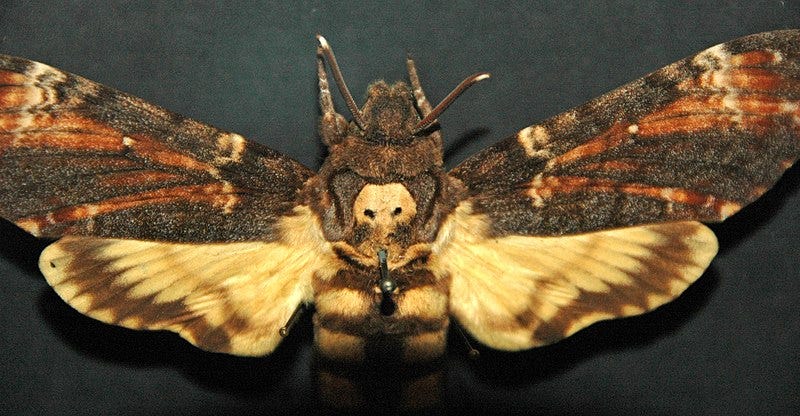
One of the most unusual and horror movie-like traits of the Death’s-head Hawkmoth is its ability to mimic the sound of honeybees. This is accomplished by the moth’s ability to make a high-pitched squeaking noise by rubbing together specialized scales on its thorax. This mimicry allows the moth to approach beehives undetected, as bees tend to be less aggressive towards other bees.
In addition to its unique mimicry abilities, the Death’s-head Hawkmoth is also known for its strange feeding habits. Unlike most moths, which feed on nectar and other plant fluids, the Death’s-head Hawkmoth has been observed raiding beehives and feeding on honey and bee larvae. This behavior has earned the moth a reputation as a pest and has made it unpopular with beekeepers.
Overall, the Death’s-head Hawkmoth’s eerie appearance and unusual behavior have made it a popular subject in horror movies and other forms of pop culture. In fact, it famously appeared on the movie poster for the 1991 horror film “The Silence of the Lambs.”
The Madagascan Sunset Moth
The Madagascan Sunset Moth is a large and colorful species of moth that is native to the island of Madagascar. It is known for its striking colors, which include a metallic blue-green and purple, as well as its long tails that extend from its hind wings. While it may not seem like a horror movie character at first glance, this moth has a fascinating ability that makes it worthy of a horror movie plot
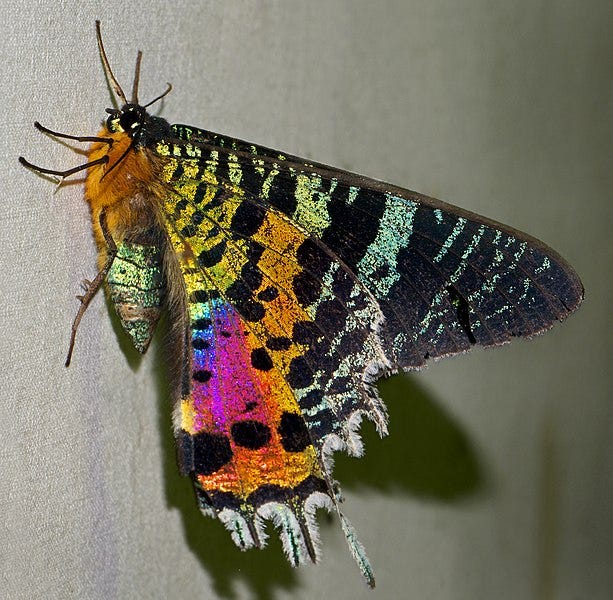
The Madagascan Sunset Moth has the ability to change color depending on the angle from which it is viewed. This is due to the way that light interacts with the microscopic structures on its wings. The moth is able to create a shimmering effect that makes it appear as though it is changing color right before your eyes. In the dark, the moth glows bright green, making it an eerie sight to behold.
In addition to its ability to change color and glow in the dark, the Madagascan Sunset Moth also has a unique defense mechanism. When threatened or disturbed, the moth will emit a high-pitched squeaking sound. This sound is produced by the moth rubbing its wings together and can be quite unsettling to hear.
While the Madagascan Sunset Moth may not be a typical horror movie monster, its ability to change color, glow in the dark, and emit a high-pitched sound make it a fascinating and eerie creature to behold.
The Gypsy Moth
The Gypsy Moth (Lymantria dispar) is a species of moth that is native to Europe and Asia, but has been introduced to North America where it has become an invasive species.
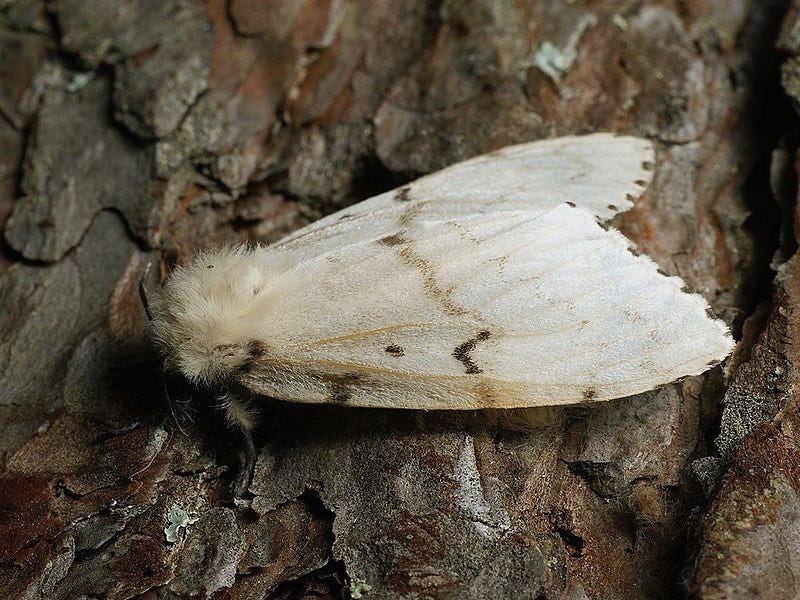
The larvae of the Gypsy Moth are voracious eaters and can defoliate entire trees, causing significant damage to forests and other ecosystems. When the larvae pupate, they spin cocoons that are covered in sharp, spiky hairs that can irritate human skin and cause respiratory problems if inhaled.
One interesting fact about the Gypsy Moth is that it is an example of sexual dimorphism, meaning that males and females have different physical characteristics. Male Gypsy Moths are smaller and more slender than females, and they have bushier antennae that help them locate potential mates.
While the Gypsy Moth may not be quite as terrifying as some of the other moths we’ve discussed in part one, its ability to defoliate entire forests and cause allergic reactions with its cocoon hairs is certainly noteworthy.
The Luna Moth
The luna moth is a beautiful and fascinating insect that is native to North America. While it may not be as horrifying as some other insects , it does have some interesting and unique features.
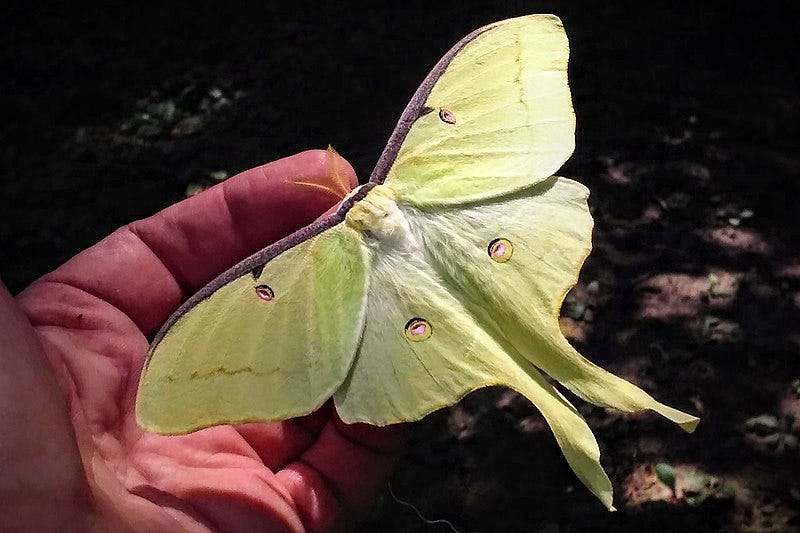
First of all, the luna moth is absolutely enormous. Its wingspan can be up to 7 inches across, making it one of the largest moths in North America.
The luna moth has a unique defense mechanism. When threatened or disturbed, it will flap its wings rapidly and emit a clicking noise that is thought to scare away predators.
While the luna moth may not be quite as terrifying as some of the other Moths from part 1, it is still a fascinating and beautiful creature that has captured the imaginations of many people.

If you enjoyed this article and would like to support me please consider becoming a medium member via my affiliated link:


,_Vohimana_reserve,_Madagascar_(cropped).jpg)