
RELATIONSHIPS | REGRET | FATHER AND SON
Memories of Our Fathers
These are two potent memories of our fathers, good and bad, present and absent, that we carry with us day by day
Sabana Grande and Alex🏳️🌈🇺🇸
(Not a Medium member? Click to read this story, gratis.)
In response to a remark by Dr Mehmet Yildiz about authors writing in collaboration, Sabana Grande conceived this project. He invited Steve Alexander🏳️🌈🇺🇸 to collaborate in writing this work. Before this collaboration, they did not know one another.
Each wrote a story about a memory of his father that you are about to read. At the end, each will share some insights he gained about the other from his story.
My Favorite Memory Of My Father by Sabana Grande
It was a cold Autumn day, and I was playing outside my grandparents’ house. I was probably wearing a huge stuffy hat with a pom-pom on top. I was about 7 years old. I had climbed all the trees in my yard and was now resting on a swing set under the shadow of our huge walnut tree. Our house and our yard were both very long and narrow.
I saw a figure in the distance. My dog began to bark. It was my father. It was one of the few times I would see him in my life, for my mother and father had separated while I was very young. They did not get along.
My father and grandparents did not get along either. He was a hard man to get along with. He was aloof, preferring jokes over real conversation. I found that I could never know much about him even while I was talking with him. At this time, I was being raised by my grandparents. My mother was abroad and my father came to visit me.
He walked into our yard holding a giant wrapped up box the length of his body. It may even have been bigger than him!
As soon as I had recognized him, I ran up to him. I hugged him and he gave me the box. He then took it back off me since he would still have to carry it inside for me, seeing as the whole weight of the thing could probably crush me into a pancake.
My pom-pom fluttered in the wind on my hat as I ran inside and opened it to find out it was a giant Lego set of an entire airport. My father couldn’t stay; he left. That was the summary of both of my relationships with my parents: they came, they brought me gifts that always came wrapped up in an “I have to go.”
However, that one time my father promised me he would be back the next day, and he was.
We went to a mountain resort and went skiing, then we went to a swimming pool. It was my first time in one. We talked about life while in a sauna, or I talked and he listened.
He bought me a model airplane made of Styrofoam that could actually fly with a remote control. Back then, that was a big deal. Probably shouldn’t have flown it when it was snowy and windy, though.
But the memory of both my father and me holding the remote trying not to lose it has been stuck in my mind ever since.
Soon after this memory, my mom would take me with her abroad and I would never see him again. For various reasons, including violence, my mother got sole custody of us.
Hence, this is my favorite memory, not only because we got to bond and travel, but because I have not many others to cling onto.
“I Will Kill Him.”
No Man Steals Another Man’s Wife and Gets Away With It. by The Wordsmith™🏳️🌈🇺🇸
It was fall 1972. We were in the living room of the house he and Mom had bought in December 1961 — the theater where I spent my teen years in combat, then left when I was 18 and gone off too college in 1966. I left without looking back and hadn’t returned in the intervening six years. I had intended never to return.
Yet, there I was.
My little sister had recently graduated from high school and left for college. Mom had finally abandoned the battlefield. With neither her nor Marcia in the house, it was cold and empty.
He sat across from me in his old armchair, feet firmly on the floor, legs spread apart in his typical fashion. His eyes flashed the last remaining rays of hatred. He was on his way down to a more settled emotional state from the place of rage and dangerous intent he had been for nearly an hour.
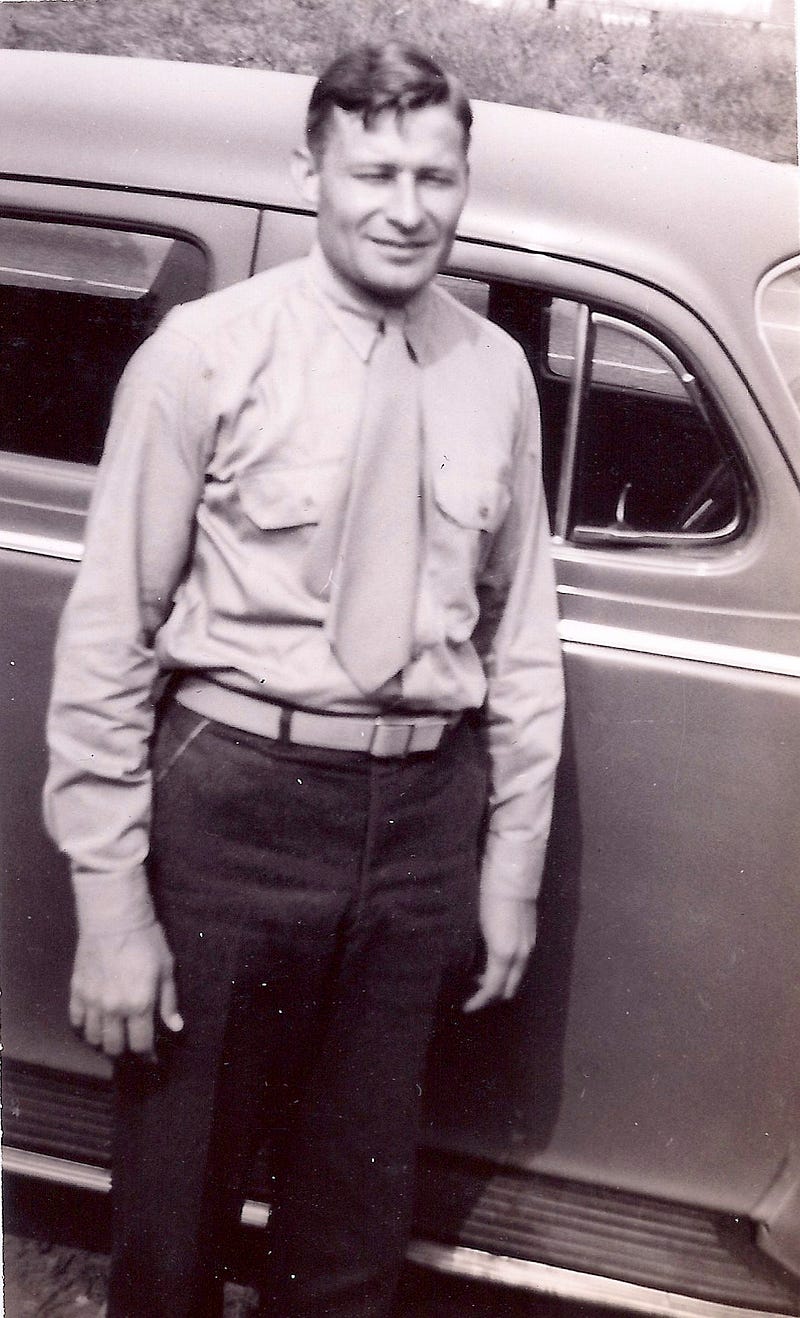
At 5 feet 11 inches, he was shorter than me. He weighed perhaps 220 pounds, much of it muscle, but not all — especially around his belly, where he had a typical beer-gut. His upper back and shoulders were broad and muscular, though. Rope-like veins ringed his considerably sized biceps and forearm muscles like steel bands encircling a concrete column. I could see them because he was wearing a Jockey A-shirt, the kind with a crew neck, no sleeves, and straps over the shoulders. It was the kind of undershirt he always wore. His arms, shoulders, and neck were weathered brown from the sun. He had big hands that were callused and gnarly from 27 years of hard labor.
He was my father.
I was 24, a full-grown man, 6 feet 2 & 1/2 inches tall and 175 pounds, none of it fat. Yet, he seemed to me still the towering, threatening man of my childhood, the U.S. Marine staff sergeant who had fought in the first wave of every major island invasion in the Pacific Theater in World War II. He was the man who had killed every Japanese soldier that ever crossed his path, not because he especially wanted to but because “they made me kill all of them.”
Still, I knew he had the capacity.
Not an hour earlier, he had threatened to kill the man whom he said had stolen his wife from him. For emphasis, his Marine Corps sidearm laid on the table beside him, loaded, but safety on.
Mom called me at work a week earlier and asked that I have lunch with her. She’d not done that before. Something noteworthy was afoot. She picked me up the next day; there was a man in the front passenger seat whom she introduced as a friend from work, Bob. He didn’t look noteworthy.
I climbed into the back, and we were off to China Town. For the next hour, we talked of the things ordinary people ordinarily talk about over lunch — nothing noteworthy. But there was something, an un-materialized expectancy, in the air.
After lunch, she drove to the Mall and parked in a lot on the Washington Monument grounds. It was in that car, in that place, on that day, she told me something noteworthy,
“I‘m leaving your father. I’m divorcing him. Bob and I are going to marry.”
She had waited until she saw the last of her children safely out of the house, in college, and self-sufficient, before making her move toward happiness.
I looked at Bob, who looked defensive and remained silent.
Looking back at Mom, I asked, “Are you happy?”
“I will be,” she said, with a cheerfulness I couldn’t remember ever seeing in her.
I believed her.
I said, “Well then, it’s about damned time. You should have left him 25 years ago.”
That was the week before he and I sat across from each other.
On the day before, in the unhappy house where she had spent the last eleven years of her unhappy marriage, she told my father she was leaving. She wanted an uncontested divorce. She gave him the papers. They argued. They did the dance around. “Is there another man? Who is he? How long have you known him? What’s his name?” She wouldn’t answer.
He grew angry and ugly.
“I will kill the sniveling, son-of-a-bitch bastard. No one steals my wife and gets away with it. I’ll follow you and find him, and I will kill him.”
He said that if she wanted her divorce, she could go upstairs, gather what clothes she could carry, leave, and not return. If she wanted him not to contest it, she’d get nothing but those clothes. She left a few minutes later with what she could carry over her arm. He didn’t allow her a suitcase.
That night, she called me from a motel room. Crying, she told me what had happened. She was afraid, not for herself, but for Bob. She didn’t know what to do. I told her I’d take care of it.
“But what can you do?”
“Don’t worry, Mom. I’ll take care of it. No one is going to die. No one is even going to be hurt, physically anyway.”
She talked for several hours more, then said she was exhausted. We said goodnight.
I had been on the phone in our bedroom. Michael R. and Tommy lay on their sides next to me. Each had an arm on my chest, a leg across mine. They had been listening to my side of the conversation. We were lovers, a triad. They were my life and my light. They were my rock. But that’s another story; it doesn’t belong in this one.
I’ll just say I leaned on them. I described what my father was like, what life with him had been like from age five on. They let me talk. They didn’t attempt to solve the problem. They just listened and offered support. When, at last, I had talked the dismay and anger at what he had done out of my system, I said I knew what to do. They asked what. I told them.
That was the day before. This was today. I was in our old living room. Across from me, he fumed. He repeated the threat, looking at the weapon for emphasis.
A scowl still contorted his lips. He clenched his jaw. I could see the muscles straining. It was a grim and angry visage that met my eyes across the twenty feet that separated us.
“No. You won’t,” I said in a commanding voice he’d never heard from me.
He snapped his head sharply toward me with a look that said, “You little bastard!”
But the words that came were, “Who’s gonna stop me? Huh? You,… kid?”
“No. Marcia.”
With that, the hateful glare left his eyes replaced by a… a surrender I had not seen before. I was certain it had never in his life been there until then.
Marcia is my little sister who had just left for college. She is six years younger, but her experience with him might as well have been two decades removed. He doted on her. With her, he had been a loving, responsible, caring father. He had cared what she thought of him as he never had with me. She loved him. She respected him. He seemed to need that.
“Do you want her in court at your murder trial? Every day? Seeing you subdued in front of the jury that will lock you away? Hearing how you shot a man for nothing other than your wounded ego? Seeing the forensic evidence, the murder pictures? Hearing the judge sentence you?”
“What do you want her to think of you? How do you want her to remember you when you’re gone? What weight do you want to saddle her with?”
I asked these questions in a staccato succession, giving him no time to react between them.
I saw the firestorm leave his face. He slumped. He calmed. I had hit him squarely between the eyes. I had his attention.
I pressed nothing home. I sat in silence with him for a long time. His head hung down in despair. Finally, he looked up at me. He looked away from me, to his right, away from the gun. He looked back at me. He rose and crossed the distance between us.
Standing two feet in front of me, he looked me in the eye and said, “Stand up, kid,” but there was no menace in his tone.
When I did, he took a step further forward, put his arms around me, and hugged me.
“I love you, son,” he whispered in my ear.
He returned to his chair, sat, and sobbed. I had never known him to cry. I had never seen him vulnerable. I hadn’t thought he could be.
I cried. He had never hugged me, never touched me but in anger. He had never said the word love in my hearing except, perhaps, to refer to his love of beer, pool, and poker.
He kept his vow to Mom. He didn’t contest the divorce, but he gave her nothing from the estate. He destroyed the rest of her clothes.
He stayed in the house for a while, trying to make a go of it. But he couldn’t manage the expenses without Mom’s salary. She wanted to rent a condo she had found, but she hadn’t the resources without his disability pay. She wouldn’t live with Bob, who was in his own divorce process, until they married.
In the two years since graduating from college, I had saved $6000. Other than my monthly paycheck, I had no resources myself. I gave them each $3000.
Mom made it work. She paid first and last month’s rent and put a security deposit down on the condo. She bought a bed and a sofa. She bought some necessities for the kitchen and some clothes. She rented the rest of the furniture and appliances she needed. She got on.
My father tried but could not survive in that house. Though he never did acknowledge it, the loss was too substantial to bear. He sold the kitchenware, the pots, and pans, the small appliances, the furniture. What he couldn’t sell, he trashed. He sold the house and bought an Airstream trailer. I wouldn’t see or speak to him again for three years.
In 1981, he died at 68, in the small northeast Texas town of his boyhood from alcoholism. He had moved there in 1975 to live with his older sister, with whom he had had an on-again-off-again relationship since marrying Mom in 1945. In the nine years from 1972 to his death, I saw him twice. I spoke to him a third time, on the day of the night of his death.
I was 33 and a lawyer in Philadelphia. His hospital doctor got my work number from my brother and called me. He told me that if I wanted to see my father alive, I’d best get on a plane to Dallas. Then, he handed the phone to my father.
He spoke in a frail voice I would never have recognized.
“I’m really sick, son.”
Those were the last words I heard him say. He died while I was in the air.
In the time since, I’ve tried not to have memories of him. When I do, they are invariably in nightmares. But I carry with me the one memory of that afternoon in our old living room when I saw him vulnerable and almost broken, when I heard him say something I had never before heard and would never afterward hear again,
“I love you, son.”
What I learned of Steve Alexander🏳️🌈🇺🇸 from His Story. Insights By Sabana Grande
It does not sound from this piece as if Steve Alexander had a good relationship with his father. I can relate to this. Mine was also difficult to get close to, although mine preferred humor to keep people away from what he held close to his heart and what made him vulnerable.
In this piece, I can immediately tell that Alex’s father is an alpha male, especially from his body language. Either that or he just likes ‘man spreading’.
My father was absent in my life. Alex’s father was emotionally absent. I imagine that was more difficult for him.
In my memory, I was a mere child. I like looking at the relationship Alex had with his dad when he was older. I didn’t see my dad, I think, almost ever again after that memory, hence why it was my favorite. Since my father was also quite cold, I wonder whether my relationship with him might have been similarly strained as Alex’s: He never told Alex he loves him, only once. And he doled out most of his affection to his daughter. I have never had any of those problems with mine due to absenteeism and so it strikes a chord with me to see that relationships are either there or they aren’t. They can be tough and strenuous on the parties involved, causing heartache.
My parents were also divorced, so I can relate to my dad not having been very happy about it.
I also learned from this piece that Alex is an excellent negotiator. It was very subtle and very powerful to ask questions to his father about what his daughter might have thought of him when another man might have liked to just tell him he was wrong to his face. Alex was clearly very intelligent at 24. I wish I could say the same about my fights with my parents at that age, but oh well, the memory I chose of my father was in my childhood for he wasn’t around after.
I like the fact that Alex chose an aftermath to his piece, so we could see how both of his parents have fared after the divorce. This is something I just learned from him. I find it more difficult to be as vulnerable and brave as he was in this piece.
I have learned from him that I should from now on be less sparing with my words and try to delve into more dialogue and stronger conclusions and aftermaths to my stories, which I haven’t done up until now.
I am glad to have learned this and to have learned about your strained relationship with your ex-marine father. It was a pleasure to read. Thank you.
What I Learned Of Sabana Grande from His Story. Insights by Steve Alexander🏳️🌈🇺🇸
At seven, SG (I’ve taken to calling him that without permission or invitation; if it annoys him, he’s too considerate to say so) is living in his maternal grandparents’ house, his father and mother being absent. I think he doesn’t particularly like his grandparents or the living situation. He uses their “house,” not his “home.” I think he’s very aware that he doesn’t have a proper home.
Perhaps I read too much into it; home is, after all, the first synonym listed in the dictionary for house. But to me, they are not the same. Home connotes somewhere warm, cozy, inviting, and overtly loving. House connotes a cold structure empty of all those things. I think SG’s grandparents’ house is not, to this seven-year-old, a home. I think the adult writing the story still feels that.
The adult SG recites that he particularly remembers this visit by his father because, unlike others, it stretched over two days running, and he got two marvelous toys any boy would jump at, the Lego airport and the Styrofoam remote flying model airplane. But he got an even greater gift, time. Time alone with his father. Time skiing. Time in the pool. Time in the sauna. Time talking, even if his father mainly listened. But most of all was his father’s participation with him in the joyous act of jointly operating the model plane’s remote control.
This warm memory lives co-extensively in SG’s adult mind with the ice-cold one of the all too infrequent visits bringing only hollow gifts invariably “wrapped up in an ‘I have to go.’” They jostle in his mind, those two memories, sweet and bitter, kind and cruel. But he lets us know in the ultimate paragraph which wins out. I think that’s a clue to the adult’s disposition. I suspect that he doesn’t often let the bitter and cruel dominate.
Concluding Remarks, by Sabana Grande
Writing is an incredible process. Two works that may otherwise have been okay on their own may come together to create something better than the sum of its parts. That is what we have tried to achieve here, a contrapuntal experience. Who knows? We might have failed. But the fun was in the writing and the process.
We hope you have enjoyed reading these stories as much as we have enjoyed writing them.
Have a nice day!
Sabana Grande Written in collaboration with The Wordsmith™🏳️🌈🇺🇸 25 September 2020 © Sabana Grande © Steve Alexander


