
“The Scream” Has a Message
Written by the painter himself.
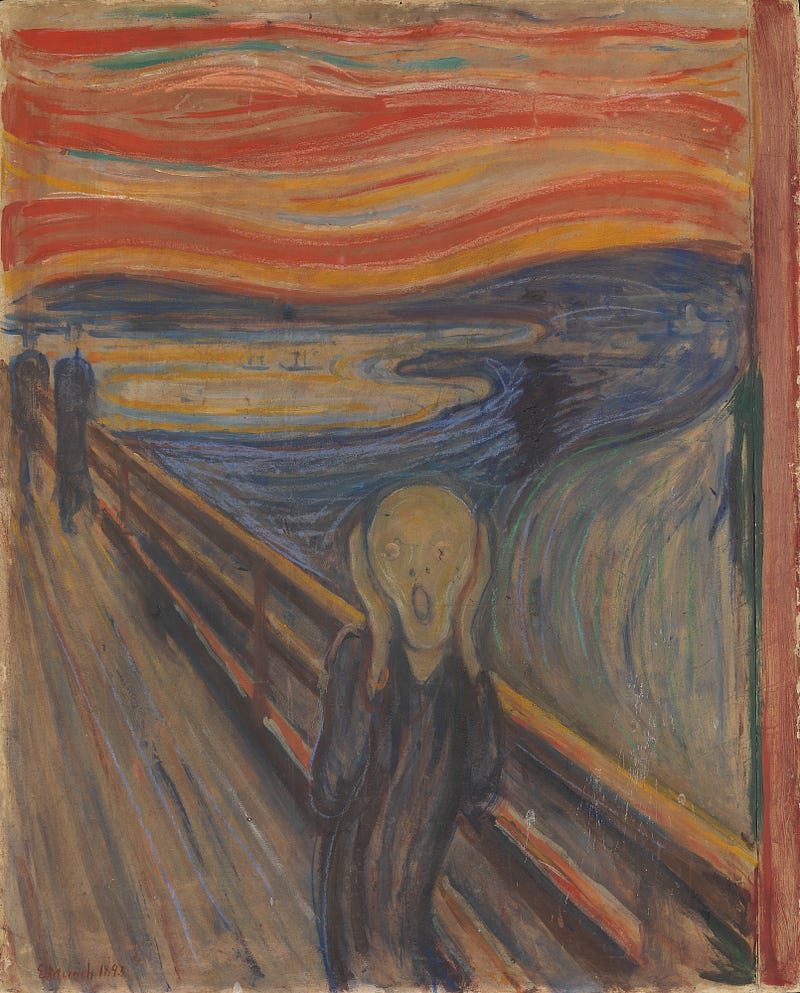
I don’t know about you, but I’ve seen this painting a bunch of times in my life and never known anything about it. I mean, it’s a bendy person screaming… what more is there to know?
Turns out, a lot. This piece has been the subject of almost as much speculation as the “Mona Lisa” and quite recently, historians have used infrared cameras to analyze something barely discernable written on it. At first, they suspected vandalism but it was later proven that the message was written by Edvard Munch — the painter — himself.
In order to understand the message, you will need to first know the history of this work and Edvard Munch. However, you have every right to skip to the end if you’re curious and want to find out faster.
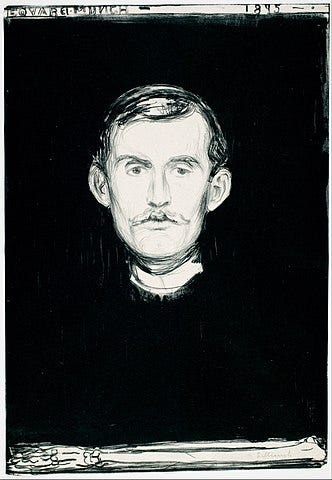
Edvard Munch
Munch is a Norweigian painter who was born on December 12, 1863 and died at the end of World War II from natural causes.
He studied at the Royal School of Art and Design in Oslo where he was influenced by nihilist Hans Jæger “to paint his own emotional and psychological state.”
Hence, he became what is known as an expressionist, painting what he felt, not what he saw. He was insecure and remained unmarried throughout his life. A pastel version of “The Scream” — there are several — sold for $120 million in the U.S. in 2012, which made it the most expensive painting in the world at the time.
The Scream
This painting was originally titled in German “Der Schrei der Natur” (The Scream of Nature), and in Norwegian, it was named “Skrik” (Shriek). The painting symbolizes human anxiety. The story goes that while out for a walk with two friends in 1893, Munch observed that the setting sun had turned the clouds “a blood-red.”
“My friends walked on, and I stood there trembling with anxiety — and I sensed an infinite scream passing through nature.” — Edvard Munch
The painter later described having felt ill and anxious. A decade prior, during the years 1883 to 1884, a volcano near Oslo was erupting, darkening the skies. It could also be that it polluted the air near it. Some historians speculate that the painting from 1893 was actually based on an experience Munch had during the eruption years, though nobody knows for certain. Whatever the case, the feeling Munch had resulted in one of the most iconic paintings in the world.
Munch first displayed his new work in foreign countries, including Germany where he received a good response from the public. However, upon bringing it back to Norway he found that his own people didn’t like it. Art critic Henrik Grosch said that “The Scream” was proof that people shouldn’t “consider Munch a serious man with a normal brain.” This hurt Munch deeply as he was already pretty insecure and suffered bouts of anxiety.
At a Students’ Association meeting, one young man named Johan Scharffenberg further rubbed salt on the would by questioning “Munch’s mental health claiming that his paintings proved he was not of sound mind.” He was a medical student, so Munch, upon being told he was insane for painting what he did, fell even deeper into despair.
Other Norweigian critics suggested that Munch should “be sent to a hospital and forbidden from painting.” They touched on the painter’s greatest fears in saying this.
You see, Munch’s family was ridden with various mental illnesses. His grandparents and father had a history of depression. At the time, Munch’s sister was having manic depressive outbursts and had been forcibly brought to what at the time was known as a “lunatic asylum.” She was later also diagnosed with schizophrenia. One of his other sisters had died from tuberculosis which can also cause mental illness before death. Munch himself had at least one mental breakdown in his life.
So the last thing he wanted to hear was that he was heading down the same road as the rest of his family. A note which said: “Could only have been painted by a madman” was subsequently found on his original painting. As stated earlier, until 2020 it was assumed that this was another harsh criticism written by some vandal.
The Painting Was Stolen
“The Scream” was stolen twice: once from the National Gallery of Oslo in 1994 and later from the Munch Museum in 2004. The painting had been damaged during the robberies, which were the result of poor security systems in the galleries.
Some of the yellow paint from the work has also been flaking off for years. As such, after it was retrieved from the thieves in 2004, scientists from across Europe — such as the National Research Council of Italy and the European Synchrotron Radiation Facility in France — have studied the painting in detail for the first time. Their main goal was to find out why the paint was flaking and how to repair the damage done to the canvas by the thieves (the paint was flaking off because of moisture).
However, since the painting has now been undergoing “extensive conservation” for over a decade, the scientists finally decided to also have a look at the penciled message. What has been assumed to be vandalism for over 100 years was finally proven to be a message from Munch himself. And as stated above, the reason Munch wrote it was because the painting itself which was about anxiety had caused him even more anxiety after it was painted. The handwriting of the message also matches Munch’s own.
Mai Britt Guleng — the curator of the National Museum of Norway — has explained that the statement was “an expression of the artist’s vulnerability.” It has since also been said that “The Scream” is more than a painting. It is “a symbol of psychology as it anticipates the 20th-century traumas of mankind.”
“Could only have been painted by a madman” — Edvard Munch
The message, therefore, is that the artist was scared that he was losing his own mind.
These aren’t the articles you’re looking for:
References
https://edition.cnn.com/style/article/edvard-munch-the-scream-inscription-scli-intl/index.html https://allthatsinteresting.com/hidden-message-scream-painting https://en.wikipedia.org/wiki/The_Scream https://en.wikipedia.org/wiki/Edvard_Munch https://edition.cnn.com/style/article/the-scream-painting-preservation-edvard-munch-scn/index.html


