
The “Titanic” of Japanese Battleships
The “Yamato Class” was the world’s biggest battleship and was used by the Imperial Japanese Navy in World War II.
Have you ever wanted to build something big and useless? Have you ever wanted to build something big and useless that was also extremely expensive and easy to sink through aerial bombardment?
Those were the exact questions that Japanese engineers in Hiroshima during World War II must have asked themselves before building this ship. It was commissioned in 1941 and remains to this day the biggest battleship the world has ever seen.
Japan had staked its ability to win the naval war against the U.S. on this ship. They lost badly.
A Steel Giant
In October 1935, Japanese engineers began planning the building of the Yamato. The Americans at the time were limited in the size that they could build their battleships because they wanted them to be able to pass through the Panama Canal.
The Japanese did not have such constraints. The other reason why they had wanted to build big ships was that even before the start of the war, Japan knew that it would never be able to compete with the U.S. output of battleships, so they wanted to build huge ships that could take on multiple U.S. destroyers.
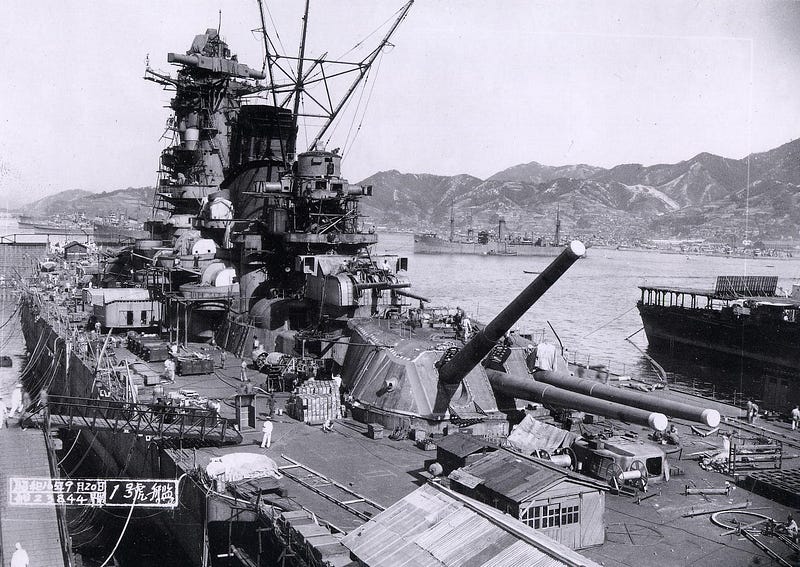
Yamato
Yamato was named after the ancient Yamato province in Japan. It cost the equivalent of $8 billion in today’s money to build. It was originally intended to be part of a group of 4 battleships that would be built the same. It had a sister ship, Musashi. However, the Japanese later decided against building two more ships like it.
The ship was built under extreme secrecy. Its keel was laid down in 1937 at a drydock at Kure Naval Arsenal, Hiroshima. The dock needed to be deepened for its construction.
The Japanese officials in charge of the production of this battleship also installed canopies around the dock to prevent American spies from seeing its construction or learning of its specifications. Japanese workers going in and out of the dockyard were compared with their photos. It took more than 3 years before the ship was finished.
Yamato officially joined the war in late 1941 — a few weeks after the bombings of Pearl Harbor. It was the size of 10 or 15 battleships put together. Its total displacement was 72,808 tons. Its length was 863 feet or 263 meters. Its main battery consisted of 3 giant 40-SK Mod. 94 guns.
They were of an 18-inch caliber. Its secondary battery consisted of two Type 3 guns of 6-inch caliber. Its anti-aircraft artillery consisted of 12 coaxial Type 89 guns of 5-inch caliber and 52 Type 96 automatic cannons that were almost 1 inch in caliber.
The ship was basically armed to the teeth. It was protected by 11–16 inch armor on its main build. The main turrets were protected by 7–26 inch armor. The ship was powered by 154,000 shp. (shaft horsepower) and could travel at a speed of 27 knots (31+ miles per hour). At 16 knots, the ship had an operational range that could easily take it all the way from Japan to the United States shores.
The main turrets of the battleship could fire shells that weighed 1.5 tons at a speed of 2,600 feet per second. They were made to be able to penetrate anything else they might find on the ocean.
Each of these three main turrets had three guns. 150 men could fit inside each turret. The ship had altogether 3000 crew members. This is still the largest battleship that has ever been built today. Nobody has built anything bigger since this was built during World War II.
A Japanese Joke
The ship took part in its first mission on June 4, 1942. It served as an HQ ship and didn’t fire any shots.
It was the flagship of the Japanese Combined Fleet. It remained relatively unused until later in the war because the Japanese commanders were saving it for major battles against the U.S. This later proved to be a mistake as naval military tactics evolved in a way that Yamato couldn’t cope with a few years later.
Japanese soldiers and sailors were disappointed with their flagship and quipped that: “the world’s three most useless things were China’s Great Wall, the Egyptian Pyramids, and the battleship Yamato.”
The Yamato was sent out numerous times since its commission to attack American ships. During the times that Japanese admirals such as Isoroku Yamamoto actually intended to use it for combat, it did not meet any American ships or successfully engage them. Other times, the ship doubled as a command center for the Japanese Combined Fleet.
It eventually became the case that because of its large size, it was used to ferry troops and equipment to other Japanese isles. On December 25, 1943, it was sent out to carry soldiers and armament to the garrisons at Kavieng and the Admiralty Islands. However, it was intercepted by a U.S. submarine named Skate 180 miles out at sea. The submarine fired 4 torpedos at Yamato, one of which tore a hole just below the ship’s anti-torpedo bulge.
The hole was 82 feet across. The hull of the ship was ripped open causing the rear turret’s magazine to flood. It took about 3,000 tons of water as it sailed towards the Truk Islands. Once there, temporary repairs were applied that meant that by January it was able to sail to a proper dock for permanent repairs.
On January 16, 1944, it arrived at Kure, Hiroshima, where for two weeks it was dry-docked and had its torpedo damage fixed. While there, Captain Nobuei Morishita was given command of the ship. Until March they also added more guns to the ship and upgraded its radar and anti-aircraft systems. It was proposed to add even more steel plates to the parts of the ship outside of its armored citadel. But it was decided that it would have made the ship too heavy.
Yamato then underwent some sea trials and then was simply moved around from base to base for another few months until early June of that year, when Yamato and her sister Musashi acted as troop transports to the Philippines as part of Operation Kon. On their way to the Island of Biak, the Japanese commanders were informed of U.S. attacks on the Mariana Islands.
The Imperial Japanese Navy commanders decided to concentrate all of their greatest naval forces in the hopes of securing a decisive victory against the U.S. Pacific Fleet. The famous Battle of the Philippine Sea ensued — or, as it was dubbed by the Americans: The Great Marianas Turkey Shoot.
Japan lost 3 aircraft carriers and 426 aircraft and the Yamato shot at its own returning aircraft by accident. Following this disaster, the ship returned with its tail between its metaphorical legs back to Japan to be refueled and rearmed.
“What was the problem?” Japanese commanders must have asked themselves. “Not enough guns,” they seemed to decide. They added even more guns to the ship.
“Say Hello to My Little Friend” — The Americans
Whereas the Americans did not actually say that, the ensuing battles were even more disastrous for the Japanese Navy. The Japanese fleet had been greatly reduced by U.S. submarines.
In response to this, the Japanese launched Operation Shō-Gō. This involved Japanese forces converging on the island of Leyte, where American troops were landing. This resulted in one of the largest naval engagements in history.
The task force included the Yamato, Musashi, and other battleships, heavy cruisers, and destroyers. While on its way, U.S. submarines sank at least three of their heavy cruisers and battleships.
The next day, while in the Sibuyan Sea, the Japanese force lost three more heavy cruisers, which eliminated most of its air defense abilities. During that day, American aircraft sorted 259 times from the U.S. Essex and landed three armor-piercing bombs on Yamato. It took on another 3,000+ tons of water in its hull.
Its sister, Musashi was the main focus of the American attack. It was sunk after being hit by 17 bombs and 19 torpedoes.
Their next battle near Samar — also in the area — resulted in the Yamato hitting its first surface targets. It was the only time in its entire lifespan it would engage surface targets ie. not airplanes and submarines. The Japanese force managed to destroy two American escort carriers, two destroyers, and two destroyer escorts.
This did not end up as a true win for them, however, because the Yamato was eventually taken out of the fight as it had to steer away from incoming torpedoes and couldn’t rejoin the fight. Also, the Japanese mistakenly thought that the U.S. force was much bigger than it actually was so they withdrew.
The Japanese forces were then split up by the Japanese commanders. As the Yamato was crossing the East China Sea on its way back to Hiroshima for repairs, more of its accompanying fleet was sunk by U.S. submarine Sealion. 1 battleship and 1 destroyer were lost.
Back at Kure docks, the Yamato’s old anti-aircraft guns were replaced with new ones. Aruga Kōsaku was given command of the ship from that point on.
Anti-Aircraft Guns
Japanese historians later said that Yamato’s biggest weakness was its air-defense capability. It had long-range and short-range guns for air defense however if U.S. aircraft flew somewhere in between the ranges of the two types of guns, neither of the two types were effectively able to fire on them.
In actual practice, the Yamato’s guns were slower to fire than they were supposed to be. Also, on top of all of these problems, the guns it did have were just insufficient for defending against large aerial attacks.
Earlier in the article, I wrote that the Yamato was kept by Japanese commanders for large decisive battles, which resulted in it not seeing much combat for years after its construction. Since the ship was planned in 1935, naval wars changed significantly to rely far more on aerial bombardment. This was what the Yamato was least well prepared for.
Its Last Battle
The U.S. bombed Kure where the Yamato was stationed in March 1945. However, Yamato sustained almost no damage and Japanese fighter planes dispersed the American attack force. 16 other warships had been hit, but the damage was not irreparable.
The U.S. at the time planned to invade the Japanese mainland. Part of the beginning of that plan was the attack and invasion of the island of Okinawa — codenamed Operation Iceberg by U.S. forces. At the start of April, the Japanese launched Operation Ten-Go which was a Bushido Samurai style mission in which the Yamato, one cruiser, and eight destroyers would attack the U.S. invading forces or die trying.
Unfortunately for the Japanese, the U.S. had decrypted their radio transmissions and knew that this force was on its way. They prepared a carrier strike force to intercept the Yamato before it could reach the vulnerable landing craft. This was a really good move because the Japanese had ordered the Yamato to beach itself once it began taking water and serve as an “unsinkable gun emplacement” on the beaches of Okinawa.
Hellfire from the Sky
At 12:30 on April 7, 1945, 280 U.S. bombers and torpedo bombers (both in the form of aircraft) loomed over the advancing Japanese force. It was the U.S. Taskforce 58. They first took out a straggler ship, the Asashimo, which had fallen out of formation.
Seven minutes later, they began dropping bombs on Yamato. According to Naval Legends, the Americans knew that the ship was the pride and last hope of the Japanese navy. Their attacks were a demonstrative execution.
Four bombs hit Yamato, taking out a 5-inch gun and several automatic cannons. In the next 20 minutes, two more armor-piercing bombs hit Yamato, and a torpedo hit her portside. In response, the Yamato fired her anti-aircraft guns.
By 14:02, the Americans launched their second attack on the wounded Yamato ship. Four more torpedoes delivered by aircraft hit the Yamato, destroying its already damaged control center. It stopped being able to move and began slowly tipping.
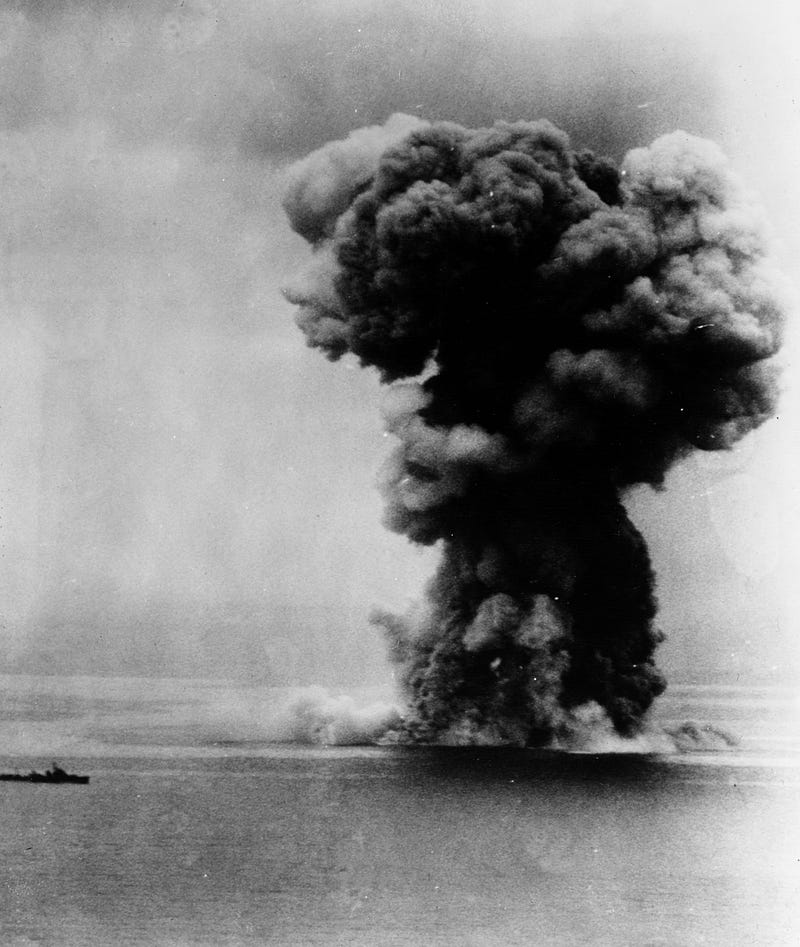
When the ship capsized, a mushroom cloud formed as a result of the explosion of one of her two bow magazines. It rose 3.7 miles/ six kilometers into the air. The Americans took photos. 3,000 crew members as well as the Japanese commanders went down with the ship. Some swimming crew members were sunk under by the suction created by the sinking ship.
About 300 Japanese sailors survived and were carried back to Japan on the surviving destroyers as the whole force retreated.
It is not confirmed exactly by how many bombs and torpedoes the Yamato was hit in order to sink it, but it is estimated that it took at least 11 torpedos and six bombs. Other ships can be sunk by just one torpedo — as a comparison.
Conclusion
Something really great was built by the Japanese military and then saved for too long until the Americans already knew how to handle it — through aerial bombardment. Saving your best for last did not work for the Japanese military and the existence of the Yamato was incredibly wasteful considering how little action it saw in its lifetime.
It was described as having the best of everything. But everything did not work well together. For instance, it had the biggest guns and thickest armor. However, as a result, its fire rate was sometimes too slow. The ship was also made to destroy other ships, which is why it was a mistake for the Japanese commanders to save it until the U.S. had built a huge fleet of aircraft carriers for aerial bombardment.
Its commanders had been successful before taking command of the Yamato. However, the Yamato had never performed remarkably well in any single battle — even shooting at Japanese planes during one mission. Its main purpose throughout the war — though initially unintended — was to ferry troops and munition.
It was a great ship and an even greater disappointment for the Japanese navy and the Japanese soldiers who thought of the Yamato as their lucky charm for a while — before calling it useless.
This giant currently lies under the ocean, from where people have been unable to remove it so far. Thank you for reading.
References:
https://www.navygeneralboard.com/top-10-biggest-battleships-of-all-time/#:~:text=Yamato%20Class%20(71%2C659%20Long%20Tons)&text=Being%20the%20battleships%20that%20were,the%20largest%20battleships%20ever%20built. https://www.youtube.com/watch?v=zYrj3gzXgeA&t=616s&ab_channel=WorldofWarshipsOfficialChannel https://en.wikipedia.org/wiki/Japanese_battleship_Yamato https://www.goodreads.com/book/show/801473.A_Glorious_Way_to_Die


