avatarJosep Ferrer

Free AI web copilot to create summaries, insights and extended knowledge, download it at here

4959

Abstract

://readmedium.com/10-basic-sql-commands-for-every-developer-out-there-programming-pyrhon-data-science-learning-basics-notions-700793fdc4ed">basic commands of SQL</a>. Some common SQL commands include <code>CREATE</code> ,<code>SELECT</code>, <code>INSERT</code>, <code>UPDATE</code>, and <code>DELETE</code>.<i> These commands are used to create, retrieve, add, modify, and delete data in a database, respectively.</i></p><div id="17cc" class="link-block"> <a href="https://readmedium.com/10-basic-sql-commands-for-every-developer-out-there-programming-pyrhon-data-science-learning-basics-notions-700793fdc4ed"> <div> <div> <h2>10 Basic SQL Commands for Every Developer Out There</h2> <div><h3>And how to crush into SQL mastering them.</h3></div> <div><p>medium.com</p></div> </div> <div> <div style="background-image: url(https://miro.readmedium.com/v2/resize:fit:320/1*8L5rELNMDQl9N_6R0u6v4w.png)"></div> </div> </div> </a> </div><p id="877d">To learn SQL there are plenty of free resources. I strongly recommend following the <a href="https://www.w3schools.com/sql/">W3Schools SQL Tutorials</a> or<a href="https://medium.com/r?url=https%3A%2F%2Fsqlbolt.com%2F"> SQLBolt.</a> YouTube has plenty of channels as well. One of my favorites is the following one!</p> <figure id="571e"> <div> <div> <img class="ratio" src="http://placehold.it/16x9"> <iframe class="" src="https://cdn.embedly.com/widgets/media.html?src=https%3A%2F%2Fwww.youtube.com%2Fembed%2FzbMHLJ0dY4w%3Ffeature%3Doembed&amp;display_name=YouTube&amp;url=https%3A%2F%2Fwww.youtube.com%2Fwatch%3Fv%3DzbMHLJ0dY4w&amp;image=https%3A%2F%2Fi.ytimg.com%2Fvi%2FzbMHLJ0dY4w%2Fhqdefault.jpg&amp;key=a19fcc184b9711e1b4764040d3dc5c07&amp;type=text%2Fhtml&amp;schema=youtube" allowfullscreen="" frameborder="0" height="480" width="854"> </div> </div> </figure></iframe></div></div></figure><h1 id="9c6c">#3. Create your first data table</h1><p id="b0e1">Next, <b>you can start practicing your SQL skills by working with sample databases or creating your own. </b>As you need some sample data to upload and start working with it,<b> <i>y</i></b><i>ou can use the worldcities CSV file that is attached <a href="https://github.com/rfeers/Medium/tree/main/Sample%20Data%20for%20Beginners">here</a>.</i></p><p id="a33d">Following this tutorial, you can import your first table into your MySQL environment.</p> <figure id="da3d"> <div> <div> <img class="ratio" src="http://placehold.it/16x9"> <iframe class="" src="https://cdn.embedly.com/widgets/media.html?src=https%3A%2F%2Fwww.youtube.com%2Fembed%2FXgN816pc9lA%3Ffeature%3Doembed&amp;display_name=YouTube&amp;url=https%3A%2F%2Fwww.youtube.com%2Fwatch%3Fv%3DXgN816pc9lA&amp;image=https%3A%2F%2Fi.ytimg.com%2Fvi%2FXgN816pc9lA%2Fhqdefault.jpg&amp;key=a19fcc184b9711e1b4764040d3dc5c07&amp;type=text%2Fhtml&amp;schema=youtube" allowfullscreen="" frameborder="0" height="480" width="640"> </div> </div> </figure></iframe></div></div></figure><p id="b95f">One your database is created, you can start playing around witin your MySQL environment.</p><h1 id="0847">#4. Practice writing SQL queries</h1><p id="2338"><b>This is the most important step where you practice writing SQL queries to extract, filter, and transform your data. </b>Use commands such as <code>SELECT</code>, <code>JOIN</code>, and <code>GROUP BY</code>. Explore SQL functions and aggregations, such as <code>SUM</code> and <code>AVG</code>.</p><p id="f322">The key concept here is starting with simple queries and gradually move on to more complex ones. It is important you start designing modular and reusable queries since the very beginning. You can check out how to do so in the following link.</p><div id="0d60" class="link-block"> <a href="https://betterprogramming.pub/how-to-structure-readable-and-reusable-sql-queries-623485ac4a36"> <div> <div> <h2>How To Structure Readable and Reusable SQL Queries</h2> <div><h3>The importance of modularity</h3></div> <div><p>betterprogramming.pub</p></div> </div> <div> <div style="background-image: url(https://miro.readmedium.com/v2/resize:fit:320/1*w4VDBeWvtVNwdQ-77fMIBA.png)"></div> </div> </div> </a> </div><h1 id="62dd">#5. Explore advanced SQL concepts:</h1><p id="6b21">Once you have a good grasp of the basics, it’s time to move on to more <a href="https://readmedium.com/4-killer-sql-commands-to-take-your-sql-skills-to-the-next-level-programming-analytics-data-science-query-fb1e76f94052"><b>adva

Options

nced SQL concepts</b></a><b>, such as subqueries, aggregate functions, and stored procedures.</b> These concepts will help you write more complex SQL queries and manipulate data more effectively. A great place to learn these concepts is <a href="https://mode.com/sql-tutorial/"><b>Mode SQL</b></a><b>.</b></p><h1 id="9435">#6. Work on real-world projects</h1><p id="cd4a"><b>The best way to master SQL is by working on real-world projects that involve databases.</b> Try to find a project that interests you and use SQL to retrieve, manipulate, and analyze data. This will help you gain practical experience and develop your SQL skills. You can find some initial ideas and exmples in the following link.</p><div id="f7ab" class="link-block"> <a href="https://www.dataquest.io/blog/sql-projects/"> <div> <div> <h2>10 Exciting SQL Project Ideas for Beginners (2023)</h2> <div><h3>To demonstrate your SQL skills to your future or current employers, you need to create your own projects. This is how…</h3></div> <div><p>www.dataquest.io</p></div> </div> <div> <div style="background-image: url(https://miro.readmedium.com/v2/resize:fit:320/0*t7RY8dup20vteOho)"></div> </div> </div> </a> </div><p id="9178">Another nice course is the <a href="https://8weeksqlchallenge.com">8-week sql challenge by Danny</a>. You will find 8 case studies that will allow you to practice advanced SQL with real-world problems.</p><figure id="13f5"><img src="https://cdn-images-1.readmedium.com/v2/resize:fit:800/0*VpDkpkb4UbVUZTnn.png"><figcaption><a href="https://8weeksqlchallenge.com">8 week SQL challenge by DataWithDanny</a></figcaption></figure><h2 id="5173">Some final tips:</h2><ol><li><b>Practice, practice, practice — </b>The more you work with SQL, the more comfortable and proficient you will become.</li><li><b>Learn from others</b> — Join online communities and forums dedicated to SQL, and take advantage of online resources and tutorials.</li><li><b>Stay up-to-date </b><i>SQL is constantly evolving</i>, so make sure to keep up with the latest trends and best practices by reading blogs and articles on the topic.</li><li><b>Focus on understanding the logic behind the language — </b>SQL is a logical language, so it is important to understand the underlying concepts and principles.</li></ol><p id="d73f"><b>Data always has a better idea — trust it.</b></p><p id="ebcf">You can subscribe to my <a href="https://medium.com/subscribe/@rfeers"><b>Medium Newsletter</b></a><b> to stay tuned and receive my content</b>. <i>I promise it will be unique!</i></p><p id="0d98">If you are not a full Medium member yet, <b>just check it out <a href="https://medium.com/@rfeers/membership">here</a> to support me and many other writers. </b><i>It really helps </i>:D</p><p id="d893">Some other nice medium related articles you should go check out! :D</p><div id="0287" class="link-block"> <a href="https://betterprogramming.pub/5-sql-tips-to-improve-your-queries-58c0e93ff4ef"> <div> <div> <h2>5 SQL Tips to Improve Your Queries</h2> <div><h3>Subtle changes in your code make all the difference</h3></div> <div><p>betterprogramming.pub</p></div> </div> <div> <div style="background-image: url(https://miro.readmedium.com/v2/resize:fit:320/0*EaQRpAo20ZX7ftL0)"></div> </div> </div> </a> </div><div id="1c06" class="link-block"> <a href="https://readmedium.com/4-killer-sql-commands-to-take-your-sql-skills-to-the-next-level-programming-analytics-data-science-query-fb1e76f94052"> <div> <div> <h2>4 killer SQL commands to take your SQL skills to the next level</h2> <div><h3>And how to master these time-saving commands</h3></div> <div><p>medium.com</p></div> </div> <div> <div style="background-image: url(https://miro.readmedium.com/v2/resize:fit:320/1*qzZ-NqlKQ96IqUqpIO_f1Q.png)"></div> </div> </div> </a> </div><div id="92f1" class="link-block"> <a href="https://betterprogramming.pub/how-to-structure-readable-and-reusable-sql-queries-623485ac4a36"> <div> <div> <h2>How To Structure Readable and Reusable SQL Queries</h2> <div><h3>The importance of modularity</h3></div> <div><p>betterprogramming.pub</p></div> </div> <div> <div style="background-image: url(https://miro.readmedium.com/v2/resize:fit:320/1*w4VDBeWvtVNwdQ-77fMIBA.png)"></div> </div> </div> </a> </div></article></body>

6 steps to master SQL in 2023 — Breaking it down to basics

The Essential Guide for Newcomers
Self-made image.

SQL — Structured Query Language — is a powerful tool used for managing and analyzing data in relational databases. Whether you are a data analyst, a software developer, or simply someone interested in understanding how databases work, learning SQL can be an incredibly valuable skill to have.

However, for those who are new to SQL, the sheer volume of information can be overwhelming.

In this article, I will break down the basics of SQL to help you get started on your journey to mastering the language in 2023.

Let’s discover together how to crash into SQL 👇🏻

What is SQL and Why is it Important?

Imagine you’re in charge of a library. You have thousands of books, each with its own unique title, author, genre, and publication date. Keeping track of all this information manually would be a daunting task, especially as the number of books in your library grows.

This is where SQL comes in.

SQL is like a magic wand for managing and manipulating all the data in your library — or any other kind of data for that matter.

With SQL, you can easily search for books by title, author, or publication date, and even filter your results to find exactly what you’re looking for. You can also use SQL to update or delete books from your library, and even add new books with all their information in a snap.

But I am pretty sure if you are reading this you already know what’s SQL and its power… right?

To crash into SQL, you can follow 5 basic steps:

#1. Setting up our working environment

Install a SQL databases management system such as MySQL or PostgreSQL, on your computer. And then install the client as well. In my case I installed MySQL and MySQL Workbench, you can know how I did it here or you can go to MySQL’s official guidelines.

In case you prefer PostgresSQL, you can follow the tutorial below.

So now that we got our environment set up, the real magic comes in!

#2. Getting familiar with the basics of SQL

The first step in getting started with SQL is to familiarize yourself with the basics of relational databases.

A relational database is a type of database that organizes data into tables and relationships between those tables. These relationships allow data to be easily linked and queried. In case this is a concept that is completely unknown to you, I strongly recommend pursuing the Stanford Databases: Relational Databases and SQL free course.
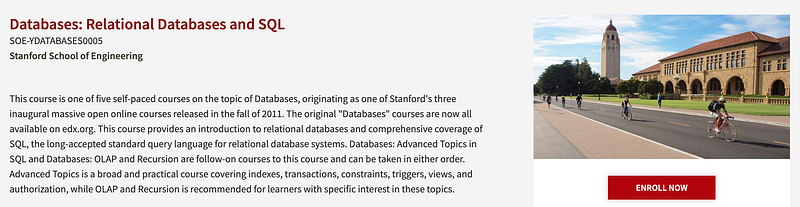
Databases: Relational Databases and SQL wesbite.

Once you have a basic understanding of relational databases, you can begin to learn the syntax and basic commands of SQL. Some common SQL commands include CREATE ,SELECT, INSERT, UPDATE, and DELETE. These commands are used to create, retrieve, add, modify, and delete data in a database, respectively.

To learn SQL there are plenty of free resources. I strongly recommend following the W3Schools SQL Tutorials or SQLBolt. YouTube has plenty of channels as well. One of my favorites is the following one!

#3. Create your first data table

Next, you can start practicing your SQL skills by working with sample databases or creating your own. As you need some sample data to upload and start working with it, you can use the worldcities CSV file that is attached here.

Following this tutorial, you can import your first table into your MySQL environment.

One your database is created, you can start playing around witin your MySQL environment.

#4. Practice writing SQL queries

This is the most important step where you practice writing SQL queries to extract, filter, and transform your data. Use commands such as SELECT, JOIN, and GROUP BY. Explore SQL functions and aggregations, such as SUM and AVG.

The key concept here is starting with simple queries and gradually move on to more complex ones. It is important you start designing modular and reusable queries since the very beginning. You can check out how to do so in the following link.

#5. Explore advanced SQL concepts:

Once you have a good grasp of the basics, it’s time to move on to more advanced SQL concepts, such as subqueries, aggregate functions, and stored procedures. These concepts will help you write more complex SQL queries and manipulate data more effectively. A great place to learn these concepts is Mode SQL.

#6. Work on real-world projects

The best way to master SQL is by working on real-world projects that involve databases. Try to find a project that interests you and use SQL to retrieve, manipulate, and analyze data. This will help you gain practical experience and develop your SQL skills. You can find some initial ideas and exmples in the following link.

Another nice course is the 8-week sql challenge by Danny. You will find 8 case studies that will allow you to practice advanced SQL with real-world problems.

8 week SQL challenge by DataWithDanny

Some final tips:

  1. Practice, practice, practice — The more you work with SQL, the more comfortable and proficient you will become.
  2. Learn from others — Join online communities and forums dedicated to SQL, and take advantage of online resources and tutorials.
  3. Stay up-to-date SQL is constantly evolving, so make sure to keep up with the latest trends and best practices by reading blogs and articles on the topic.
  4. Focus on understanding the logic behind the language — SQL is a logical language, so it is important to understand the underlying concepts and principles.

Data always has a better idea — trust it.

You can subscribe to my Medium Newsletter to stay tuned and receive my content. I promise it will be unique!

If you are not a full Medium member yet, just check it out here to support me and many other writers. It really helps :D

Some other nice medium related articles you should go check out! :D

Programming
Data Science
Sql
Software Development
Data Anlysis
Recommended from ReadMedium