
Master Time Management Through Transitions
Three tips for teachers that help to avoid time wasting habits in the classroom.

The three tips involve investments in:
- Lesson Planning
- Classroom Management
- Discipline Strategies
Time in the Classroom
Time in the classroom takes on a different meaning depending on whether you are a teacher or student, even though both result in the same goal — getting things done.
Time management for teachers means giving the students enough time to get things done.
For students, time management means having the skills and time to get things done.
In the classroom, when students are enjoying the lesson with the teacher, time seems to fly right by.
The true sign that a teacher has delivered a well timed out lesson is that students are left wondering where the time went!
Two Times in the Classroom
At the beginning of every school year I introduce students to the notion that there are “two times” in this classroom.
- Teacher time
- Independent time
Teacher Time
Teacher time is when the class is teacher-led. This is my time as a teacher — no one else’s. I am explaining the lesson and I do not want any unecessary interruptions.
This is NOT the time students can ask to leave the classroom — unless it is an absolute emergency.
You as an experienced adult on bladder control can judge if a student has a ‘bathroom’ emergency.
Independent time
Independent time is when the class is student led. This is where students are doing work independently or in groups to complete an activity.
This IS the time students (one at a time) can ask to leave the classroom, leave their chairs without permission to get supplies for activities, or move around to talk with other students.
It is important that teacher plan for both times in their lesson plan to allow for a change of pace in the classroom that is often needed to benefit teaching and learning.
Avoiding Time-Wasting Habits in the Classroom
Let’s now look at time wasting habits to avoid in helping to improve your time management skills when it comes to teaching.
In this video, I sum up what I share in this article about the three main tips to invest in, inorder to avoid wasting time in the classroom.
If you enjoyed this video, please like it and subscribe to my YouTube channel https://www.youtube.com/@TheETIAcademy
I. Not Making Useful Lesson Plans
Teachers, and myself included, generally hate making lesson plans.
However, it goes without saying that teachers need to come into the class prepared with what they will teach the students.
Making lesson plans helps give teachers a sense of direction with what they will teach while helping to give a sense of how much time it takes.
And what keeps students interested is not so much what the teacher will teach, but how they will teach the material.
Tip #1: Always Keep in Mind “How You Will Teach”
To start your lesson, students need to feel that there will be a clear beginning, middle, and end to the lesson.
They just won’t see the end coming in an interesting lesson!
How you will teach the lesson makes the students more interested in participating.
The best way to approach this is to break up the lesson into different timed activities.
Students shouldn’t be kept sitting in one way for the entire duration of the class time. They need to be allowed to move around for a portion of the class.
Usually this is done when students have some independent time to get activities done. Students can leave their chairs to get supplies for their activities without needing to ask for permission.
II. Not Establishing Classroom Management
Some teachers believe that giving time to establishing classroom management rules and routines is a waste of time.
But the truth is, before any beneficial teaching and learning can take place, there has to be established rules and routines in the classroom.
Classroom management strategies work best with older students when they are involved with the decision making process as to how the classroom will be run.
Including students when establishing classroom rules, extension activities, and discipline strategies gives students a sense of autonomy — which gives them a sense of freedom.
Tip #2: Allow Students to Recognize Their Freedom
Avoid issues with classroom management by having students understand that there are two important “times” in the class.
Yes! The “times” are the “teacher time” and “independent time” I mentioned earlier!
The different labels tell students that there are certain times when they can and can’t ask to leave the classroom.
When students know that they have “independent” time in the classroom, they will feel like they have more freedom.
III. Using Unrealistic Discipline Strategies
When teachers make threats with discipline strategies that don’t seem fair, such as no one is allowed to leave the class for break time, students learn not to respond to the teacher in any positive way.
When students help to establish rewards and consequences for controlling negative behavior, they will show more respect to teachers and students in the classroom.
But how should teachers deal with students who show disruptive behavior?
Tip #3: Allow Students to Time to Reflect
They should ask the students to reflect on their own behavior and how it impacts on others.
How should students reflect?
The teacher could have a discussion with the class if many students were impacted or could ask students to write down their reflection if parents need to get involved.
Both teachers and students need to be aware that their negavtive behavior may have serious and negative impacts on other students.
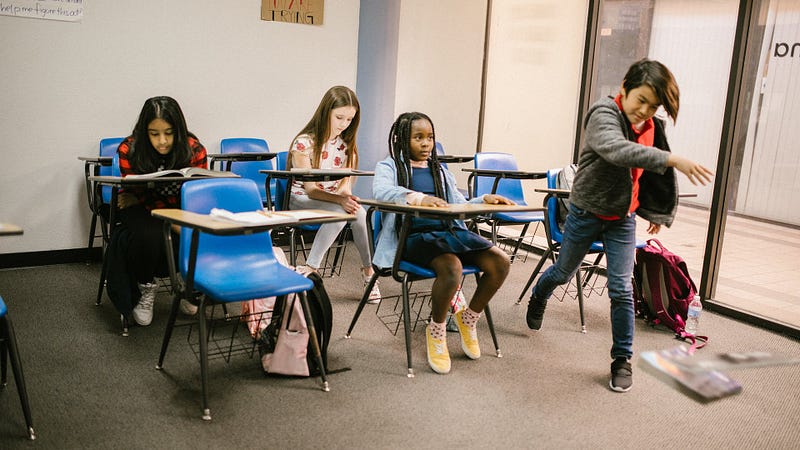
We would hope all behavior in class makes for positive impacts, but we must also know how to deal with negative impacts to students as well.
Final Thoughts…
Bullying (or negative behavior) has no place in the classroom, and students from day one need to acknowledge that the golden rule “treat others the way you want to be treated” serves the purpose of creating a safe space for teaching and learning to take place.
The classroom is a safe space, and anyone who wishes to threaten it will be addressed through understanding, that actions do not happen in a vaccuum.
More than one person will be affected by negative actions in the classroom. When a student misbehaves, it’s not only on them. It reflects on the other students, the teacher, and the parent/guardian of the student.
Think before you speak, or act should be on the forefront of students minds as they will impact many more people than they could imagine.
I hope you enjoyed reading this article and found it useful for building effective time management skills that will help with your educational goals in teaching for years to come!
Please consider reading my other articles on teaching strategies in today’s classrooms.


