
D as Diagramming: The Customer Profile and Life-to-be-Owned
How to develop a Framework with a Metaphor?
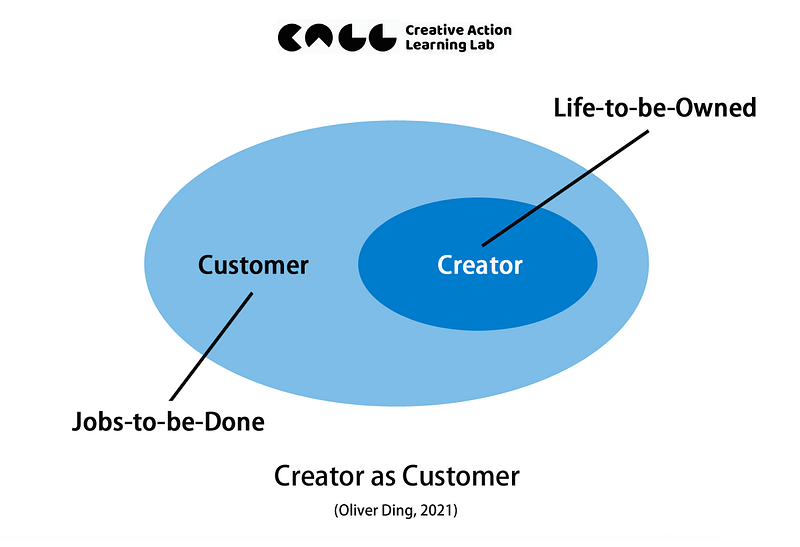
This post aims to introduce a new practical framework for customer research: Life-to-be-Owned. This framework is inspired by Jobs-to-be-Done and the Customer Profile. However, I only pay attention to a special type of customer: Creators.
This article is part of the D as Diagramming project which aims to explore the power of diagrams and diagramming. The D as Diagramming project is organized with several themes and random ideas. For example, iART is a theme that is expanded from one post into a sub-project (1, 2, 3, 4, 5, 6, 7). The Strategic Value Proposition diagram is a random idea, however, it inspired me to design a set of diagrams.
I am also inspired by feedback from friends on social media platforms such as Linkedin and Twitter. The Life-to-be-Owned framework was born from a discussion on Linkedin.
Contents
Part 1: Inspiration
1.1 The Customer Profile 1.2 Gains and Pains 1.3 Life-to-be Owned 1.4 Creator as Customer
Part 2: Jobs-to-be-Done
2.1 Jobs-to-be-Done: A Brief History 2.2 Radical Repurposing 2.3 Jobs as Metaphor
Part 3: Theory-based Reflection
3.1 Activity Theory 3.2 Self-Determination Theory 3.3 Can Activity Theory and SDT work together? 3.4 The Motivation Chain
Part 4: Reflection
4.1 Knowledge Frameworks: Abstract Model and Concrete Model 4.2 Can we use a metaphor to develop a framework? 4.3 Powers of Knowledge Frameworks
Part 1: Inspiration
Part 1 introduces the Customer Profile and the Life-to-be-Owned framework.
1.1 The Customer Profile
On Oct 22, 2021, I published an article and shared the Creative Work Canvas.
The article discussed the difference between diagrams/frameworks and canvases. I used the Customer Profile which is a module of Business Model Canvas as an example and I offered a revised version of it.
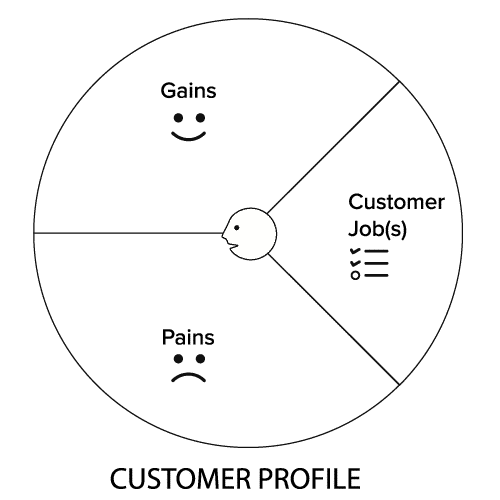
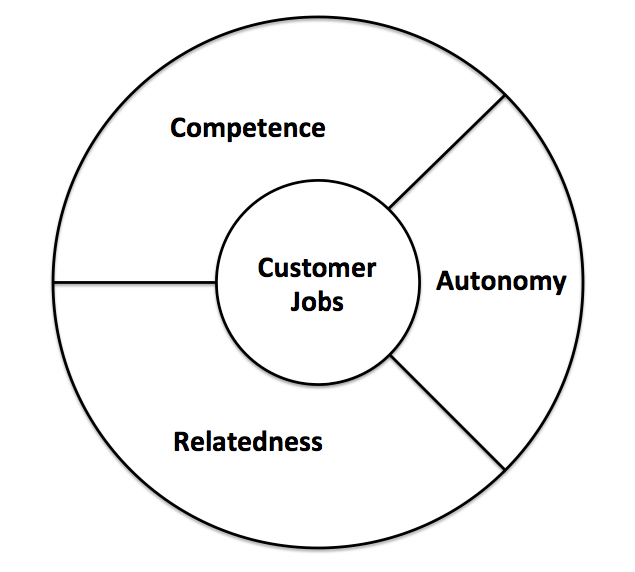
The above-left diagram is the original version of Customer Profile. The right diagram is my version.
I found the original version from a 2014 book titled Value Proposition Design. The Customer Profile module sets three spaces for sense-making: Customer Jobs, Gains, and Pains. According to the authors,
- Customer Jobs: describe what customers are trying to get done in their work and in their lives, as expressed in their own world.
- Gains: describe the outcomes customers want to achieve or the concrete benefits they are seeking.
- Pains: describe bad outcomes, risks, and obstacles related to customer jobs.
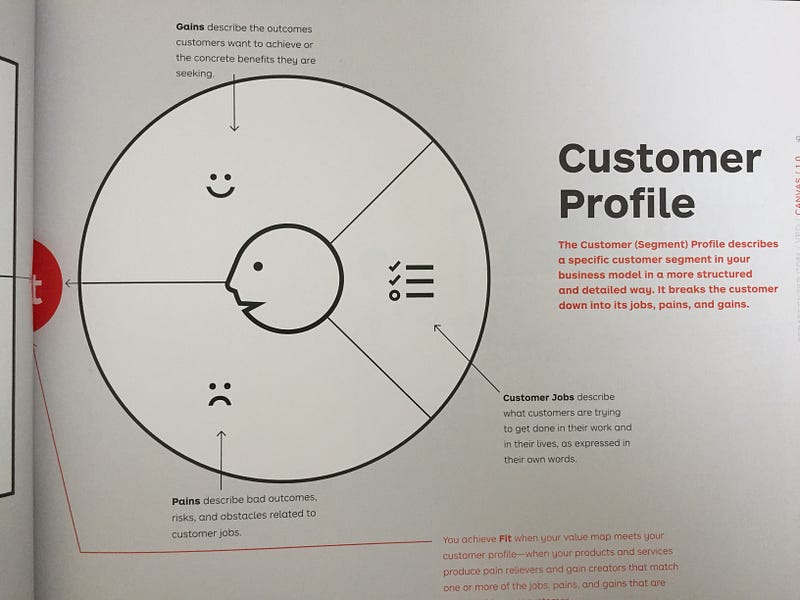
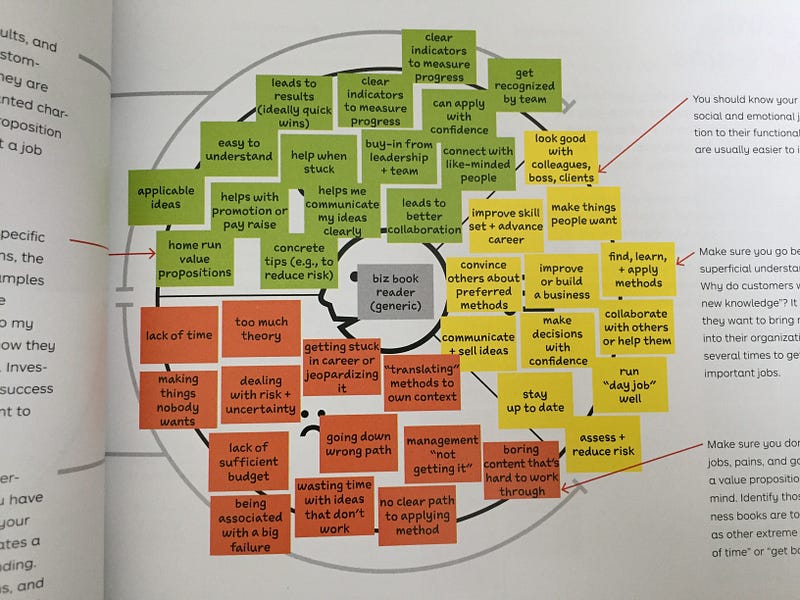
The above two pictures show the original canvas and its one use case. It is clear that the value of a canvas is its status of canvas-in-use for understanding data in order to achieve sensemaking in a special situation. In the case of Value Proposition Design, the situation is designing a business model for a new/old product/service.
Inspired by Peter Gardenfors’ Conceptual Space: The Geometry of Thought, I also suggested a foundational principle for designing canvas:
A good canvas matches visual areas and conceptual spaces with a simple and unique style of spatial configuration.
According to Gardenfors, a Conceptual Space is defined as a set of Quality Dimensions with a geometrical structure. Also, there is a middle layer called Domain in Cardenfors’ theory. As Gardenfors explained, “A domain is a set of integral dimensions that are separable from other dimensions… A conceptual space can then be defined as a collection of one or more domains.”
Let’s use the Customer Profile module as an example. As mentioned above, the Customer Profile module suggests three ideas: Customer Jobs, Gains, and Pains. That means the makers of the canvas set two dimensions for a conceptual space named Customer Profile.
- Dimension 1: Customer Jobs
- Dimension 2: Gains and Pains are two values of the same quality dimension.
Is this conceptualized knowledge a perfect solution for understanding customers? It depends on your perspective. You definitely can develop your knowledge frameworks for studying customers.
I just did an example for this suggestion!
If we review the Customer Profile and we could find there are two quality dimensions:
- Dimension 1: Customer Jobs
- Dimension 2: Impact (Gains=positive impact + Pains=negative impact)
This is the structure of the conceptual space of Customer Profile. Now, let’s review its visual areas. There are three visual areas that correspond to three ideas. However, it doesn’t match the structure of the conceptual space. We can’t perceive any cues of the two dimensions.
It seems this is a “bug” from the perspective of the Conceptual Spaces theory. Can we fix this “bug”? I made a new version of the Customer Profile canvas. See the diagram below.
First, I moved “Customer Jobs” into the center. Second, I use “Competence”, “Autonomy” and “Relatedness” to replace “Gains” and “Pains”.
The new version clearly displays two types of Visual Areas: the center and the surrounding space. People can directly perceive the difference between these two types of areas. The center refers to a dimension while the surrounding space refers to the other dimension. Even though there are three visual areas in the surrounding space, they are perceived as a whole. In this way, we can fix the “bug”.
The three new terms are adopted from Self-Determination Theory (SDT) which is an established psychological theory about human motivation. SDT claims that there are three basic psychological needs for human beings. Thus, the new version of Customer Profile uses Basic Psychological Needs as a domain that has three dimensions.
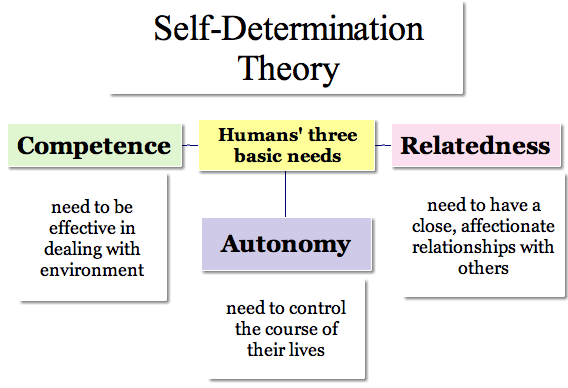
The new version adopts a special psychological theory to develop the conceptual space.
Does every canvas need to adopt theoretical concepts from scholars?
It depends on your motivation.
1.2 Gains and Pains
I shared the article on Linkedin and Jonathan Edwards made comments about Gains and Pains.
I find gains and pains confusing and I am not the only one as many people will often ask if something is a pain or a gain or even a job! People say this does not matter as long as it’s up there on a sticky, but I think it does. As the theory stands you can always convert a gain into a pain and vice versa. One silly example to see this is price, cheap could be a gain but costly is a pain, so what is it? My opinion is that cost is always a pain and that’s that.. Everything is mixed up and badly defined, do pains refer to existing solutions and gains to the solution you want to create?! Then what’s the point of having those two dimensions? won’t you just invert all the pains… There are so many problems with this framework that it’s hard to even know where to begin… I think jobs-to-be-done is much more precise on these questions.
I had never heard of SDT and AT so granted, maybe I don’t know what I am talking about, but my initial reaction to the use of “autonomy”, “competence” and “relatedness” is that this is potentially worse than the Gains — Pains approach. Ok so SDT says those three are people’s most basic needs. Maslow says it is “self-actualization”.
I think the problem is not finding the true fundamental motivation of people, but being clear on what a motivation is and how one can describe it as best as possible.
“It is a risk to directly use uncommon theoretical terms to name visual areas and conceptual spaces for a canvas because people can’t understand it easily. It is also a risk to only use common words to name visual areas and conceptual space because people can’t directly perceive the innovative value of a canvas.” (my original words)
Yes totally agree with you, this is a valid concern if you are using these tools for workshops for example. This is not personally my interest so I prefer clear definitions.”
1.3 Life-to-be Owned
Inspired by Johathan Edwards’ comments, I reviewed the Jobs-to-be-Done framework and I decided to expand the new version of Customer Profile into a new framework.
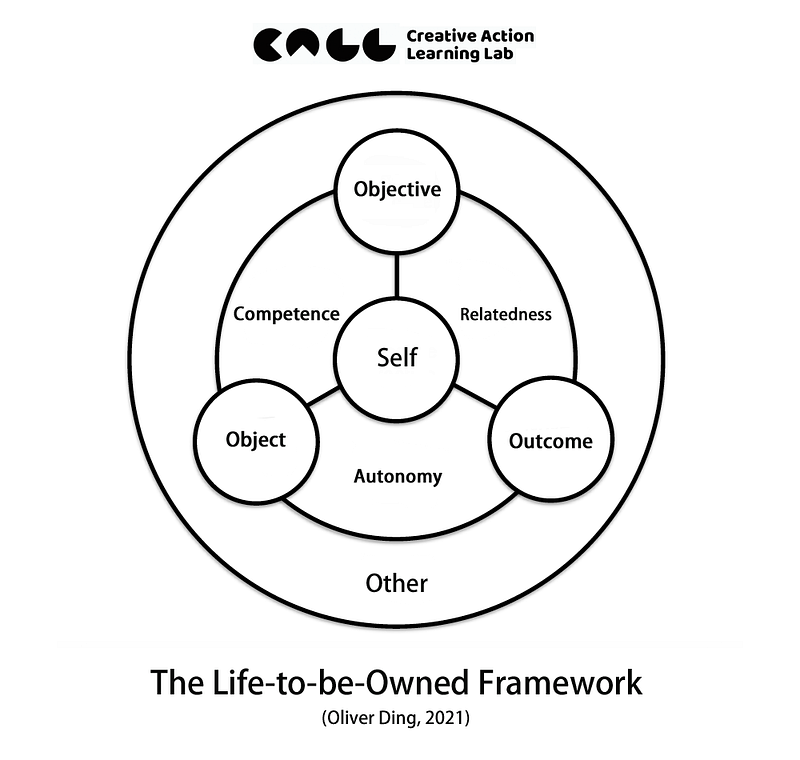
The above diagram is based on the new version of Customer Profile and a meta-diagram called Tripartness. There are three dimensions:
- Dimension 1: Social (Self—Other)
- Dimension 2: Activity (Objective — Object — Outcome)
- Dimension 3: Basic Psychological Needs (Competence — Autonomy — Relatedness)
The term “Customer Jobs” is replaced with “Activity”. In addition, I added “Social” to the framework.
The final result is pretty good. I have been thinking about connecting Activity Theory and Self-determination Theory for a while. The Life-to-be-Owned framework is a good starting point.
1.4 Creator as Customer
The Jobs-to-be-Done framework is an established practical framework for customer study. I am not going to develop an alternative to it. My focus is on creators and knowledge workers. If we consider creators as a special type of customer, then the Life-to-be-Owned framework is suitable for this niche.
If you are researching non-creator customers, you can adopt the Jobs-to-be-Done framework or other frameworks for your projects.
If you want to develop products for creators, you can try the Life-to-be-Owned framework. Since it is an early idea, I’d like to invite you to join me and we can work together on improving it.
I also consider the Life-to-be-Owned framework and the Creative Work Canvas as two components of the Life-as-Activity approach which aims to build a theoretical approach for helping knowledge workers achieve creative life.
Part 2: Jobs-to-be-Done
Part 2 reviews the Jobs-to-be-Done framework. There are two versions of Jobs-to-be-Done, I realized that this is a typical case of Concept Competition. Thus, I adopt Project-oriented Activity Theory to discuss this case.
2.1 Jobs-to-be-Done: A Brief History
The Jobs-to-be-Done framework is developed by Tony Ulwick who is the founder of the innovation consulting firm Strategyn.
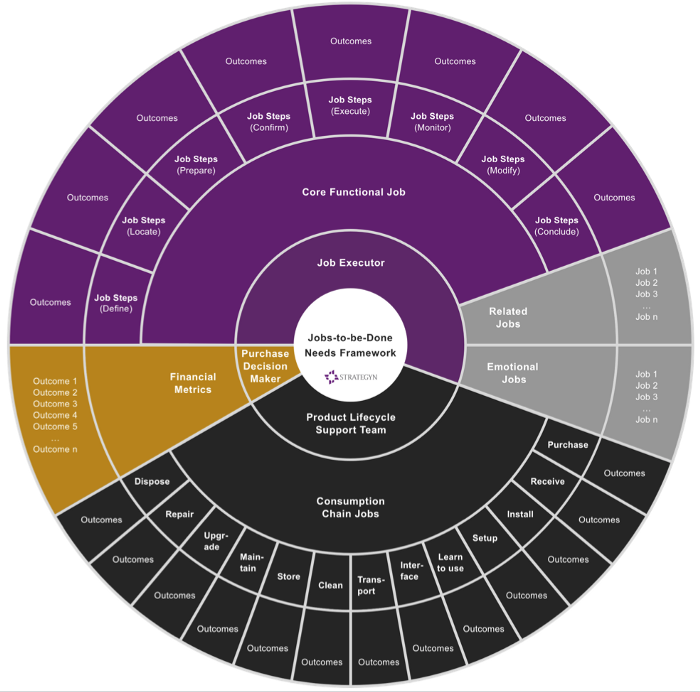
The above diagram is found in Tony Ulwick’s 2017 article: What Is Jobs-to-be-Done?
According to Tony Ulwick, The original idea of Jobs-to-be-Done was a reflection on Six Sigma which is a method of improving processes in the organizational context.
“It was in North Sydney, Australia, with an IBM team in 1990 when I had a mental breakthrough. Six Sigma thinking seeks to improve the quality of the output of a process by identifying and removing the causes of defects. It uses a set of quality management methods, mainly empirical, statistical methods, to address process deficiencies. It occurred to me that we could apply Six Sigma and process control principles to innovation if we studied the process that people were trying to execute when they were using a product or service, rather than studying the product itself. Once we made the process the subject of our investigation, we’d be able to break it down into process steps, study each step in detail, and attach metrics to each step that we could measure and control in the design of a product.” (2018, p.15–16)
In October 1991, Tony Ulwick left IBM and founded The Total Quality Group and named his new method CD-MAP which stands for customer-driven maps. In 1999, the company was renamed to Strategyn and the method was renamed as Outcome-Driven Innovation (ODI).
The name of Jobs-to-be-Done is initiated by Harvard Business School professor Clayton Christensen. Tony Ulwick shared the details of his meeting with Clayton.
“In late 1999, I had the distinct pleasure of introducing Outcome-Driven Innovation and our research and segmentation techniques to Harvard Business School professor Clayton Christensen. We met in his Harvard office on several occasions in the 5 years that followed. I introduced Clay to ODI and showed him examples of how the process was executed and the results it delivered our clients. Clay was quick to key in on the fact that the focus of our approach was not on the customer or the product, but rather on the underlying process the customer was trying to execute, or, as he eventually came to call it, the ‘job’ the customer was trying to get done. Clay was kind enough to cite Strategyn and me as originators of these practices in his 2003 book, The Innovator’s Solution, in which he popularized the idea that people ‘hire’ products to get a ‘job’ done. To this day, Clay continues to be a proponent of Jobs-to-be-Done Theory and a key contributor to its development.” (2018, p.18–19)
In other words, the method was created by Tony Ulwick and it was popularized with a new name “Jobs-to-be-Done” by Clayton Christensen’s naming and writing.
In 2005, Tony Ulwick published a book titled What Customers Want: Using Outcome-Driven Innovation to Create Breakthrough Products. In this book, he used “Jobs-to-be-Done Theory” to describe a higher-level idea and use ODI for a lower-level application method. The new name became a “theory” while the original method became a two-level knowledge product. In 2018, Tony Ulwick published a new book titled Jobs To Be Done: Theory to Practice and he kept the two-level structure for his method.
2.2 Radical Repurposing
In 2016, Alan Klement published When Coffee and Kale Compete: Become Great at Making Products People Will Buy. He repurposed the idea of “Jobs-to-be-Done” and offered a new version of “Jobs-to-be-Done”:
- Jobs-As-Progress: a theory that is promoted by Clayton Christensen, Bob Moesta, and Alan Klement.
- Jobs-As-Activities: an ideology and typology promoted by Anthony Ulwick and licensees of his patented Outcome-Driven Innovation.
This is a typical case of Concept Competition. I have mentioned this topic in a previous article: Activity U (VIIII): Project-oriented Activity Theory. From the perspective of Project-oriented Activity Theory, the process of formation of a concept is an activity/project. Now we can consider the social movement of “Jobs-to-be-Done” as the process of formation of the concept of “Jobs-to-be-Done”.
We should notice that the process of “formation of concept” is a dynamic process. Andy Blunden points out, “A concept is a unit of a social formation and cannot be said to exist until it has achieved a degree of stability and interconnectedness within that form of life. Further, a concept is subject to modification in the course of its objectification which must be taken as part of the concept formation, and not simply the ‘registration’ of the concept.” (2014, p.171) In order words, the key is formation. We should adopt a process view of Concept. The process of “formation of concept” is a process of an idea transforming from an “unreal concept” into a “real concept” through various objectification in the real-life world.
The process is not simple and linear. There are possible misconceptions within different phases. It is possible to enter the initialization phase with a misconception of the situation and start a project with the wrong idea.
Andy Blunden clearly claims that there are three aspects of objectification of a concept: symbolic, instrumental, and practical.
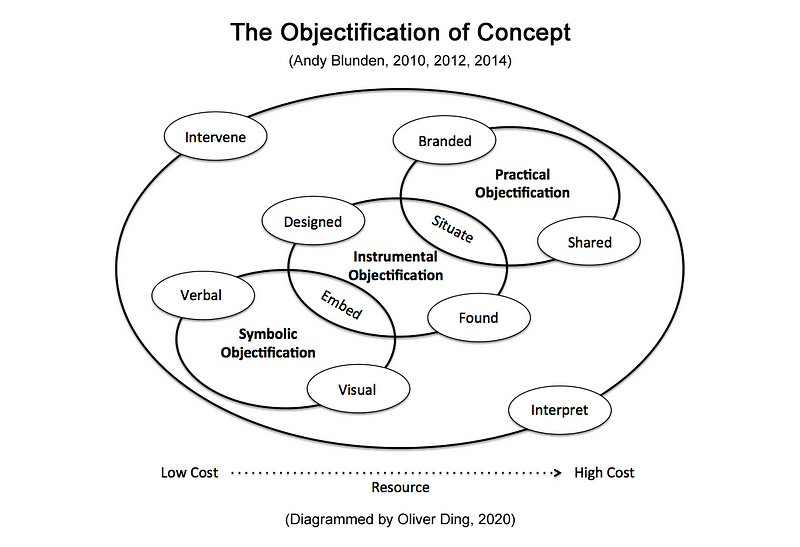
According to Blunden, “Firstly, the moment someone first communicates the concept of the project it is given a name or symbolically represented in some other way, after which the word or symbol functions as a focus for actions. The word eventually enters the language and acquires nuances and meaning through the development of the project and its interaction with other projects and institutions.” (2014, p.9) For the case of Jobs-to-be-Done, the name was given by Clayton Christensen. However, the reality of what the concept refers to is created by Tony Ulwick.
The second aspect of objectification is instrumental objectification. According to Blunden, “Secondly, the project may be objectified by the invention and production of some new instrument or by the construction of material artifacts which facilitate or constrain actions in line with the project and facilitate its integration into the life of a community. The word in which the project is symbolically objectified may then be taken as referencing this artifact, reifying the concept as if it were an independently existing object, rather than an ideal functioning as the focus of a new form of social practice which constitutes it.” (2014, p.9) In the case of Jobs-to-be-Done, we see books, websites, and other things.
If you search “Jobs-to-be-Done”, you will find the following two websites:
- Jobs to be Done (JTBD): https://jtbd.info/
- JTBD+Outcome-Driven Innovation: https://jobs-to-be-done.com/
Kevin Richard made a comment about the “repurposing” and “radical repurposing” of terms/words/concepts. I pointed out two types of outcomes:
- At a particular project, the process might lead to a creative product or an innovation. This means opportunities for the repurposing creators.
- At the idea ecology of a concept, the process might lead to the deconstruction of a concept.
Let’s use the concept of “Affordance” as an example, it was a theoretical concept of Ecological Psychology. However, many other scholars outside Ecological Psychology adopted the concept and redefined it for their own domains. For each domain, the new concept is useful, but for the whole idea ecology of “Affordance”, the concept eventually became a normal word.
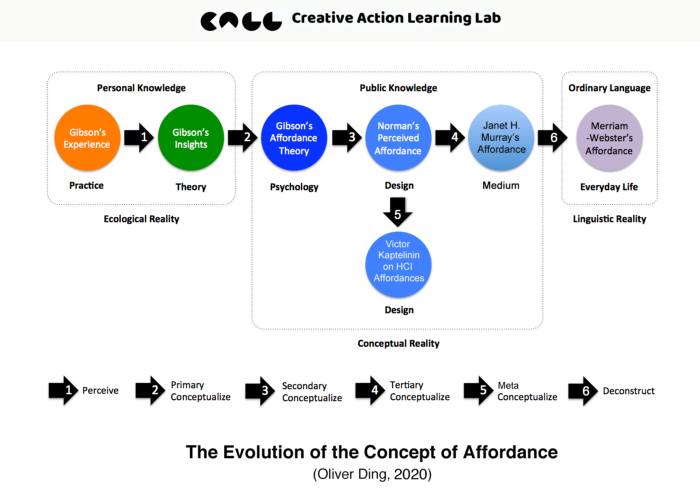
I also conducted a genetic analysis of the development of the “Affordance” Concept Ecology. See the above diagram. I found there are six moments of the development process:
- Perceive: A person perceives a brand new reality in the real-life world and discovers its theoretical value.
- Primary Conceptualize: The person conceptualizes his insights and develops a brand new theoretical concept.
- Secondary Conceptualize: The original theoretical concept is adopted and modified by others. This moment generates first-order variation and second-hand concepts.
- Tertiary Conceptualize: A second-hand concept is adopted and modified by others without returning to the original theoretical concept. This moment generates second-order variation and third-hand concepts.
- Meta Conceptualize: This moment is about reflecting and reviewing the developmental process of a concept ecology.
- Deconstruct: People use the word part of the concept without deeply considering its theoretical meaning and value. An awesome theoretical concept became a buzzword.
You can find more details about the Affordance Analysis project in Knowledge Discovery: The Concept Dynamics Framework.
The case of “Affordance” is about a theoretical concept. There is another type of concept: normal words. For example, “Opportunity”, “Outcome” and other normal words are language words. Scholars or domain researchers can repurpose them and develop them as theoretical concepts.
However, the case of “Jobs-to-be-Done” is about private knowledge. The term “Jobs-to-be-Done” is not a normal word. It refers to Tony Ulwick’s method when the term was named by Clayton Christensen. Later, Alan Klement cut the link between the name (Jobs-to-be-Done) and its reality (Tony Ulwick’s method) and reinterpreted the name Jobs-to-be-Done into Jobs-as-Progress.
Eventually, the concept of Jobs-to-be-Done became a mess at the stage of instrumental objectification.
There is a clear solution to clear this mess. Alan Klement should directly use Jobs-as-Progress, or other names. Customer Research is a big discipline, you can create new concepts as many as you want.
2.3 Jobs as Metaphor
Now let’s review the concept of Jobs-to-be-Done. As mentioned above, this is a name that is a metaphor.
Tony Ulwick developed his method from his practical experience. He also emphasizes that he is a practitioner, “The most rewarding part of my journey has resulted from being a hands-on ODI practitioner. That is my passion. I have led and continue to lead hundreds of innovation engagements with inspiring people in the world’s most admired companies.”
In his 2018 book, Tony Ulwick defined Jobs-to-be-Done as a “needs framework”. He said, “Harvard Business School marketing professor Theodore Levitt said, ‘People don’t want to buy a quarter-inch drill. They want a quarter-inch hole!’ Clayton Christensen said, ‘People buy products and services to get a job done’. In his most recent book, he says, ‘Customers don’t buy products; they pull them into their life to make progress.’ These are the basic constructs of Jobs-to-be-Done Theory, but these constructs are only the tip of the iceberg. Jobs-to-be-Done Theory has a game-changing implication.” (2018, p.47)
Jobs-to-be-Done Theory provides a framework for (i) categorizing, defining, capturing, and organizing all your customer’s needs, and (ii) tying customer defined performance metrics (in the form of desired outcome statements) to the Job-to-be-Done. (2018, p.48)
The framework suggests a typology of “jobs”:
- the core functional jobs
- related jobs
- emotional jobs
- social jobs
- consumption chain jobs
The framework also emphasizes three unique characteristics:
- A job is stable; it doesn’t change over time.
- A job has no geographical boundaries.
- A job is solution agnostic.
Now let’s look at Alan Klement’s version of Jobs-to-be-Done:
A Job to be Done is the process a consumer goes through whenever she aims to transform her existing life-situation into a preferred one, but cannot because there are constraints that stop her.
He clearly rejected Tony Ulwick’s approach. For Alan Klement, it is a mistake to understand a Job to be Done as an activity or task.
The biggest mistake I see is thinking of a Job to be Done as an activity or task. Examples include store and retrieve music, listen to music, cut a straight line, or make a quarter-inch hole. These are not Jobs; rather, they are tasks and activities — which means they describe how you use a product or what you do with it. For example, music streaming products such as Pandora and Spotify were designed specifically so customers didn’t have to store and retrieve music like when they used CDs or MP3s. As far as listening to music, that is a broad activity that varies wildly depending on the context. Someone listening to music, so he can maintain his motivation during a workout, is engaging in a very different activity than someone going to the opera to listen to music. (2016, p.32)
Tony Ulwick used “listening to music” as a typical example of a core functional job. He said:
First, a job is stable; it doesn’t change over time. It’s the delivery vehicle or the technology that changes. Take the music industry, for example. Over the years people have used many products to help them “listen to music” (the Job-to-be-Done). This has included record players, tape and cassette players, compact disc players, MP3s and streaming services. Through this decades-long evolution of drastically changing technology platforms, the Job-to-be-Done has remained the same. The job is a stable focal point around which to create customer value.(2018, p.55-56)
The diagram below is quoted from Alan Klement’s 2016 book.
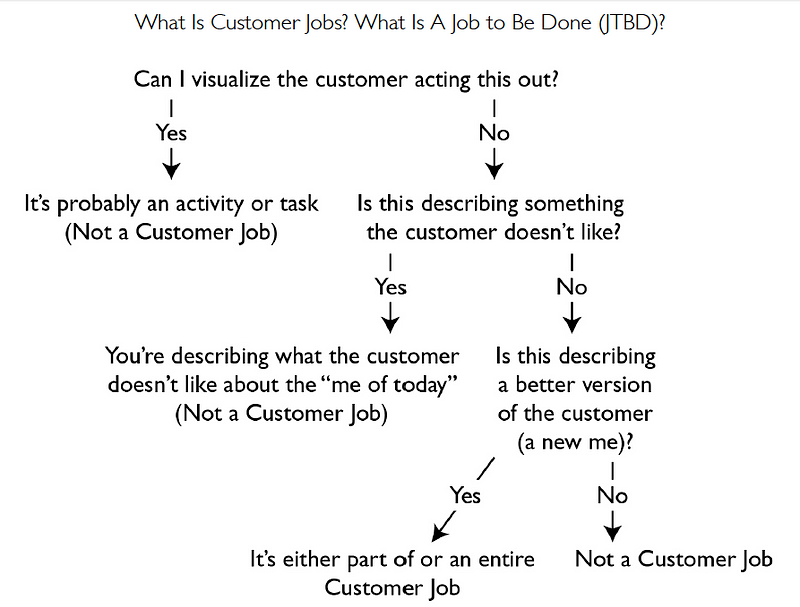
As discussed above, there are two ideas behind the same name “Jobs-to-be-Done”. Each approach has its own perspective. Both versions use Jobs-to-be-Done as a metaphor to develop frameworks.
Why don’t they directly use theoretical concepts to develop frameworks? Why don’t they use “Goals”, “Needs”, “Talks”, and “Outcomes”?
Part 3: Theory-based Reflection
Now we can move to the field of academic research and find some theoretical concepts for our discussion.
3.1 Activity Theory
Let’s use theoretical concepts to talk about customer research. There is a simple framework for discussing activities from Activity Theory.
Activity Theory or the “Cultural-historical activity theory (CHAT)” is an interdisciplinary philosophical framework for studying both individual and social aspects of human behavior. From the perspective of Activity Theory, human activity or ‘what people do’ represents the basic unit of analysis when studying human behavior. The most important aspect of Activity Theory is understanding both individual and collective aspects of human practices from a cultural and historical perspective.
A major account of Activity Theory is A. N. Leontiev’s activity approach to psychological theory. In 2012, Kaptelinin and Nardi summarized five basic principles of Leontiev’s activity theory:
- Object-orientedness
- The hierarchical structure of activity
- Mediation
- Internalization and externalization
- Development
The hierarchical structure of activity was originally conceptualized by A. N. Leontiev (1978). Leontiev wanted to develop a psychological theory at the individual level with the concept of Activity. Thus, we will see three levels of activity correspond to three levels of psychological notions.
Let’s see a diagram first. I found the following diagram from Victor Kaptelinin and Bonnie A. Nardi’s book Acting with Technology (2006, p.64). The three levels of activity are activity, actions, and operations. The three levels of psychological notions are motive, goals, and conditions.
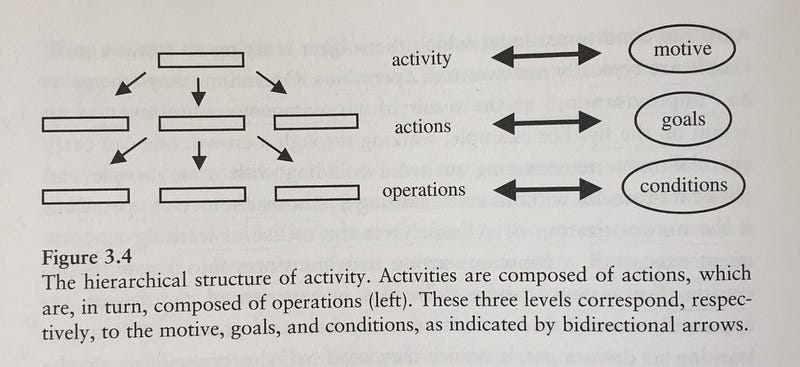
According to Leontiev, “Separate concrete types of activity may differ among themselves according to various characteristics: according to their form, according to the methods of carrying them out, according to their emotional intensity, according to their time and space requirements, according to their physiological mechanisms, etc. The main thing that distinguishes one activity from another, however, is the difference of their objects. It is exactly the object of an activity that gives it a determined direction.” (1978, p.98)
So, what’s the object of activity?
The answer from Leontiev is the motive of activity. Leontiev claimed, “According to the terminology I have proposed, the object of an activity is its true motive. It is understood that the motive may be either material or ideal, either present in perception or exclusively in the imagination or in thought. The main thing is that behind activity there should always be a need, that it should always answer one need or another.” He also added a note about the term motive, “Such restricted understanding of motive as that object (material or ideal) that evokes and directs activity toward itself differs from the generally accepted understanding”. (1978, p.98)
After defining the “activity — motive” level, Leontiev moved to its sub-level: the “action — purpose” level. He said, “We call a process an action if it is subordinated to the representation of the result that must be attained, that is, if it is subordinated to a conscious purpose. Similarly, just as the concept of motive is related to the concept of activity, the concept of purpose is related to the concept of action.” (1978, p.99)
Leontiev also used “goal-directed processes” and “actions” interchangeably. For example, he said, “We call a process an action if it is subordinated to the representation of the result that must be attained, that is, if it is subordinated to a conscious purpose. Similarly, just as the concept of motive is related to the concept of activity, the concept of purpose is related to the concept of action.” (1978, p.99)
You can find more details about the hierarchy of human activity and social practice in a previous article.
The value of Activity Theory is that it considers “Mind — Activity” in one theoretical framework. If we adopt this perspective to see the debate between two versions of Jobs-to-be-Done, then we can realize that these two approaches are talking about two parts of a whole. We should notice that there are five basic principles of Leontiev’s activity theory. Other principles are Object-orientedness, Mediation, etc.
- Object-orientedness: Jobs-to-be-Done is the Object of Activity Theory.
- Mediation: Products are Mediation that helps people archive their objects.
Alan Klement emphasizes his definition of Jobs-to-be-Done: “better me”.
Keep in mind that a Job to be Done describes the “better me.” It answers the question, “How are you better since you started using [product]?”and “Now that you have this product, what can you do now that you couldn’t do before?” Renowned psychologist Albert Bandura described humans as “proactive, aspiring organisms”. Customer Jobs carries this idea into markets, making the claim that we buy and use things to improve ourselves, to make progress. If you’re not describing a Customer Job in terms of progress, you’re probably describing something else.(2016, p.35)
The term “better me” is a metaphor too. We can understand it from the theoretical concept of “transformation” of Activity Theory. According to Victor Kaptelinin and Bonnie A. Nardi, “Leontiev extends and develops the original scope of Rubinshtein’s principle of ‘unity and inseparability of consciousness and activity,’ in three respects. First, Leontiev states that psychological studies should not focus only on the ‘psychological aspect of facet of activity’ (as suggested by Rubinshtein), such as the relationship between activity and subjective experience. Instead, he maintained that the relevance of activity to psychology is of a more general nature: activity is of fundamental importance to psychology because its special function, ‘the function of placing the subject in the objective reality and transforming this reality into a form of subjectivity’ (Leontiev, 1975)…” (2012, p.20)
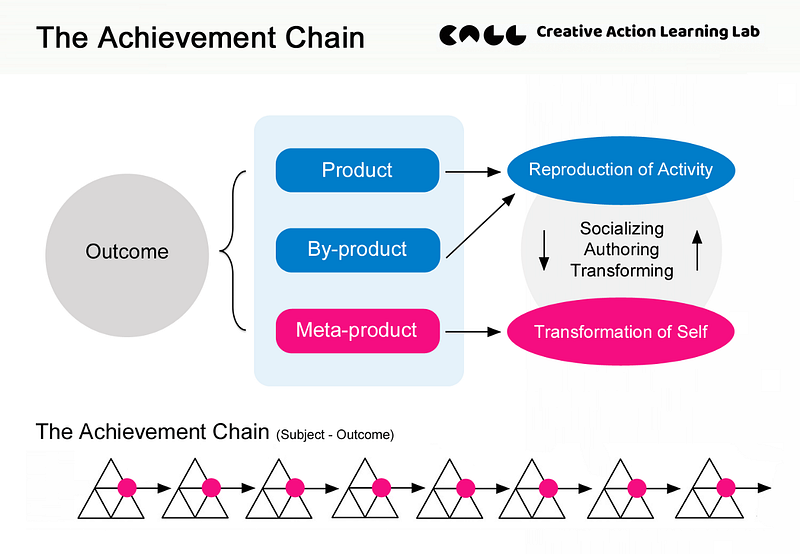
I also use a simple diagram to describe the relationship between object and outcome in a previous article Life as Activity (v0.3). The Life-as-Activity approach understands Development as an interactive process of Reproduction of Activity and Transformation of Self. The outcome of the activity generates product, by-product, and meta-product. Product and by-product generate new activity while meta-product contributes to the transformation of self which leads to better individual performance within the new collective activity.
Finally, I’d like to discuss Object and Objective. This is a complex issue of Activity Theory. According to Kaptelinin and Nardi (2012), “In Russian there are two words with similar but distinct meanings: objekt and predmet. Both refer to objectively existing entities, but the notion of predmet typically also implies a relevance of the entity in question to certain human purposes or interests…Leontiev deliberately referred to the object of activity as predmet rather than object. However, this distinction is usually lost in English translation since both words are translated as ‘object.’ ” (p.29)
Some North American scholars use a special format to use the concept of objective: object(ive). I personally use Object (what is acted on) and Objective (what is motive about) for some frameworks.
3.2 Self-Determination Theory
Now let’s move to a general psychological theory of human behavior and personality development: Self-Determination Theory (SDT). There are so many established motivation theories. The reason why I choose SDT for our discussion is that it is particularly concerned with how social-contextual factors support or thwart people’s thriving through the satisfaction of their basic psychological needs for competence, relatedness, and autonomy.
SDT is an empirical humanistic psychological theory. As an empirical approach, SDT is developed with empirical methods such as operational definitions, observational methods, and statistical inferences. As a humanistic approach, SDT rejects the behaviorist perspective of psychology.
According to Richard M. Ryan and Edward L. Deci, “…one can observe the human capacities to be apathetic and alienated, to disconnect from and dehumanize others, and to behave in ways that imply fragmentation and inner division rather than integration. These seemingly contradictory human natures, with capacities for activity and passivity, integrity and fragmentation, caring and cruelty, can be theoretically approached in different ways. As briefly mentioned, one approach, taken by the more behavioristic schools of thought, has assumed that organisms can be conditioned, programmed, or trained to be more ‘positive’ in functioning, or they can be programmed, conditioned, or trained to be more ‘negative.’ In other words, the contradiction is resolved within such theories by assuming a relatively empty or highly plastic organism that is shaped to be either more positive or more negative, with little need to consider the constraints or contents of human nature.” (2017, p.9)
In recent years, we have been seeing a popular discussion about behavior design and the science of persuasion within the design and development of digital platforms. One example of such a discussion is a 2016 article The Scientists Who Make Apps Addictive which was published in The Economist’s 1843 magazine. The beginning of the article introduced B.F. Skinner and the Skinner Box, “In 1930, a psychologist at Harvard University called B.F. Skinner made a box and placed a hungry rat inside it. The box had a lever on one side. As the rat moved about it would accidentally knock the lever and, when it did so, a food pellet would drop into the box. After a rat had been put in the box a few times, it learned to go straight to the lever and press it: the reward reinforced the behaviour. Skinner proposed that the same principle applied to any ‘operant’, rat or man. He called his device the ‘operant conditioning chamber’. It became known as the Skinner box. Skinner was the most prominent exponent of a school of psychology called behaviourism, the premise of which was that human behaviour is best understood as a function of incentives and rewards. Let’s not get distracted by the nebulous and impossible to observe stuff of thoughts and feelings, said the behaviourists, but focus simply on how the operant’s environment shapes what it does. Understand the box and you understand the behaviour. Design the right box and you can control behaviour.”
In a 2018 article titled The 21st Century Skinner Box, the author Ronald E. Robertson points out, “Unlike behavior scientists of the past, engineers and designers working at companies like Google, Amazon, Facebook, Microsoft, and Apple have enormous sample sizes to draw from, and the nature of digital environments allows them to rapidly adjust their experiments on the fly. The shape and color of the buttons you press, the timing of each notification you receive, and the content of every piece of information that reaches you have often been curated through this data-driven process of mass experimentation. And companies don’t just run these experiments once; they run them over and over again, storing each stimulus and response, customizing reinforcers and schedules of reinforcement to maximize their influence. Over time, this enables companies to predict, shape, and condition each user’s habits and triggers on a scale previously unimaginable.”
Ryan and Deci consider SDT as an alternative to Behaviorism. They emphasize that the assumption behind SDT is a human nature “which is deeply designed to be active and social and which, when afford a ‘good enough’ (i.e., a basic-need-supportive) environment, will move toward thriving, wellness, and integrity. Yet some of the very features of this adaptive nature also make people vulnerable to being derailed or fragmented when environments are deficient in basic need support. Social contexts can be basic need-thwarting, with various developmental costs, including certain defensive or compensatory strategies… According to SDT, therefore, our manifest human nature is, to a large degree, experience dependent — its forms of expression are contingent on the conditions of support versus thwarting and satisfaction versus frustration of these basic needs. SDT places human beings, with their active, integrative tendencies, in dialectical relation with ambient social contexts that can either support or thwart those tendencies.” (2017, p.9)
Unlike Behaviorism, the SDT approach accepts both “bad” and “good” environments from the dialectical stance. Ryan and Deci give a definition of the “good” environment, “We thus characterize social environments in terms of the extent to which they are: (1) autonomy supportive (versus demanding and controlling); (2) effectance supporting (versus overly challenging, inconsistent, or otherwise discouraging); and (3) relationally supportive (versus impersonal or rejecting). Autonomy support includes affordances of choice and encouragement of self-regulation, competence supports include provisions of structure and positive informational feedback, and relatedness supports include the caring involvement of others.” (2017, p.12)
The basis of SDT is a special view of human needs. SDT theorists claim that there is a core set of psychological needs which are universally essential for optimal human functioning, regardless of developmental epoch or cultural setting. Ryan and Deci point out, “Within SDT, needs are specifically defined as nutrients that are essential for growth, integrity, and well-being…SDT’s three basic psychological needs are those for autonomy, competence, and relatedness.” (2017, p.10) The whole account of SDT is based on these three basic psychological needs.
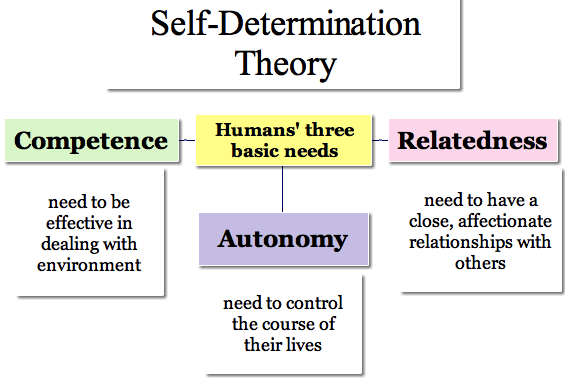
Ryan and Deci also made a distinction between basic physiological needs and basic psychological needs. The former refers to nutrients required by bodily health and safety, “include such requirements as oxygen, clean water, adequate nutrition, and freedom from physical harms.”(2017, p.10)
In order for further discussion, I’d like to adopt a model developed by Ellen Skinner and Kathleen Edge in 2000. According to the authors, “The motivational model is an action-theoretical account of motivation, and its goal is to provide a framework for explaining psychological sources of energized and directed action. The basic model integrates work on attachment, perceived control, and self-determination.”
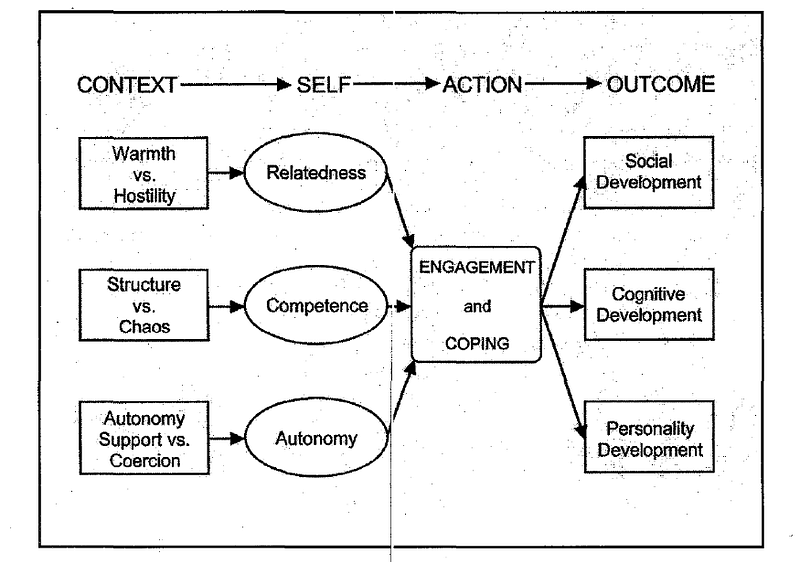
The model is based on Self-determination Theory (SDT). Skinner and Edge pointed out, “Ongoing engagement refers to active, goal-directed, flexible, constructive, persistent, focused interactions with the social and physical environments. In contrast, patterns of action are described as disaffected when individuals are emotionally alienated or behaviorally disengaged from participation in an enterprise. Coping describes patterns of action when ongoing engagement encounters resistance or is disrupted. Energetic resources (effort, executive capacity, ego resources) are required to regulate actions. Action regulation under stress is considered ‘coping.’ Engagement and coping are critical mechanisms through which motivational processes influence the quality of self-systems and social relationships and, over time, shape development.”
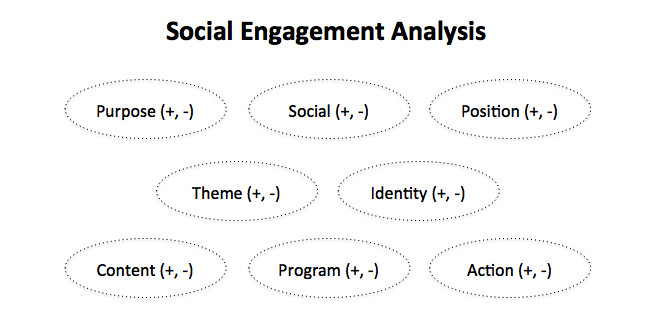
In the Developmental Project model, I adopt Skinner and Edge’s model to develop a module. This module refers to positive impact (Engagement) and negative impact (Coping).
3.3 Can Activity Theory and SDT work together?
The above discussion introduces Activity Theory and Self-determination Theory (SDT). Let’s put them together and design a practical framework for discussing Creators as Customers.
Activity Theory and Self-determination Theory (SDT) are two different psychological theories. Can they work together?
First, the Life-to-be-Owned framework is a practical framework that aims to offer a tool for discussing a special type of customer: creators. The goal of the framework is not to combine these two theories into a new theory.
Second, both theories have their own shortcomings. Self-determination Theory (SDT) only discusses motivation and doesn’t pay attention to the structure of activity and the meditation of objects while Activity Theory doesn’t offer a concrete description of motivation. For example, Activity Theory doesn’t offer concepts such as competence, relatedness, and autonomy. For the Life-to-be-Owned framework, these two accounts just complement each other.
Third, Activity Theorists tend to use qualitative research methods for empirical studies while Self-determination Theory (SDT) adopts the quantitative method to study human motivation. For the Life-to-be-Owned framework, we can access rich and diverse knowledge resources from these two disciplines.
Fourth, both theories have similar views about the “self-world” relationship. According to Ryan and Deci, there are two views of self in the field of psychology, “The term self carries quite distinct meanings in different psychological theories, and there is a particularly salient contrast between its meaning within social-cognitive perspectives and in organismic approaches. Most social-cognitive views can be traced to the tradition of the looking-glass self (Cooley, 1902; Mead, 1934), in which the term self is primarily employed to represent an object of one’s own perception. In this tradition, the self is understood as a constructed concept, image, or representation (viz., self-concept) accompanied by a collection of mechanisms for governing action (viz., self-schemas) that are usually oriented toward verifying, enhancing, or protecting this representation. Thus the self is referred to…as self-as-object…By contrast, the self of organismic psychologies has typically (though with some notable exceptions) concerned what McAdams (1990) characterized as the self-as-subject and what we refer to as self-as-process…For our purposes thus far, our discussion has merely highlighted that from a self-as-process view the self is not primarily an object of perception or evaluation but, rather, is phenomenally accessed as the sense of activity in contacting, relating, assimilating, constructing, and caring in the world.” (2017, p.52-53)
Though Activity Theory doesn’t consider the term “self” as a core concept, it embraces the inseparability of subjects and objects. According to Kaptelinin and Nardi (2012), “Activity,” the foundational concept of activity theory, is understood as a relationship between the subject (that is, an actor) and the object (that is, an entity objectively existing in the world). The concept refers to a special type of relationship between the subject and the object; it is characterized by two distinctive features: (a) subjects of activities have needs, which should be met through subjects’ interaction with the world, and (b) activities and the entities they are relating (i.e., subjects and objects) mutually determine one another. More generally, activities are generative forces that transform both subjects and objects.” (2012, p.12)
We can consider this view echoes SDT’s self-as-process within the social context.
3.4 The Motivation Chain
For the Life-to-be-Owned framework, the name “Life-to-be-Owned” is a metaphor that refers to an ideal life. If a person owns his life, then it means his life activities are self-determined. For creators, I think their main life activities are creative works.
Kaptelinin (2005) pointed out, “…the object of activity can be defined as ‘the sense-maker’ which gives meaning to and determines values of various entities and phenomena. Identifying the object of activity and its development over time can serve as a basis for reaching a deeper and more structured understanding of otherwise fragmented pieces of evidence.” According to Kaptelinin, the original Leontiev (1975/1978) definition of the object of activity as “its true motive” has some conceptual issues. He argued, “If the object of activity is its true motive, then two concepts — ‘the object of activity’ and ‘the motive of activity’ — mean basically the same thing.” He suggested that it is better to separate the object of activity from the motive of activity in order to deal with poly-motivated activities.
This suggestion creates room for connecting Activity Theory and SDT. In a previous article, I introduced an idea called the motivation chain in order to discuss the “subject-object” relationship. The diagram below summarizes the discussion about the motivation chain by combining three basic psychological needs and four criteria for good objects of activities.
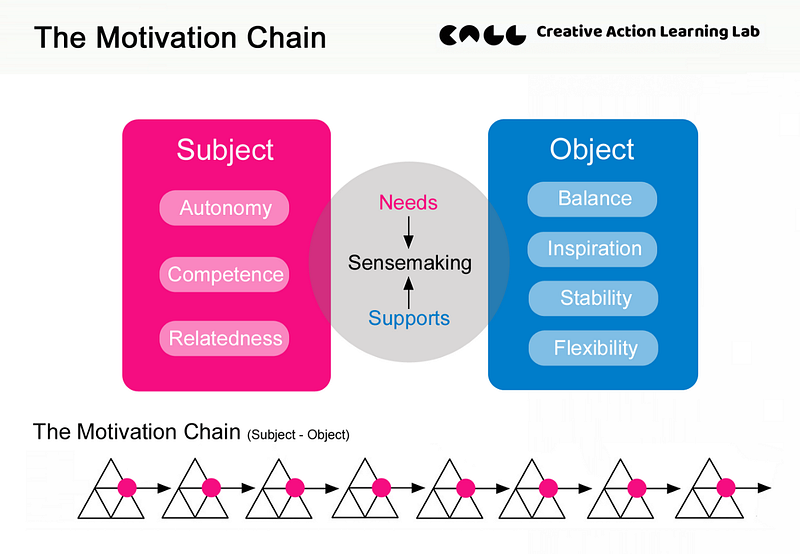
According to Ryan and Deci, “Our conceptualization of the effects of social contexts is pertinent to both motivation and behavior in immediate situations and to development and wellness over time. In other words, supports for autonomy, competence, and relatedness not only are theorized to facilitate more self-determined and high-quality functioning in the immediate situation, but they are also understood to promote the development of more effective self-functioning, resilience, and enduring psychological health for the long term.” (p.12) By connecting SDT with Activity Theory, we can discuss the subject-object with the three basic psychological needs.
Kaptelinin (2005) also suggested four criteria for “successful” objects of activities: “ (a) balance: the effective motives should be properly represented; if a motive is systematically ignored, the activity may face a breakdown; (b) inspiration: the object of activity should be not only rationally feasible but also attractive and energizing, ( c) stability: if the object changes too often, the activity can be disorganized; and (d) flexibility (the opposite of stability): when the factors, such as motives and available means, change, the object of activity should be redefined to avoid becoming obsolete and ineffective.” We can consider these four criteria as supports offered by the object of activity.
Now we can consider the Motivation Chain as a part of the Life-to-be-Owned framework.
3.5 The Self—Other Relevance
As mentioned above, the Life-to-be-Owned framework considers three dimensions:
- Dimension 1: Social (Self — Other)
- Dimension 2: Activity (Objective — Object — Outcome)
- Dimension 3: Basic Psychological Needs (Competence — Autonomy — Relatedness)
I use Relevance Theory to develop a model for understanding the “Self — Other” dimension. On Nov 19, 2021, I published D as Diagramming: An Integrated Framework for Studying Knowledge Diagrams (Part 2) which discussed my “Relevance” thematic space and a practical perspective “Cultural Significance”. In order to write the article, I developed the following typology of Relevance.
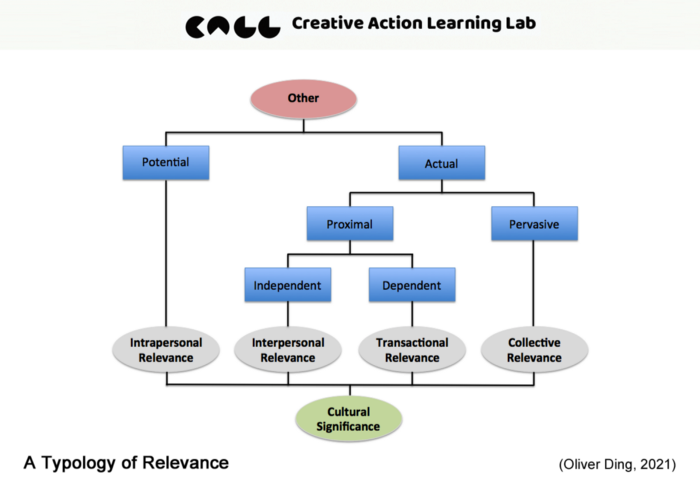
The above typology uses four units of analysis:
- Intrapersonal Relevance: the Other is potential, not actual.
- Interpersonal Relevance: the Other is actual, but the “Self—Other” is not considered as a whole.
- Transactional Relevance: the Other is actual, and the “Self—Other” is considered as a whole.
- Collective Relevance: the Other is pervasive, not proximal. The “Self — Other” relationship is understood as “Self — Group”.
The core of the framework is three aspects of Other.
- Potential v.s. Actual
- Independent v.s. Dependent
- Proximal v.s. Pervasive
If a person doesn’t have direct interaction with actual other people, he considers if his work or actions are relevant to predecessors or any other people. Then, this means Intrapersonal Relevance. For example, I am comparing my typology with Schutz’s typology while I am writing this article. Since Schutz is a predecessor to me, he can’t respond to me. I can’t have direct interaction with him. However, the Potential aspect also considers contemporaries. For example, there are many contemporary researchers who study Schutz’s theoretical thoughts. Now I don’t have any direct interaction with them, but I could have direct communication with them in the future.
Interpersonal Relevance refers to direct interactions for getting feedback from others. In this situation, the Other is actual, but the “Self — Other” is not considered as a whole since they don’t share reciprocity of motives. How can a person get good feedback from others? It depends on Relevance from the Other’s perspective. We can adopt Schutz’s typology of Relevance to understand Other’s Relevance. For example, If I want to get good feedback for my work on the D as Diagramming project, I need to consider my writing style for audiences. If I share a particular article on Linkedin and mention some contacts, I need to consider if these contacts are relevant to the article.
Transactional Relevance is about dependent relationships and interactions. The Other is actual, and the “Self — Other” is considered as a whole. and they share reciprocity of motives. In this situation, the person and Others share reciprocity of motives, challenges, and background knowledge. If we adopt Schutz’s typology of Relevance, it has high relevance in both three types: Motivational relevance, Thematic relevance, and Interpretational relevance.
Collective Relevance considers Others as a pervasive group, not a particular person or several people. The “Self — Other” relationship becomes the “Self — Group” relationship. This refers to Schutz’s social domains of relevance.
Part 4: Reflection
How to develop a framework with a metaphor? Can we develop a knowledge framework with a metaphor? Why do we do it?
These questions lead to a deep issue regarding our views and beliefs about various types of knowledge such as academic theories and practical frameworks.
4.1 Knowledge Frameworks: Abstract Models and Concrete Models
Based on the usage of academic concepts, I define two types of knowledge frameworks: Abstract Models and Concrete Models. The difference between Abstract Models and Concrete Models is the former adopts theoretical concepts from meta-theories or specific theories while the latter doesn’t.
In a previous article titled HERO U — A New Framework for Knowledge Heroes, I shared the following diagram for discussing different types of knowing.
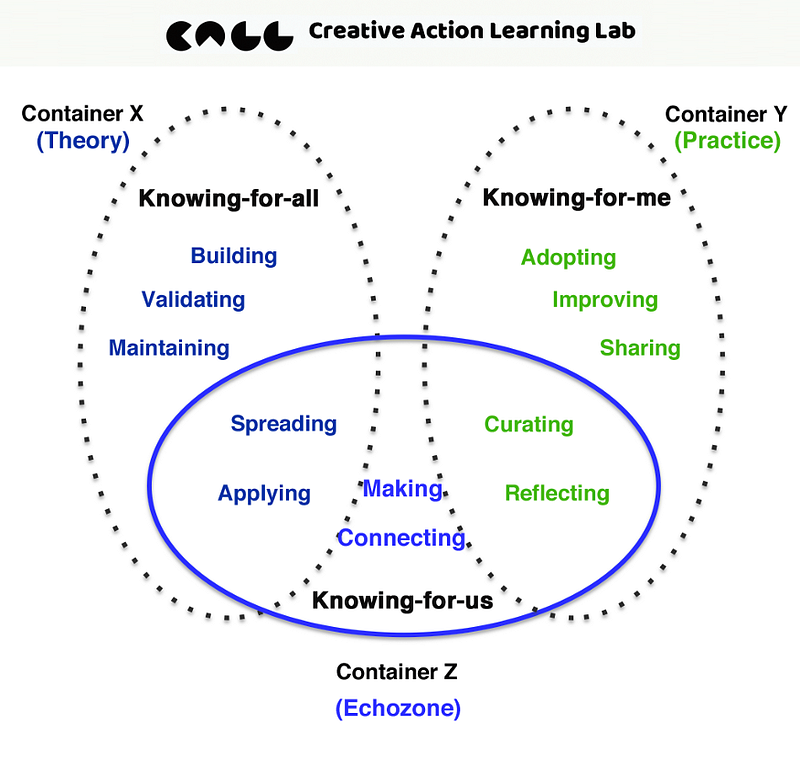
The Knowing-for-us activity is located in the Echozone container. The outcome and motivation are about spreading and applying public knowledge to professional domain practices, curating and reflecting on personal practical experiences, and connecting different domains in order to make new shared knowledge for participants.
The corresponding Objects of Knowing are Specific Theory, Abstract Model, Concrete Model, and Domain Practice. You can find more details about this typology in the original article.
If Creators don’t adopt theoretical concepts to develop Concrete Models, how do they develop them? They usually use metaphors or redefine normal words as their basic concepts for a new concrete model. Jobs-to-be-Done is a typical example.
4.2 Can we use a metaphor to develop a framework?
Yes, we can. However, we have to pay attention to some deep issues with this approach.
Each metaphor has two aspects: words and meaning.
Sometimes, you start with the words because you can’t find a simple word to describe a thing you want to tell. In the beginning, Jobs-to-be-Done is a simple word for describing Outcome-Driven Innovation (ODI).
Sometimes, you can focus on the meaning and you don’t rely on the function of words. For example, the communication research scholar Brenda Dervin used the bridge as a metaphor to visualize her sense-making methodology.
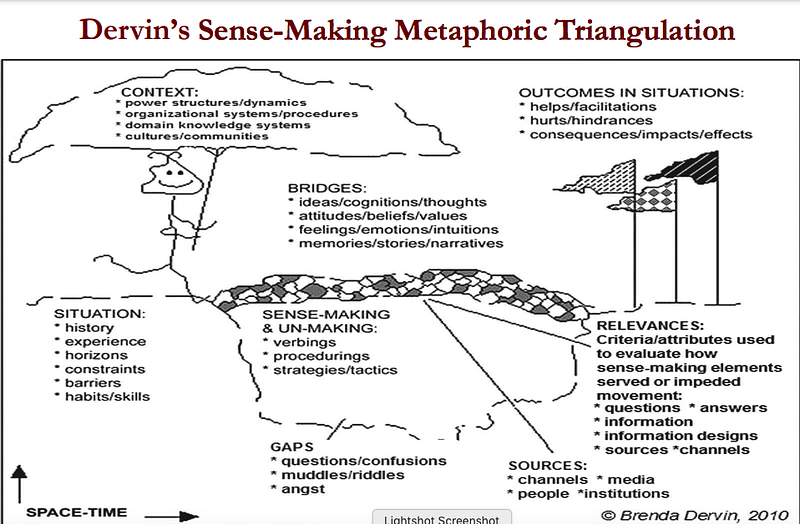
According to Brenda Dervin, the metaphor of bridge refers to an activity, “Assume a human being taking steps through experiences: each moment, a new step. The step may be a repetition of past behavior, but it is always theoretically a new step because it occurs in a new moment in time-space. Assume a moment of discontinuity in which step-taking turns from free-flowing journey to stop. Focus on the individual at this moment of discontinuity, this stop which does not permit the individual, in his or her own perception, to move forward without constructing a new or changed sense. Determine how the individual interprets and bridges this moment: what strategy he or she used to define the situation which was the gap; how he or she conceptualized the discontinuity as gap and the bridge across it; how he or she moved tactically to bridge the gap; how he or she proceeded with the journey after crossing the bridge.” (2003, p.277)
In fact, Brenda Dervin offered the other diagram for her theoretical approach, see the diagram below:
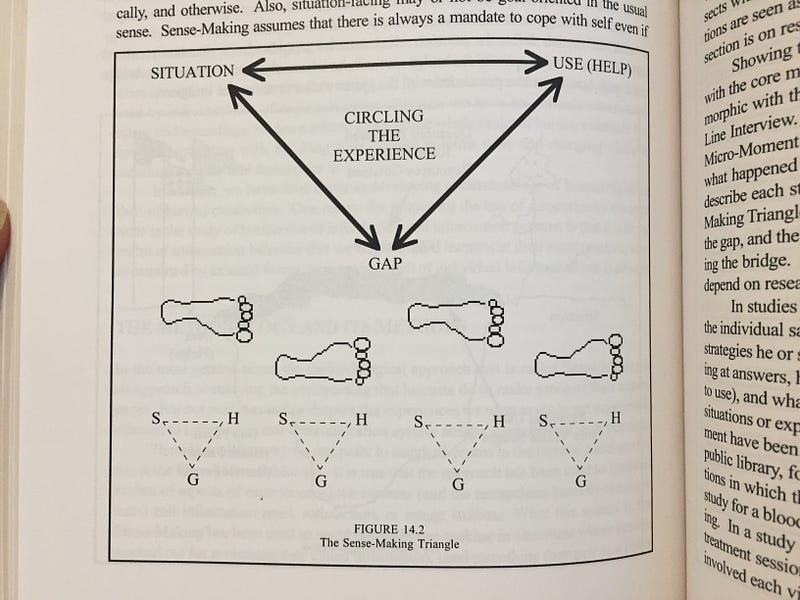
The above diagram shows a structure of a sense-making moment: Situation — Gap — Use (Help). When an individual moves through an experience, each moment is potentially a sense-making moment.
Though Brenda Dervin used the metaphor of Bridge to visualize her ideas, she didn’t directly use “bridge” as a concept. The basic concept of the approach is “sense-making moment”.
I’d like to suggest a rule for developing knowledge frameworks with metaphors: Don’t stop on the aspect of words, you should work deeply on the aspect of meaning. An ideal knowledge framework should make a good balance between words and meaning.
You can find more details in Knowledge Discovery: The Concept Dynamics Framework.
4.3 Powers of Knowledge Frameworks
The present discussion is for practitioners and domain knowledge workers. While practitioners tend to directly use concrete models, some domain researchers tend to develop abstract models. Let’s use CSCW as an example. CSCW stands for Computer Supported Cooperative Work.
In 2002, IBM researcher Christine A. Halverson published a paper titled Activity Theory and Distributed Cognition: Or What Does CSCW Need to DO with Theories on CSCW. The author suggested that we can consider four powers of theories: descriptive power; rhetorical power; inferential power; and application power.
- From a pragmatic view of theory, we can identify four attributes we want. First, we require descriptive power. Theory in CSCW should provide a conceptual framework that helps us make sense of and describe the world. This includes describing a work setting as well as critiquing an implementation of technology in that setting.
- Second, we need rhetorical power. A theory should help us talk about the world by naming important aspects of the conceptual structure and how it maps to the real world. This is both how we describe things to ourselves and how we communicate about them to others. Further, it should help us persuade others that our view is correct.
- The third attribute is inferential power. Without engaging in arguments about whether theories are true, or only falsifiable (Popper, 1992), we do want a theory to help us make inferences. In some cases, those inferences may be about phenomena that we have not yet understood sufficiently to know where or how to look. We may hope that inferences will lead to insights for design. Or we may want to predict the consequences of introducing change into a particular setting.
- An important fourth attribute has to do with application: how we can apply the theory to the real world for essentially pragmatic reasons. Mostly this translates to our need to inform and guide system design. We need to describe and understand the world at the right level of analysis in order to bridge the gap from description to design.
We can apply this typology to knowledge frameworks. Practitioners are both thinkers and doers.
- Practitioners as thinkers: descriptive power and inferential power.
- Practitioners as doers: rhetorical power and application power.
Though practitioners have different paths of career development, such as entrepreneurs, managers, and professionals, I think each practitioner should develop both thinking skills and doing skills. In the age of information overload, Epistemic Development is essential for every practitioner.
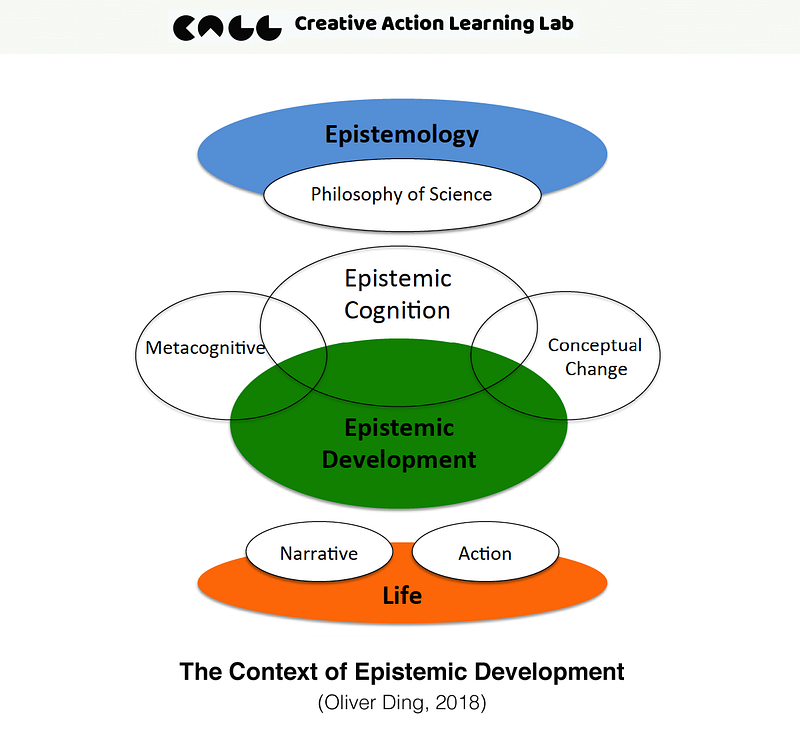
A simple way of epistemic development for practitioners is paying attention to the four powers of each knowledge framework. We can also use it as a checklist to review our own knowledge frameworks.
You are most welcome to connect via the following social platforms:
Polywork: https://www.polywork.com/oliverding Twitter: https://twitter.com/oliverding Boardle: https://www.boardle.io/users/oliver-ding Linkedin: https://www.linkedin.com/in/oliverding
License
This work is licensed under the Creative Commons Attribution-NonCommercial-ShareAlike 4.0 International (CC BY-NC-SA 4.0) License. Please click on the link for details.


