
D as Diagramming: Strategic Value Proposition
An Example of Diagramming as Thinking
Diagramming is one of the strategic ways of my Knowledge Curation activities. I have written about diagrams and diagramming about theoretical building and development here. This time, I’d like to share a mini Knowledge Curation work with diagramming.
Last week I read Joan Magretta’s 2012 book: Understanding Michael Porter: The Essential Guide to Competition and Strategy
It’s an amazing re-engagement with a classic strategic approach. I read Porter’s books many years ago. The author uses a diagram (see comment) for describing Porter’s ideas on value proposition. Inspired by the diagram and the writings, I use a meta-diagram I developed two years ago to run a mini Knowledge Curation work.
Porter defines the value proposition as the answer to three fundamental questions: 1. Which customers are you going to serve? 2. Which needs are you going to meet? 3. What relative price will provide acceptable value for customers and acceptable profitability for the company?
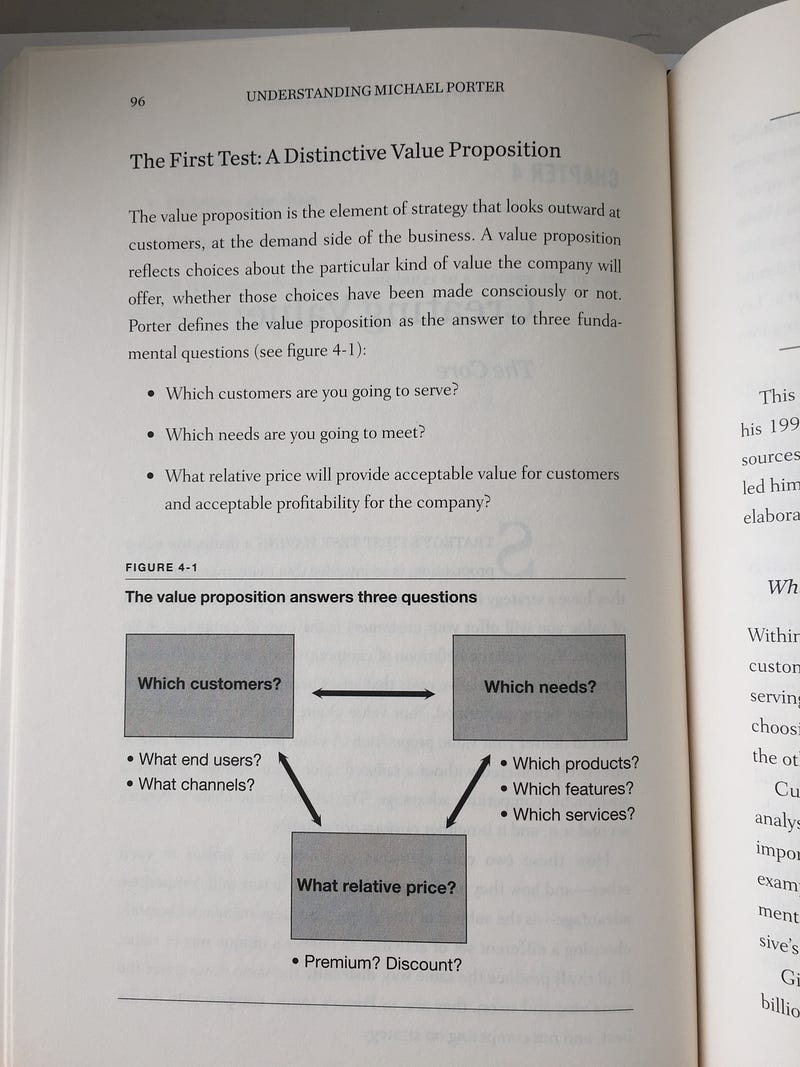
This is a great starting point. I expand this framework with my meta-diagram.
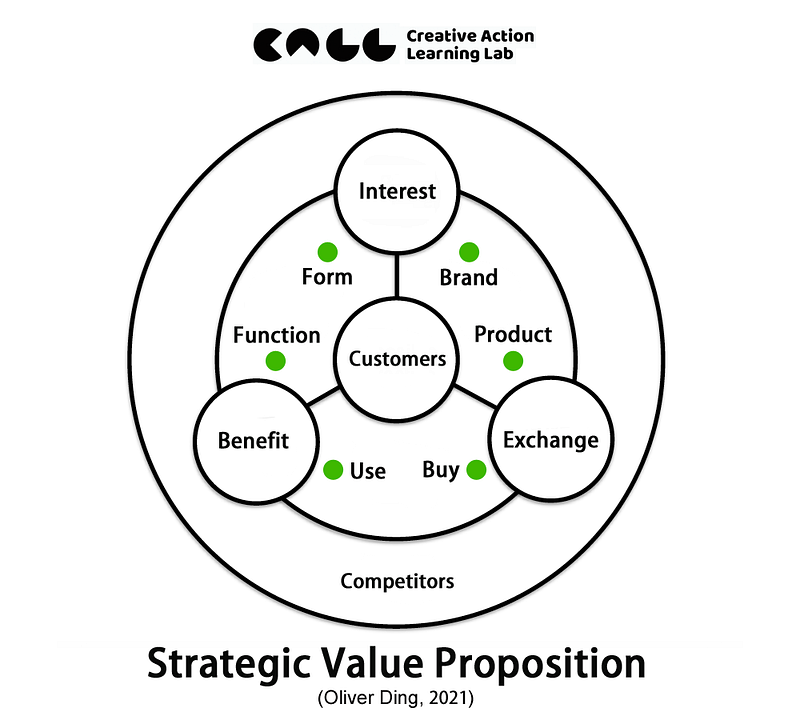
I move customers to the center of the diagram. I use “Interest” to replace “Needs”. The term “price” is replaced by “exchange”. I add “Benefit” and “Competitors” to expand the original framework.
By using the meta-diagram, I identify three zones and six themes of these zones.
1. The Interest-Benefit Zone
This zone is about Design and Development. The themes of the zone are “Form” and “Function”.
2. The Interest-Exchange Zone
This zone is about Marketing and Communication. The themes of the zone are “Brand” and “Product”.
3. The Benefit-Exchange Zone
This zone is about Situational Context. The themes of the zone are “Buy” and “Use”.
Finally, the term “Competitors” connects to Porter’s famous Five Forces model.
Knowledge Curation is about dialogue between Concept and Diagram, Past and Present, Self and Others, Read and Make…etc.
Update
This post was originally published on July 12, 2021. I recently wrote some new articles to expand the original diagram.
- D as Diagramming: The Dialectical Room and Value Engagement
- D as Diagramming: The Interactive Zone and Value Engagement
- D as Diagramming: The Value-fit Framework and Canvas
I also wrote some articles about Startup and Strategy:
You are most welcome to connect via the following social platforms:
Polywork: https://www.polywork.com/oliverding Twitter: https://twitter.com/oliverding Boardle: https://www.boardle.io/users/oliver-ding Linkedin: https://www.linkedin.com/in/oliverding
License
This work is licensed under the Creative Commons Attribution-NonCommercial-ShareAlike 4.0 International (CC BY-NC-SA 4.0) License. Please click on the link for details.


