
Data Science, Content Development
Let’s Discover Millions of Free Datasets.
A brief introduction to Google Datasets demonstrating a sample search on the web.

Background
For many of us, using data on the Internet resembles the metaphor of drinking from a fire hydrant. Fortunately, we have great services to help the consumers drink from this metaphorical data hose.
In one of my previous articles in Data Driven Investor, titled “Free Quantitative Data for Writers”, I emphasized the importance of statistical data to increase content quality and reader satisfaction and introduced you to the World Bank's free data services.
Internet, particularly the World Wide Web (WWW), can offer millions of datasets, easily accessible, in many topics and disciplines.
In this article, I want to introduce the new Google Datasets with possible use cases for writers.
For several years, the Google Datasets service was in beta. I knew it was promising.
Finally, Google announced it for full services a month ago.
Since then, I have tried it for several research topics in my field and was amazed at the richness of data sources spread across over 25 million datasets, which can be accessed from a single search link.
Google Datasets is a powerful service giving access to rich datasets, and data sources, leading to access to actual data for use.
When I search the term “Medium”, I came across only one dataset.
As Medium is relevant to my audience for this article, I want to use this dataset as an example to show you how to access the datasets using the new Google Datasets service.
How to access free datasets via the Google Datasets
In this example, I show you how to access a dataset related to and originated from our platform, Medium. Here are the simple steps:
Step 1:
Enter the URL for the Google Datasets to your web browser.
The URL is: https://datasetsearch.research.google.com
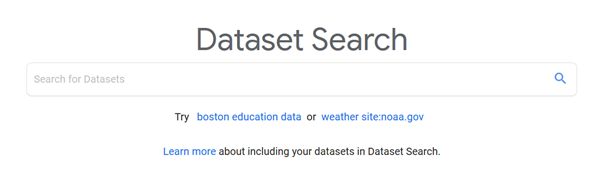
When you enter this link, you can see the following screen.
Step 2:
Type the term “Medium” in the search for Datasets box and click on the search icon.
You will see the following screen.
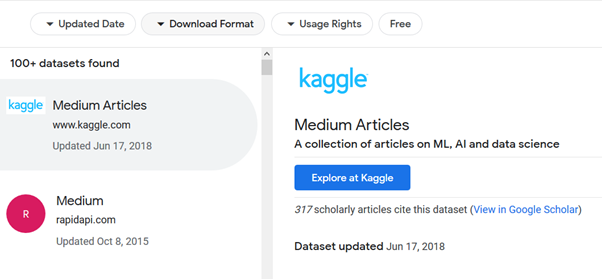
In this example, Google Datasets found a dataset which is called Medium Articles belonging to an organization called “Kaggle”.
This dataset provides a collection of articles on Machine Learning, Artificial Intelligence, and Data Science. This dataset was updated on 17 June 2018. It is not too old hence I am interested in exploring this dataset to gain some insights.
Let’s check the details of this dataset.
Step 3:
Click on the Explore at Kaggle button. (Blue colored button).
We will see the following screen providing an introduction to this dataset.
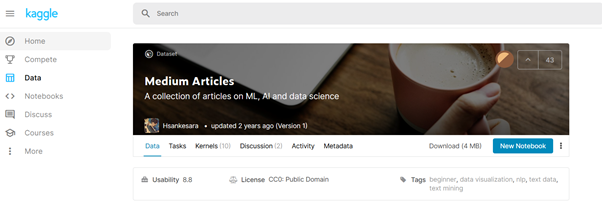
Let’s take a quick look at this dataset, what we can learn from its context.
Step 4:
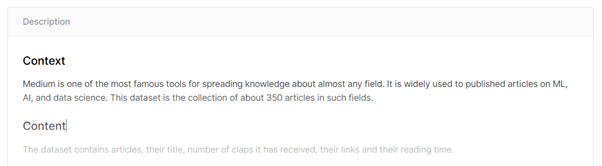
Scroll the screen down and you will see the description of the context
Let’s check the data sources for this dataset.
Step 5:
Scroll down the screen.
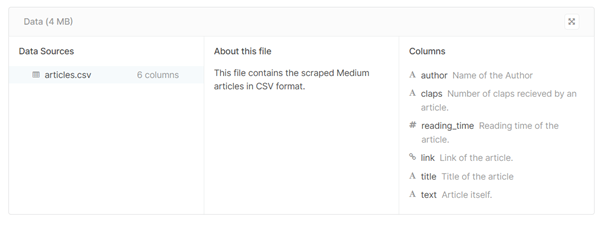
As depicted in the following screen capture, we will see that the data source for this dataset is a CSV file with six columns, including author, claps, reading time, link, title, and text.
Now, let’s see the actual data from this source.
To keep this fitting in a reasonable screen, I choose only 2 records from the data source as an example.
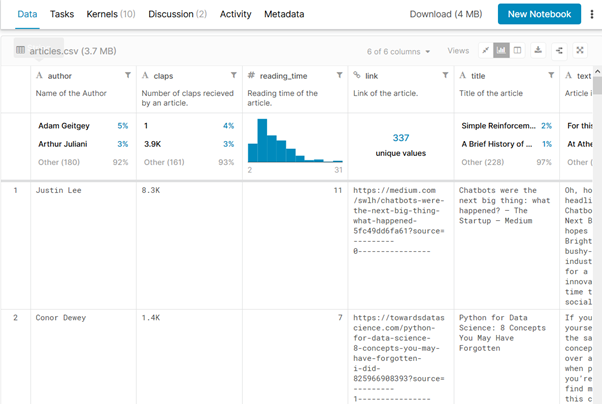
It is up to you, as writers, how to interpret and use this data. As writers, we have different use cases, goals, and aspirations. My aim is to show you the clean lake and it is up to you to drink from it.
However, I’d like to show a few tips to use and extend the dataset searches.
Scenario:
In this example, we are using a dataset from the Kagel.com. We may wonder what other datasets this organization provides.
Step 6:
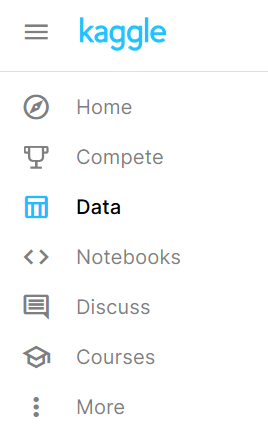
Click on the Data icon (third from the top), as shown in the following screen capture.
This company provides many datasets, as of today 29049 to be precise, as shown in the following screenshot.
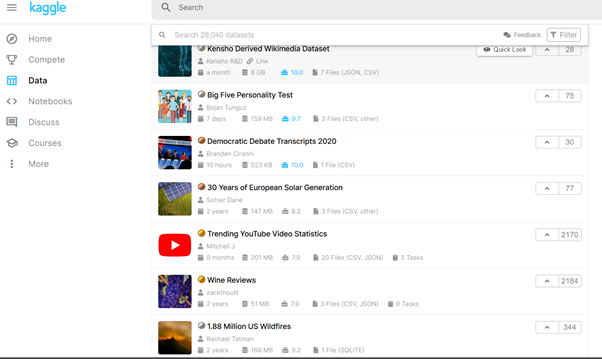
Instead of browsing these many datasets, we can use the Filter option.
Step 7:
Click on the Filter button and you will see the following screen.
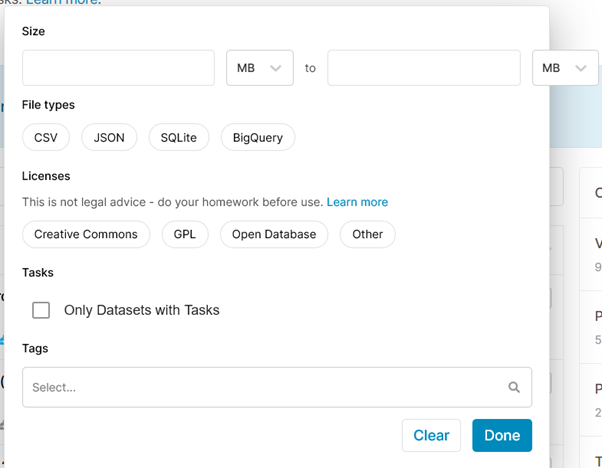
By using the parameters such as size, file types, licenses, tasks, and tags, we can reasonably reduce the number of datasets from a particular datasets provider.
In terms of datasets search, there is one more item to ease your search.
To show this, we will go back to the Google Datasets original screen introduced in the first step.
Step 8:
Type the URL: https://datasetsearch.research.google.com on your browser.
You will see the following items on the top of the search screen.

The reason I want to show this screen is to filter your datasets search parameters.
This screen allows us to set an updated date, download format, usage rights, and free status.
Most of us will check the free datasets therefore clicking on this button can ensure that we review the free datasets available for our search.
Conclusion
With this quick introduction, I hope you can start exploring and discovering terrific datasets for your research to enrich your content for reader satisfaction.
When you write an article including data obtained from the Google Datasets, please tag me as your reader because I truly enjoy reading data-driven and data-rich articles.
If you are into data architecture by profession, you may check the following articles reflecting my experience in the field.
And if you are interested in free courses in the Data Science discipline, you may check the following article to find relevant courses for your professional development. The article also includes how to gain industry-recognized badges for the Data Science discipline.
Thank you for reading my perspectives. I wish you a healthy and happy life.
If you find this article valuable, you might check my holistic health and well-being stories reflecting on my reviews, observations, and decades of sensible experiments.
Sample Health Improvement Articles for New Readers
Defeat Metabolic Syndrome and Slim Down Waistline with Three Tips
Six Tips to Prevent Brain Atrophy and Lower the Risks of Mental Disorders
Why 442 Million People Live Diabetic and What We Can Do About it
What Can We Do About NCDs Killing 41 Million People Yearly?.
Reduce the Risks of Neonatal Disorders to Prevent Infant Mortality.
Reduce the Risks of Major Diseases with Healthy Lifestyle Habits
I also write about valuable nutrients. Here are the links for easy access:
Boron, Urolithin, taurine, citrulline malate, biotin, lithium orotate, alpha-lipoic acid, n-acetyl-cysteine, acetyl-l-carnitine, CoQ10, PQQ, NADH, TMG, creatine, choline, digestive enzymes, magnesium, hydrolyzed collagen, nootropics, pure nicotine, activated charcoal, Vitamin B12, Vitamin B1, Vitamin D, Vitamin K2, Omega-3 Fatty Acids, and other nutrients that might help to improve metabolism and mental health.
I publish my lifestyle, health, and well-being stories on EUPHORIA. I wrote several articles on major diseases and valuable nutrients for health. My focus is on metabolic, cellular, mitochondrial, and mental health. Here is my collection of Insightful Life Lessons from Personal Stories.
You might join my seven publications on Medium as a writer by sending a request via this link. You might find more information about my professional background.