avatarDr Mehmet Yildiz

Free AI web copilot to create summaries, insights and extended knowledge, download it at here

4500

Abstract

s, and build capacity.</li><li><b>Global consumption database</b> is a data source on household consumption patterns in developing countries.</li></ol><h2 id="506d">A Quick Walk-through of Using World Bank Data Catalogue</h2><p id="d04a"><b>Step 1: </b>Go to <a href="https://datacatalog.worldbank.org/"><i>https://datacatalog.worldbank.org/</i></a></p><figure id="8bcf"><img src="https://cdn-images-1.readmedium.com/v2/resize:fit:800/1*qmClDLCT6UtbPDkxdVm62A.png"><figcaption></figcaption></figure><p id="2d1c"><b>Step 2:</b> Enter a keyword. In this example, I use Australia as my keyword.</p><p id="3256">Click on the search icon on the top right side of the window.</p><figure id="4e5c"><img src="https://cdn-images-1.readmedium.com/v2/resize:fit:800/1*zt2AD-RvXhPMksdJsPDFqA.png"><figcaption></figcaption></figure><p id="1433"><b>Step 3:</b> In this search example by using the term Australia, we receive 10290 search results.</p><p id="0ecc">We may need to sort and refine the search.</p><figure id="4c49"><img src="https://cdn-images-1.readmedium.com/v2/resize:fit:800/1*zt2AD-RvXhPMksdJsPDFqA.png"><figcaption></figcaption></figure><h2 id="2114">How to sort and refine searches</h2><p id="9200"><b>Step 4:</b> We can sort by All, Datasets, Indicators, and Visualisations.</p><p id="157f"><b>Step 5:</b> We can also sort by Most Relevant, Alphabetical, or Last Updated.</p><p id="8fbc"><b>Step 6:</b> We can refine our findings using the following criteria.</p><figure id="328f"><img src="https://cdn-images-1.readmedium.com/v2/resize:fit:800/1*7NP40NQsd37GaIljeYQtcA.png"><figcaption></figcaption></figure><h2 id="41eb">Which Regions and Countries are Included?</h2><p id="4ef9">We can find data on the following seven regions.</p><p id="bdee">Here is a list of regions and countries that we can collect free data from.</p><h2 id="36eb">North America:</h2><p id="3019">Bermuda, Canada, United States</p><h2 id="512c">South Asia</h2><p id="f523">Afghanistan, Bangladesh, Bhutan, India, Maldives, Nepal, Pakistan, Sri Lanka</p><h2 id="b973">East Asia & Pacific</h2><p id="a4d7">American Samoa, Australia, Brunei Darussalam, Cambodia, China, Cook Islands, Fiji, French Polynesia, Guam, Hong Kong SAR, China, Indonesia, Japan, Kiribati, Korea, Dem. People’s Rep., Korea, Rep., Lao PDR, Macao SAR, China, Malaysia, Marshall Islands, Micronesia, Fed. Sts., Mongolia, Myanmar, Nauru, New Caledonia, New Zealand, Niue, Northern Mariana Islands, Palau, Papua New Guinea, Philippines, Samoa, Singapore, Solomon Islands, Taiwan, China, Thailand, Timor-Leste, Tonga, Tuvalu, Vanuatu, Vietnam</p><h2 id="4d9c">Europe and Central Asia</h2><p id="83e6">Albania, Andorra, Armenia, Austria, Azerbaijan, Belarus, Belgium, Bosnia and Herzegovina, Bulgaria, Croatia, Cyprus, Czech Republic, Denmark, Estonia, Faroe Islands, Finland, France, Georgia, Germany, Gibraltar, Greece, Greenland, Hungary, Iceland, Ireland, Isle of Man, Italy, Kazakhstan, Kosovo, Kyrgyz Republic, Latvia, Liechtenstein, Lithuania, Luxembourg, Moldova, Monaco, Montenegro, Netherlands, Norway, Poland, Portugal, Romania, Russian Federation, San Marino, Serbia, Slovak Republic, Slovenia, Spain, Sweden, Switzerland, Tajikistan, Turkey, Turkmenistan, Ukraine, United Kingdom, Uzbekistan</p><h2 id="c49b">Latin America and the Caribbean</h2><p id="b0df">Anguilla, Antigua and Barbuda, Argentina, Aruba, The Bahamas, Barbados, Belize, Bolivia, Brazil, The British Virgin Islands, Cayman Islands, Chile, Colombia, Costa Rica, Cuba, Curaçao, Dominica, Dominican Republic, Ecuador, El Salvador, Grenada, Guatemala, Guyana, Haiti, Honduras, Jamaica, Martinique, Mexico, Montserrat, Nicaragua, Panama, Paraguay, Peru, Puerto Rico, Sint Maarten (Dutch part), St. Kitts and Nevis, St. Lucia, St. Martin (French part), St. Vincent and the Grenadines, Suriname, Trinidad and Tobago, Turks and Caicos Islands, Uruguay, Venezuela, RB, Virgin Islands (U.S.)</p><h2 id="6036">The Middle East and North Africa</h2><p id="3776">Algeria, Bahrain, Djibouti, Egypt, Arab Rep., Iran, Islamic Rep., Iraq, Israel, Jordan, Kuwait, Lebanon, Libya, Malta, Morocco, Oman, Qatar, Saudi Arabia, Syrian Arab Republic, Tunisia, United Arab Emirates, West Bank and Gaza, Yemen, Rep.</p><h2 id="2ab8">Sub-Saharan Africa</h2><p id="faea">Angola, Benin, Botswana, Burkina Faso, Burundi, Cabo Verde, Cameroon, Central African Republic, Chad, Comoros, Congo, Dem. Rep., Congo, Rep., Côte d’Ivoire, Equatorial Guinea, Eritrea, Eswatini, Ethiopia, Gabon, Gambia, Ghana, Guin

Options

ea, Guinea-Bissau, Kenya, Lesotho, Liberia, Madagascar, Malawi, Mali, Mauritania, Mauritius, Mozambique, Namibia, Niger, Nigeria, Rwanda, Senegal, Seychelles, Sierra Leone, Somalia, South Africa, South Sudan, Sudan, São Tomé and Principe, Tanzania, Togo, Uganda, Zambia, Zimbabwe</p><h1 id="bc65">Conclusion</h1><p id="53bf">We can access the World Bank data services from the link: <a href="https://data.worldbank.org/">https://data.worldbank.org/</a></p><p id="bb7a">Quantitative data is widely used by writers, bloggers, instructional designers, and other content developers. It is also commonly used by presenters. Effective communicators usually make their speech openings with interesting statistics.</p><blockquote id="2132"><p>Relevant statistical data can motivate the audience and help the communicators to create an instant bridge and connect with the audience rapidly.</p></blockquote><p id="1ede">Hope you find this quick introduction to Word Bank Data useful. I plan to provide more free data sources in my upcoming articles.</p><p id="79cf">In the meantime, if you are interested in Big Data, you can gain a perspective on how I deal with Big Data for digital transformation solutions at work.</p><div id="f902" class="link-block"> <a href="https://readmedium.com/how-to-deal-with-big-data-for-ai-1d17ca089673"> <div> <div> <h2>How to deal with Big Data for AI?</h2> <div><h3>As a key enabler of artificial intelligence, cognitive computing, and subsets of AI e.g. machine learning, deep…</h3></div> <div><p>medium.com</p></div> </div> <div> <div style="background-image: url(https://miro.readmedium.com/v2/resize:fit:320/1*oUr68UTNN6H_iFw08J7O9Q.jpeg)"></div> </div> </div> </a> </div><p id="2280">I wish you all the best with your data search enriching your content with quality data.</p><h1 id="76c1">About the Author</h1><p id="cfd5">I am a technologist, postdoctoral researcher, author of several books, editor, and digital marketing strategist with four decades of industry experience.</p><p id="4e5e">I write articles on <a href="https://dr-mehmet-yildiz.medium.com/">Medium</a>, <a href="https://original.newsbreak.com/@digitalintelligence-561548">NewsBreak,</a> and <a href="https://vocal.media/authors/dr-mehmet-yildiz">Vocal Media</a>. On Medium, I established <a href="https://medium.com/illumination">ILLUMINATION</a>, I<a href="https://medium.com/illumination-curated">LLUMINATION-Curated</a>, <a href="https://medium.com/illuminations-mirror">ILLUMINATION’ S MIRROR</a><a href="https://medium.com/technology-hits">,</a> <a href="https://medium.com/illumination-book-chapters">ILLUMINATION Book Chapters</a>, <a href="https://medium.com/technology-hits">Technology Hits</a>, <a href="https://medium.com/technical-excellence">SYNERGY</a>, and <a href="https://medium.com/readers-digests">Readers Hope</a> publications supporting 12,000+ writers on Medium. You can j<a href="https://digitalmehmet.com/contact/">oin my publications requesting access here</a>. You may <a href="https://dr-mehmet-yildiz.medium.com/subscribe">subscribe to my account</a> to be notified when I post on Medium. I share my health and well-being stories on my publication, <a href="https://medium.com/sensible-biohacking-transhumanism">Euphoria.</a></p><p id="43df">If you are new to Medium, you may join <a href="https://dr-mehmet-yildiz.medium.com/membership">by following this link.</a> A small part of your membership fee will not only support my writing but your reading times can support many great writers on this platform. Opportunities for readers and writers are endless on this platform.</p><div id="9405" class="link-block"> <a href="https://readmedium.com/heath-fitness-lifestyle-topics-collected-on-transhumanism-leadership-a22f1d4f7de1"> <div> <div> <h2>Heath, Fitness, & Lifestyle Topics Collected on Euphoria</h2> <div><h3>Eclectic articles addressing interesting and important life matters for individuals and society</h3></div> <div><p>medium.com</p></div> </div> <div> <div style="background-image: url(https://miro.readmedium.com/v2/resize:fit:320/1*CvOJVRajvZBcp3-0rXHwcw.jpeg)"></div> </div> </div> </a> </div></article></body>

Data Science, Writing

Free Quantitative Data for Writers

Using reliable data sources for writers, bloggers, podcasters

Image by Gerd Altmann from Pixabay

Using reliable data sources is crucial for writers, bloggers, podcasters, instructional designers, public speakers, and content developers for effective verbal and written communication.

Introduction

I love data. Data is an important asset for content development.

As a data driven person, I cannot survive, thrive, or perform without data.

In my professional work, academic studies, and personal research, I need both qualitative and quantitative data for analysis, communication, and make informed decisions.

Both data forms (qualitative & quantitative) are important, serve different purposes, and can have specific use cases.

In this article, I cover quantitative data providing a practical use case example for writers and communicators.

Purpose of Quantitative Data for Writers and Communicators

Quantitative data and statistics can increase the quality and credibility of the content.

Effective communicators use quantitative data and statistics creatively to add flavour to their verbal and written content, make the content interesting, and make the arguments credible.

Finding reliable data sources can be challenging. However, there are many useful free data sources produced and made available by reliable organisations.

Purpose of this Article

In this article I’d like to introduce the Open Bank data services available to public as free of charge.

I introduce the key features, scope, and how to use the Word Bank’s data services.

The World Bank provides free and open access to global development data.

Let’s start with the data types.

The World Bank Data Types
The World Bank provides 3 types of data.

1. Time Series which include datasets and indicators level data that is a sequence of numbers collected at regular intervals over a period of time.

2. Microdata which is unit-level data obtained from sample surveys, censuses, and administrative systems.

3. Geospatial which covers data that has explicit geographic positioning information included within it in either vector or raster format.

The World Bank Data Resources

The World Bank provide nine important data resources.

Here is a summary of the resources.

  1. Open data catalogue provides a listing of available datasets, preformatted tables, and reports.
  2. Databank provide an analysis and visulization tool. It contains collections of time series data on various topics.
  3. Microdata library allows access to data sets collected via sample surveys of households and business organisations.
  4. World development indicators provide the main World Bank collection of development indicators compiled from formal international sources.
  5. Open finances provide raw data about World Bank Group’s finances. This resource includes disbursements and management of global funds.
  6. Projects and operations resource provide access to basic information on all of the Worl Bank’s lending projects since 1947.
  7. Open data toolkit provides an understanding of open data and how to plan and implement an open data program.
  8. Living standards measurement study supports countries in conducting a household survey to generate high-quality data, improve survey methods, and build capacity.
  9. Global consumption database is a data source on household consumption patterns in developing countries.

A Quick Walk-through of Using World Bank Data Catalogue

Step 1: Go to https://datacatalog.worldbank.org/
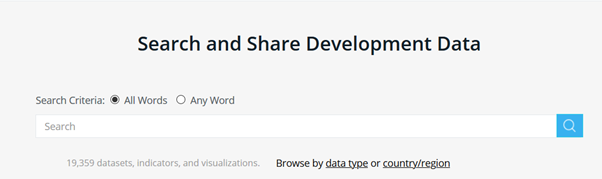
Step 2: Enter a keyword. In this example, I use Australia as my keyword.

Click on the search icon on the top right side of the window.
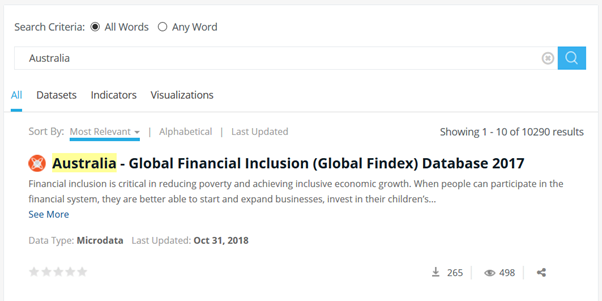
Step 3: In this search example by using the term Australia, we receive 10290 search results.

We may need to sort and refine the search.

How to sort and refine searches

Step 4: We can sort by All, Datasets, Indicators, and Visualisations.

Step 5: We can also sort by Most Relevant, Alphabetical, or Last Updated.

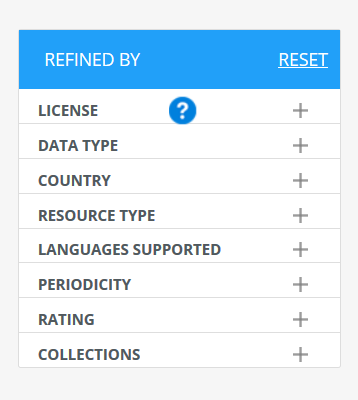
Step 6: We can refine our findings using the following criteria.
Which Regions and Countries are Included?

We can find data on the following seven regions.

Here is a list of regions and countries that we can collect free data from.

North America:

Bermuda, Canada, United States

South Asia

Afghanistan, Bangladesh, Bhutan, India, Maldives, Nepal, Pakistan, Sri Lanka

East Asia & Pacific

American Samoa, Australia, Brunei Darussalam, Cambodia, China, Cook Islands, Fiji, French Polynesia, Guam, Hong Kong SAR, China, Indonesia, Japan, Kiribati, Korea, Dem. People’s Rep., Korea, Rep., Lao PDR, Macao SAR, China, Malaysia, Marshall Islands, Micronesia, Fed. Sts., Mongolia, Myanmar, Nauru, New Caledonia, New Zealand, Niue, Northern Mariana Islands, Palau, Papua New Guinea, Philippines, Samoa, Singapore, Solomon Islands, Taiwan, China, Thailand, Timor-Leste, Tonga, Tuvalu, Vanuatu, Vietnam

Europe and Central Asia

Albania, Andorra, Armenia, Austria, Azerbaijan, Belarus, Belgium, Bosnia and Herzegovina, Bulgaria, Croatia, Cyprus, Czech Republic, Denmark, Estonia, Faroe Islands, Finland, France, Georgia, Germany, Gibraltar, Greece, Greenland, Hungary, Iceland, Ireland, Isle of Man, Italy, Kazakhstan, Kosovo, Kyrgyz Republic, Latvia, Liechtenstein, Lithuania, Luxembourg, Moldova, Monaco, Montenegro, Netherlands, Norway, Poland, Portugal, Romania, Russian Federation, San Marino, Serbia, Slovak Republic, Slovenia, Spain, Sweden, Switzerland, Tajikistan, Turkey, Turkmenistan, Ukraine, United Kingdom, Uzbekistan

Latin America and the Caribbean

Anguilla, Antigua and Barbuda, Argentina, Aruba, The Bahamas, Barbados, Belize, Bolivia, Brazil, The British Virgin Islands, Cayman Islands, Chile, Colombia, Costa Rica, Cuba, Curaçao, Dominica, Dominican Republic, Ecuador, El Salvador, Grenada, Guatemala, Guyana, Haiti, Honduras, Jamaica, Martinique, Mexico, Montserrat, Nicaragua, Panama, Paraguay, Peru, Puerto Rico, Sint Maarten (Dutch part), St. Kitts and Nevis, St. Lucia, St. Martin (French part), St. Vincent and the Grenadines, Suriname, Trinidad and Tobago, Turks and Caicos Islands, Uruguay, Venezuela, RB, Virgin Islands (U.S.)

The Middle East and North Africa

Algeria, Bahrain, Djibouti, Egypt, Arab Rep., Iran, Islamic Rep., Iraq, Israel, Jordan, Kuwait, Lebanon, Libya, Malta, Morocco, Oman, Qatar, Saudi Arabia, Syrian Arab Republic, Tunisia, United Arab Emirates, West Bank and Gaza, Yemen, Rep.

Sub-Saharan Africa

Angola, Benin, Botswana, Burkina Faso, Burundi, Cabo Verde, Cameroon, Central African Republic, Chad, Comoros, Congo, Dem. Rep., Congo, Rep., Côte d’Ivoire, Equatorial Guinea, Eritrea, Eswatini, Ethiopia, Gabon, Gambia, Ghana, Guinea, Guinea-Bissau, Kenya, Lesotho, Liberia, Madagascar, Malawi, Mali, Mauritania, Mauritius, Mozambique, Namibia, Niger, Nigeria, Rwanda, Senegal, Seychelles, Sierra Leone, Somalia, South Africa, South Sudan, Sudan, São Tomé and Principe, Tanzania, Togo, Uganda, Zambia, Zimbabwe

Conclusion

We can access the World Bank data services from the link: https://data.worldbank.org/

Quantitative data is widely used by writers, bloggers, instructional designers, and other content developers. It is also commonly used by presenters. Effective communicators usually make their speech openings with interesting statistics.

Relevant statistical data can motivate the audience and help the communicators to create an instant bridge and connect with the audience rapidly.

Hope you find this quick introduction to Word Bank Data useful. I plan to provide more free data sources in my upcoming articles.

In the meantime, if you are interested in Big Data, you can gain a perspective on how I deal with Big Data for digital transformation solutions at work.

I wish you all the best with your data search enriching your content with quality data.

About the Author

I am a technologist, postdoctoral researcher, author of several books, editor, and digital marketing strategist with four decades of industry experience.

I write articles on Medium, NewsBreak, and Vocal Media. On Medium, I established ILLUMINATION, ILLUMINATION-Curated, ILLUMINATION’ S MIRROR, ILLUMINATION Book Chapters, Technology Hits, SYNERGY, and Readers Hope publications supporting 12,000+ writers on Medium. You can join my publications requesting access here. You may subscribe to my account to be notified when I post on Medium. I share my health and well-being stories on my publication, Euphoria.

If you are new to Medium, you may join by following this link. A small part of your membership fee will not only support my writing but your reading times can support many great writers on this platform. Opportunities for readers and writers are endless on this platform.

Data Science
Writing
Leadership
Content Marketing
Innovation
Recommended from ReadMedium