
Travel | It Happened To Me
Is This the New Normal in Air Travel?
The changing face of air travel over the past two years
Hand Sanitiser. Disinfectant Wipes. Face Masks.
Those were the essential items. The must-pack travel list over the past two years. That is if you were one of the few who were able to travel abroad.
Travel, especially air travel for many, had been off the cards during that time. Dreams of vacations and weekend breaks abroad were no longer the norm and travel changed during the pandemic.
More recently, there is hope that the face of air travel is changing.
Heathrow Airport and some airlines are planning to ease the face mask rules. The UK will be dropping the use of the passenger locator form. These are indications of the shift back that is taking place. This increases the likelihood that other countries, airlines, and airports may follow suit. However, the rules around air travel change quickly so it would be best to check before you travel.
These signs are hopeful of a return to some sort of normality with air travel.
I traveled at the start of the pandemic in August 2020 from the UK to New Zealand, not by choice but out of necessity, you can read why here.
I recently traveled again in March 2022 from the UK to New Zealand, again out of necessity.
Here are my experiences of flying over the past two years.
During both of those flights, which involved transit stopovers, the changes in air travel were apparent.
The most masked change (sic) was whilst waiting in the airports, during transit, and during the flights. There was a mandatory requirement to wear a face-covering at all times except when eating.
On my first journey, if I add in transit times, I had to wear a face-covering for the flying times which added up to 24 hours, and also during transit of 10 hours. This was over 34 hours with a muzzle over my face. It was a stifling experience, to say the least. And I had not planned to repeat this experience, vowing that I would only travel again once this pandemic and the rules like this around air travel had subsided.
I had therefore not expected, to find myself needing to travel again to New Zealand in March 2022. This time it entailed a similar 24-hour flying time with a 5-hour transit. But what didn’t change was my face was again covered for the duration as was required.
Whilst we have all become more accustomed to mask-wearing, it is still not a pleasant experience when it occurs for such extended periods, leading me to work out ways to have a break from it.
Simple Ways To Have Breaks from Mask Wearing
I may have lingered longer in the loo with the luxury of taking off my mask. However, let’s be real, it is not normally the place you want to take off your mask, but desperation calls for such measures.
I probably took longer than I should have over the airplane food, and Linda Ng would have a lot to say about that as she simply loves airplane food.
I know I asked for more cups of coffee than I normally would, just to pretend that I was drinking so I could lower my mask that bit longer.
Here are some other changes with air travel that I came across:
1. Covering Up Fully
This is the sight that I saw in the airport terminal at Hong Kong airport.
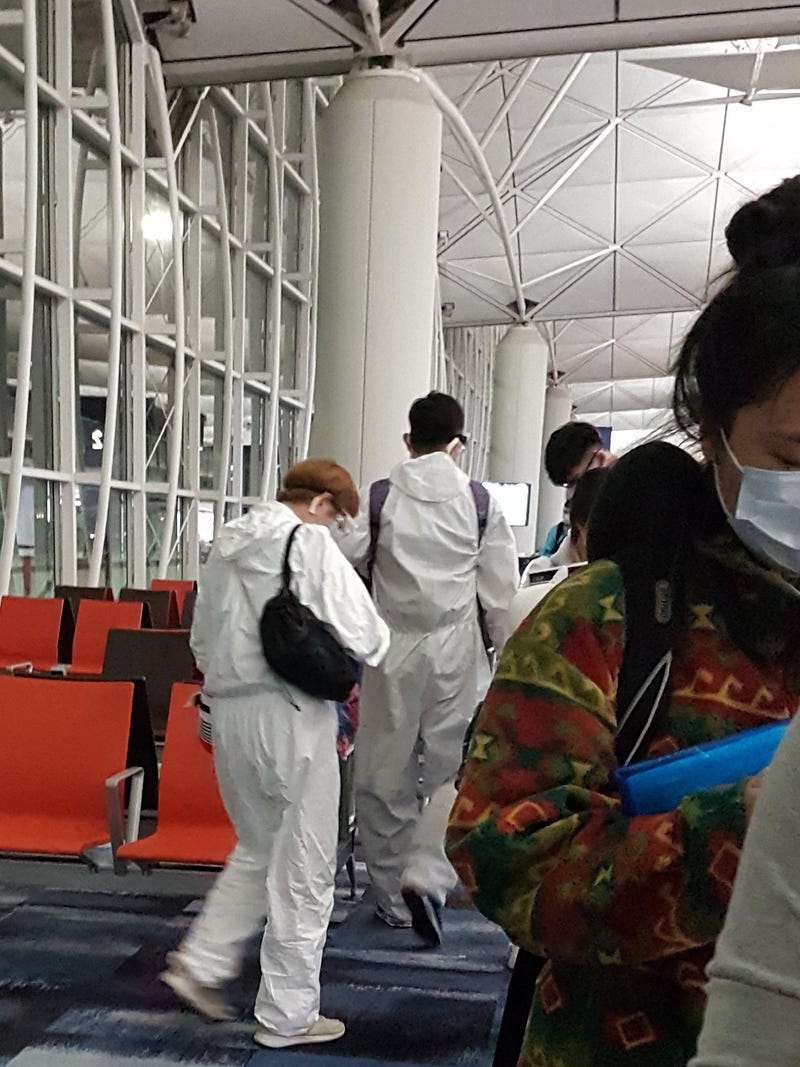
At the time I was surprised, to see some passengers wearing full-body suits of PPE (Personal Protective Equipment) like this. The use of PPE was not commonplace, it was especially not something you would see at an airport. It was quite bizarre to observe and at the same time frightening in some ways to come across.
The sight of this hit home that traveling during that time carried risks. It also made me wonder if I should have covered up just a bit more and whether the flimsy mask on my face would be enough protection?
Fear of the virus was still high, and no one knew what to expect or when it would end.
I traveled again in March 2022, and this is the sight I saw at Changi Airport in Singapore.
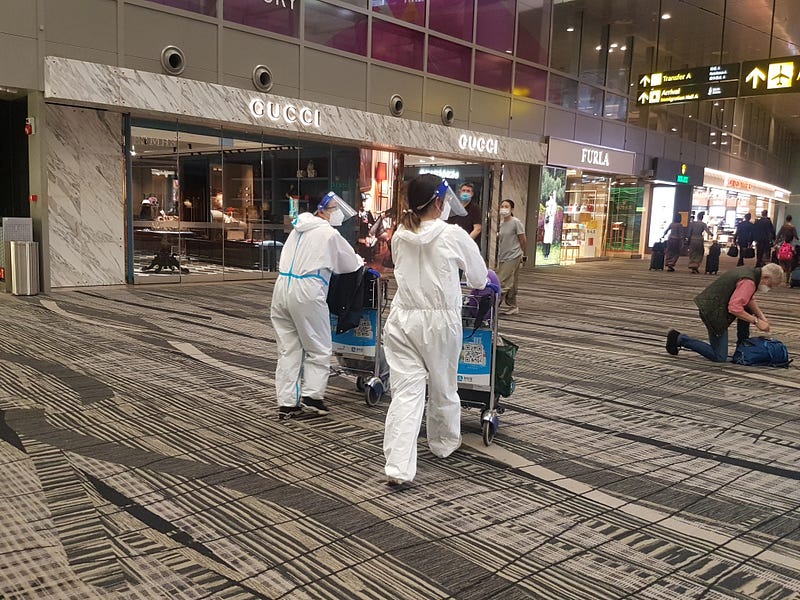
By now the use of PPE had become more commonplace, but mainly in healthcare settings. It was still not the norm to see people in PPE like this in places like the airport. These two were the few donning this attire and they stood out.
What struck me was that they clearly had this fear of the virus; however, it did not stop them from traveling.
I love traveling and when the world starts to connect again, I hope that this attire will not become the face of travel in the new era.
Hopefully mask-wearing, and PPE will become a thing of the past when taking a flight in the future and not one of the essential items to pack.
2. Empty terminals and closed duty-free shops
I had transited through Hong Kong airport, where there was not a lot going on for the 10 hours transit.
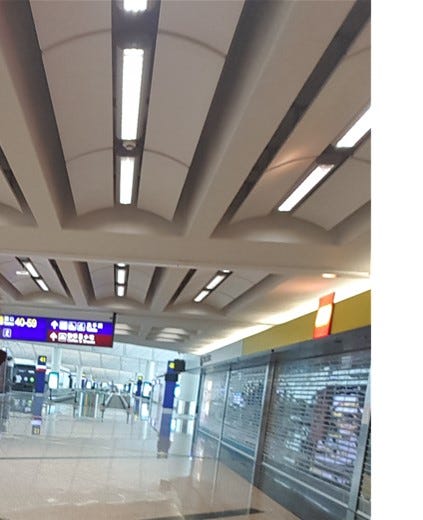
The picture was the same at Auckland airport.
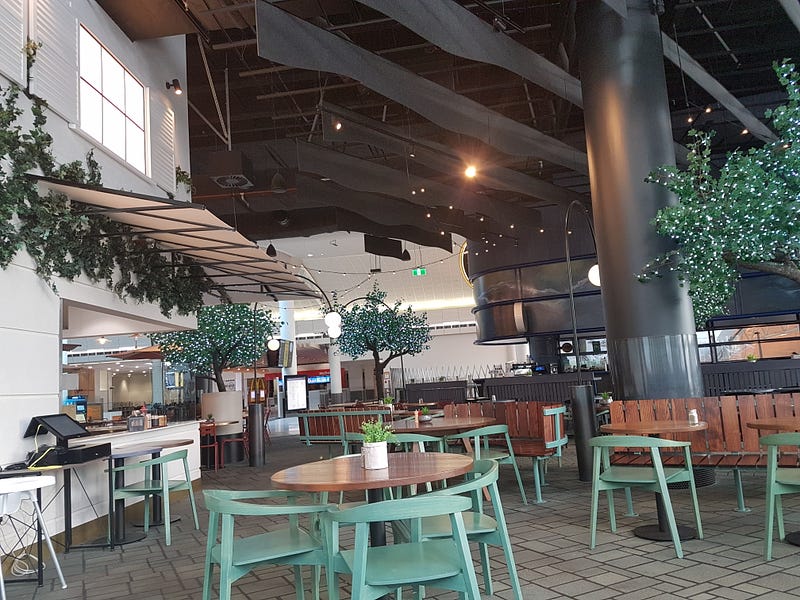
This is inside of Singapore terminal in 2022.
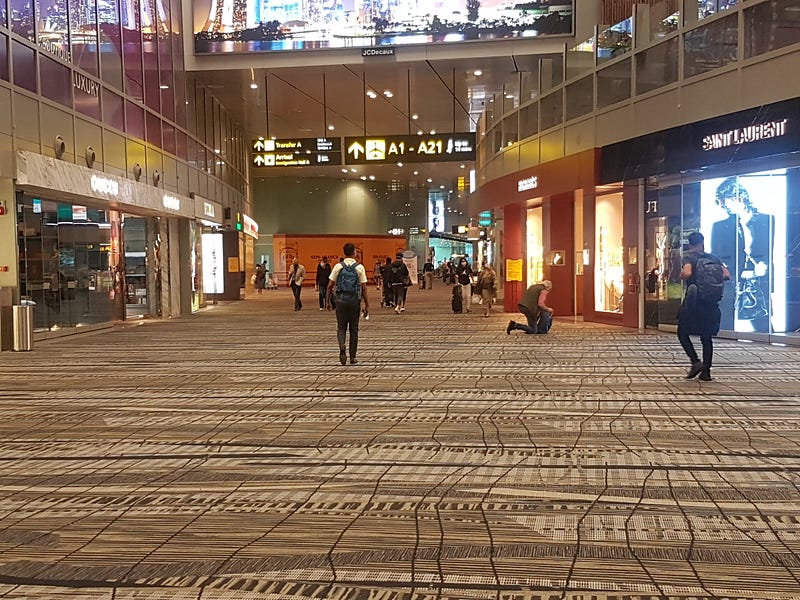
Travelers were non-existent in 2020. In 2022 they are still cautious. The departure lounges are quieter than normal. Shops are slowly starting to open as passenger footfall starts to increase.
3. People are still cautious about travel
I left from Heathrow Terminal 2.
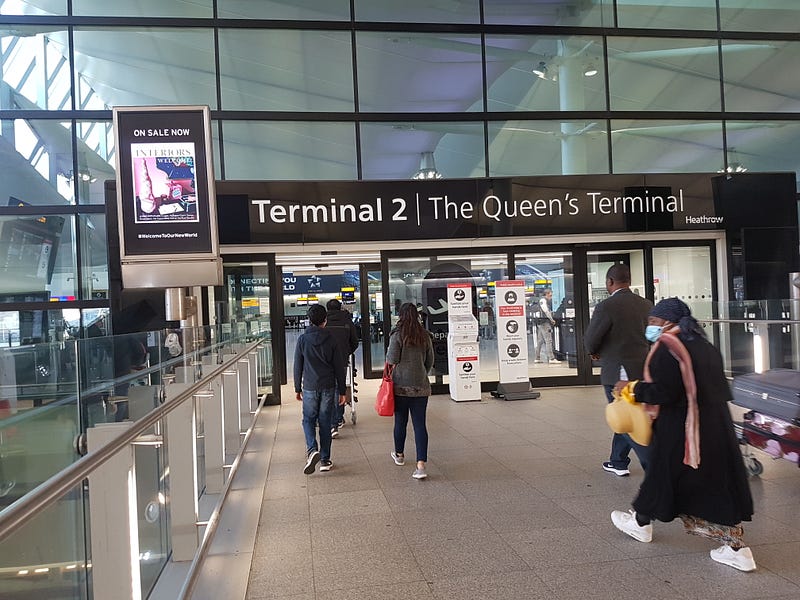
This was the departure lounge at Terminal 2 in March 2022.
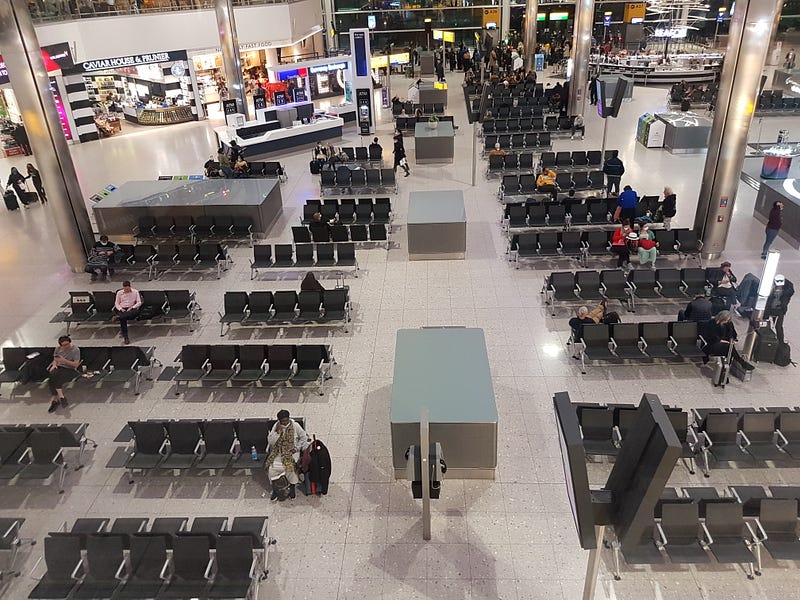
As you can see it was quite empty by Heathrow standards. It would normally be teeming with passengers, with a struggle to find a seat. In contrast, there were very few passengers traveling.
Here is the departure board, which shows just how few flights were actually leaving.
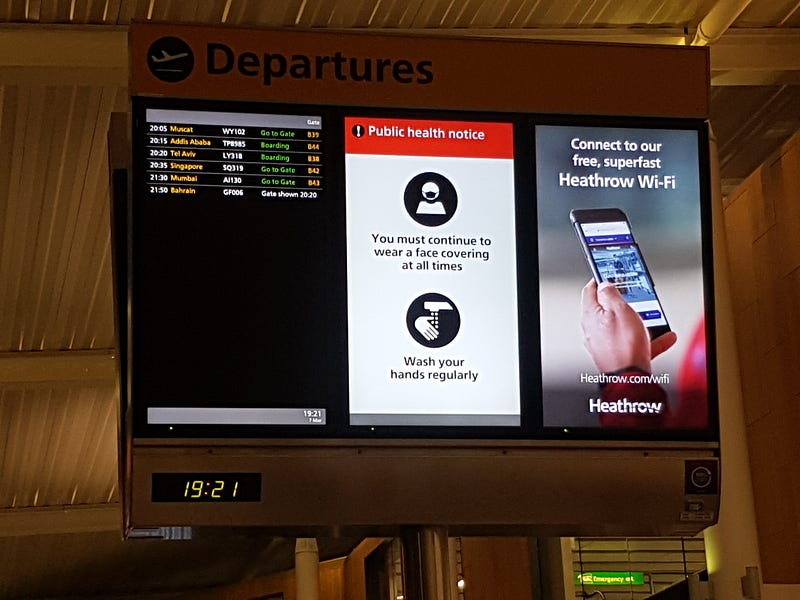
4. Airlines flying at less than half capacity
My flight from the UK to Hong Kong in 2020 was fairly full. I was surprised by this, all things considered. I was also not certain that the measly mask around my face would protect me that much.
My flight from the UK to Singapore in March 2022, was also full. I was not as surprised as travel was starting to open up more by this time. Singapore also introduced Vaccinated Travel Lanes to allow some passengers to travel more easily and which enabled opening travel with certain countries.
But my connecting flight onwards on both occasions, to New Zealand, was empty by comparison. The few passengers on board, each had a row of three seats to themselves. What a luxury that was, as I stretched out for the night, who needs business class when this happens. Sadly, it does not happen often, and as travel opens up, we will be back to the cramped economy class, fighting for overhead luggage space and hassling for spare empty seats.
Here’s the flight to New Zealand, you can see how empty it was.
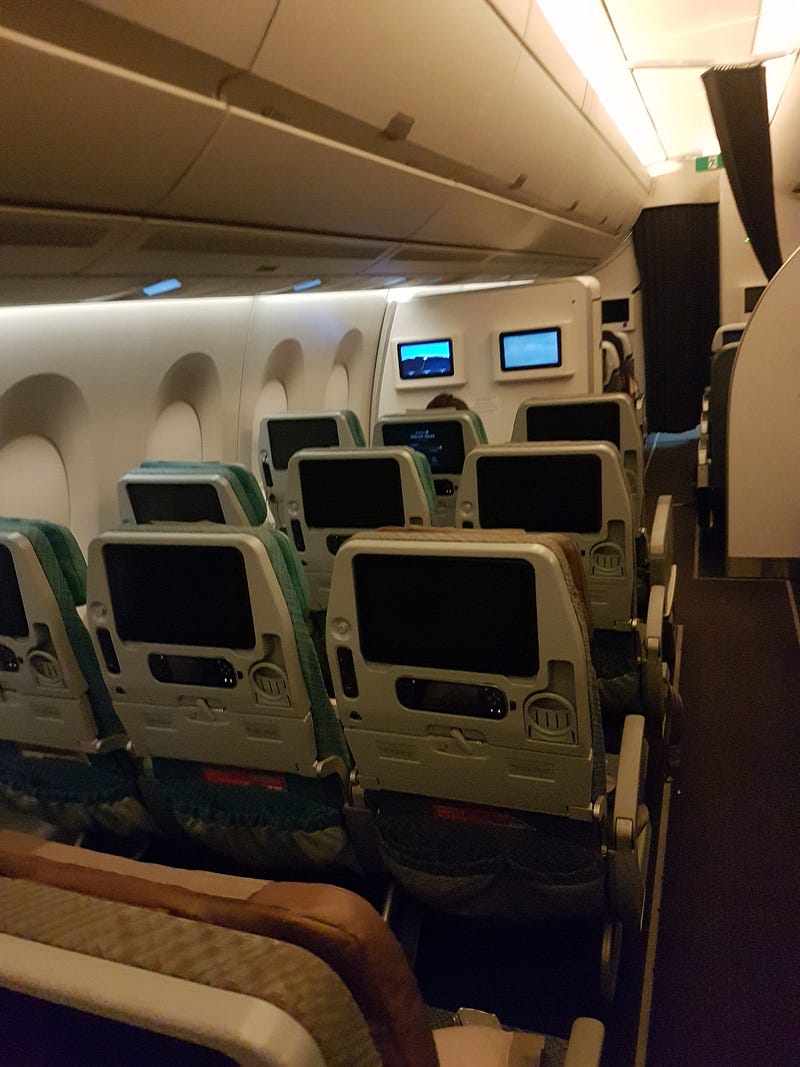
The reason for this is the borders in New Zealand are one of the last in the world to open up. I had to obtain special permission to travel, on both occasions, due to the closed borders. Recently, Prime Minister Jacinda Arden announced that New Zealand will be welcoming visitors again, news headlines declare, “Fortress New Zealand is opening up”. Who would have thought we would see countries closing their borders to the whole world.
5. Getting tests before and after departure
One of the things that has made travel that much harder has been the requirement to get a PCR or supervised RAT (Rapid Antigen Tests).
Each country has its requirements, so travel is not a straightforward matter anymore.
You have to check each country’s requirements before traveling and make sure that you obtain the correct test within the specified timeframe window.
It’s no wonder that testing calculators like this one, have popped up. These help you to work out the timing when you need to get your test done. By simply entering your flight date and time, it will give you the 72, or 48 hours window whichever one you need to comply with. This helps you to know when to book your pre-departure test.
What is pre-departure testing?
Each country introduced its requirements. These can change rapidly. These requirements mean that visitors have to complete specific testing before departure and sometimes also on arrival.
For example, I had to complete a PCR test within 48 hours of my departure, which I had to pre-book. I then had to complete RAT tests on Day 0/1 and again on Day 5/6 after arrival. For the RAT tests, I was given the testing kits at Auckland airport and had to call a special number to provide the results.
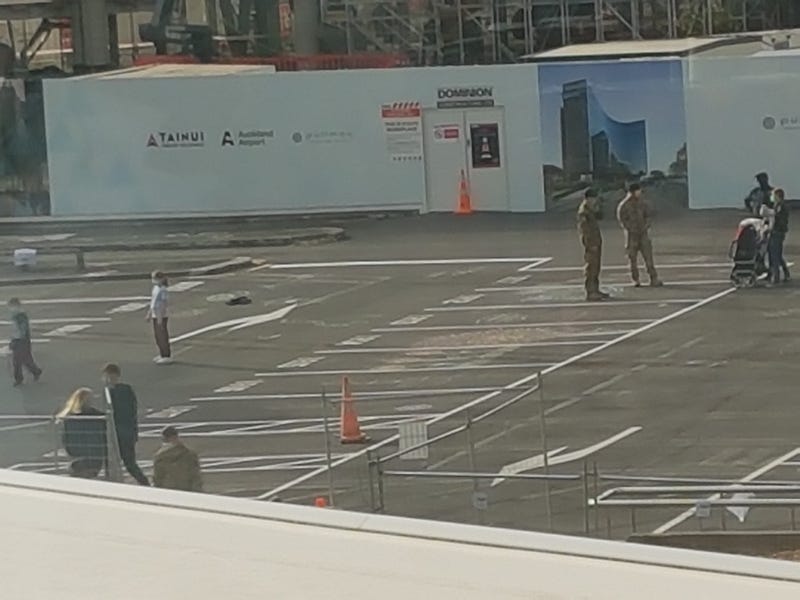
The pre-departure testing requirement is a drop in the ocean, compared to what New Zealand had in place over the past two years. Prior, to this it was mandatory isolation. When I traveled in August 2020, I had to undergo two weeks of mandatory isolation in a managed center in Auckland.
In Summary: The Changing Face of Air Travel
Before you rush out to pack your suitcases and jet off to the beach or other destination, it is no longer simply a case of having a valid passport and checking visa requirements, now you will have to check pre-departure and testing requirements as well. And your essential items packing list.
All this takes more planning. It also adds to the cost, especially if you are a family. All these factors need to be considered when planning a trip abroad. We are no strangers to change. We are all used to having our little plastic bags containing our 100mls toiletries when traveling. This is the norm worldwide. But it wasn’t at one time. Maybe these testing requirements and PPE will become the norm, although, I hope not.
Air travel changed over the past two years, I experienced this first hand. It was not as straightforward as before. It is clear that air travel is opening up again, albeit, with some changes. Whether it will get back to some sort of normal, only time will tell. The signs however are hopeful that travel may get back to some sort of normal.
Hopefully, when that happens, we will all also consider more sustainable travel in the future. And think whether the trip we take is really necessary given all that we have been through.
Did you travel during the pandemic, what changes did you see? Are you looking forward to traveling, despite any changes, that may continue to be in place?
© Bernie Pullen, All Rights Reserved.
If you enjoyed reading, please support me directly with your Medium subscription. It helps a lot!
Get my articles by subscribing here.
If you wish to, I like coffee!


