
RACIAL JUSTICE/EDUCATION
Inviting George Floyd to My Classroom
One year later, I would like to spend some time exploring what all this means
I established early in my teaching career the desire to tell the truth. To be up-front with my students; to discuss the news of the day frankly and explicitly. To take the blinders off what has often passed for public high school education and have a free exchange of informed opinion.
Room 215 was always known as a place where kids could speak their minds. But they also knew that the right of free expression, so often lacking in today’s classrooms, went hand-in-hand with their duty to know what the heck was going on in the world.
I’ve reached across the literary landscape to cover some pretty incendiary — but necessary — topics with my students. Capital punishment, when we analyzed the reporting and the fluency of Truman Capote throughout In Cold Blood. Racism, sexual abuse, and freedom of expression when we combed through the poetic prose of Maya Angelou’s I Know Why the Caged Bird Sings. The brutality of homelessness and mental illness when we explored the honest accounting of The Soloist.
Students learned what Socrates and the ancient Greeks knew: That questions and ideas are the bedrock of any democracy, even in a high school classroom. Perhaps especially in a high school classroom.
That’s why I’m feeling adrift this week. I’ve been gone from Room 215 for almost four years now. How would I cover the News of the Day with my students in 2021, when we face more challenges as Americans — and especially as human beings — than ever before?
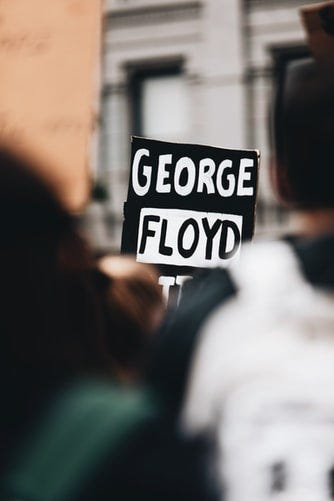
This week we remember the death of George Floyd on the streets of Minneapolis. On May 25th of last year, he succumbed to the knee of police officer Derek Chauvin. And as we discuss Floyd’s sacrifice today, both as a country and as individuals, I’d like to think I would assign my students to spend some time thinking about what the events of this past year mean.
Most of us know the particulars. Floyd was accused of passing a counterfeit $20 bill at a corner store. Four policemen responded to the call from Cup Foods. After a tussle, after the cops had handcuffed Floyd and slammed him face down on the street, Chauvin kneeled on Floyd’s neck for nine minutes and 29 seconds, as his prone prisoner cried “I can’t breathe” at least 28 times and repeatedly called for his mother.
Floyd’s death over Memorial Day weekend last year started a movement. Americans seeking justice marched from Seattle to D.C. The “Summer of Racial Reckoning” created a rhetorical call for equity in this country that Americans haven’t seen since the Civil Rights movement of the 1960s.
My challenge as a teacher would be to encourage my students to use their developing skills of media literacy to first understand the issue and then to figure out what it all means.
Required reading would include news coverage, first of Floyd’s death, then the ongoing protests during the Summer of 2020, and finally the trial that ended in the guilty verdicts against Chauvin. I would select articles from Floyd’s hometown paper, The Minneapolis Star-Tribune. We would read accounts in the national press, including The New York Times and The Washington Post.
Yes, I have a bias toward the print media. It’s where I got my start as a journalist, and I believe in the tenets of a newspaper’s truth-telling that aren’t always present in more flamboyant television news. And I strongly believe that reliance on the traditional, mainstream media is important to inform one’s view of the world. But I would have my students take a look at television coverage of both Floyd’s death and the demonstrations in the street last summer.
National Public Radio had a brilliant story about how different kinds of media play into our personal views of any situation, and in particular, the Chauvin trial in March. We’d take a look at clips from Fox, MSNBC and local television coverage, as well.
What about Darnella Frazier’s almost 10-minute cell phone video, which played a large part in Chauvin’s ultimate conviction? In a world where everything is equal, I’d lean toward screening it in my classroom. Yes, it is brutal. Yes, it is heart-wrenching. But Ms. Frazier was 17 years old when she filmed George Floyd’s death. This teenager, the same age as most of my students in Room 215, had the presence of mind to stand there on a Minneapolis street corner and film not only an egregious civil rights violation, but the slow suffocation of a man while onlookers begged the ogre kneeling on Floyd’s neck to let up, for God’s sake.
Here’s where a seldom-used classroom caveat comes in. I would send a letter home with each of my students, explaining the video and the reasons I think it could more fully inform our discussion. I would have a parent/guardian sign the letter if they wished to give permission for their child to watch the video in my classroom. I would grant students — if they didn’t want to watch this incredibly graphic footage — the option of excusing themselves from class, and perhaps reading a summary of what I planned to screen in Room 215.
But I look at the situation this way: My students would have already read In Cold Blood — the ultimate, graphic treatise on murder and capital punishment — and Caged Bird, with all of its powerful scenes. Not one of my students or parents ever complained about the “realistic” view of either one of these works. I have an idea that not one of my students or parents, in May 2021, would complain about Darnella Frazier’s video, either.
Along the way, I would have students decide the most important points to talk about. They don’t need to hear my views. And we’d have a loosely structured discussion — not really a debate, but more of a Socratic Seminar — involving their questions and their points-of-view. And because the George Floyd case has so many different pieces — Floyd’s death, the protests, the trial, the conviction — we’d probably have more than one student-led discussion.
At the end of our unit, students would, of course, have a writing assignment.
“In a 500 words, please explain your reaction to the so-called ‘Summer of Racial Reckoning’. You must use independent research (at least two sources), classroom discussion and reading to support your viewpoint”.
Short, concise, to the point.
I’m not looking for a full-on research paper here. The students would have already spent quite a bit of time reading about and discussing George Floyd, his death, and everything that came after that. And I’m not interested in them being judge and jury this time, either. I just want them to think about what we’ve covered, and decide if the Summer of 2020 was a time of reconciliation and perhaps healing, or if it just threw more embers on the fires of racial hatred that have been burning in this country for hundreds of years.
And before anyone jumps down my throat about any perceived “wokeness” in this assignment: Each student is entitled to her/his opinion, as long as they can back it up.
So, I’ll be thinking about George Floyd a lot this week. And reading about him, watching news clips, and maybe writing about him again, too. I don’t have a traditional classroom anymore, but if any of you want to join me in a free exchange of ideas, I’d love to engage and hear what you have to say.
I’ll also spend time watching Darnella Frazier’s 10-minute cell phone video. No, even though I strongly believe this brave young woman deserves the Nobel Peace Prize — or at least the Pulitzer — I haven’t had the fortitude to watch the whole thing all the way through — yet.


