
Do You Know Why the Caged Bird Sings?
Maya Angelou did, and her lessons still resonate
Every year at this time, I dusted off my mad English Teacher Skills. Dove back into my literary archives. Prepared to amaze a group of 16- and 17-year-olds with what I knew. And what they should know, too.
Teenagers are a fragile bunch, at least in suburban public schools. They’re often protected from the outside world, and if they meet with a challenge, it usually involves a position on the JV soccer team or a role in the school’s Spring Musical.
But these kids are also resilient, and they’re fierce. And, for the most part, they know that they should pay attention to what matters. So if they are confronted by a situation that smacks of even the smallest scintilla of the reprehensible, they are prepared to do battle to right that wrong.
Dr. Maya Angelou knew that. And she spent her 86 years on this earth supporting those who saw the rusty side of a bad penny more than once. That’s why her works resonated with my Lang cherubs.
This week marks Dr. Angelou’s 93rd birthday. I always started our AP English Language (aka AP Nelson) unit in time to commemorate her birth and her contributions to the Planet Earth.
I first met Dr. Angelou as a 16-year-old myself. My high school wasn’t the most progressively forward campus, so no one assigned me one of the author’s seven autobiographies. A friend, who babysat for a college English professor, snagged Dr. Angelou’s preeminent memoir, I Know Why the Caged Bird Sings, from her client’s prodigious personal library, and passed it along to me.
I read Caged Bird at least half a dozen times before I graduated from high school a year-and-a-half later.
I assigned Caged Bird to my high school cherubs every one of my 23 years in the teaching trenches. And those suburban students — even the boys, who were clearly uncomfortable with the topics of racism, sexism, rape and redemption — never disappointed me.
But we didn’t just read the book. We learned about Maya Angelou’s crusade to rescue the Human Race from itself. That she wasn’t just a prodigious author, but a poet; that she wasn’t just a writer, but a composer, an actress, a professor, a campaigner. She called herself “a teacher who writes”, and penned the inaugural poem, “On the Pulse of Morning”, for President Bill Clinton’s swearing-in in 1993. She was nominated for the Pulitzer Prize, and my students — to a kid — always thought a grave injustice was perpetrated on this American icon when she didn’t win.
Angelou received the Presidential Medal of Freedom in 2010 from President Barack Obama. She believed in the human right to health care, and more than 30 medical and health-care facilities are named in her honor. She collected more than 50 honorary degrees over a lifetime of achievement. How fortunate so many were able to spend a semester — or two, or perhaps three — at Wake Forest University, where the internationally renowned poet, civil rights activist, actress and author was named that university’s first Reynolds Professor of American Studies. She discovered her passion for teaching at what is colloquially known as Wake, and taught there for 40 years.
I always wanted to sample one or more of Dr. Angelou’s courses: “World Poetry in Dramatic Performance”; “Race, Politics and Literature”; “African Culture and Impact on U.S.”; “Race in the Southern Experience”, and “Shakespeare and the Human Condition.”
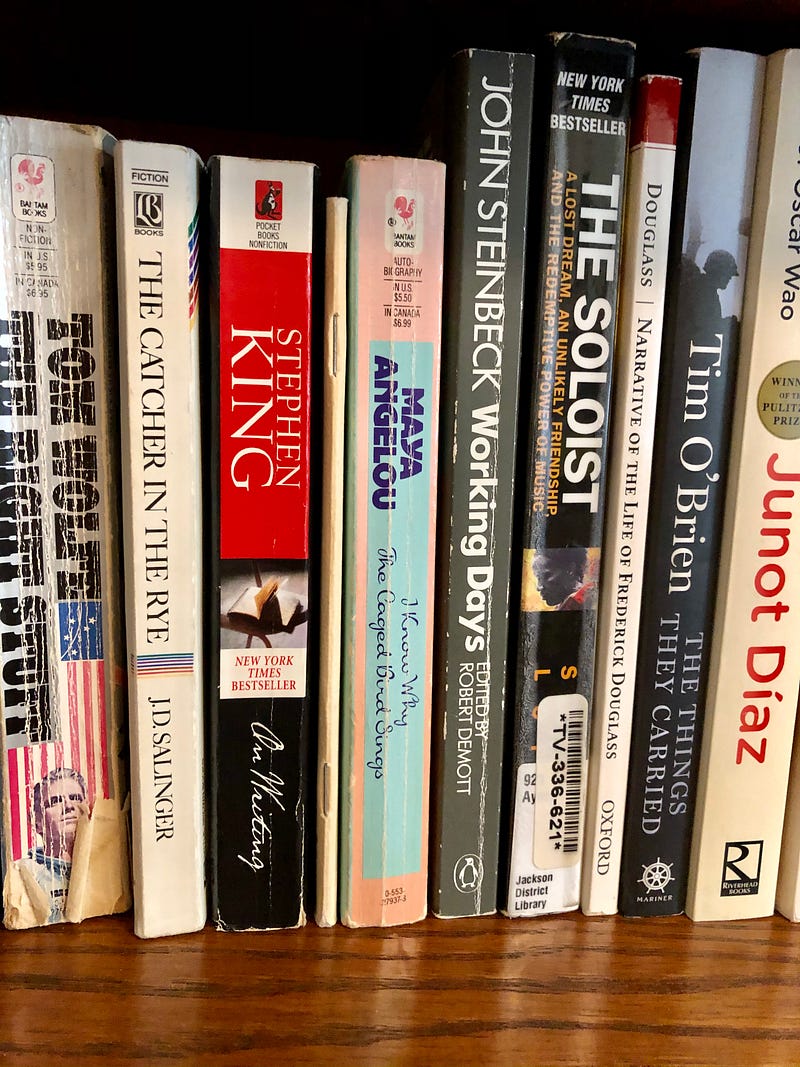
Sadly, I never made it down to Winston-Salem. But over the years, I’ve continued to learn from Maya Angelou. I Know Why the Caged Bird Sings sits on my “special” bookshelf at home, where I keep the dog-eared volumes that I taught over the years. I pull it out whenever I need the inspiration to soldier on in this increasingly desperate world. This little girl from Stamps, Arkansas, was always “Hoping for the best, prepared for the worst, and unsurprised by anything in between”. She inspired me to start writing again with this simple, yet elegant, declaration in the pages of Caged Bird: “There is no greater agony than bearing an untold story inside you”.
I always closed our study of Dr. Angelou with a tidbit that pre-dated the Harlem Renaissance. A famed poet of whose work inspired that later era of self-discovery, Paul Laurence Dunbar, penned a poem he named “Sympathy”. Maya Angelou took the title of her most well-known memoir from his stanzas:
I know why the caged bird sings, ah me, When his wing is bruised and his bosom sore, — When he beats his bars and he would be free; It is not a carol of joy or glee, But a prayer that he sends from his heart’s deep core, But a plea, that upward to Heaven he flings — I know why the caged bird sings!
My students learned a great many lessons from Dr. Maya Angelou, the greatest of which was perseverance. Live life beyond the soccer fields and the high school auditoriums. Always.
“If you’re always trying to be normal,” the good doctor said, “you will never know how amazing you can be.” Amen to that.