
Value Circle #6: The Indirect Activity of Platform Ecology Center
The Synergy Effects of Networked Knowledge Centers
This article is part of the Value Circle project. You can find more related articles below:
- Value Circle #1: From “Mental Moves” to “Value Circle” — August 7, 2023
- Value Circle #2: Engaging with Lui’s Theoretical Sociology — August 9, 2023
- Value Circle #3: TALE as A Thematic Transformation Hub — August 31, 2023
- Value Circle #4: From “ARCH” to “Activity Circle” — Oct 11, 2023
- Value Circle #5: Building A Joint Knowledge Center — Dec 29, 2023
The Value Circle project aims to reflect on the development of several knowledge centers and explore the dynamics of networked knowledge centers. It follows the Mental Moves project, especially the idea of “Mental Moves between Knowledge Centers”.
Originally, the “Networked Knowledge Centers” refers to the following knowledge centers. You can find more details in TALE: A Possible Theme called “Knowledge Center”.
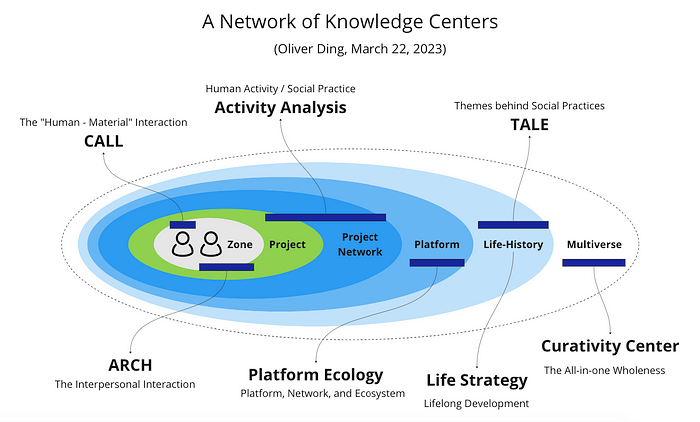
1. CALL(Creative Action Learning Lab) Center The “Human — Material” Interaction
2. ARCH Center The Interpersonal Interaction
3. Activity Analysis Center Human Activity/Social Practice
4. Platform Ecology Center Platform, Network, and Ecosystem
5. Life Strategy Center Lifelong Development
6. TALE (Thematic Analysis Learning Engagement) Center Themes behind Social Practices
7. Curativity Center: The All-in-one Wholeness
The above seven knowledge centers are built by myself. All knowledge frameworks and related books are created by me. I didn’t work on all knowledge centers at the same time.
In 2023, Platform Ecology Center and Life Strategy Center were inactive knowledge centers. However, I made progress in Platform Ecology Center and Life Strategy Center by working on knowledge projects belonging to other knowledge centers.
In order to highlight such a type of Synergy Effects of Networked Knowledge Centers, I used the following terms for the Value Circle project:
- Direct Activity
- Indirect Activity
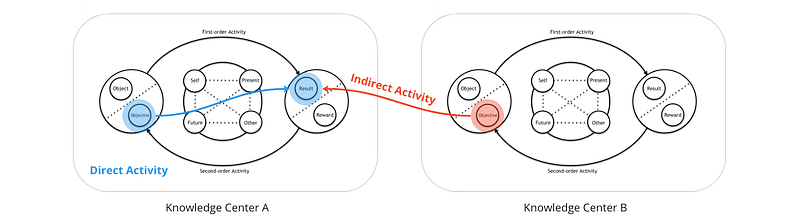
If the objective of a knowledge project is defined by a particular knowledge center and its outcome contributes to the progress of the knowledge center, then the project belongs to the category of Direct Activity of the knowledge center.
If the objective of a knowledge project is defined by a particular knowledge center and its outcome contributes to the progress of other knowledge centers, then the project belongs to the category of Indirect Activity of the other knowledge centers.
This article aims to use the Indirect Activity of Platform Ecology Center in 2023 to conduct a case study about this idea.
The AAS approach to Knowledge Center
AAS stands for Anticipatory Activity System. The Anticipatory Activity System (AAS) framework is inspired by Activity Theory and Anticipatory System theory. It aims to offer an abstract model to understand the “Self, Other, Present, Future” structure of social life.
While the traditional Activity Theory focuses on “Exploitative Activity”, the AAS framework is more about “Exploratory Activity”.
Traditional activity tends to use the following hierarchy to understand human activity:
- Operation
- Action
- Activity System (an Activity)
- Activity Network (a network of Activity Systems)
You can find more details in The Hierarchy of Human Activity and Activity System: Four levels of contradictions.
From 2020 to 2023, I developed a new hierarchy as an alternative to the traditional approach.
- Operation (individual subject)
- Action (individual subject)
- Activity Circle (two subjects)
- Project (collaborative project)
- AAS (a set of projects)
At the “Project” level, we can use the Activity System model or the Developmental Project model to understand a “Project”. You can find more details in the Project Engagement approach.
Originally, I used the Project Engagement approach to understand the Activity of Knowledge Center. Since a Knowledge Center runs a set of knowledge projects, we can understand it as an Anticipatory Activity System.
- First-order Activity: Knowledge Service
- Second-order Activity: Knowledge Discovery
We can apply the AAS framework to understand Direct Activity and Indirect Activity. See the diagram below.
What’s the difference between Direct Activity/Indirect Activity and First-order Activity/Second-order Activity?
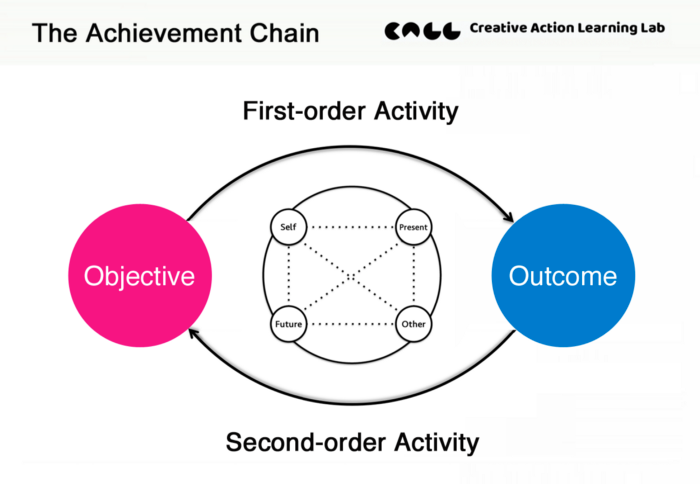
Second-order Activity refers to a specific type of activity that discovers significant insights and defines objectives and objects for other types of activities.
First-order Activity refers to normal activities in which objects are defined by Second-order Activity.
First-order Activity and Second-order Activity form an Anticipatory Activity System. The outcome of First-order Activity supports Second-order Activity and the objective of First-order Activity is defined by Second-order Activity.
If the connection between Objective and Outcome crosses two Anticipatory Activity Systems, then we define it as Indirect Activity.
Platform Ecology Center
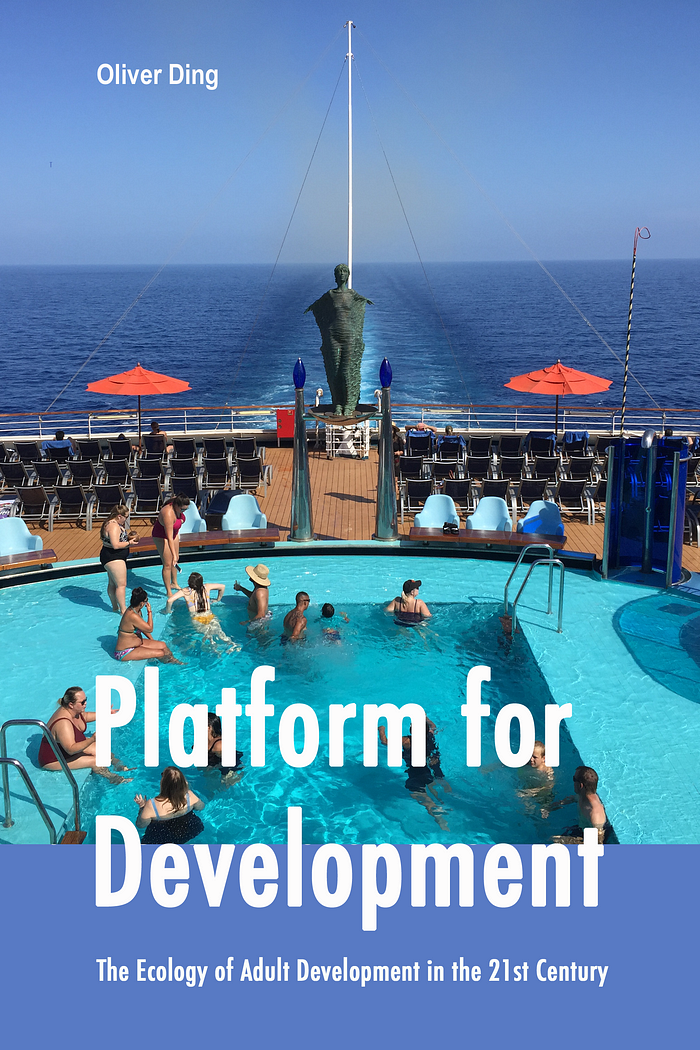
I started the Platform Ecology project in 2019. The major outcome of the project is a book (draft) titled Platform for Development: The Ecology of Adult Development in the 21st Century (2021).
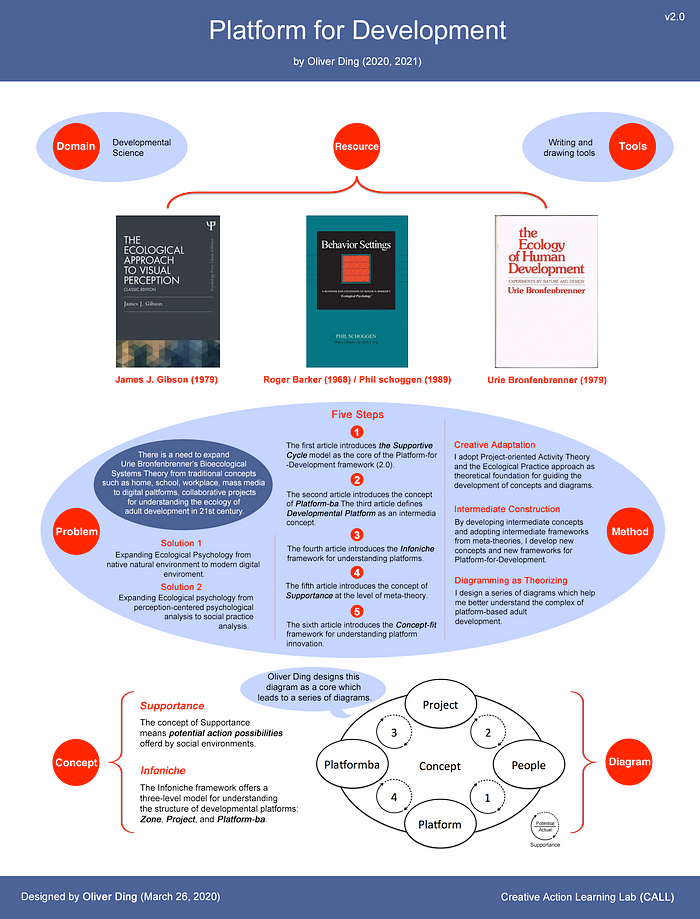
The major outcome of the book (draft) is an ecological approach to adult development. See the diagram below.
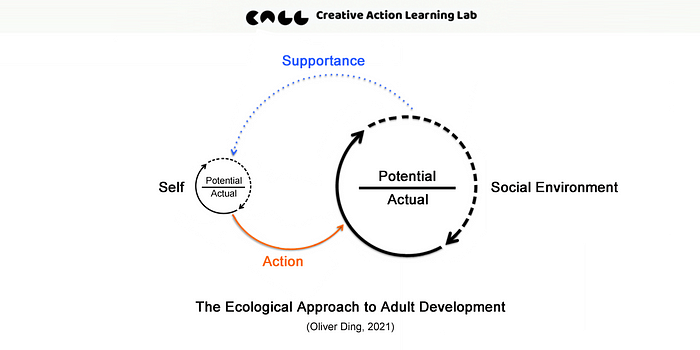
The above diagram represents a new model of adult development from the perspective of the Ecological Practice approach. A person’s development means the transformation between the Potential Self and the Actual Self, this process is related to the transformation between Supportance (potential action possibility) offered by the social environment and Actual Action.
The book also offered a framework for understanding the platform ecology. See the diagram below.
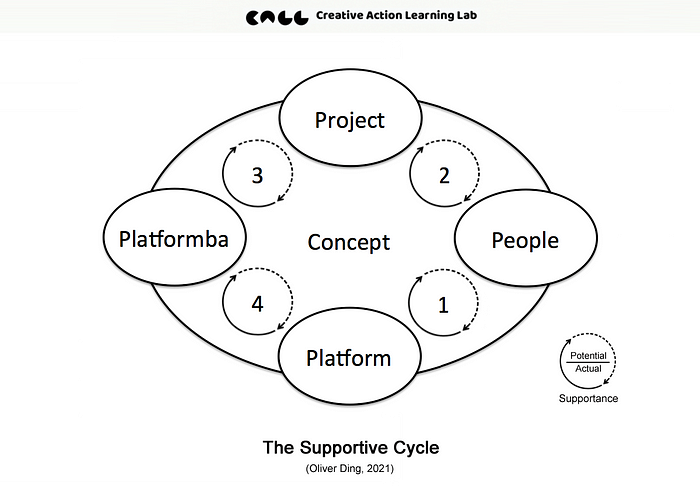
The above diagram represents the model of the Supportive Cycle. The four types of entities are Platform, People, Project, and Platformba. The four movements are labeled as 1, 2, 3, and 4 in the diagram. However, these numbers don’t refer to steps or stages. I consider these interactions to be parallel development. The focus of P4D is not studying the development of individual entities such as the development of digital platforms, but the relationship between people and the whole of Platform(Project) from the perspective of adult development.
The Supportive Movement is defined by the concept of Supportance which refers to the potential supportive possibilities for actions. Each movement is divided into two states: the Potential status and the Actual status. The relationship between two entities is roughly considered as “environment” and “organism” from the ecological perspective. One side (as the “environment”) offers Supportances to the other side (as the “organism”).
- Environments: Platform, Project
- Organisms: People, Platformba
You can find more details in The Supportive Cycle (v1.0) and Platform for Development (2.0).
In 2022, I developed the Platform Genidentity Framework and moved to test a related concept called “Knowledge Center”.
I used the diagram below to represent a rough idea of the “Platform Genidentity” framework.
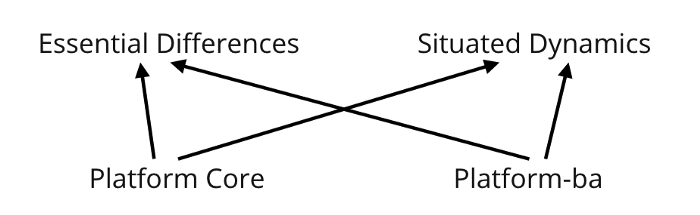
What’s Platform Genidentity? I use the concept of Platform Genidentity to describe a process of keeping the uniqueness of a platform within a long-term duration. For example, Google.com (a Search Engine), Wikipedia.org, and YouTube.com, these three websites keep their original core design without major changes.
In order to understand the complexity of Platform Genidentity, I developed the following two new concepts:
- Platform Core: a basic unit of a platform. For example, a Tweet, a YouTube video page, a Q&A page on Quora, etc.
- Platform-ba: a platform-based sociocultural field. For example, YouTube-ba is a YouTube-based sociocultural space. You can find more details here.
As mentioned above, we have an operational definition of the concept of Genidentity: A thing’s Genidentity is defined by Essential Differences with Situated Dynamics.
For Platform Ecology, we need to discover the sources of Essential Differences and Situated Dynamics. I think the sources are Platform Core and Platform-ba. However, they don’t work as a one-to-one mapping relationship. See the above diagram.
Finally, we need to add “Platform” back to the framework. The whole structure is a nested whole.
- Platform-ba [Platform (Platform-core)]
This structure of Platform-ba can be understood as the following model:
- Platform-ba{Project [Zone (People)]} which is the focus of the Platform-for-Development framework.
Since the Platform Genidentity Framework focuses on the perspective of platform owners, we will pay attention to the relationship between Platform-core, Platform, and Platform-ba.
You can find more details in Platform Genidentity: The Movements of Unfolding Uniqueness.
In 2022, I also designed a board on Milanote and used it as the homepage of Platform Ecology Center.
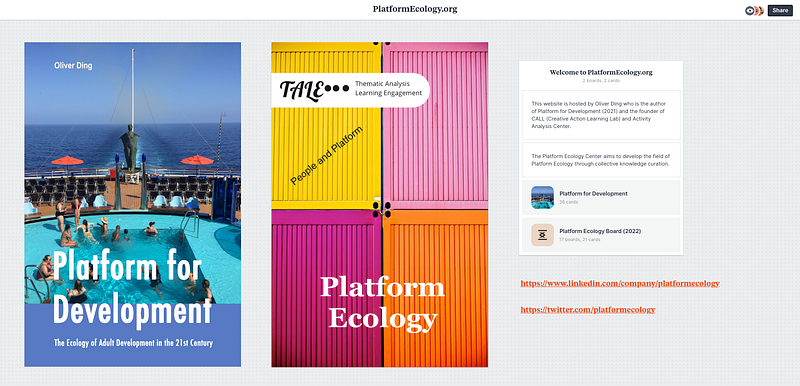
Though I set up a LinkedIn page and a Twitter account, I wasn't active in updating these social media accounts because I was busy with other knowledge centers.
Platform Ecology as A Possible Discipline (2023)
In 2023, I updated my thoughts about the Platform Ecology project while working on other knowledge centers.
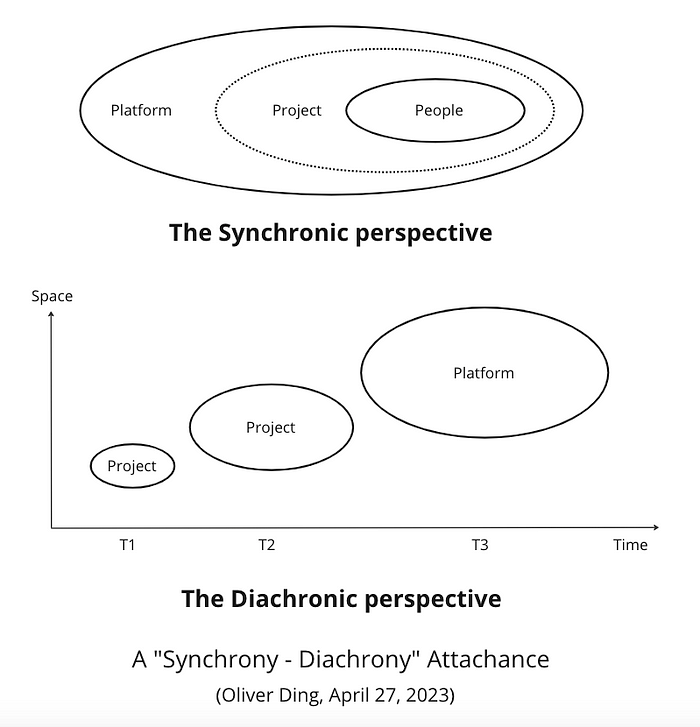
On April 27, 2023, I worked on the Mental Moves project which belongs to CALL (Creative Action Learning Lab). I reflected on the development of Platform Ecology and used it as an example of Mental Moves to conduct a case study. You can find more details in Mental Moves #2: Creative Swapping of Mental Elements.
On April 28, 2023, I worked on the Thematic Exploration project which belongs to a knowledge center called TALE (Thematic Analysis Learning Engagement). I wrote an article titled TALE: A Possible Theme called “Possible Discipline”. This article introduced an idea called “Configurational Theory” for understanding disciplines.
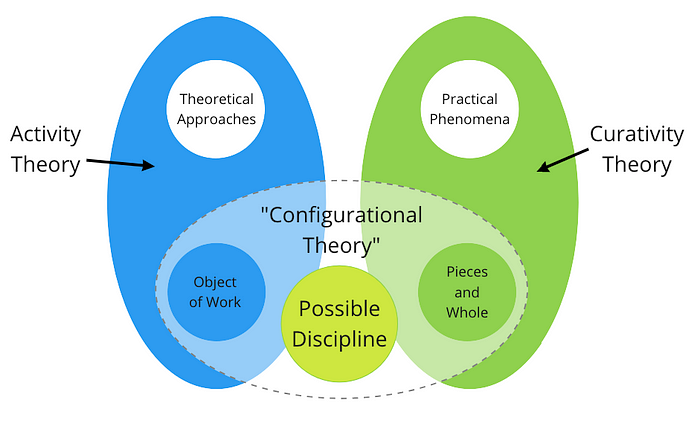
On May 8, 2023, I applied the idea of “Configurational Theory” to the Platform Ecology project and developed a Configurational Theory for it. See the diagram below.
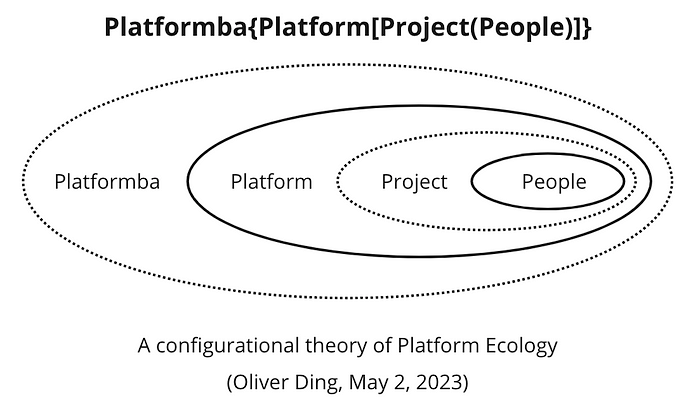
Originally, the term “Platform Ecology” refers to my vision of applying the ecological practice approach to study Platform-related social practices. I consider it as a knowledge enterprise that could lead to different projects such as the Platform-for-Development framework, Platform as Container, Platform Innovation as Concept-fit, etc.
If we see “Platform Ecology” as an approach or a perspective, then the word “Ecology” refers to the Ecological Practice approach which is a particular theoretical approach.
If we see “Platform Ecology” as a possible discipline, then the word “Ecology” refers to the normal word which means the study of the relationship among living organisms and their environment. In this manner, Platform is the primary environment for People.
The configurational theoretical approach separates “Object of Study” and “Theoretical Approaches”. For the same Object of Study, different researchers can use different theoretical approaches.
This is a major insight about the Platform Ecology project. You can find more details in TALE: A Possible Discipline called “Platform Ecology”.
Platform Ecology and Concept System (2023)
From April 2023 to August 2023, I worked on a strategic design research project about a Web 3.0 platform. A by-product of the project is the idea of “Spontaneous Concept System”.
The web3 platform recently launched a new product that aims to enable non-technical users to create, launch, and host their own decentralized applications (DApps). We may use the “No-code DApps platform” to frame the new product.
I have 0 knowledge of web3 and DApps. The first step of the Strategic Design Research project is to directly use the platform to create a simple DApp without formal training. I also didn’t read their HELP documents and DEVELOPER documentation.
I just learned some new knowledge about web3 and DID (Decentralized Identify) by using their platform to create a simple website with several pages. Sometimes I searched some keywords on the web in order to know some new terms. Sometimes I just use the Try-and-Fail approach to figure out the real meanings of some new terms.
After successfully launching the simple website, I made the screenshot below.
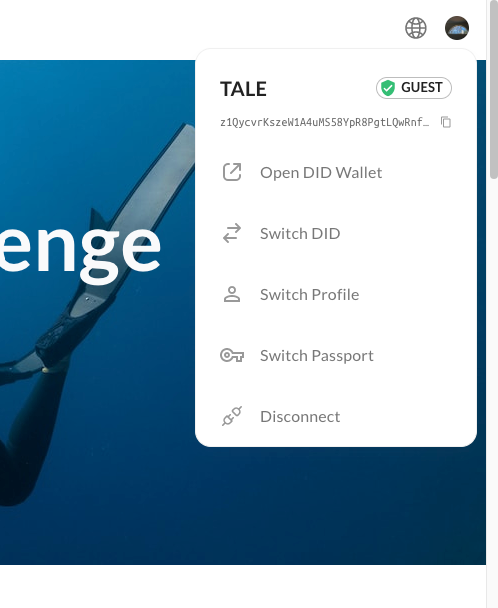
At that moment, I realized that there was a gap between the platform owner’s Concept System and my Concept System. As the designer of the platform, the owner clearly understands the following terms and the complicated relationships between these terms:
- DID Wallet
- DID
- Profile
- Passport
However, I have to figure out the following questions:
- What is the difference between DID Wallet and DID?
- I can see the Wallet on an app on my mobile phone. But, where is my DID?
- What does Switch DID mean? Do I have more than one DID?
- What’s the difference between Passport and DID?
By reading some documents, I can understand their design decision about separating Social Profiles and User Accounts.
The platform used a multi-layer approach to design its DID system. It’s fine to directly push this complicated structure to Developers because Developers can read documents.
Now we can use “Spontaneous Concept System” to describe my concept system. See the diagram below.
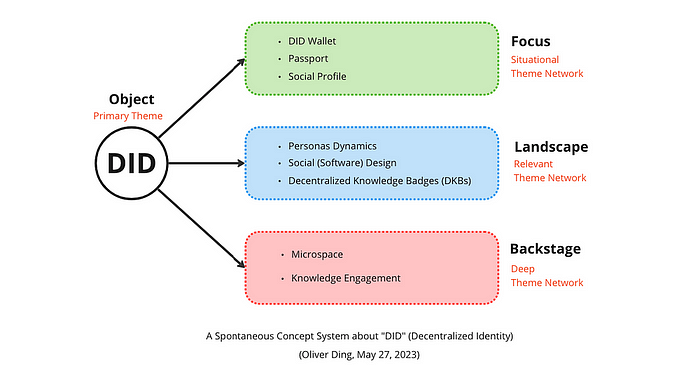
You can find more details in TALE: A Possible Theme called “Spontaneous Concept System”.
Later, I applied the idea of “Spontaneous Concept System” to discuss the Objectifcation of Concept System in Nov 2023. The outcome is a new framework called the Landscape of Evolving Concept System. See the diagram below.
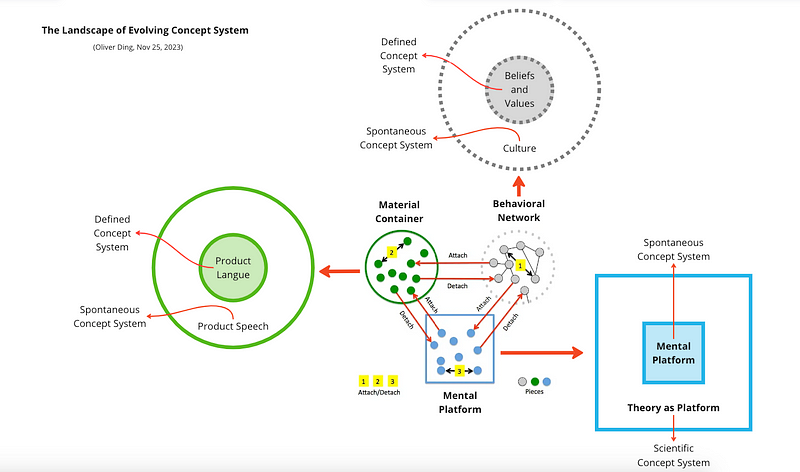
The above framework was part of the Territory of Concepts project which belongs to TALE and Curativity Center.
However, I used the “Container — Network — Platform” schema as the basic model to generate the above framework. The schema is also the basic model of the Platform Ecology project.
In March 2021, I applied Activity Theory to study platform innovation and made the Concept-fit framework. See the diagram below.
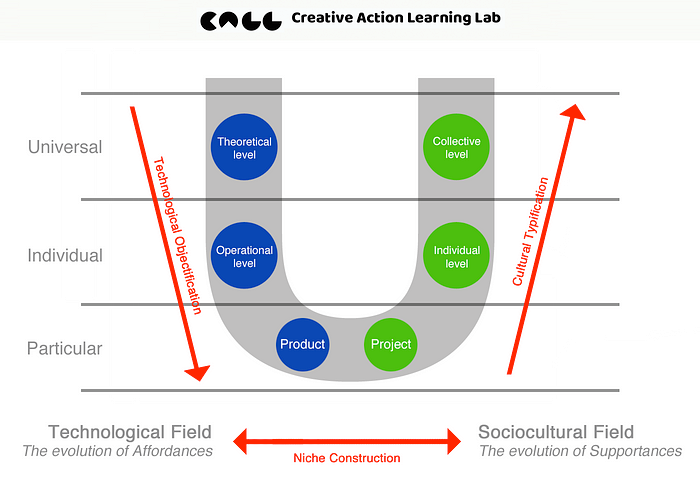
In Nov 2023, I made a Creative Swapping and used the basic model of Platform Ecology to understand the development of Concept System.
A major insight was a new concept called “Mental Platform” which corresponds to “Theory as Platform”.
- Theory as Platform: an established academic theory is a Scientific Concept System. A founder learns some ideas from a Scientific Concept System, or from many theories. In this stage, an academic theory is perceived as a developmental platform that supports his/her lifelong learning and cognitive development.
- Mental Platform: Finally, he/she curates ideas into a meaningful whole and develops his/her own Spontaneous Concept System about a particular possible product. Since his/her goal is to build a successful innovative product, the Spontaneous Concept System could be understood as a Mental Platform that supports his/her activities.
The Concept-fit frameworks didn’t touch the team’s mental activities and their internal team activity.
The Landscape of Evolving Concept System framework covers three major parts of an enterprise: the team’s mental activity, the team’s internal activity, and the users’ activity.
In this way, I developed a new perspective to understand the Platform Ecology project. You can find more details in Mental Platform: The Evolving Concept System.
The Platform Ecology Meta-framework (2023)
The Knowledge Engagement project is the primary project of Curativity Center in 2023. One of the tasks of the Knowledge Engagement project is Theoretical Curation for Building Meta-frameworks.
On July 16, 2023, I used the “Ontology — Realism — Hermeneutics” schema to analyze a brand new psychological theory about human nature. A friend of mine in China developed the theory and sent me a summary of his new book (draft) about the theory.
The outcome is amazing! It encouraged me to apply the “Ontology — Realism — Hermeneutics” schema to develop the Platform Ecology (v3.1) meta-framework.
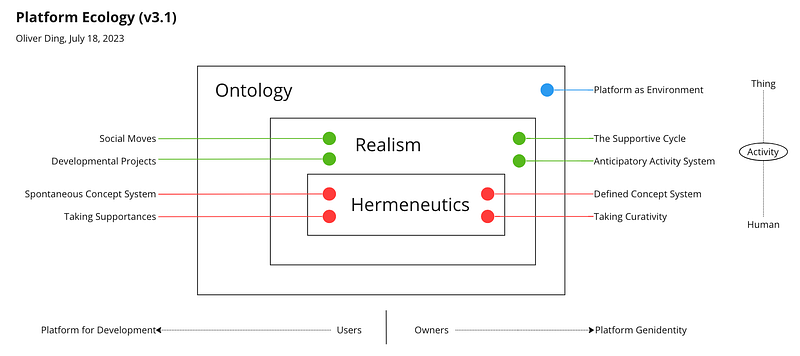
On July 18, 2023, I used the “Ontology — Realism — Hermeneutics” schema to curate several frameworks for the Platform Ecology Project. See the diagram below.
In 2022, I learned the “Ontology — Realism — Hermeneutics” schema from Ping-keung Lui’s theoretical sociology.
Lui aims to build a brand new theoretical sociology as a candidate for the paradigm of sociology. According to Lui, “There are three kinds of theories in sociology, namely, social theory, sociological theory, and theoretical sociology. ”
The structure of Lui’s theoretical sociology is a nested structure. See the diagram below. According to Lui, “The realism comprises a subjectivist structuralism and an objectivist stock of knowledge, while the hermeneutics is an interpretation and an analysis. Second, I shall present an ontology that nests the realism within its boundaries.” (p.250, 2016, Aspects of Sociological Explanation)
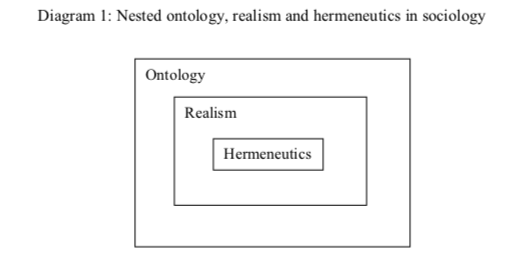
We should see this grand theory as a dialogue between philosophy and sociology because “Ontology” and “hermeneutics” are respectable terms in philosophy, but “realism” — sandwiched between them — is not. Lui emphasizes that Realism is the sociological matter proper (p.251, 2016, Aspects of Sociological Explanation).
Realism is determined by Ontology.
Realism leads to Hermeneutics which considers two parts: the actors’ interpretation and the researcher’s analysis.
For the Platform Ecology project, Ontology is defined by the above Configurational Theory which refers to the notion of “Platform as Environment”.
Realism refers to a set of sub-frameworks:
- The Supportive Cycle
- The Anticipatory Activity System (AAS) framework
- The Social Moves framework
- The Developmental Project Model
Hermeneutics refers to the following ideas:
- Spontaneous Concept System
- Defined Concept System
- Taking Supportances
- Taking Curativity
- The Platform for Development framework
- The Platform for Genidentity framework
You can find more details in Platform Ecology (v3.1).
Platform Ecology, Creative Life Theory, and Social Moves (2023)
From August 2023 to Dec 2023, I worked on the Social Moves project which belongs to CALL and Curativity Center.
On August 24, 2023, I made the diagram below.
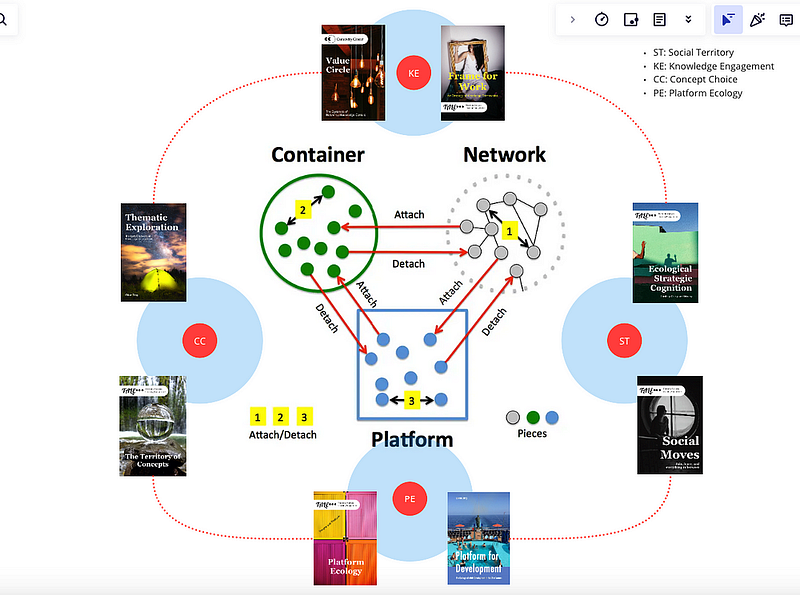
The center of the diagram is called “the Network — Container — Platform Move” perspective.
On August 17, 2023, I wrote the article titled The Ecological Practice Design Toolkit (V2, 2023) and recognized that the X-Y-Z Echo (see the above screenshot) is the most popular model!
In contrast, I didn’t frequently use the Network — Container — Platform Move.
On August 23, 2023, I realized that I should use it as the knowledge model for curating the set of possible themes. This notion led to the thematic scrapboard on August 24, 2023.
On Sept 28, 2023, I realized that I moved to a creative thematic dialogue between two themes:
- Theme (Concept)
- Platform (Project)
So I framed it as the third-wave development of “Creative Life Theory”. See the diagram below.
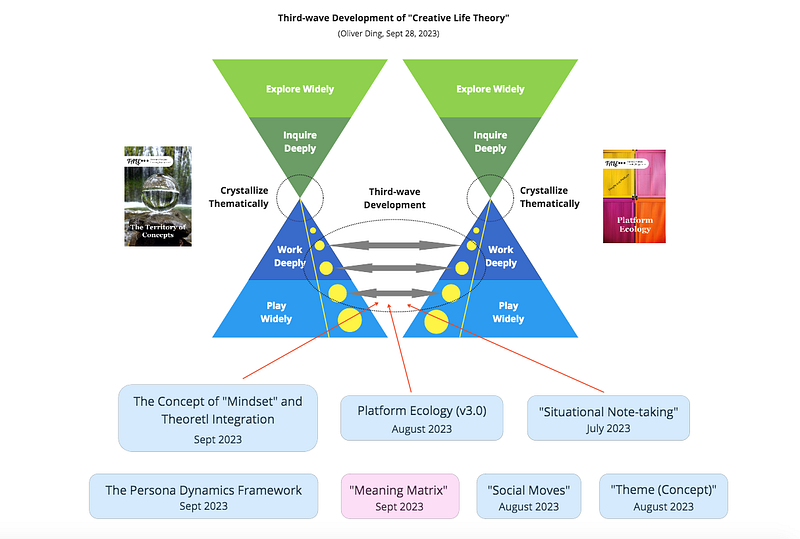
Why did I consider Platform Ecology as part of the third-wave development of Creative Life Theory?
There are several reasons.
First, I continuously adopted ideas from Lui’s theoretical sociology to develop my ideas. The Platform Ecology (v3.1) used the “Ontology — Realism — Hermeneutics” schema as a meta-framework. This is an example of the Utilization of Theoretical Resources.
Second, I used the “Developmental Platform” as the primary concept for the Platform Ecology project. I also defined five types of Developmental Platforms. Theory is one of these five types.
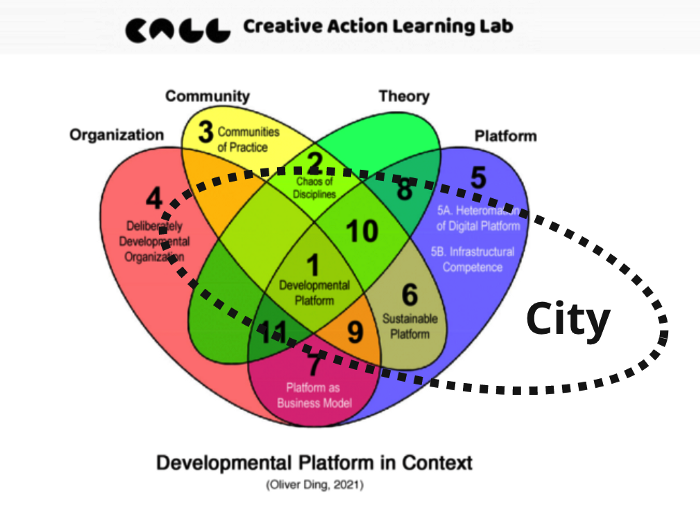
This is why I worked on the project about “Mindset” and “Theoretical Integration”. In other words, I am working on a sub-project about “Theoretical Platform”.
Lui’s theoretical sociology is a “Theoretical Platform”.
Third, there is a theme called “Social Moves” within the Platform Ecology (v3.1) meta-framework.
The theme of Social Moves was inspired by the theme of Mental Moves. While the Mental Moves project is more about knowledge creators’ creative cognition, the Social Moves project is more about startup founders’ creative social action.
The Evolving Concept System is a bridge between Mental Moves and Social Moves.
- Mental Moves is about developing concept systems which refers to Mental Platform
- Social Moves is about Behavioral Network and Material Container
In this way, I considered the Platform Ecology project as a sub-project of the Social Moves project.
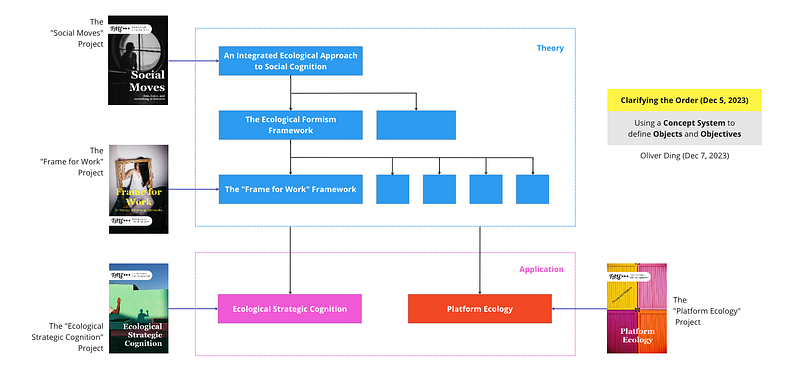
This is a fantastic strategic change!
You can find more details in Social Moves: Weaving the Mind and Clarifying the Order.
How does Indirect Activity work?
Let’s apply the Direct Activity/Indirect Activity model to understand the above stories.
April 27, 2023
The primary knowledge center is CALL (Creative Action Learning Lab) while the primary knowledge project is the Mental Moves project.
- Objective: Conduct case studies to study the concept of Attachance
- Outcome: Use “Platform Ecology” as an example to conduct a case study about the theme of ‘Creative Swapping” and discover the “Synchrony — Diachrony” Attachance
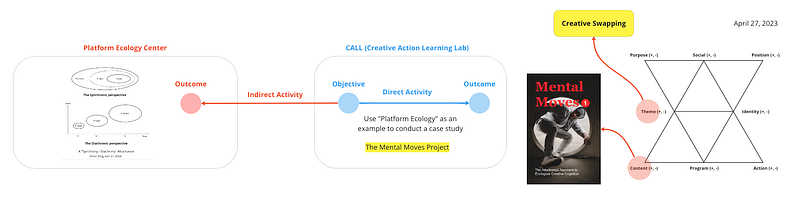
For the Platform Ecology Center, I learned a great idea that there are two perspectives: the Synchronic perspective and the Diachronic perspective.
May 2, 2023
The primary knowledge center is TALE (Thematic Analysis Learning Engagement) while the primary knowledge project is the Thematic Exploration project.
- Objective: Develop possible themes and develop the Strategic Thematic Exploration framework
- Outcome: Develop the possible theme of “Possible Discipline” and highlight the idea of “Configuration Theory”.
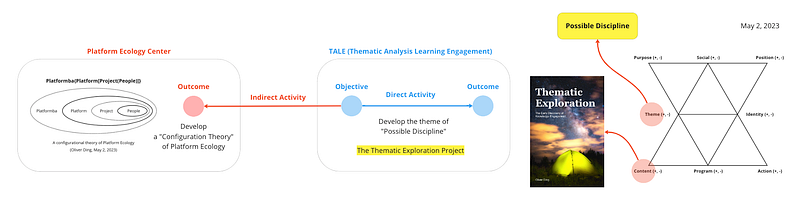
For the Platform Ecology Center, I considered Platform Ecology as a Possible Discipline and developed a “Configuration Theory” for it.
May 27, 2023
The primary knowledge center is Curativity Center while the primary knowledge project is the Territory of Concept project.
- Objective: Explore the process of Conceptual Elaboration which is the second phase of the journey of knowledge engagement
- Outcome: Define the concept of “Spontaneous Concept System” and related concepts: “Defined Concept System” and “Scientific Concept System”.
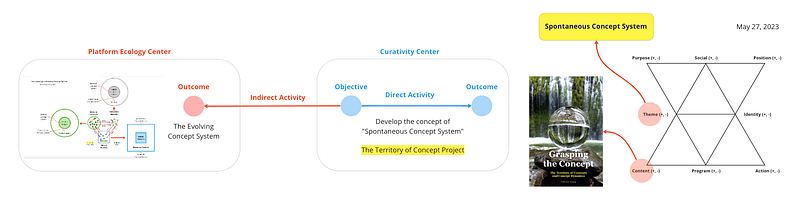
For the Platform Ecology Center, I applied the concept of “Spontaneous Concept System” to develop the “Landscape of Evolving Concept System” model in Nov 2023.
July 18, 2023
The primary knowledge center is Curativity Center while the primary knowledge project is the Knowledge Engagement project.
- Objective: Explore the power of the “Ontology — Realism — Hermeneutics” schema for building meta-frameworks
- Outcome: A new case study about the schema
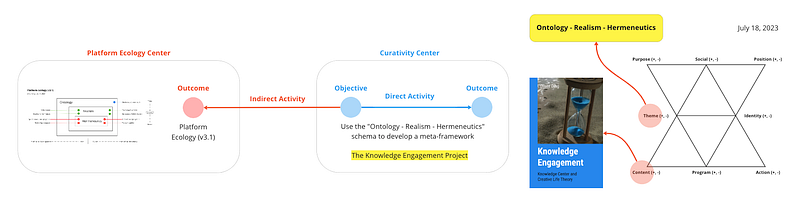
For the Platform Ecology Center, I applied the “Ontology — Realism — Hermeneutics” schema to curate several frameworks and concepts about Platform Ecology. The outcome is a meta-framework: Platform Ecology (v3.1).
Sept 28, 2023
The primary knowledge center is CALL while the secondary knowledge center is Curativity Center. The primary knowledge project is the Creative Life Theory project.
- Objective: Use the “Network — Container — Platform” schema to curate possible projects
- Outcome: a set of connected themes for future projects, a dialogue between the theme of “Theme (Concept)” and the theme of “Platform (Project)”.
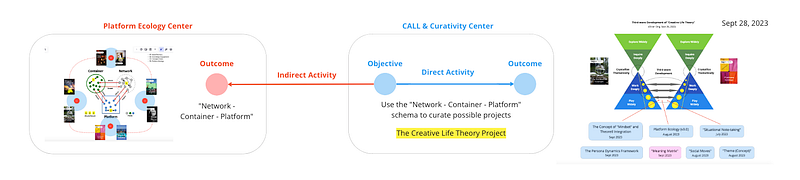
For the Platform Ecology Center, I highlighted the “Network — Container— Platform” schema.
Nov 22, 2023
The primary knowledge center is Curativity Center while the primary knowledge project is the Social Moves project.
- Objective: conduct a case study about psychological counseling platform
- Outcome: A new case study about the theme of “Social Moves”
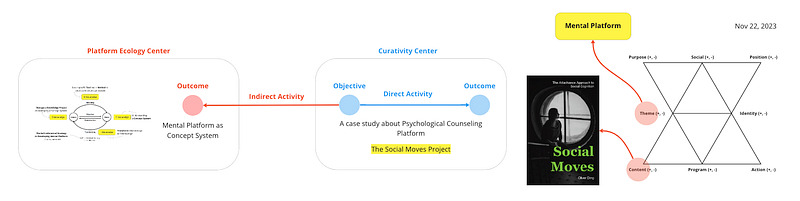
For the Platform Ecology Center, I developed the concept of “Mental Platform” and considered it the mental model of “Theory as Platform”.
Both Mental Platform and Theory as Platform are Concept Systems.
I also developed a self-referential strategy to develop mental platforms.
In summary, the Indirect Activity of Platform Ecology Center in 2023 is more about strategic thinking.
- April 27, 2023: the Synchronic perspective and the Diachronic perspective
- May 2, 2023: a “Configuration Theory” of Platform Ecology
- May 27, 2023: the concept of “Spontaneous Concept System”
- July 18, 2023: the Platform Ecology v3.1 meta-framework
- Sept 28, 2023: the “Network — Container — Platform” schema
- Nov 25, 2023: the Landscape of Evolving Concept System, Mental Platform, and Theory as Platform
A major change in my thoughts about the Platform Ecology project is the following piece:
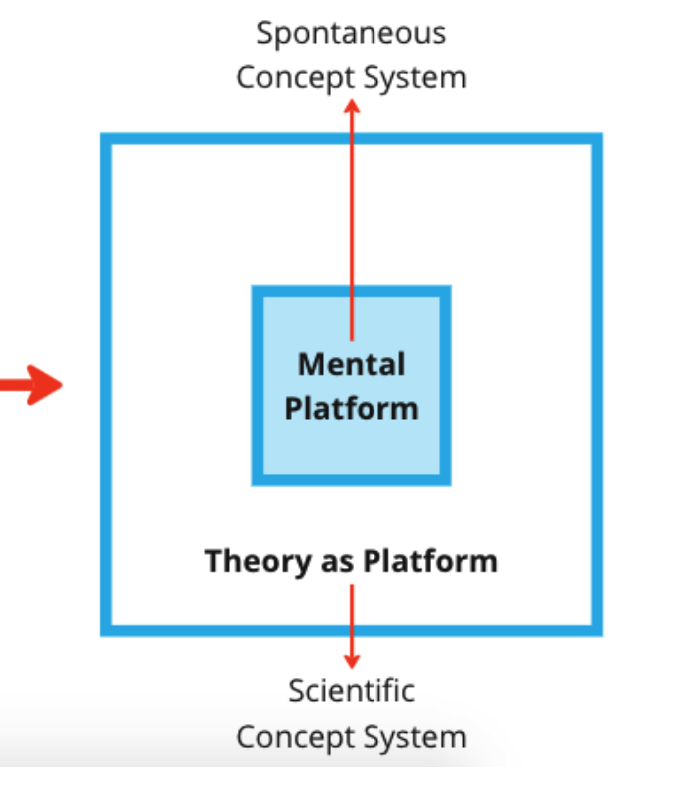
The notion of “Mental Platform” inspired me to make a diagram blending:
The “Spontaneous Concept System/Defined Concept System/Scientific Concept System” schema + The Evolving Concept System + The Product Langue framework +The Project Engagement framework
The “Theory as Platform/Mental Platform” schema is the further development of the original idea of “Theory as a Developmental Platform”.
- Theory as Platform: an established academic theory is a Scientific Concept System. A founder learns some ideas from a Scientific Concept System or many theories. In this stage, an academic theory is perceived as a developmental platform that supports his/her lifelong learning and cognitive development.
- Mental Platform: Finally, he/she curates ideas into a meaningful whole and develops his/her Spontaneous Concept System about a particular possible product. Since his/her goal is to build a successful innovative product, the Spontaneous Concept System could be understood as a Mental Platform that supports his/her activities.
Moreover, the nested squares could connect to the Knowledge Discovery Canvas.
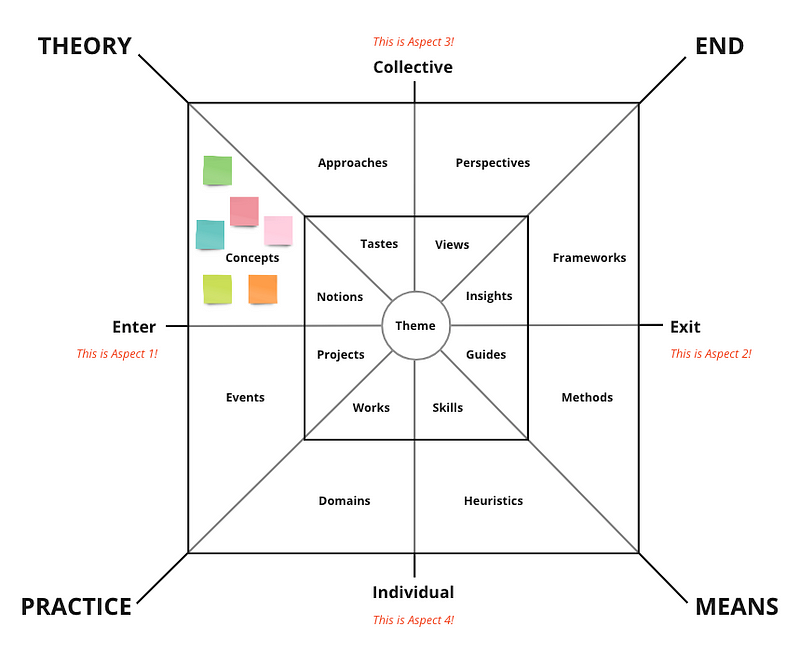
The above canvas has two squares. One is Inner Space and the other one is Outer Space. While Inner Space refers to the Subjective Meaning of Knowledge, Outer Space refers to Objective Knowledge.
We can associate the Inner Space with “Mental Platform” and associate the Outer Space with “Theory as Platform”.
In this way, I turned the Platform Ecology project into a sub-project about the Evolving Concept System.
Wow! This is a fantastic Indirect Activity!