
In Buenos Aires We Trust
Travel article
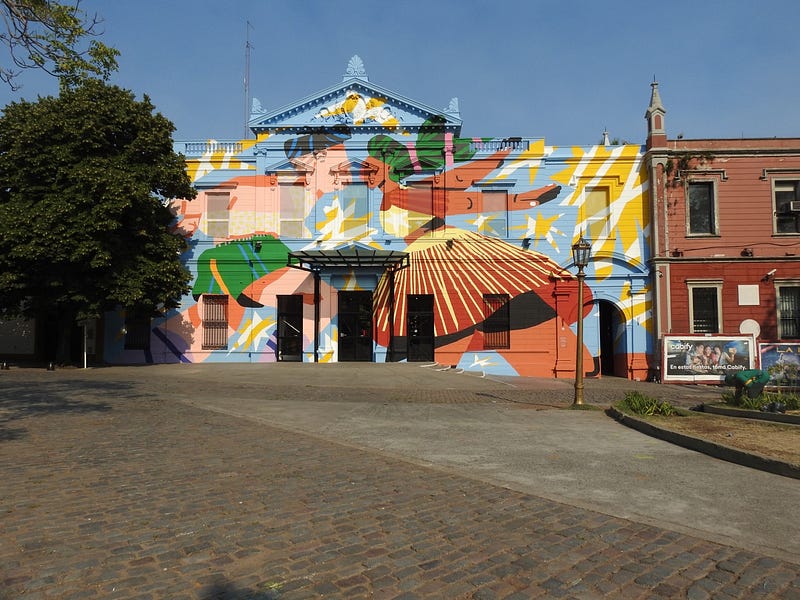
In 1977 Bruce Chatwin began the second chapter of his travelogue In Patagonia with the assertion that “The history of Buenos Aires is written in its telephone directory.” Nowadays, without a phone book in sight, it is difficult to corroborate this. Instead, one has to turn to the city’s cemeteries.
Following a light breakfast due to over-satiation from my first Argentine ojo de bife and arroz con leche, Maria and I walked a few blocks from our hotel to the Recoleta Cemetery. There we found an imposing, daunting, and simultaneously beautiful collection of towering mausoleums. The commemorated included former military commanders, Nobel laureates, presidents, and of course, in one corner the tomb of the seemingly immortal Eva Perón. The true history, however, was written between the lines.
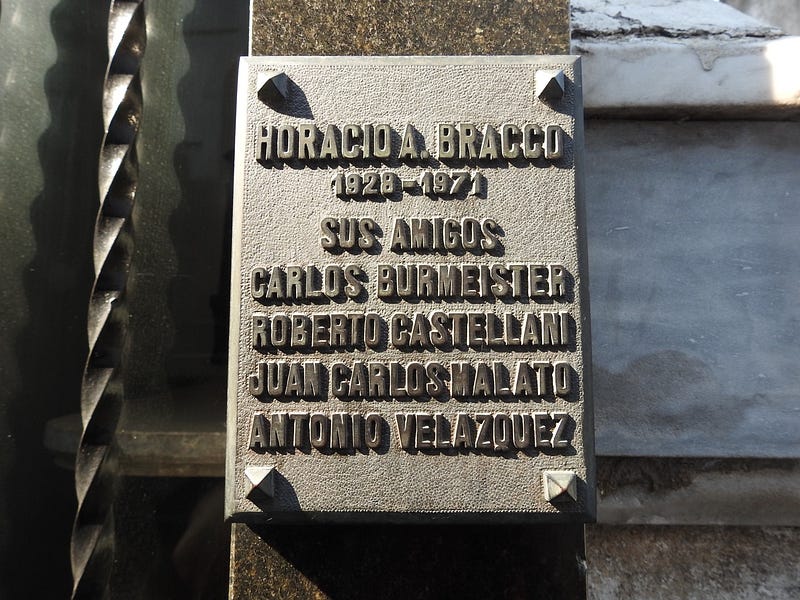
The names on the headstones ranged from Grosso to Fernandez; Zimmerman to Castellani; Velazquez to Burmeister. Italian, Spanish, and German apellidos, to name but a few varieties. The history of the people of Buenos Aires lives on in the cemetery of La Recoleta. What emerges is a diverse picture unique to the New World of a country re-discovered — with all the historical baggage that term entails (note the lack of indigenous surnames). Argentina is a melting pot of cultures and temperaments that over the course of the past two centuries has come to find its own unique identity and customs, albeit without ever fully dismissing its predominantly European ancestry. There is a distinctive embrace for one's lineage here where one can be an Italo or Spanish-Argentine (or German or Belgian, for that matter) in the same way that one identifies as Boston-Irish.
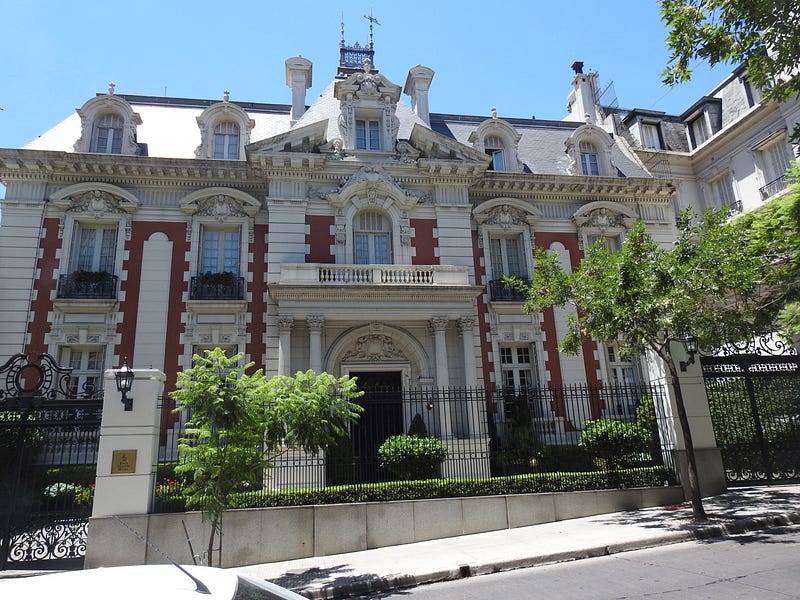
We exited the cemetery and proceeded on our walk to the Palermo neighborhood. One cannot help but notice the disparity between the upscale neighborhoods of Buenos Aires’ historic center — with their colonial-era mansions and manicured parks — versus the modern yet decadent urban sprawl of the outlying barrios. Passing through the wide, tree-lined boulevards of Palermo with their boutique stores selling designer clothes and Starbucks’, I nearly got the feeling of being in any Western European big city.
Just as I was allowing this thought to ferment in my head, I stopped to take a picture of Maria at a crossing. All of a sudden I was confronted by an energetic elderly man in his late seventies who was oddly reminiscent of King Juan Carlos of Spain. He scolded me gravely with the unique blend of authority and disappointment that only a grandparent can tap into. It was the kind of reprimand that makes a child feel guilty. What was he on about? Well, he told me that I was out of my mind for going around with my camera in plain sight in this city because it would most certainly get nicked. Taken aback, I politely explained to him that I normally wear it around my neck (somewhat offended that I was mistaken as the naive tourist). Grandpa Juan Carlos went on to fervently explain that that was simply not good enough and instructed me to tuck the camera under my t-shirt to better conceal it. He then stormed off — probably on a mission to warn off other oblivious tourists. In deference to his royal authority, I tried this method for a couple of blocks before realizing how absurd I looked. I decided to instead just take comfort in the armed police that seem to be located every twenty meters in this city — even in broad daylight.
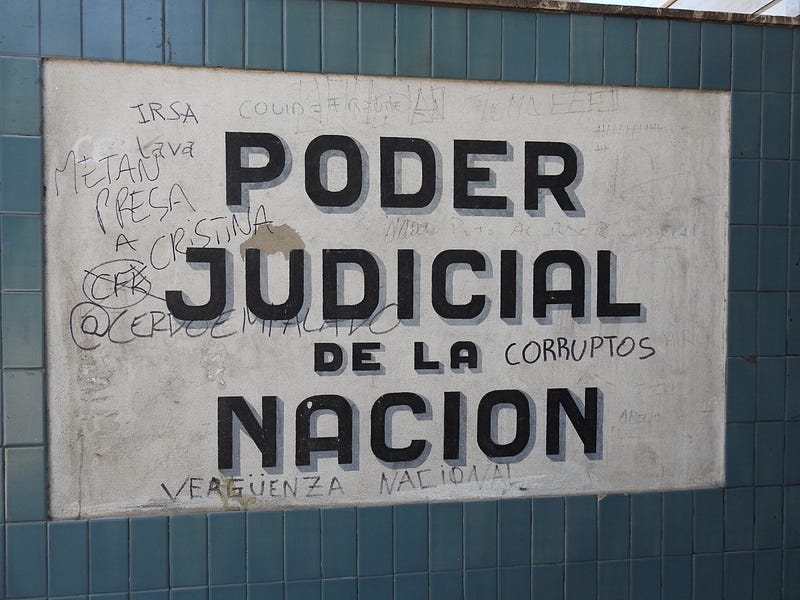
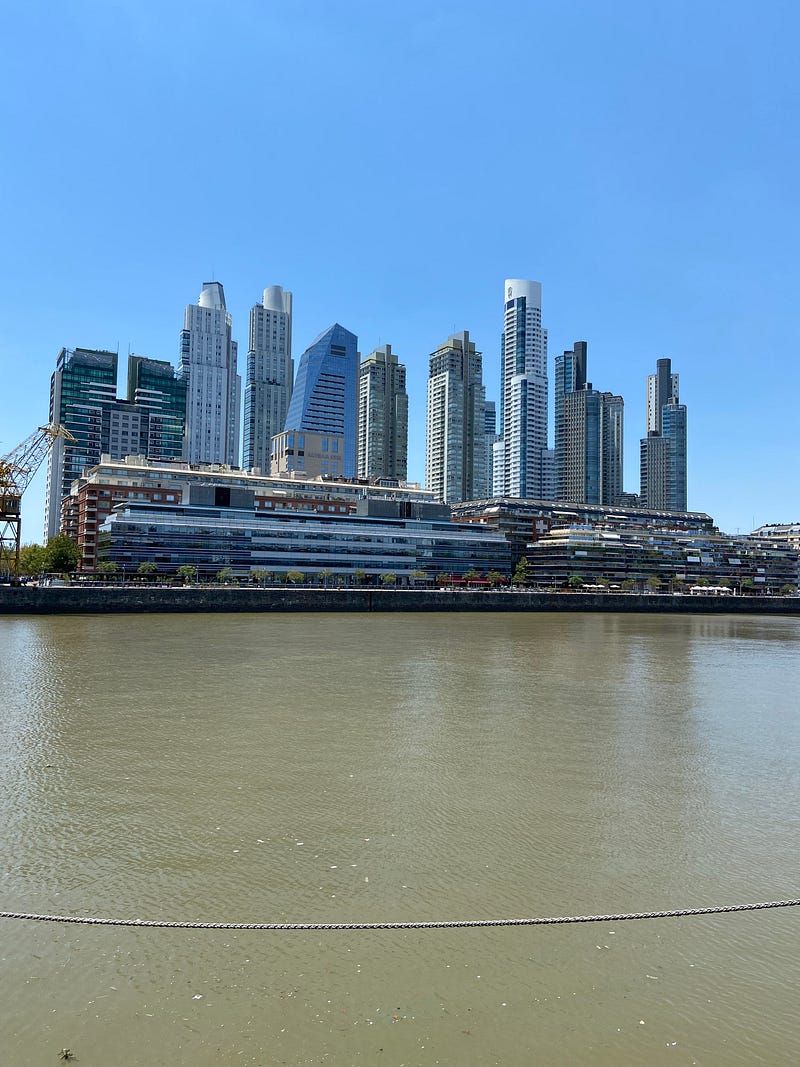
Later, as we took a break from the afternoon heat and sat down to lunch for an overly cheesy pizza, Maria made the astute observation that it seemed nobody trusts each other in Argentina. It was a more than valid point. The animated Juan Carlos look-alike was just one of many manifestations of this. I heard the disregard for politicians from my vendor friend at the market in San Telmo when he explained to me that with all the money they “took” they could afford apartments for their girlfriends in Puerto Madero (the Miami of Buenos Aires). I saw it in the vulgar graffiti decorating the justice palace — attacked from every side of the political spectrum, from left to right, from Peronistas to anti-Kirchneristas. That evening one of the main national news outlets aired an editorial about a new far-right Plan Condor conspiracy that through alleged corruption of judicial branches throughout the continent would seek to consolidate power. This sense of distrust was present from our first day when upon check-in, the hotel concierge insisted we exchange our money on the black market since we could not rely on the rates at the government-backed official exchange. As we strolled through Palermo after running into Juan Carlos, we added an extra thirty seconds to every store visit because we had to get buzzed in and out of the locked doors.
On top of those obvious signals of mistrust, there seems to be an enormous appetite for public debate. All one has to do is turn on the hotel television after 9 PM to witness it. Programs consist of a controversial case — in the days we were there it was about a juvenile gang beating gone badly — and two participants taking opposing sides on the topic. The face-off is reminiscent of a Sergio Leone western duel. Contestants initially play by the rules only to then go for the jugular while expertly rebutting each other’s claims. The debate ultimately degenerates into a shouting match without a definitive resolution. Granted, it is box office entertainment — especially for a tourist — but it also speaks to something deeper. It is often stated that there are forty-two million fútbol managers in Argentina, each with a different tactical philosophy. Add to that a lack of trust, and the possibilities for discussion are endless.
On the other hand, this atmosphere which, although intense, is not a pervasively negative one as in other countries, is very much rooted in the past. Take my adoptive Argentine grandfather Juan Carlos for example. A person from his generation in Argentina has seen it all. His parents or grandparents took a gamble and a high-risk journey when they immigrated to this new frontier most likely due to desperate circumstances back home. Once settled in their new home, they witnessed various military coups, the ensuing dictatorships which ‘disappeared’ thousands of their compatriots, a dirty war, a phony war, various debt defaults, skyrocketing inflation, and constant devaluations of their currency. Given this backdrop, is it any wonder that there is a trust deficit and such an inclination for public debate?
The next morning, our last in Buenos Aires, it was already nearing thirty-two degrees celsius as I made my way out for a morning run. The heat here is fairly dry with an underlying humidity of less than twenty percent which makes being in the shade quite bearable and keeps perspiration to a minimum. Sometimes you are even blessed by some ocean breeze working its way through the wind tunnel of the Rio Platense.
As I jogged down Avenida del Libertador from Recoleta to Palermo I passed multiple dog walkers with five to eight hounds on tangled leashes (this seems to be a typical sighting in Palermo). Any stroll or run through an Argentine city is an opportunity to get a pulse on the national mood. Countless albiceleste Messi shirts, Campeones billboards, and celebratory special edition magazines at the newsstands served as a friendly reminder for anyone that may have missed it that this fútbol mad country was just one month removed from its first World Cup triumph in thirty-six years.
No matter which neighborhood you pass, however, it’s the ghosts of the past that loom largest. Evita is idolized everywhere. Baptized once as the “spiritual leader of the nation” she is undoubtedly less polarizing to rally around as a mythical figure in the Argentine consciousness than her late husband Juan Perón. Our hotel claims she lived in our building which is supposed to mean more than an eight out of ten on booking.com. There are Café Evita’s, Evita museums, the Evita special on menus, and Evita boulevards. To my mind, I cannot think of a First Lady anywhere in the world so lionized and adored as Evita continues to be by her compatriots. Does she serve as a reminder of a richer and more prominent — for better or worse — Argentina?
It is not just the legend of Evita, however. One cannot go more than a few blocks without seeing some rendition of the flawed footballing genius el pibe de oro’s (Maradona) face painted on a wall. Perhaps the most flabbergasting and incomprehensible call to the past — at least for a foreign tourist — is the invocation of the Malvinas Argentinas (The Falkland Islands) on graffiti and official military posters. What in Europe is seen as a phony war by a desperate dictatorship is here instead considered the opposite. To this day, new generations of Argentines who were not even alive during the Falklands invasion in the eighties see them as theirs instead of British. One thing is to commemorate the muchachos that lost their lives during the invasion, another is to glorify the belligerence of a regime that used said invasion to distract from the dirty war they were concurrently waging on the home front.
In Argentina, the myths of the past and their contradictory interpretations seem at times to eclipse hopes for the future. Soon enough, even the recent World Cup victory will become part of the rearview mirror of nostalgia. The amazing phenomenon, as we would continue to be reminded on our trip, is that the Argentines — in spite of struggling to make sense of their complex history — seem to go on about their daily lives with a hopeful yet determined smile on their faces, loving their country through thick and thin, unconditionally. Regardless of the emotional roller coaster they have ridden, they show up, eager to showcase their beautiful country to the world. Having gotten our Argentine induction in the big city, we were now ready to continue the journey southward.
This article is part of a series on my recent travels which will be released in multiple installments over the coming weeks. Stay tuned! In the meantime you can find some of my other pieces below: