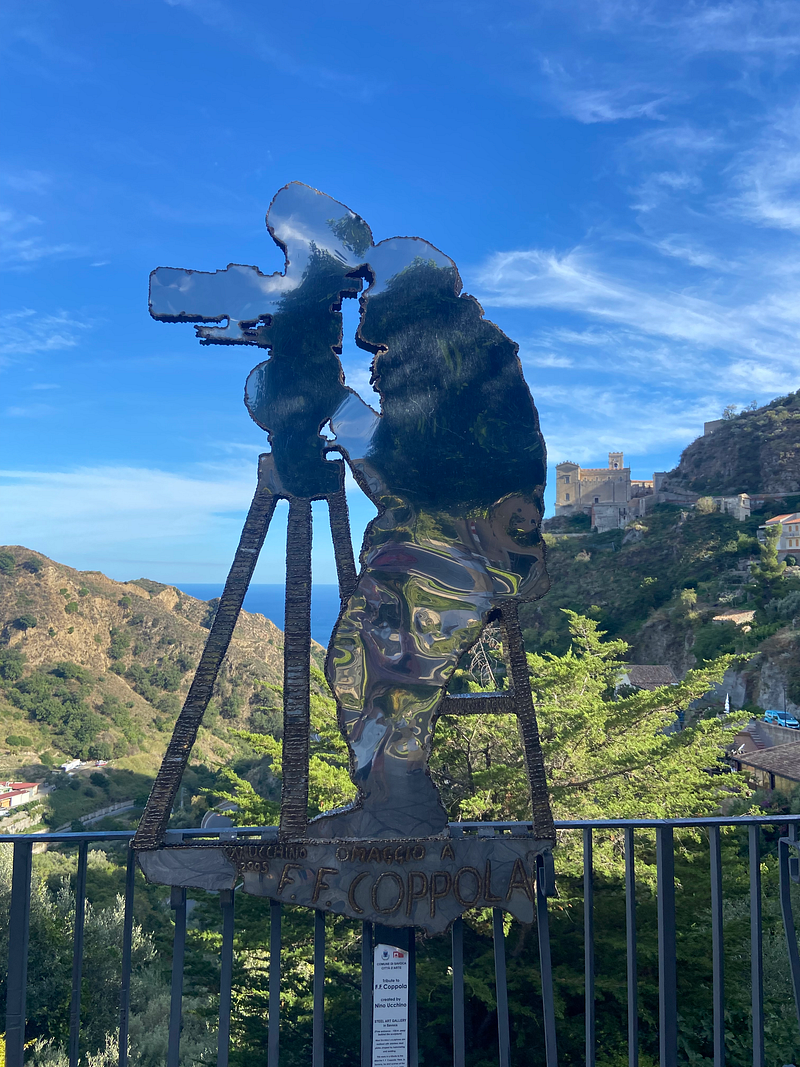
A Pilgrimage in the Name of the Godfather
I was twelve years old the first time my mother allowed me to watch The Godfather with her. It was minus twenty something degrees on a gloomy Minnesota January day, providing the perfect contrast to the rugged, deforested Sicilian landscapes we would come across later in the film. I remember we had a day off from school for some teacher conferences and, since there is not much to do outdoors in Minnesota winters without risking frostbite–you can only build so many snow forts in one winter–our Sony Bravia made for a great companion. The DVDs had arrived in the mail from Netflix the day before (Yes, Netflix was around before streaming. And, yes, we were a family of early-adopters. We also lived in the middle of nowhere without a video store within striking distance. Actually, come to think of it, Netflix saved us.)
As an Italian boy growing up in America I had already been pigeonholed as a Godfather connoisseur for years, despite never having actually watched the films. However, twelve is a weird age. One in which you are constantly playing a very intricate game of three-dimensional chess to fit in and so will often pretend to have seen or heard things that might get you into the cool crowd. Now, I would actually be able to walk the talk–even though the other guys in my class had also probably been pretending all along. Over the next two days, my mom and I immersed ourselves into the life of the Corleone family, tackling both the iconic, rewatchable part one and the deeply depressing part two. I remember feeling quite indifferent upon finishing the marathon. As a twelve year old boy my attention span was inferior to that of a goldfish and so I thought it was actually a bit boring in certain sections–basically any part where there was not a gun fight or nudity. The nuance of the cinematography and score were lost on me. I was fully impervious to the greater themes and motifs about immigration, identity and family. Furthermore, I definitely did not identify with any of the characters. They lived on Staten Island and spoke English with hints of a thick, incomprehensible Sicilian dialect. I, on the other hand, considered myself a real Italian. (I also did not really believe that Al Pacino played Michael Corleone when my mom pointed him out to me. “Al Pacino is old” I said.) It was not until I rewatched the films in high school with a slightly increased attention span (having graduated from goldfish to bluefin tuna) that I started to better understand the intricacies of Francis Ford Coppola’s masterpiece. Nowadays I find myself glued to the screen for entire weekends every other year enthralled by the plight of the Corleone family. They have become, without a shadow of a doubt, my favorite films. And so it goes without saying that when my parents invited my brother, my wife and I to celebrate their thirtieth wedding anniversary in Taormina — on the northeast coast of Sicily — I was more than intrigued by the prospect of a Godfather tour. Coppola had used the towns of Savoca and Forza D’Agró just up the coast from where we stayed to stage the Sicilian scenes from the films. On my previous two trips to Sicily I had never managed the excursion northeast. My time had finally come.
Perched on a peak overlooking the Messina strait and the mainland, is a quaint middle of nowhere postcard town that looks like hundreds of others in Italy when you crane your neck upwards from a neighboring stretch of highway. Those types of towns which you admire but that are always a bit too far out of the way for a short lunch stop on a road trip. In the original Mario Puzo novel, the Corleone family originates from their namesake town in central Italy. As we learned from our guide/driver/Godfatherologist Domenico (who also happens to be a marine biologist — everyone in Sicily seems to have various side hustles and to be very good at least at two of them) however at the time of filming in the seventies the town of Corleone was deemed too modern to stage scenes from the fifties and earlier as was mandated by the script. This led to Coppola’s team scouting other parts of the region to stand in for Corleone.
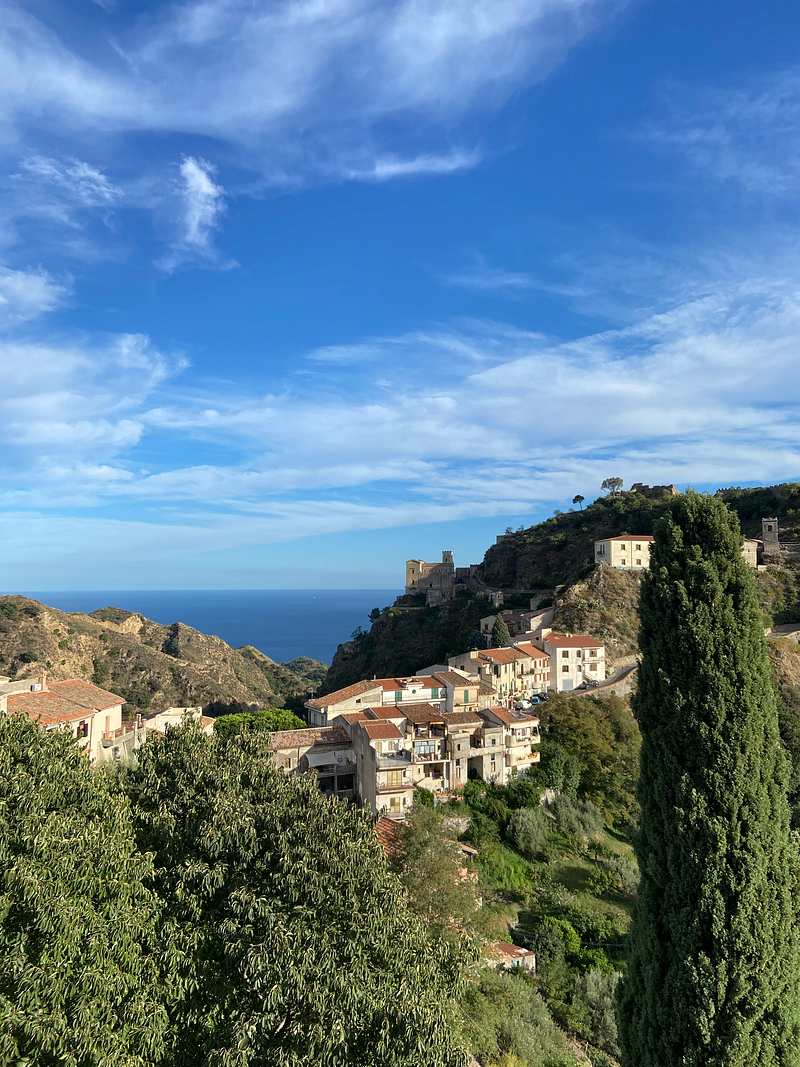
Apart from having been the staging ground for one of the twentieth century’s most iconic cinematic masterpieces, Savoca sets itself apart from those other postcard towns by having remained frozen in time. If not for the cell phones in our pockets, this could be mistaken for a form of time travel. The landscape is the same as it was, mountainous and dry with fichi d’india sprouting in all directions. It remains dotted sporadically with houses and villas from two centuries ago. The location feels as remote and sparsely populated as it did — we only ran into a few other Godfather-crazed tourists in the afternoon we visited and the few locals must have been napping. In the film, in fact, upon walking through the desolate village for the first time, Michael asks his bodyguards Caló and Fabrizio “Where have all the men gone?” The same could be asked today in countless Sicilian villages, simply swapping out “men” with “young people”. You can understand why this place made for the perfect hideout for him in part one and could still do so in 2022. As if this was not enough, the main landmarks have remained those shot in the film.
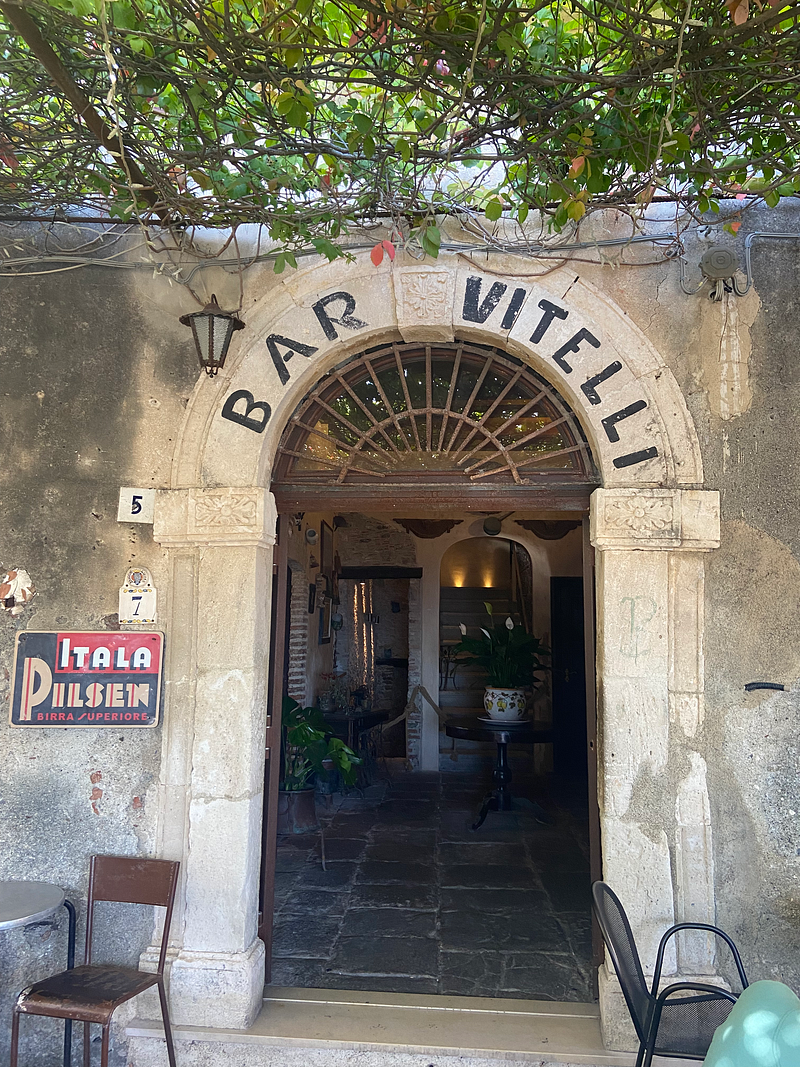
Upon arrival we immediately stopped for coffee and a granita at the Bar Vitelli where, during part one, Michael met Apollonia’s father and asked him for her hand in marriage. The bar has remained uncannily similar to the one which made a brief yet unforgettable four minute appearance in the film–only 2.2% of its entire length. The Itala Pilsen sign remains plastered next to the entrance. Inside you can still find the very chair used by Al Pacino during filming. My younger brother noticed some minute differences which only a true film nerd could ever notice, but other than that the Bar Vitelli has remained very true to form. Domenico explained to us that the new ownership of the establishment had brought it back from being a decadent relic a few years ago and it seems they have struck the perfect balance between historic shrine and functioning cafe without becoming Disney-ish. My father, who had somehow not seen any of the films until earlier this year (better late than never, I guess), wore a light blue coppola siciliana as he sipped his granita al limone to make his experience even more authentic. I also wanted to wear my burgundy coppola from Palermo but was vetoed by my wife, Maria, while packing for the trip. I would get my revenge however, by playing the Godfather theme on my phone as we walked from the bar to the church where Michael married Apollonia.
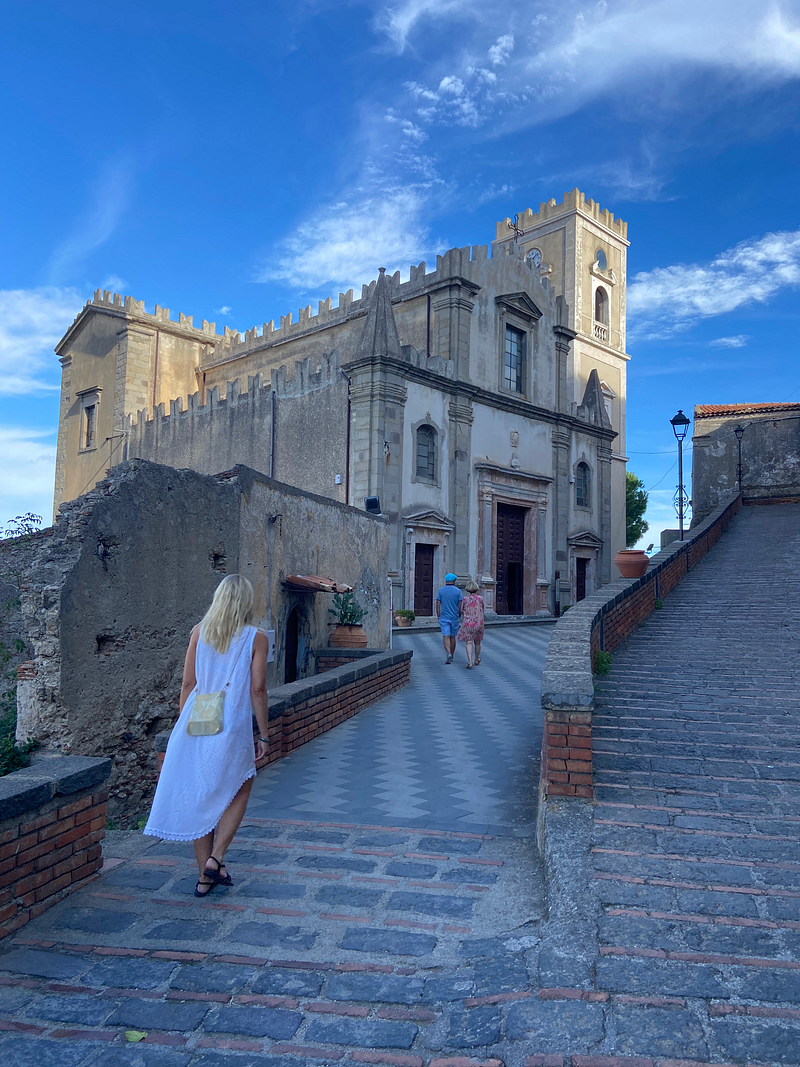
Although I do not remember getting visibly emotional at the sight of Al Pacino’s chair at the bar, like many of Domenico’s Italian-American guests had on previous tours, I quickly became enthralled by this town. It was on the brief walk uphill to the church that, aided by the mystical score of the film playing through my pocket, I fell in love with Savoca. There is something about the multitude of breathtaking views combined with the remoteness of the location and the romantic notion of backwards time travel that I have only encountered in Savoca. As we walked towards the Chiesa di San Nicoló (which is also claimed by two other saints–competition for fame remains rife amongst saints in the Catholic church apparently) the landscape bounced back and forth between rolling yellow-brownish fields and rich green vegetation. Looking down and to the east is the blue hue of the strait of Messina with mainland Italy seemingly just a short hop across the water but feeling a world away. As we neared the church, I hit pause on the soundtrack only to still hear the dramatic score in the background. I turned around to see a graying middle-aged tourist pacing with a laptop in his hand. He was rewatching the scenes of Michael and Apollonia. We gave each other a brief head nod acknowledging the mystical experience we were undergoing.
As we completed our loop around town, running into a couple stray cats and maybe one car, my family made a few jokes about what it would be like to live in a place like this, especially in winter. Having heard this, Domenico was quick to enlighten us on a new European-sponsored initiative to bring abandoned Italian villages, such as Savoca, into the twenty-first century. Both Italian residents and foreigners can apply to buy a house here for one euro (that’s €1–approximately $0.97 at the time of writing). Upon further research I discovered that, although there are some strings attached such as having to begin reconstruction within eighteen months of the purchase, this project is not a scam. The initiative has the lofty goal of attracting investment to these neglected ghost towns in an effort to bring back life–the very people Michael was looking for in the first film — and accelerate the economic development of southern Italy.
What a place to spend one year writing a novel, I thought. My father must have had his coppola on a little too tightly, because he wholeheartedly supported my idea. My mother and Maria, on the other hand, rejected it saying I would go crazy and this was just another one of my provocative ideas. My brother, meanwhile, was probably too busy analyzing the Sicilian scenes of the movie frame by frame. I will not be discouraged, however. Along with a tacky Vito Corleone bottle-opener magnet, we also brought back a magnet of Savoca that I hope will aid my lobbying efforts on the home front. Worst case scenario, at least I have found my ideal hiding spot in case my writing ruffles too many feathers. That is, unless Savoca turns into a Sicilian Singapore or Dubai because of all the one euro houses that get purchased. Something tells me that is likely to take at least another half century.