
Welcome to Argentina!
I woke up groggy-eyed, with legs swollen to the size of century old redwoods and a stiff back to the sound of three simultaneously screaming babies somewhere over the east coast of Brazil. Being that Brazil is basically a continent in and of itself, this meant we still had three hours of flying to go before touching down in Buenos Aires. This allowed me to explore the British Airways interactive map, which was surprisingly user-friendly. After fumbling around with the zoom function, I noticed that instead of darting over to the east coast of the US and then continuing southward from there, our pilot had shot straight down through the Atlantic and did not hover over any land until he dipped into Brazil. I filled the last couple of hours with Jordan Peele’s Nope — continuing my horror movie plane tradition, a surprisingly decent complimentary breakfast frittata and a round of hyper-competitive Neapolitan scopa with Maria which was constantly interrupted by the flight attendant wanting to learn every single scoring possibility. Before we knew it we had arrived in the land of the world champions.
Here we were. Almost exactly four months to the date since the big day, our honeymoon had finally come. Three weeks. Three full weeks. No computers, no work emails, no social pressure. Just the two of us. Maria and I specifically chose to wait until January for our trip because, not only would it in a way extend the wedding, but, perhaps equally importantly from a mental health standpoint, it would allow us, yet again, to cut short the frigid, dark and damp Danish winter. At this stage, I would like to go on record writing that I remain the biggest fan of my adoptive home of Copenhagen eight months a year, but please get me out of there in the middle of winter. Humans were not conceived as a species that could cope with so little sunlight. No matter what everyone says, vitamin D pills can only bridge the gap so far. After much discussion we chose to start our travels as far south as you can get by visiting Argentinian and Chilean Patagonia before stopping by Jamaica on the way home. First stop: Buenos Aires.
Buenos Aires has two airports. Ezeiza is the major intercontinental hub and upon arrival seems very orderly and modern — more akin to Bogota than La Paz, where I once found a lone shoe doing uninterrupted and unclaimed rounds on the baggage carousel. The passport control was efficient, courteous and technologically advanced. Argentina recently joined a handful of other countries in forgoing the stamping of passports and actually processing everything through the microchip which we pay so handsomely to renew every ten years.
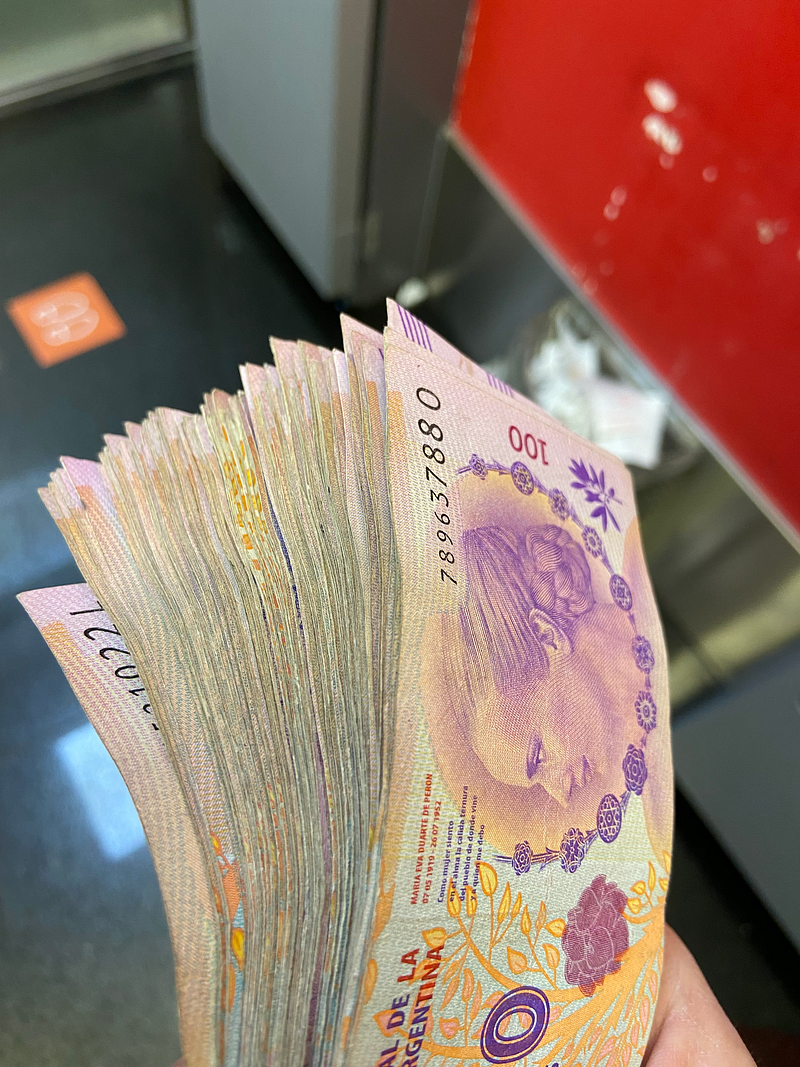
All this order and progress came to a screeching halt as soon as we picked up our luggage and exited the arrivals terminal. Now we were welcomed to South America in the warm and chaotic way I remembered from previous travels. A thirty-five degree celsius draft was already making its way through the sliding doors at ten in the morning as illegible signs with names dotted the crowd, ecstatic hugs and kisses were exchanged, taxi imposters seemed omnipresent and elderly North American cruisers were visibly overwhelmed. I went straight to the official taxi stand assuming I would have to dig into my negotiation textbook but was pleasantly surprised when I was simply given the flat rate for the part of the city we were going to. The catch, and there’s always a catch, was that although the payment would be upfront at the desk, it had to be done in efectivo (cash). I had the kind lady at the desk point me to the ATM at which I proceeded, through two separate withdrawals each with a flat commission, to receive a stack of paper money as thick as a National Geographic double-issue which I spared myself from counting and converting. Upon handing it over to the lady at the taxi counter, I was met with a laugh which I reciprocated. I also thought it was comical to be carrying so much cash in 2023 but to my amazement that was not the punchline. Apparently this weighty stack of mighty Argentine pesos was the equivalent of ten dollars — only one-fourth of the agreed upon fee. It was only after multiple trips to ATMs in the ensuing twenty-four hours that I discovered that despite the rampant and chronic hyper inflation, the Argentine central bank had not adhered to the Zimbabwean school of printing larger and larger bills. On top of that, for some reason I cannot quite grasp, since many services still only accept cash, there was a maximum threshold for withdrawals at most ATMs and a substantial commission for withdrawals for foreign cards. Were the Argentine’s taking advantage of us? Probably. But it did not matter, we needed to get a taxi and so I trudged back to my ATM, concealing my stack of ten dollars as well as I could on the way there. Fifteen minutes later I emerged with the War and Peace of money stacks which I handed over at the taxi stand and was returned a modestly slimmed down handful of change. First lesson on Argentine economics: if you want to save time, you should determine money quantity by thickness. National Geographic can get you some coffees. An epic novel from the 1800s can get you dinner for two or a taxi ride into town.
Having spent our change on coffees, we waited forty-five minutes in a loosely defined queue until our number was called and then hopped into our pre-paid cab. From Ezeiza the first thing you notice is the wide expanses of grassy fields alongside the road onto which cars seem to exit freely for summer picnics under the tree shade. In the first few minutes of the ride we passed the Argentine Football Federation’s training center, at least twenty sponsor billboards thanking the campeones and a few cyclists zooming down the emergency lane of the highway. Then, out of nowhere, we came into the controlled chaos of the outer barrios on the outskirts of the metropolis where city planning seems to have been an afterthought while the city was inundated by migration from the surrounding provinces. We then reached the nineteenth century palaces of the center that could easily have you mistake Buenos Aires for Paris or Madrid. The contrast was extraordinary. Buenos Aires is a city of many faces, made as rich by its diversity as it is made poor by its monetary policy.
Upon freshening up and having an animated argument (everything is slightly more animated in Argentina) with the hotel reception clerk about an apparently mandatory cash deposit which forced me back to an ATM, we went for a walk all the way from our neighborhood of Recoleta, through the center, to San Telmo. Our supposedly upscale neighborhood was not dissimilar in its ghost-town vibes from a big Italian city in mid-August. It seemed that the locals who were not picnicking on the side of the freeway were at the beach. Who could blame them given the scorching heat accentuating itself off the concrete?
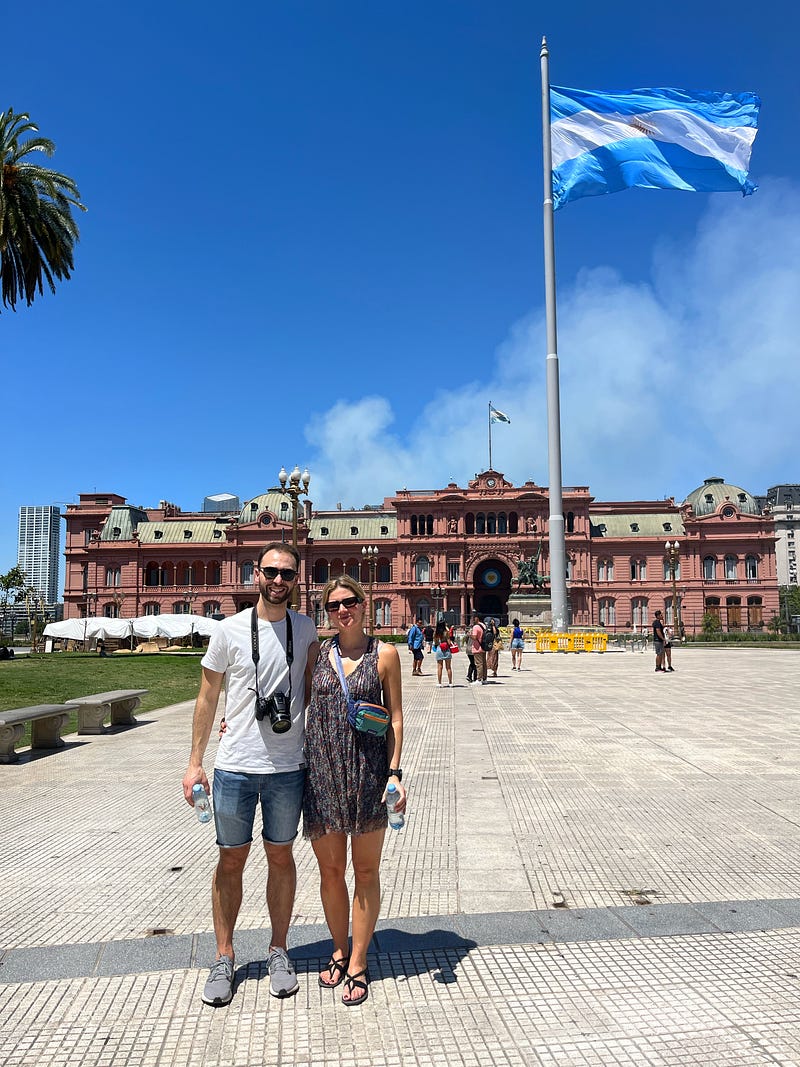
On the walk we passed the classic main sights including the obelisco (essentially a skinnier Washington Monument) and the casa rosada (the pink house where the president works but does not reside). We also passed the Central Bank, which I wanted to enter to ask a few probing questions about their currency controls, but they were closed — seemingly also at the beach enjoying themselves with what one can only imagine were stacks of freshly minted pesos. We continued to navigate the minefield of human exchange machines — an army of middle-aged men placed every two meters on the main avenues halfheartedly chanting “cambio, cambio” — until we finally found the crowds at the Sunday market in San Telmo.
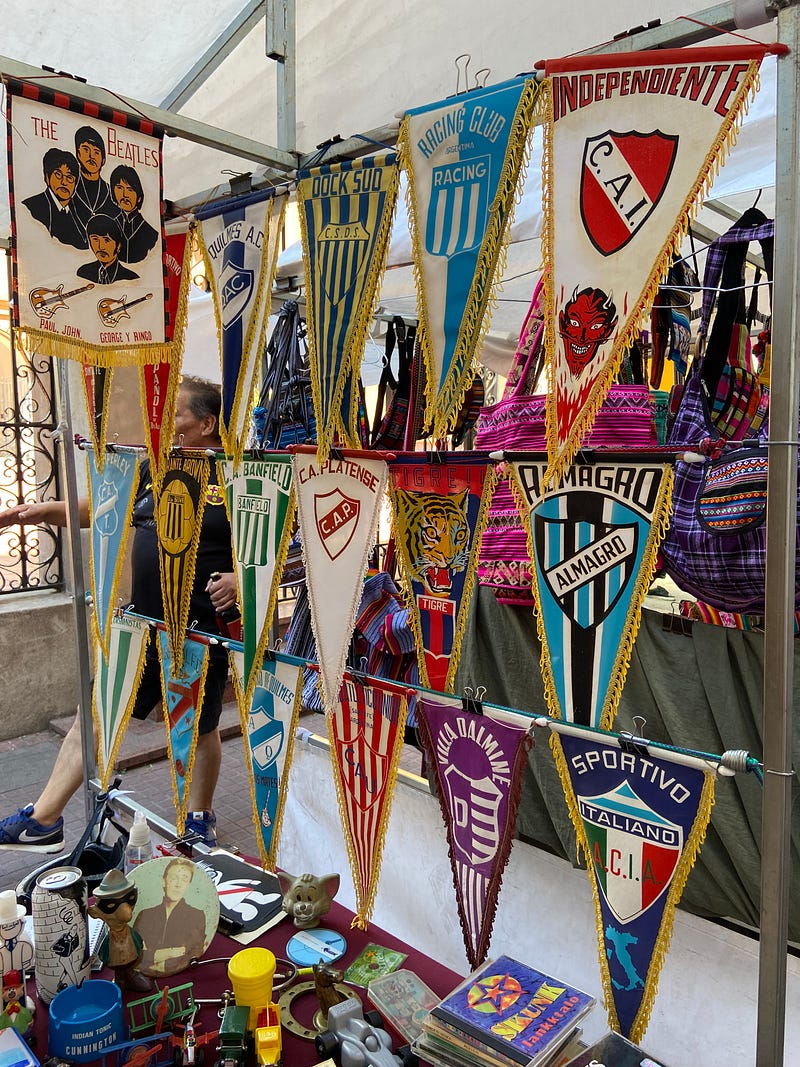
It may have been the fresh honeymoon vibes or the sun going to my head but this was the first time Maria did not have to drag me kicking and screaming through a market. The vibes were phenomenal in this never-ending bazaar of artisanal craft. There was no obnoxious, overly-aggressive, in-your-face salesmanship which had the unintended effect of making me all the more intrigued in the carved mate cups and Maradona iconography.
At one point I stopped to talk to a ceramic vendor when I saw a Boca Juniors painted vase (that looked more like a bong). I asked him if he supported the Xeneixes to which he replied: “Yes, but I do not really follow fútbol anymore. Too much plata.” I pointed out that it was odd to run into an Argentine that was not into fútbol — especially given the current historical context. With a wry grin he told me he actually used to play for River Plate — Boca’s historic rival. From there he came unwound and went on a monologue about the football federation’s alleged corruption — “millionarios, billionarios” — and the unequal preferential treatment received by players during the pandemic lockdown. All sensible points, I thought. But then I finally cornered him by asking about the recent World Cup triumph and he quickly transformed himself from a disgruntled former aficionado into one of the forty-two million football trainers in the country. He analyzed Messi’s style of play with astute precision before acknowledging that “the French guy (Mbappe) is good too.” He asked me if I saw Messi’s first goal back with PSG the evening prior. He then jokingly wished me and Italy good luck in the next World Cup, fully aware of the fact that they may not qualify yet again. So much for not caring about fútbol. Maybe by Argentinean standards.
After our brief aside on fútbol he asked about our honeymoon and was eager to hear our first impressions of the city, seemingly wanting to ensure we had a good time while there. He then told his personal story as if we were long-lost acquaintances from a past life. He had been in Almería, Spain for a while, where he had his daughter, then worked at Disney World in Orlando before returning home because “it’s tough to live here but it’s Argentina.” He shook my hand and told me to enjoy the rest of our trip, seeming to have fulfilled his mission despite not even attempting to harass me with a “special price.” I was already starting to like this place.
This article is part of a series on my recent travels which will be released in multiple installments over the coming weeks. Stay tuned! In the meantime you can find some of my other pieces below:


