
Imagine Bruce Lee being interviewed by Johnny Carson and doing kung fu with Elvis

An unmistakable groan materializes when Matthew Polly confesses in the third installment of an exclusive interview series that Bruce Lee had been booked to promote Enter the Dragon on The Tonight Show Starring Johnny Carson in August 1973. Less than a month earlier as the “Little Dragon’s” debut leading role in a Hollywood film accumulated unprecedented buzz for Warner Bros., he collapsed for the second and ultimately fatal time of what Polly theorizes was a heat stroke at only age 32.
Would nerves have inhibited Lee’s summit in front of such a massive Western audience where his performance would not be edited? “Bruce was more sensitive than he liked to admit, particularly about his accent and English skill level,” says the ink slinger responsible for Bruce Lee: A Life. “On the other hand, he’d been doing non-stop TV, print, and radio interviews for the last two years in Hong Kong [i.e. for The Big Boss, Fist of Fury, and Way of the Dragon]. So he might have stumbled a bit at the beginning, but I’m guessing he would have settled in like an old pro within minutes.”
The first Asian American to achieve global super stardom in the sound era died with minor acknowledgment in the United States. Six years earlier Lee dutifully supported The Green Hornet as the high-kicking Kato, but the 30-minute action adventure played with nary a tongue in cheek had been ditched after a single season. According to Polly, “There is no record of The Tonight Show commenting on Bruce’s passing. He was a nobody at that time in America.” However, video evidence obtained from Carson’s official clip licensing website proves that the quick-witted host was not totally clueless about the founder of Jeet Kune Do.
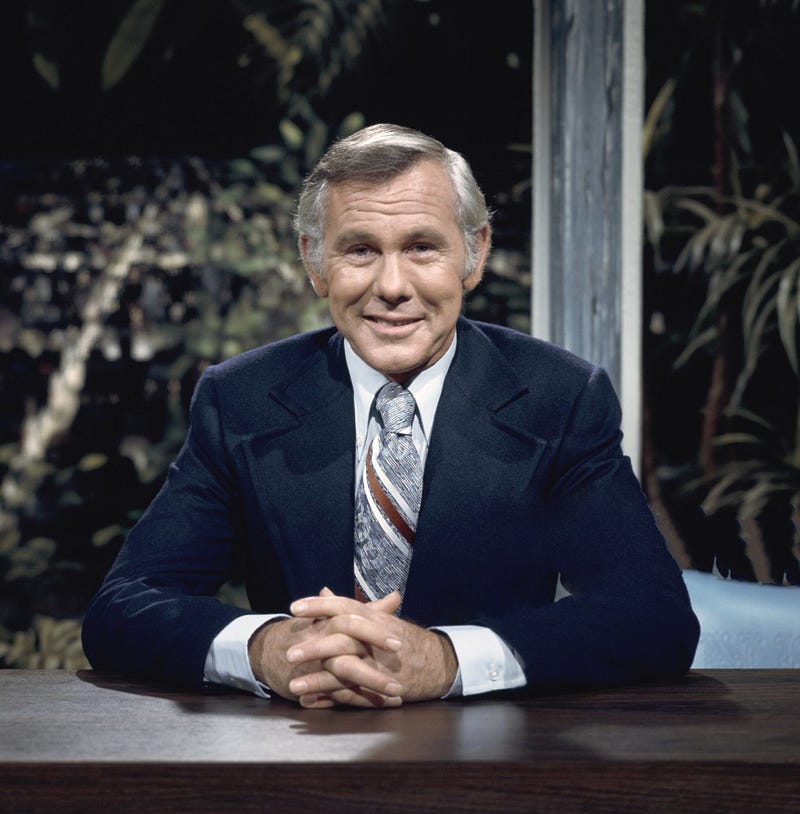
On May 11, 1973, ironically the day after Lee initially fainted inside Raymond Chow’s Golden Harvest Studios in Hong Kong while looping dialogue for Enter the Dragon, Carson’s close friend Buddy Rich was interviewed during a week of Tonight Shows taped in their former New York City stomping grounds. Prior to a karate demonstration of breaking boards, the second-degree black belt countered Carson’s belief that the burgeoning karate movie genre was “ridiculous” and that “guys jumping around and swinging on trampolines is the hokiest thing you’ve ever seen in the world.” As an example, Carson cited Fist of Fury but admitted that he had not actually sat through any martial arts movies.
The infamously fiery jazz drummer replied, “Most of the hand to hand fighting that they do is pretty real and honest. Like Bruce Lee, who’s really a pretty great karateka. Fist of Fury is very realistic.” Speaking of which, the editor of Black Belt magazine, likely Mitoshi Uyehara, was backstage doing a profile of Rich, who continued his conversation with the late night king by endorsing the rival Shaw Brothers’ Five Fingers of Death and Kung Fu, David Carradine’s popular 1972–1975 ABC series.
Curious to the nth degree, I question whether Lee crossed paths with three of my retro pop culture treasures. No, he never met John Wayne, Elvis Presley, or Audie Murphy, a cowboy leading man and one of the most decorated servicemen in U.S. history. Sensing dismay, Polly possesses a salve. “There was talk of Bruce doing a movie with Elvis at Metro-Goldwyn-Mayer, but Bruce died before they could meet.” The “Don’t Cry, Daddy” balladeer left acting permanently with the 1969 change-of-pace drama Change of Habit. His final MGM project was Elvis on Tour, a Golden Globe-winning 1972 road documentary. Chewing the fat about a potential project is a long way from signing on the dotted line. Add a monkey wrench into the equation with Colonel Tom Parker. He notoriously shot down Barbra Streisand’s comeback proposal to place his business-eschewing client alongside her in the third reconstruction of A Star Is Born.
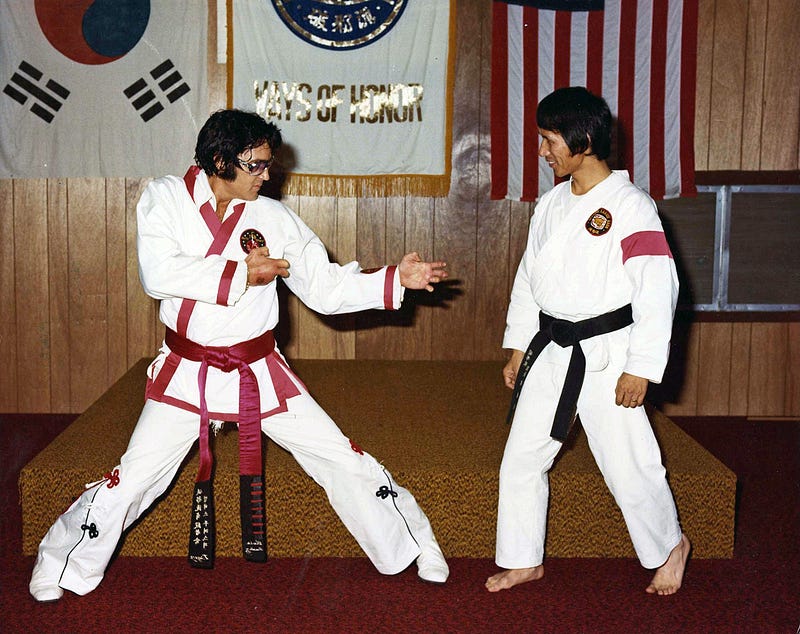
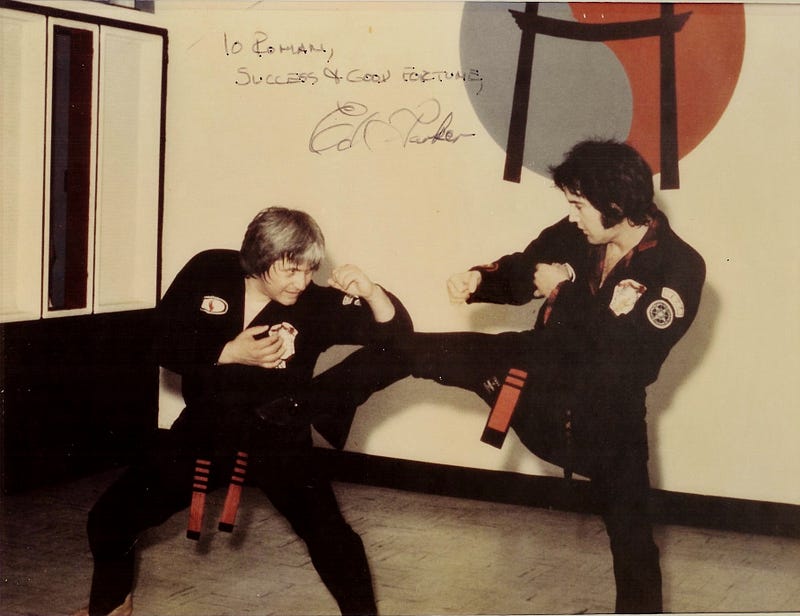
Against Parker’s wishes, in 1974 Presley sank $100,000 [$556,220 adjusted for inflation] into The New Gladiators, a documentary filming the world exploits of an all-star team of national karate champions and renowned martial arts specialists assembled by Presley’s California-based Kenpo trainer Ed Parker, the man who introduced Lee to the martial arts community at the August 1964 Long Beach International Karate Championships. The innovative ’50s rocker kindled a karate discipleship during his Army tenure in Germany and was awarded an 8th degree black belt in 1974 by Kang Rhee that was likely based on celebrity status rather than deserved merit. Presley was poised to appear on-camera narrating the tournaments, demonstrating moves, and explaining the history, principles, and spiritual elements of karate. It was never completed as his prescription dependence, weight fluctuation, and depression tightened its entanglement. Penny-pinching father Vernon Presley also interfered in his sole child’s financial matters. The footage has been compiled into two separate DVD projects — New Gladiators and Elvis Presley Gladiators. Guess which contains the Hillbilly Cat.
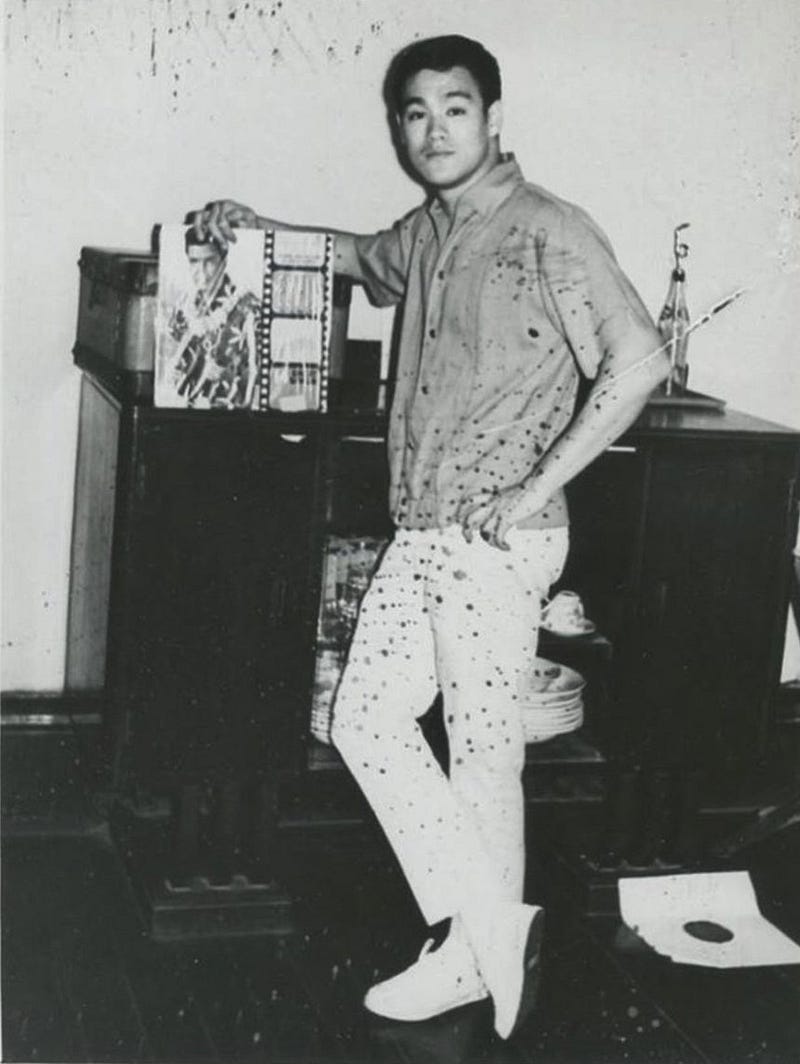
Lee fascinated Presley during the mid-’70s kung fu explosion. Graceland archivists have identified Bruce Lee: King of Kung Fu [1974] by Felix Dennis and Don Atyeo as being among Presley’s extensive book collection. Was common ground possible for the groundbreaking duo beyond martial arts? “Bruce was very good at charming people,” explains Polly. “I’m sure he would have intrigued Elvis with his philosophical perspective.” Whether profound, a canny sense of self-promotion, or a combination of both, Lee rattled off advice that could elicit divided reactions among colleagues. Here are four pearls of wisdom that have impacted yours truly:
- “You’ve got to relax. Once your body is relaxed, almost like a limp rag, you can throw anything. You’ll be surprised how deadly it is. If you tighten up before you throw a punch, it will be weak. Keep your body loose, and it’ll be like a whip.”
- “It’s a necessity to adapt one’s self to changing circumstances. The inability to adapt brings destruction.”
- “Unless you learn to calm your mind, you will never hear the world outside.”
- “If you want to learn to swim, jump into the water. On dry land, no frame of mind is ever going to help you.”
DON’T GO ANYWHERE YET! PART FOUR of the Matthew Polly / Bruce Lee interview offers commentary on Lee’s cockiness, mistress Betty Ting Pei, a crappy ’60s TV western guest spot, a hippie trapper encountering Native Americans in the rejected “Kelsey” script, and high flying side kicks during a bustling Times Square.
© Jeremy Roberts, 2020. All rights reserved. To touch base, email [email protected] and mention which story led you my way. I appreciate it sincerely.


