avatarComrade Morlock

Summary

The article discusses the complexity of assigning guilt for historical slavery, suggesting that many cultures and nations beyond white Americans have a legacy of slavery and should also reflect on their past.

Abstract

The article challenges the notion that only white Americans should feel guilty for the historical atrocity of slavery. It points out that many other countries and cultures, including Korea, the Ottoman Empire, Brazil, China, Ethiopia, Germany, Japan, and Tibet, had slavery practices that lasted well into the 19th and 20th centuries. The author argues that focusing solely on white Americans overlooks the broader scope of slavery throughout history and across different societies. The article emphasizes that guilt should not be selectively assigned based on race or nationality, as slavery was a global phenomenon. Instead, the author encourages readers to work towards a future where no one is forced into servitude, rather than dwelling on the past sins of their nations or races.

Opinions

  • The author suggests that the guilt for slavery should not be disproportionately placed on white Americans, as many other nations and cultures also have histories of slavery.
  • It is argued that any group with a history of oppression, including non-white nations and the wealthy elite, should reflect on their ancestors' roles in historical injustices.
  • The article implies that the focus on white guilt gives a pass to other participants in the slave trade, such as African slaveholders and nations that abolished slavery later than the U.S.
  • The author posits that the premise of collective racial or national guilt for historical sins is flawed and that the energy spent on guilt would be better used to prevent modern-day forms of servitude.
  • The article highlights the fact that the Trans-Atlantic Slave Trade involved a much smaller number of Africans being shipped directly to North America compared to the Caribbean and South America, suggesting a need for a more nuanced understanding of the slave trade's impact.

If white Americans should feel guilty for slavery, who should feel even more guilty?
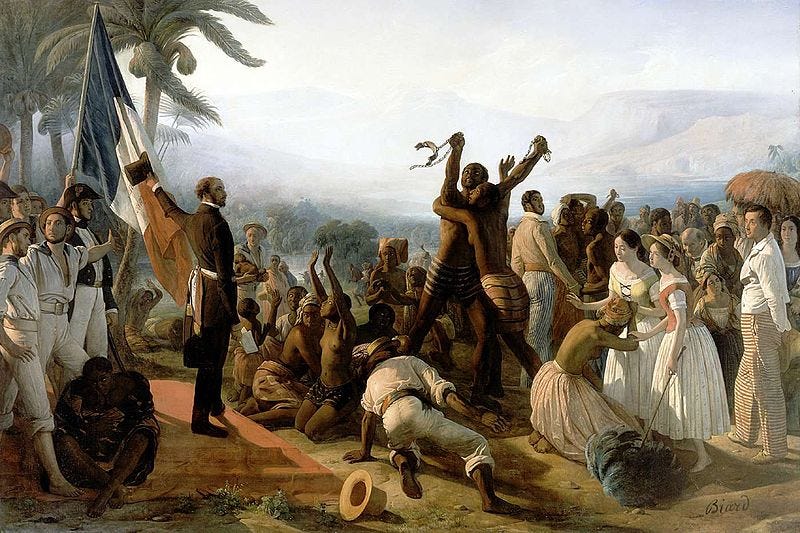
Proclamation of the Abolition of Slavery in the French Colonies, 27 April 1848 by François Auguste Biard

Identitarians often say white people should feel guilty for things done by dead rich white people. For example, in response to an article about the screenwriter of Mandela: Long Walk to Freedom saying it failed because 12 Years a Slave “sucked up all the guilt about black people that was available”, a woman with a Korean last name said,

“White people need to feel guilty. In fact, any group who oppresses others needs to feel more than guilt: they need to have their power — and the means, structures, and resources for their ancestors to be powerful — completely removed so that they and people like them can do no more harm in the world. European slavers, Nazis, the 1% billionaires — bigots and money hoarders are the cancers of this earth.”

I replied,

“I assume from your name that you’re of Korean descent. Korea didn’t abolish slavery until 1894. I hope you feel thirty years’ more guilty than any American. You also have billionaires. Bigots and money hoarders know no hue or gender.”

I didn’t realize at the time that Korea only formally abolished slavery in 1894. It effectively continued there until 1930.

Now, focusing on white Americans gives a pass to black US slaveholders and Africans who sold slaves to Europeans, but let’s accept the premise that people are responsible for their nations’ and their races’ historical sins. You can see which nationalities should feel more guilty about slavery than white Americans by checking Timeline of abolition of slavery and serfdom to see who ended slavery after 1865. A few examples:

The Ottoman Empire did not end slavery until 1882.

Brazil did not end slavery until 1888.

China did not end slavery until 1910.

Ethiopia did not end slavery until 1935.

Millions of “forced workers” were freed in 1945 when the Allies defeated Germany and Japan.

The site has at least one omission. Slavery in Tibet did not end until 1959.

There’s no culture that doesn’t have sins in its past, so don’t waste time feeling guilty for what anyone else did. Work to make a world where no one is forced to serve anyone else.

PS. “…according to the Trans-Atlantic Slave Trade Database, 12.5 million Africans were shipped to the New World. 10.7 million survived the dreaded Middle Passage, disembarking in North America, the Caribbean and South America. And how many of these 10.7 million Africans were shipped directly to North America? Only about 388,000.

Related: African Slavery was Not Better than American Slavery. It was Differently Abominable.

Mansa Musa Owned 12 Times More Slaves Than The US’s Largest Slaveowner

White Privilege
White Supremacy
White Guilt
Racism
Race
Recommended from ReadMedium