avatarComrade Morlock

Free AI web copilot to create summaries, insights and extended knowledge, download it at here

2792

Abstract

uote id="8549"><p>In one of the earliest <a href="https://en.wikipedia.org/wiki/Freedom_suits">freedom suits</a>, Casor argued that he was an <a href="https://en.wikipedia.org/wiki/Indentured_servitude">indentured servant</a> who had been forced by <a href="https://en.wikipedia.org/wiki/Anthony_Johnson_(colonist)">Anthony Johnson</a>, a <a href="https://en.wikipedia.org/wiki/Free_people_of_color">free black</a>, to serve past his term; he was freed and went to work for Robert Parker as an indentured servant. Johnson sued Parker for Casor’s services. In ordering Casor returned to his master, Johnson, for life, the court both declared Casor a slave and sustained the right of free blacks to own slaves.</p></blockquote><blockquote id="310f"><p>Laws racializing slavery hardened during Casor’s lifetime.<a href="https://en.wikipedia.org/wiki/John_Casor#cite_note-5">[5]</a> In 1662, the Virginia Colony passed a law incorporating the principle of <a href="https://en.wikipedia.org/wiki/Partus_sequitur_ventrem"><i>partus sequitur ventrem</i></a>, ruling that children of enslaved mothers would be born into slavery, regardless of their father’s race or status.<a href="https://en.wikipedia.org/wiki/John_Casor#cite_note-Banks-6">[6]</a> This was in contradiction to English <a href="https://en.wikipedia.org/wiki/Common_law">common law</a> for English subjects, which based a child’s status on that of the father. In 1699 the Virginia <a href="https://en.wikipedia.org/wiki/House_of_Burgesses">House of Burgesses</a> passed a law deporting all free blacks. But many new families of <a href="https://en.wikipedia.org/wiki/Free_negro">free blacks</a> continued to be formed during the <a href="https://en.wikipedia.org/wiki/Colonial_history_of_the_United_States">colonial years</a> by the close relationships among the working class.<a href="https://en.wikipedia.org/wiki/John_Casor#cite_note-Heinegg-1">[1]</a></p></blockquote><p id="6a5f">Anthony Johnson <a href="https://www.smithsonianmag.com/smart-news/horrible-fate-john-casor-180962352/">ended up suffering from the growing racialization of colonial law in the world that he had helped make</a>:</p><blockquote id="412d"><p>…by the time Johnson died in 1670, his race was used to justify giving his plantation to a white man rather than Johnson’s children by his wife, Mary. He was “not a citizen of the colony,” a judge ruled, because he was black.</p></blockquote><p id="4e7e"><a href="https://kon.org/urc/v4/tikhomirova.html">Black Slaveholders Prior to the Civil War</a>” by Yuliya Tikhomirova and Lucia Desir has interesting information about the black slave owners who followed Anthony Johnson:</p><blockquote id="4ca4"><p>Koger (1995) argues that a great many freemen became slave masters themselves for the same reason as wh

Options

ites, to make use of slave labor for the sake of profits. He writes, “by and large, Negro slave owners were darker copies of their white counterparts.” His research led him to conclude, “clearly the dominant pattern of the commercial use of slaves recorded in the documents indicates that black slaveholding was primarily an institution based on the exploitation of slaves rather than a benevolent system centered upon kinship or humanitarianism” (p. 101).</p></blockquote><blockquote id="6c56"><p>…Scholars including Woodson, point out that up to the 1860’s, having economic interests in common with the white slaveholders, black owners enjoyed the same social standing: attended the same churches, same private schools, and places of amusement. They frequently lived on the same streets as white families.</p></blockquote><blockquote id="50f6"><p>….Despite changes in the law, blacks continued to hold slaves through the Civil War. Koger (1995) refers to the fact that “in 1860, some 3,000 blacks owned nearly 20,000 black slaves [in the southern states]. In South Carolina alone, more than 10,000 blacks were owned by black slaveholders.”</p></blockquote><blockquote id="d353"><p>…According to Salzman, Smith, & West (1996, p. 603), “eight of the wealthiest antebellum black entrepreneurs were slaveholders from Louisiana who owned large cotton and sugar plantations.” The trajectory of Marie Metoyer, also known as Coincoin, from daughter of African-born slaves to wealthy slave owner is a case in point. After being granted freedom from her white master, she established an independent plantation in Louisiana, expanding her economic assets by purchasing slaves and additional acreage. Her offspring expanded on her holdings, making them the largest African-American slaveholding family in American history with holdings of 20,000 acres of land and 500 slaves. The widow C. Richards and her son P. C. Richards owned 152 slaves and a large sugar cane plantation. Another black slave magnate with over 100 slaves was Antoine Dubuclet, a sugar planter whose estate was valued at 264,000, when the mean wealth of southern white men for that year was 3,978 (Grooms, 1997).</p></blockquote><p id="581e">Any discussion of black slaveowners in the US should mention the richest one, <a href="https://en.wikipedia.org/wiki/William_Ellison">William Ellison</a>. His descendants continued to be wealthy: see <a href="https://www.tampabay.com/archive/1994/10/04/dr-ellison-s-family-secret-is-free-at-last/">Dr. Ellison’s family secret is free at last</a>.</p><p id="ca40"><i>Related:</i> <a href="https://readmedium.com/the-dedicated-ignorance-of-nikole-hannah-jones-and-the-1619-project-8a68ae07af33">The Dedicated Ignorance of Nikole Hannah-Jones and the 1619 Project</a></p></article></body>

Sorry, 1619 Project—The first legal slaveowner in the American colonies was black
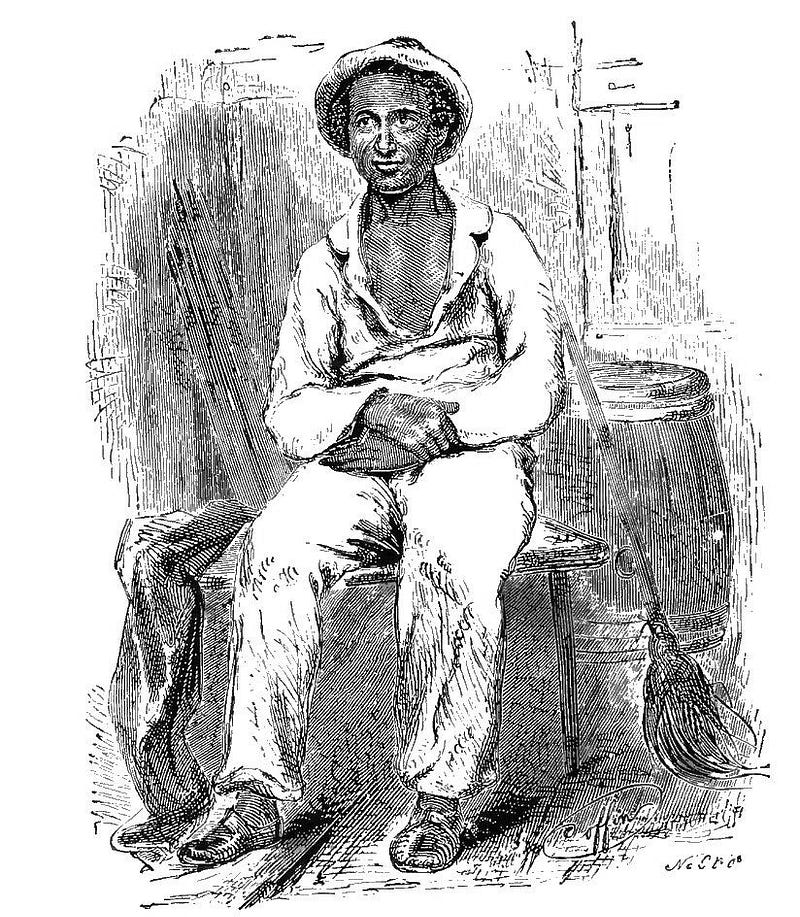
Frederick M. Coffin (engraved by Nathaniel Orr), Public domain, via Wikimedia Commons

Why isn’t everyone who is obsessed with race and slavery in the US talking about Anthony Johnson? Why isn’t the 1619 Project called the 1655 Project? Before 1655, African slaves and European indentured servants in the English colonies shared the same working and living conditions, the contracts for both groups could be bought and sold, and after their contracts expired, usually in seven years, both groups were freed so long as they had done what was expected of them. Some historians say the first slave in the colonies was John Punch, a black man who ran away from his master and was punished with a term of life service, but he was sentenced in a criminal case because running away was a crime. Most historians agree that slavery in the colonies begins with John Casor, a servant who became a slave after his former master, Anthony Johnson, went to court and argued in a civil case that Casor belonged to him for life.

The inconvenient fact for fans of the 1619 Project? Anthony Johnson was black.

Wikipedia sums up the case:

John Casor (surname also recorded as Cazara and Corsala),[1] a servant in Northampton County in the Virginia Colony, in 1655 became the first person of African descent in the Thirteen Colonies to be declared as a slave for life as a result of a civil suit.[2][3] In an earlier case, John Punch was the first man documented as a slave in the Virginia Colony, sentenced to life in servitude for attempting to escape his captors.[4]

In one of the earliest freedom suits, Casor argued that he was an indentured servant who had been forced by Anthony Johnson, a free black, to serve past his term; he was freed and went to work for Robert Parker as an indentured servant. Johnson sued Parker for Casor’s services. In ordering Casor returned to his master, Johnson, for life, the court both declared Casor a slave and sustained the right of free blacks to own slaves.

Laws racializing slavery hardened during Casor’s lifetime.[5] In 1662, the Virginia Colony passed a law incorporating the principle of partus sequitur ventrem, ruling that children of enslaved mothers would be born into slavery, regardless of their father’s race or status.[6] This was in contradiction to English common law for English subjects, which based a child’s status on that of the father. In 1699 the Virginia House of Burgesses passed a law deporting all free blacks. But many new families of free blacks continued to be formed during the colonial years by the close relationships among the working class.[1]

Anthony Johnson ended up suffering from the growing racialization of colonial law in the world that he had helped make:

…by the time Johnson died in 1670, his race was used to justify giving his plantation to a white man rather than Johnson’s children by his wife, Mary. He was “not a citizen of the colony,” a judge ruled, because he was black.

Black Slaveholders Prior to the Civil War” by Yuliya Tikhomirova and Lucia Desir has interesting information about the black slave owners who followed Anthony Johnson:

Koger (1995) argues that a great many freemen became slave masters themselves for the same reason as whites, to make use of slave labor for the sake of profits. He writes, “by and large, Negro slave owners were darker copies of their white counterparts.” His research led him to conclude, “clearly the dominant pattern of the commercial use of slaves recorded in the documents indicates that black slaveholding was primarily an institution based on the exploitation of slaves rather than a benevolent system centered upon kinship or humanitarianism” (p. 101).

…Scholars including Woodson, point out that up to the 1860’s, having economic interests in common with the white slaveholders, black owners enjoyed the same social standing: attended the same churches, same private schools, and places of amusement. They frequently lived on the same streets as white families.

….Despite changes in the law, blacks continued to hold slaves through the Civil War. Koger (1995) refers to the fact that “in 1860, some 3,000 blacks owned nearly 20,000 black slaves [in the southern states]. In South Carolina alone, more than 10,000 blacks were owned by black slaveholders.”

…According to Salzman, Smith, & West (1996, p. 603), “eight of the wealthiest antebellum black entrepreneurs were slaveholders from Louisiana who owned large cotton and sugar plantations.” The trajectory of Marie Metoyer, also known as Coincoin, from daughter of African-born slaves to wealthy slave owner is a case in point. After being granted freedom from her white master, she established an independent plantation in Louisiana, expanding her economic assets by purchasing slaves and additional acreage. Her offspring expanded on her holdings, making them the largest African-American slaveholding family in American history with holdings of 20,000 acres of land and 500 slaves. The widow C. Richards and her son P. C. Richards owned 152 slaves and a large sugar cane plantation. Another black slave magnate with over 100 slaves was Antoine Dubuclet, a sugar planter whose estate was valued at $264,000, when the mean wealth of southern white men for that year was $3,978 (Grooms, 1997).

Any discussion of black slaveowners in the US should mention the richest one, William Ellison. His descendants continued to be wealthy: see Dr. Ellison’s family secret is free at last.

Related: The Dedicated Ignorance of Nikole Hannah-Jones and the 1619 Project

1619 Project
Slavery
Race
White Privilege
Recommended from ReadMedium