
The Dedicated Ignorance of Nikole Hannah-Jones and the 1619 Project
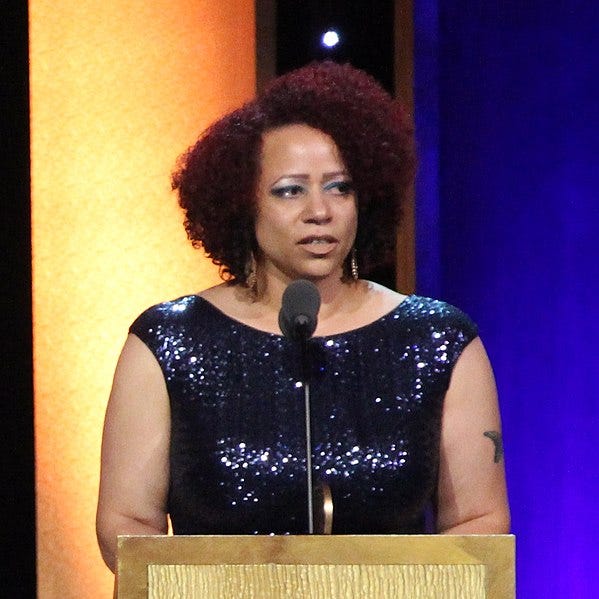
Perhaps the most important thing to understand about Nikole Hannah-Jones is that she’s a member of the black bourgeoisie who suffers from the cognitive dissonance that is common to black people of her class: How can she rationalize her privilege in a nation where black people are disproportionately poor? Her solution is to promote the secular religion derived from Derrick Bell’s Critical Race Theory. Her most famous contribution is the 1619 Project. How a commitment to an identitarian understanding of power and history helps black working-class people is vague, but it greatly helps the careers of people like Hannah-Jones.
The second most important thing to understand is that she is not a historian. Her M.A. is in journalism. She seems to dislike historians in general. How else do you explain the credentials of the writers she chose for the 1619 Project? As historian Sean Wilentz noted, her “list lacked any historian with expertise on the history of the United States before 1865, which would include, of course, the entire history of American slavery.”
Hannah-Jones and I had a brief exchange on Twitter in 2018 that inspired two blog posts, and in 2020 I wrote about the fundamental misunderstanding of the 1619 Project. Here are edited and updated versions of those posts:
I. Things I learned from tweeting with Nikole Hannah-Jones
I was in a distracting but informative twitter war that began when I made this tweet citing How Obama Destroyed Black Wealth:
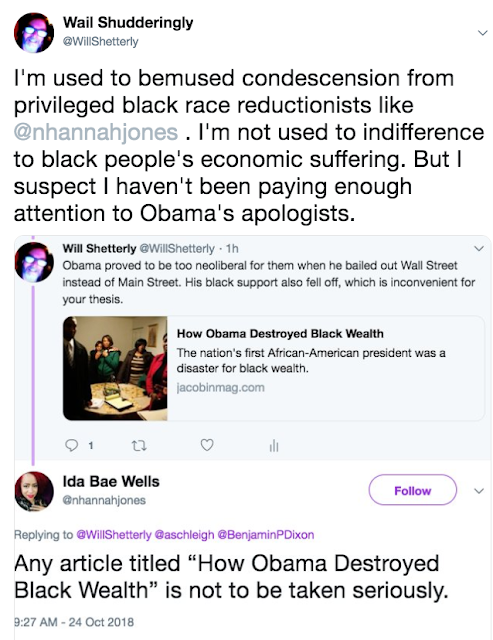
A few points about my tweet and the discussion that followed:
- “Bemused” really wasn’t the right word. As Twain noted, sometimes you reach for lightning and get a lightning bug.
- I suspect I’d like Hannah-Jones if I knew her. I completely understand why people who share her ideology admire her.
- Like most privileged identitarians, she is extremely sensitive to any hint of condescension and extremely quick to ridicule anyone she disagrees with.
- I do not have a clue what she thinks her political philosophy is. She defends Obama’s and Clinton’s neoliberalism, yet she insists she is not a neoliberal and she agreed when I cited Malcolm X’s observation, “You can’t have capitalism without racism.”
- Her ideological contradictions are powerful, as this tweet shows:
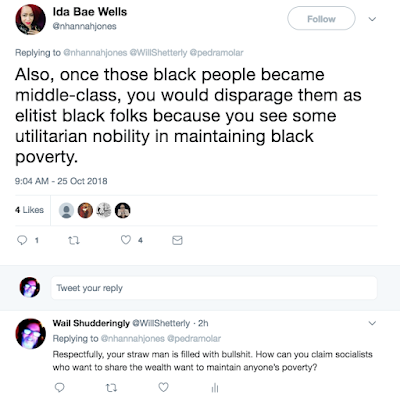
The idea that socialists want to “maintain black poverty” would have made King, a democratic socialist, and Du Bois, a communist, laugh and laugh.
- Hannah-Jones’ contradictions are magnified in her fans. The most ignorant response I saw:
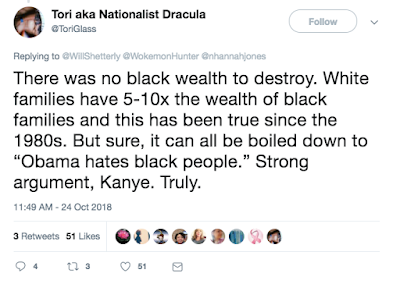
To say “there was no black wealth to destroy”, you have to believe all black people were homeless in 2008 and everything that was done to hurt them was done by racists. Identitarians cannot see that the policies which disproportionately hurt black people (because black people are disproportionately poor) were enacted by rich people of all races who don’t care about the poor of any race. They care about Wall Street, whose faithful servant Obama has always been.
Another of her fans provided this:
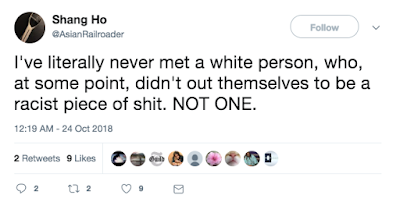
As you may guess, Shang Ho thinks white people are privileged for statistical reasons and doesn’t care that Asian Americans are more economically privileged than white Christian Americans because US immigration laws have ensured that, except for refugees, Asian immigrants are wealthy or well-educated.
II. Four things Nikole Hannah-Jones doesn’t know about race and class in the US
1. The history of voting is more complex than she thinks.
She tweeted:
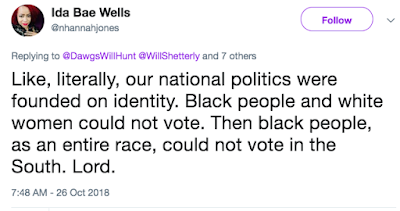
I replied, “Respectfully, read more history. Poor white men could not vote at first either. Property was the first requirement.”
Race reductionists cannot grasp that our founders prioritized class. During the colonial period, voting in the US was based on owning land. Though heads of households were usually male, widows could vote because class trumped gender. In some colonies, wealthy people of the wrong religion (Jews, Catholics, etc.) or race (blacks, Native Americans, etc.) were excluded along with poor white men, but they kept most of the privileges of wealth.
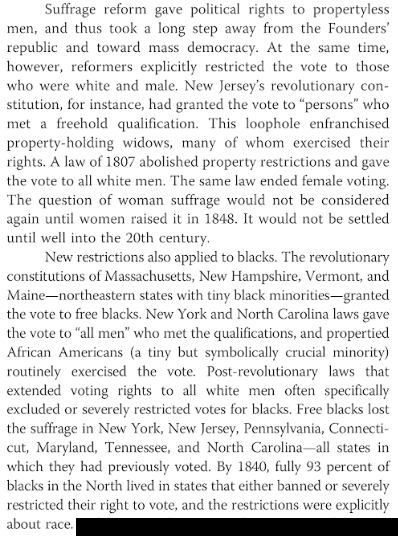
The principle that wealth mattered most continued after the Revolution. In New Jersey, wealthy white women and people of color could vote when poor white men could not:
“New Jersey’s first constitution in 1776 gave voting rights to “all inhabitants of this colony, of full age, who are worth fifty pounds … and have resided within the county … for twelve months.” In 1790 the legislature reworded the law to say “he or she,” clarifying that both men and women had voting rights.”
Rich black men could vote in Massachusetts, New Hampshire, Vermont, and Maine. The triumph of identity as a requirement to vote came decades later, when property requirements for voting were being discarded. From Liberty, Equality, Power: A History of the American People:
2. Seriously more complex than she thinks.
Hannah-Jones tweeted:
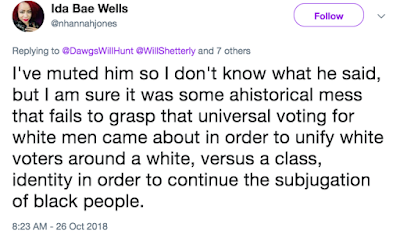
She conflates several historical processes. Racism in the US had been growing ever since Bacon’s Rebellion, when the rich started to divide the working class by race. At the same time, the demand for democracy was growing. Most people know that correlation is not causation, but Hannah-Jones happily links two separate things to support her reductionist thesis.
3. There were very rich black slaveowners.
Hannah-Jones tweeted:
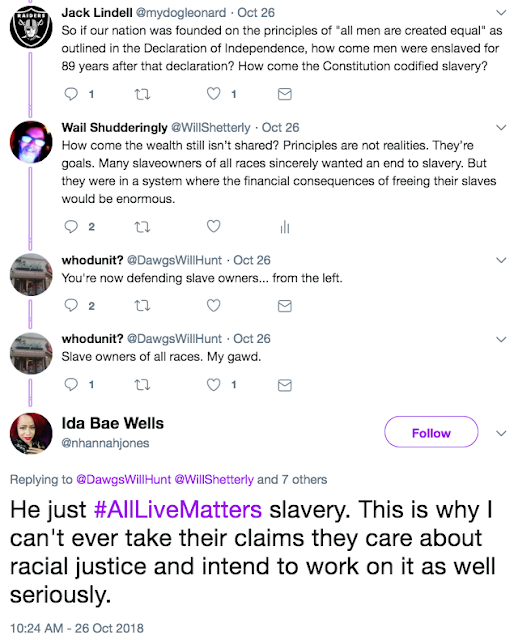
I replied, “If you don’t know about rich black slaveowners, you should not be writing about race or slavery” and suggested she start with William Ellison.
The existence of black slaveowners causes enormous cognitive dissonance for race reductionists. They insist slavery was an individual choice for white slaveowners so we should not say anything good about white slave owners like Jefferson, but slavery was a systemic matter for black slaveowners, so we should excuse black slave owners like the Widow C. Richards.
When someone provided a link to Black Slaveowners, a book by Larry Koger, who studied history at Howard, a historically black university, Hannah-Jones tweeted that offering inconvenient facts would result in being blocked:
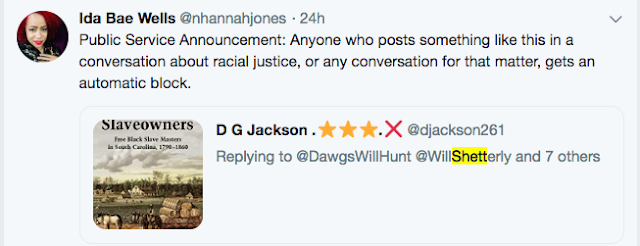
Some of her followers claimed the number of black slaveowners was too small to be relevant, but any fact that does not fit a thesis is relevant. There were certainly more than a handful. R. Halliburton Jr. notes, “The census of 1830 lists 3,775 free Negroes who owned a total of 12,760 slaves.”
We also know that some black slaveowners were extremely wealthy. See Henry Louis Gates’ Did Black People Own Slaves? and Top 10 Black Slaveowners.
4. There were slaves who were legally white.
Hannah-Jones tweeted:
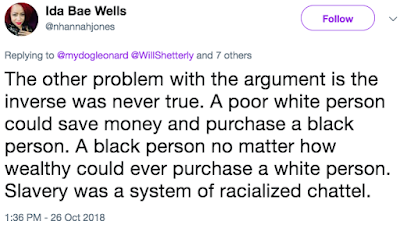
Obviously, slavery in the US was racialized, but black people could and did buy white people. People who know little history assume the one-drop rule for whiteness was always the rule, but it was a creation of Jim Crow. Ignorant people also assume that being black was the requirement for being a slave, but the only requirement was being the child of a slave. In the old South, whiteness depended on which state you were in. In most states, quadroons (people who were 3/4 white) were legally white. In a few states, octoroons (people who were 7/8 white) were legally white. Whiteness did not free you from slavery. Only a slave owner could do that.
New Englander George Fuller painted “The Quadroon” after visiting a slave sale in the south.
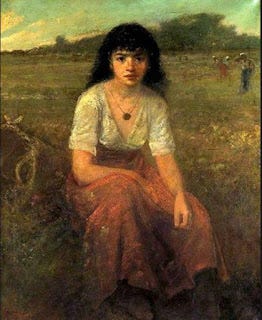
He wrote:
Who is this girl with eyes large and black? The blood of the white and dark races is at enmity in her veins — the former predominated. About ¾ white says one dealer. Three fourths blessed, a fraction accursed. She is under thy feet, white man. . . . Is she not your sister?
Fuller’s use of “accursed” is poetic, not racist — note his question for white men who have the power to end slavery. Her curse is the law that lets her be a slave because her mother was one. Some racist abolitionists hated slavery primarily because it permitted the enslavement of white people — see examples at White Slaves — The Multiracial Activist.
III. Refuting the 1619 Project: Many of the US’s founders hated slavery
Though the 1619 Project’s writers believe the US was founded to preserve slavery, its founders included abolitionists, some who wanted an immediate end to slavery and some who hoped for gradual abolition.
Thomas Jefferson’s first draft of the Declaration of Independence condemned King George for the African slave trade:
He has waged cruel war against human nature itself, violating its most sacred rights of life and liberty in the persons of a distant people who never offended him, captivating & carrying them into slavery in another hemisphere or to incur miserable death in their transportation thither. This piratical warfare, the opprobrium of infidel powers, is the warfare of the Christian King of Great Britain. Determined to keep open a market where Men should be bought & sold, he has prostituted his negative for suppressing every legislative attempt to prohibit or restrain this execrable commerce. And that this assemblage of horrors might want no fact of distinguished die, he is now exciting those very people to rise in arms among us, and to purchase that liberty of which he has deprived them, by murdering the people on whom he has obtruded them: thus paying off former crimes committed again the Liberties of one people, with crimes which he urges them to commit against the lives of another.
That was deleted to appease delegates from Georgia and South Carolina, as well as northern merchants who were part of the slave trade.
Jefferson was not alone in criticizing slavery:
“Slavery is an evil of Colossal magnitude & I am utterly averse to the admission of slavery into the Missouri Territories. It being among my first wishes to see some plan adopted by which slavery in this country may be abolished by law.” —John Adams
“Freedom is not a gift bestowed upon us by other men, but a right that belongs to us by the laws of God and nature.” —Benjamin Franklin
“…Neither my tongue, nor my pen, nor purse shall be wanting to promote the abolition of what to me appears so inconsistent with humanity and Christianity.” —Benjamin Franklin
“Who talks most about freedom and equality? Is it not those who hold a bill of Rights in one hand and a whip for affrighted slaves in the other?” —Alexander Hamilton
“It is much to be wished that slavery may be abolished. The honor of the States as well as justice and humanity, in my opinion, loudly call upon them to emancipate these unhappy people….” —John Jay
“To contend for our own liberty, and to deny that blessing to others, involves an inconsistency not to be excused.” —John Jay
Recommended responses by prominent historians:
The 1619 Project and Living in Truth by Sean Wilentz
Victoria Bynum on the inaccuracies of the 1619 Project
James McPherson on the 1619 Project
Clayborne Carson on the 1619 Project