
African Slavery was Not Better than American Slavery. It was Differently Abominable.
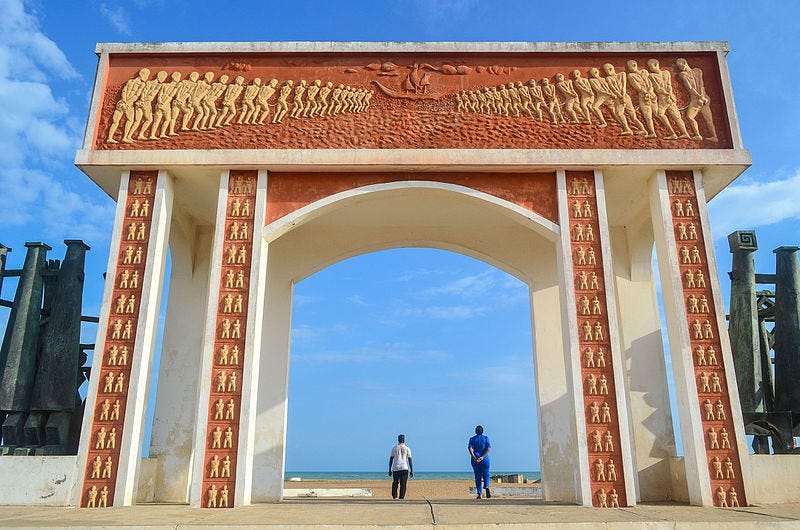
“African chiefs were the ones waging war on each other and capturing their own people and selling them. If anyone should apologise it should be the African chiefs.” — Yoweri Museveni, President of Uganda, 1998
“We cannot continue to blame the white men, as Africans, particularly the traditional rulers, are not blameless. … In view of the fact that the Americans and Europe have accepted the cruelty of their roles and have forcefully apologised, it would be logical, reasonable and humbling if African traditional rulers … [can] accept blame and formally apologise to the descendants of the victims of their collaborative and exploitative slave trade.” — The Civil Rights Congress of Nigeria, 2009
On Twitter, a privileged black woman (her bio says she lives in London and Chicago) who claimed to be an “Igbo person” was praising the ways of the Igbo tribe and saying they showed better alternatives to capitalism. That sparked a vague memory, so I googled “Igbo slavery” and found two useful introductions to the subject.
From Igbo Worlds An Anthology of Oral Histories and Historical Descriptions by Elizabeth Isichei:
“Our people traded extensively in slaves. It was a dangerous trade, but very profitable. It was dangerous, because you must be strong enough to overpower your victim. Secondly, you must be prepared to risk your life, wresting children from their parents, and so on. In fact, slaves were obtained in various ways — by kidnapping, through wars, through punishment for crimes and breach of taboos, for failure to pay debts. Parents even sold their children, for want of food.” —Nkwonto Nwuduaku
From The Descendants of Slaves in Nigeria Fight for Equality by Adaobi Tricia Nwaubani:
“Slavery existed among the Igbo long before colonization, but it accelerated in the sixteenth century, when the transatlantic trade began and demand for slaves increased. Under slavery, Igbo society was divided into three main categories: diala, ohu, and osu. The diala were the freeborn, and enjoyed full status as members of the human race. The ohu were taken as captives from distant communities or else enslaved in payment of debts or as punishment for crimes; the diala kept them as domestic servants, sold them to white merchants, and occasionally sacrificed them in religious ceremonies or buried them alive at their masters’ funerals.
…In the nineteenth century, the abolition of slavery in the West inadvertently led to a glut of slaves in the Igbo markets, causing the number of ohu and osu to skyrocket. “Those families which were really rich competed with one another in the number of slaves each killed for its dead or used to placate the gods,” Adiele Afigbo, an Igbo historian, wrote in “The Abolition of the Slave Trade in Southeastern Nigeria, 1885–1950.”
Race reductionists insist American slavery was the world’s worst form of slavery as if they want to give a pass to all other forms of slavery. In most cases, that’s because they know nothing about slavery outside of the US and what they think they know about US slavery comes from Hollywood, which lies about slavery for at least four reasons:
- Old Hollywood was squeamish, so it made US slavery look less horrible than it often was.
- New Hollywood is sensationalistic, so it makes US slavery look even more horrible than it often was.
- Hollywood has always focused on profit, so it focuses on slavery that has a strong marketing hook.
- Hollywood is capitalistic, so it avoids criticism of commerce by treating slavery as an immoral system run by psychopaths rather than a commercial enterprise run by business people. The eminent historian Barbara J. Fields noted, “Probably a majority of American historians think of slavery in the United States as primarily a system of race relations — as though the chief business of slavery were the production of white supremacy rather than the production of cotton, sugar, rice and tobacco. One historian has gone so far as to call slavery ‘the ultimate segregator’. He does not ask why Europeans seeking the ‘ultimate’ method of segregating Africans would go to the trouble and expense of transporting them across the ocean for that purpose, when they could have achieved the same end so much more simply by leaving the Africans in Africa.”
In American slavery: Separating fact from myth, Daina Ramey Berry stresses the commercial aspect of American slavery:
Enslaved people were valued at every stage of their lives, from before birth until after death. Slaveholders examined women for their fertility and projected the value of their “future increase.” As the slaves grew up, enslavers assessed their value through a rating system that quantified their work. An “A1 Prime hand” represented one term used for a “first-rate” slave who could do the most work in a given day. Their values decreased on a quarter scale from three-fourths hands to one-fourth hands, to a rate of zero, which was typically reserved for elderly or differently abled bondpeople (another term for slaves).
For example, Guy and Andrew, two prime males sold at the largest auction in U.S. history in 1859, commanded different prices. Although similar in “all marketable points in size, age, and skill,” Guy was US$1,280 while Andrew sold for $1,040 because “he had lost his right eye.” A reporter from the New York Tribune noted “that the market value of the right eye in the Southern country is $240.” Enslaved bodies were reduced to monetary values assessed from year to year and sometimes from month to month for their entire lifespan and beyond. By today’s standards, Andrew and Guy would be worth about $33,000-$40,000.
Slavery was an extremely diverse economic institution, one that extracted unpaid labor out of people in a variety of settings — from small single-crop farms and plantations to urban universities. This diversity was also reflected in their prices. And enslaved people understood they were treated as commodities.
“I was sold away from mammy at three years old,” recalled Harriett Hill of Georgia. “I remembers it! It lack selling a calf from the cow,” she shared in a 1930s interview with the Works Progress Administration. “We are human beings,” she told her interviewer. Those in bondage understood their status. Even though Harriet Hill was too little to remember her price when she was three, she recalled being sold for $1,400 at age nine or 10: “I never could forget it.”
The commercial value of slaves gave them one of the few reasons for pride in their hard lives:
…“wh*te tr*sh” … came into common use in the 1830s as a pejorative used by house slaves against poor whites. In 1833, Fanny Kemble, an English actress visiting Georgia, noted in her journal: “The slaves themselves entertain the very highest contempt for white servants, whom they designate as ‘poor wh*te tr*sh’”.[35][36]
People who insist American slavery was unique often argue that it was the only system with chattel slavery, but chattel slavery is ancient and continues today in countries like Mauritania, Haiti, and Sudan. They say American slavery’s racial aspect was unique, but the racial aspect developed for the same reason that Nigerians today are divided between the freeborn diala and the osu descendants of slaves captured from other communities. The trans-Atlantic slave trade did not start because of racism. It created racism.
“Slavery was not born of racism: rather, racism was the consequence of slavery.” —Eric Williams, historian and the first Prime Minister of Trinidad and Tobago
Because too many people read maliciously, I will add this to make my intent as clear as it can be: To say that American slavery was not worse than other forms of slavery does not excuse it. Only apologists for slavery insist one form was more benign than another. Slavery has existed throughout history and across the globe, and in every place it has existed, it has been an embarrassment to our species. Freedom is a fundamental human right.


