
Tibetan Slavery was Not Better than American Slavery. It was Differently Abominable.
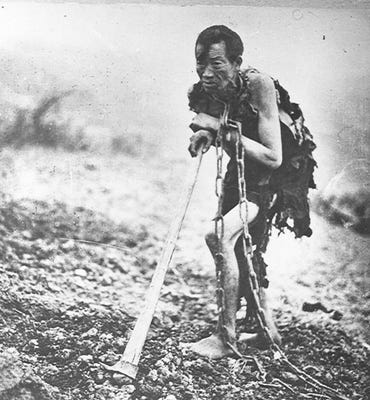
“I may not be free under Chinese Communism, but I am better off than when I was a slave.” —Wangchuk, quoted in “In Tibet, a Struggle of the Soul”
“Old Tibet was dark and cruel, the serfs lived worse than horses and cattle.” —Dechen Chökyi Drönma, the 12th Samding Dorje Phagmo, quoted in “Female living Buddha condemns Dalai Lama”
“When the Chinese speak of pre-1951 Tibet, they emphasize the shortcomings of the region’s feudal-theocratic government: life expectancy was thirty-six years; 95 percent of Tibetans were illiterate; 95 percent of the population was hereditary serfs and slaves owned by monasteries and nobles. … The statistics about Tibetan illiteracy and life expectancy are accurate.” —Peter Hessler, “Tibet Through Chinese Eyes”
Because Tibet is a centuries-old battle ground in the Great Game of Empire, politicians and academics argue angrily about the correct name for the people who were forced to serve Tibet’s priests and nobles. Should they be called slaves, serfs, or their Tibetan name, mi-ser, as though they were nothing like slaves or serfs?
The Dalai Lama used “serf” when defending the system he had ruled:
“The relationship between landlord and serf was much milder in Tibet than in China and conditions for the poor were much less harsh.” —the 14th Dalai Lama, Freedom in Exile: The Autobiography of the Dalai Lama, 1991
What people who use “serf” but object to “slave” fail to see is that serfs are slaves who are bound to the land, so their masters change when the land passes from one lord to another. I conclude that when talking about people who were born into servitude, who could be sold, who could be brutally punished or raped at the whim of their masters, who could not leave the lands of their masters without written permission, and who could be beaten with whips until they died, slave is the correct word.
Sorrel Neuss used both terms in “What we don’t hear about Tibet”:
Until 1959, when China cracked down on Tibetan rebels and the Dalai Lama fled to northern India, around 98% of the population was enslaved in serfdom. Drepung monastery, on the outskirts of Lhasa, was one of the world’s largest landowners with 185 manors, 25,000 serfs, 300 pastures, and 16,000 herdsmen. High-ranking lamas and secular landowners imposed crippling taxes, forced boys into monastic slavery and pilfered most of the country’s wealth — torturing disobedient serfs by gouging out their eyes or severing their hamstrings.
Tashi Tsering, now an English professor at Lhasa University is representative of Tibetans that do not see China’s occupation as worse tyranny. He was taken from his family near Drepung at 13 and forced into the Dalai Lama’s personal dance troupe. Beaten by his teachers, Tsering put up with rape by a well-connected monk in exchange for protection. In his autobiography, The Struggle for Modern Tibet, Tsering writes that China brought long-awaited hope when is laid claim to Tibet in 1950.
Emma Graham-Harrison also used both terms in “Tibet serf debate shadows China’s emancipation day”:
Lots of salty yak butter tea and an end to harsh beatings marked the start of the 1960s for farmer Kigya, who grew up shackled to the estate of a local nobleman by the inherited ties that once bound most Tibetans.
That world vanished overnight when Chinese troops flooded the Himalayan plateau in 1959 to quell an uprising, took direct control of government in Lhasa and rolled out radical changes.
…Few serious scholars contest that most Tibetans were bound by birth to estates held by nobles, monasteries or officials.
“The key characteristic of the system was that individuals did not have the right to opt out. They could not give back their land to the estate and live as free peasants,” said Melvyn Goldstein, at Ohio University’s Center for Research on Tibet.
… Peasants who ran away often were not brought back, and although trading of serfs happened, it was not widespread. Others rented their freedom on a yearly basis with a “human lease.”
Some “serfs” were also wealthy landowners in their own right, with serf-servants of their own, making a more complex social picture than is reflected in Beijing’s official line.
Managers could be brutal, and whips were still used in 1959.
“The owners always wanted more and one way of getting more is doing hard physical punishment and setting an example for the others, and that was common,” said Dawa Tsering, from the Tibet Academy of Social Sciences in Lhasa, who studied under Goldstein.
“The extreme was that they may beat you to death.”
If you think Tibet’s few rich serfs means they should not be called slaves, remember that rich slaves are not unique to Tibet. Some mamluks acquired great wealth, and the United States’ richest black slaveholder, William Ellison, had been born a slave. Most systems have exceptions, but the exceptions never justify the systems.
“Documents present picture of brutal past” provides harsh examples of Tibetan slavery:
A certificate, written in the old form of the Tibetan language, used before 1959 and kept as No MC 1015 File at the Archives of the Nationalities Cultural Palace, reads: “Being unable to pay back the money and grain we owe Nedong Dekhang, we, Tsewang Rabten and my wife, serfs of the Dusong Manor, must give up our daughter Gensong Tonten and younger son Padma Tenzin to Dekhang to repay the debts. The descendents of their son and daughter will be Dekhang’s serfs.”
Part of another contract, also kept at the Archives of the Nationalities Cultural Palace, as No MC 10144 File, was signed in 1947 by Drashi Choda to pay off his debt by letting his sister Tsering Lhamo work for Lharang without pay for 10 years.
It reads: “I, Drashi Choda, belong to the Nari Monastery of the Nari Manor. I borrowed 34 khal (about 1,047 pounds) and 3 sheng (0.085 bushels) of grain from the Lharang granary in the Wood-Monkey year, the interests of which amount to 6 khal (184 pounds) and 14.5 sheng (0.41 bushels). The principal and the interest total 40 khal (1,232 pounds) and 19.3 sheng (0.49 bushels) of grain.
“As I am unable to pay back the sum annually, I ask my younger sister Tsering Lhamo, who shares weal and woe with me, to pay off my debts by doing 10 years’ unpaid service for the Lharang beginning at the first day of the 12 month of this Fire-Dog year.”
The contract also stipulates: “In case of violation of the contract, Drashi Choda shall be punished according to the local law.”
P.S. In 1959, in The Dalai Lama Escapes from the Chinese, Time magazine side-stepped the slave or serf question and simply said this:
“ About four-fifths of them work to support one-fifth, who are shut up in lamaseries. What little land is not owned by the monks belongs either to the Dalai Lama or to about 150 noble families, who have kept their names and acres intact down the centuries by a mixture of polygyny and polyandry.”
Related: African Slavery was Not Better than American Slavery. It was Differently Abominable.


