
Why I Stopped Reading Hacker News Comments
The signal to noise ratio is just darn low.
First, let us agree that writing articles is not easy
Imagine a person who dedicates some portion of his time and energy to write about something on his blog. The topic must be pretty important for him to justify his devotion, otherwise why do it? If you have ever written a piece of article on a blog, then you know that it could take at least 1 hour to have a piece of text that is almost publishable. More often than not, though, this process starts several days (even weeks, months, years) before you start writing about it. When writing the article, you may find yourself doing some or all of the following:
- You start by organizing your thoughts and coming up with a tentative plan for the article. What is the topic? What are the headings and subheadings? How much are you willing to write about it? etc.
- You write, erase, write again, make corrections, edit, etc. Writing is by no means a linear process. You will go back and forth between sentences and paragraphs in order to make the article flow better. You try to come up with better opening lines for paragraphs to make them coherent with the previous ones, and as you keep writing, you discover things that you had not thought about when devising your plan in step 1.
- You search for suitable images. While Google has made it easier than ever to find pictures, it still takes much effort and time to narrow down the best ones. If you are like me, you will filter the results based on image quality (only large and high resolution), type (gif, png with transparent background, or just jpg), and maybe even color (mostly green?).
- You write a description for each photo that you insert in the article, and you add a reference link to the source.
- You may need to take screenshots, crop and edit them, and upload them to a photo-hosting website before you can insert them in the article.
- If you really care about teaching something to your audience, you may need to record your screen either as video or gif, because visually seeing how you do some task is easier than describing the steps. But recording your screen is not that straightforward: First, you might have to de-clutter your workspace, desktop, browser, etc. so that your audience will not get distracted. Second, you may have to install/purchase screen-recording software. Sure, macOS lets you do it out-of-the-box, but it lacks necessary features and you almost always end up using third-party apps for recording. Third, you may have to convert the output to a format that is acceptable by your website. For example, Medium does not allow uploading videos, so you have to convert them to gifs if you want. Also, the size limit is a challenge, so you often end up doing tricks to make the gif/video small enough (usually <25Mb).
- Your journey does not end here. In many cases, you have to embed other stuff such as Tweets, code snippets, etc. Each piece of code must be typed in Github Gists and then embedded in a Medium article. This means you always toggle between different apps and websites when creating content for your blog.
- And when you have done all of this, you must carefully choose the keywords that better reflect the content. Now you can finally publish your post/story.
- But often times you end up going back and editing your published articles. This is because sometimes you notice typos or grammatical errors when reading your own post.
Now that you have your article published, there comes the next part: the comments!
What is wrong with HN comments?
Comments from the reader’s perspective
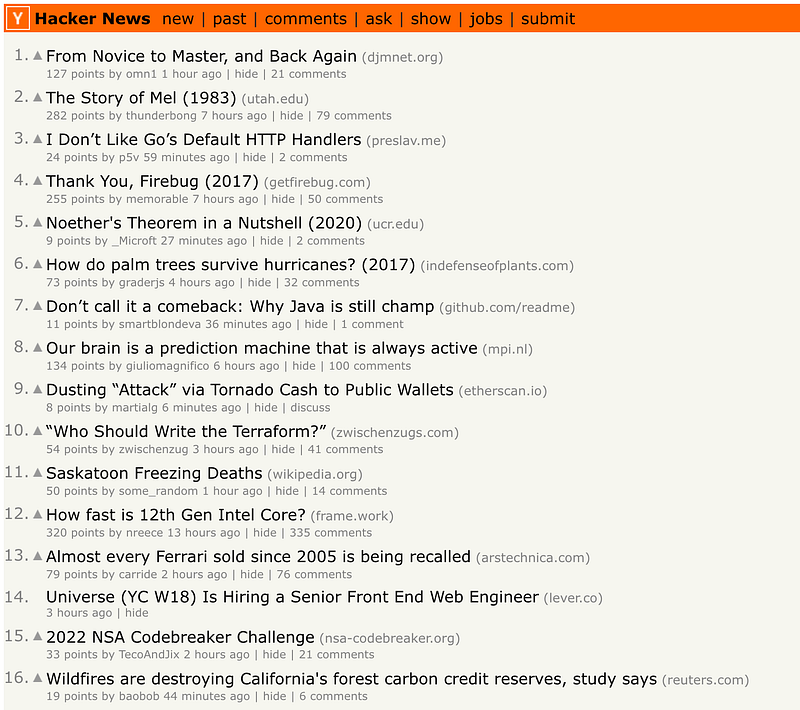
Let us look at an article and its comments when we are reading it (I am not just talking about comments on my own articles). This happens all the time on Hacker News (HN), a forum where people of all backgrounds discuss interesting articles. This is how HN front-page looks like:
Sometimes the number of comments is in the hundreds or even thousands. This happens mostly for controversial news articles, like this post about Elon Musk trying to purchase Twitter:

Obviously, no one has time to read all those comments (if you do, please get a job). Moreover, HN does not notify users about replies to their comments, so it is your duty to always check your own comments to see if there is any activity there. In the Elon Musk post, for example, top comments have hundreds or tens of replies. Do you think it is humanly possible to always check for any new comment? How would you even locate them (HN does not tell you which comments are new)?
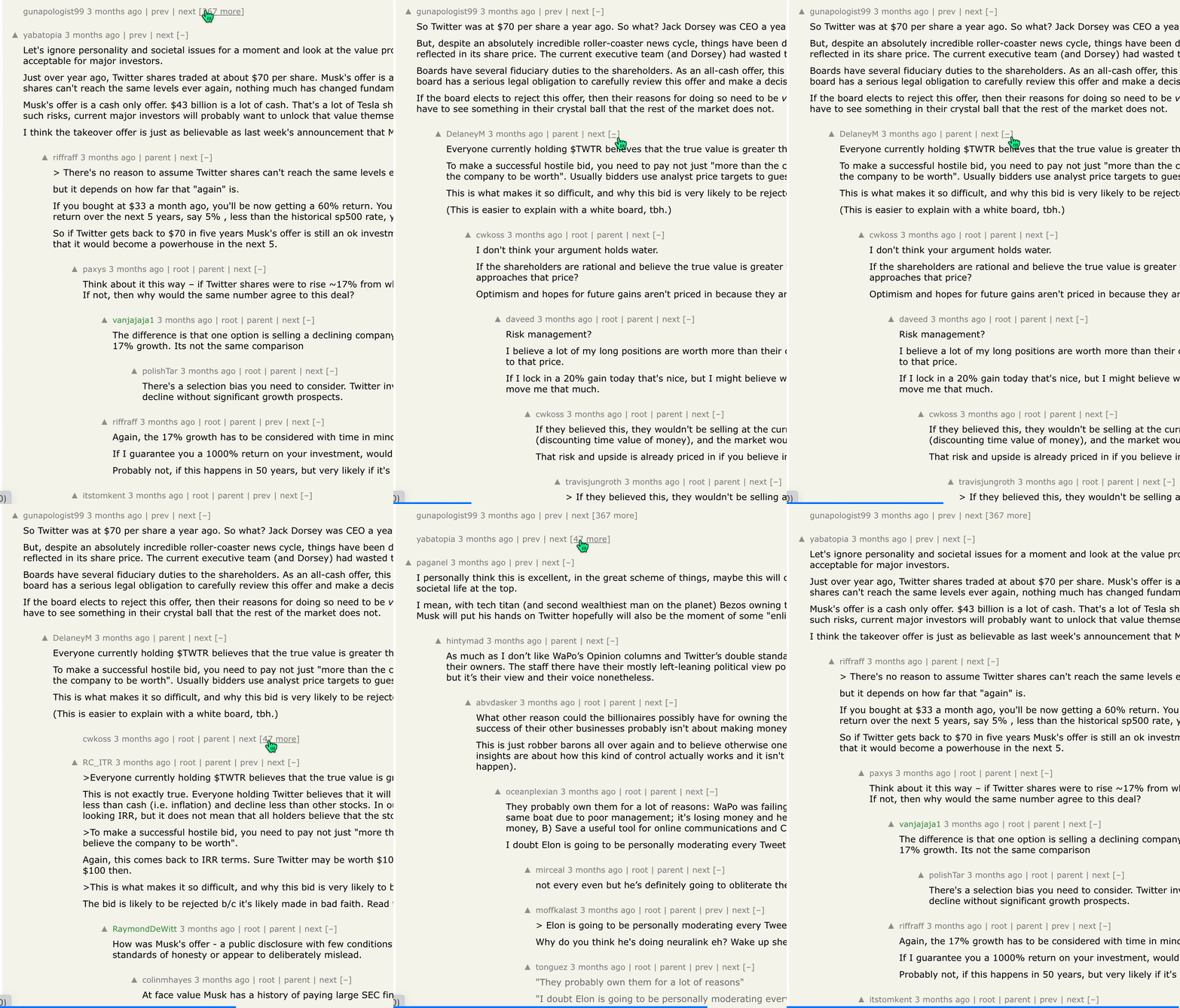
The result is a pseudo-dialog—not between a commenter and people who replied to his comment—but between different commenters who steal the focus of the discussion to their own opinion which is often tangential to the article itself. And since HN does not even show the number of upvotes/downvotes for each comment, there is no way to know if the wisdom of the crowds favors one opinion over another. The only thing that HN does provide is that highly-voted comments appear on top of low-vote comments.
Frankly, the crazy thing about HN comments is that they seem like a decent conversation to follow, but that often leads to addictive situations in which you read the comments instead of the article itself. It is like reading the article through the lens of people who supposedly read it. This is not necessarily the case, though, because many articles get upvoted merely based on their title. Sure, sometimes there is gold in comments, but in my experience, the signal/noise ratio is so low that it is not worth trying to dig that gold. Maybe this is what happens when your website gets too popular…

Comments from the author’s perspective
Comments are not intrinsically bad, but the fact that nowadays anyone can leave a comment at the snap of a finger makes them less special. We already saw how time-consuming it is to write a piece of article. How would you feel, then, if people on HN started writing mean comments down your post in less than 10 seconds? I highly recommend watching this video in its entirety. Here, Louis CK — one of the best standup comedians of all time — talks about people who leave mean comments on YouTube while taking a S#!T:
Just because you can hide behind online anonymity does not mean that you should find it appropriate to be rude, mean, and harassing. But that many people do it shows something about their true nature:
Give a man a mask and he will show you his true face.
You really have a choice
You can read an article written by someone who went through the difficulties I mentioned earlier and spent quite some time creating a content that he found important enough, or you can read the comments made by several other people who took like 10 seconds to write something (often mean and critical) about the title of the article.
You can read an article that is at least somewhat cohesive and informative, or you can read countless opinions that often do not add anything to your knowledge.
You can choose to read a piece of article that took 1 hour to write by one person, or read the comments made by 360 people who took 10 seconds to write their opinion about the article. In the end, you end up consuming the same 3600 man-seconds. The difference is that the article author went through the steps I mentioned earlier to give a better experience about his content, and the commenters did not.
At the end of the day, I believe the barrier to entry says a lot about the content. If something can be easily and quickly written by anyone (like a comment), it is often not worth reading as it could be a knee-jerk reaction to some news or some passing thought. But if something passes the hurdles and difficulties of publishing (like an online article), it often signals the fact that much thought went into it and that it was important for the author.
Can we generalize the barrier-to-entry idea?
Yes! In fact, this is how I ended up fixing my paradox of choice whenever I want to learn something new. For any topic you choose, there are millions of comments, thousands of online articles (mostly blogs), hundreds of websites, tens of online courses, and a handful of books (in any form). Which one do you think was harder to do? (Hint: the books). Which one do you think really went through some rigor and thought-plan to make their content as accessible to you as possible? (Hint: the books, then MOOCs). Which one can you read casually to get an intuition about a subject? (Hint: maybe blogs written by those who got that intuition). Choose wisely.


