Introverts Build the World. Extroverts Enjoy It.
Being an introvert in a world that requires talking to succeed…
What does “introvert” mean?
The word “introvert” comes from modern Latin “introvertere” 🤌, a combination of “intro-” (to the inside) and “vertere” (to turn). Thus, “introvert” means turn one’s thoughts inwards—in spiritual contemplation.
While turning one’s thoughts inwards is something that everybody can do, perhaps only a true introvert understands the constant urge to do so. Being an introvert is often not a choice, but something you’re born with.
But what is “introversion”, really?
We often tend to think in extremes or binaries: good vs bad, hot vs cold, high vs low, and introvert vs extrovert. Our vague language has words that well describe the two endpoints of spectrums, but it falls short to explain what’s in between. The problem is that most natural phenomena follow a normal (Gaussian) distribution, so most people actually fall in between the two endpoints.
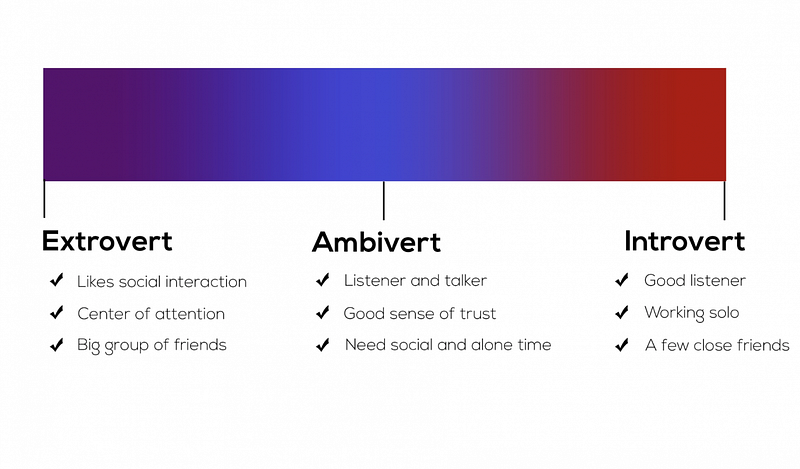
Labels are Misguiding
It’s therefore misleading, and even harmful to label things and think in black-or-white. As a kid, I was told by others that I’m an introvert, something that I later verified by personality tests. But as with most predictions and classifications, one has to be cautious about the self-fulfilling prophecy effect. In other words, being told that you’re an introvert might actually lead you to join subreddits, groups, etc. that further amplify your introversion. You might start to read about famous introverts in history books and develop a general expectation about what you should be doing. If you read articles that explain introverts as people who don’t have many friends, you might actually start to be ok with lack of friends in your life, instead of trying to change that situation.
Some personality tests give you a score/percentage of introversion vs extroversion, but still categorize you in either group. Being told that you’re an INTJ, after all, is much easier than saying that you have 60% introversion vs 40% extroversion. Labeling also makes it easy for you and other people to categorize you.
But what happens when people are confused about your category (introvert vs extrovert)? They start to leave you. As a child, I was a mixture of introvert and extrovert. Indeed, I enjoyed hanging out with friends (I still do), but soon I discovered that my friends had an expectation that I’d be down for hanging whenever. If I had a rush of introversion and needed to be alone, my friends would get disappointed. Obviously, those friendships didn’t last long because of this.
Introverts Do; Extroverts Talk
Don’t get me wrong. As an introvert, I love talking about my ideas, ideals, philosophy, ambitions, etc., but that only happens in the presence of my close friends. Going up to a stranger and starting a convo seems like a drag to me. But maybe the fact that most introverts are reserved is not because we’re not much with words, but because we already talk a lot, to ourselves. Most thinking is done via language after all, and we do the thinking in our own solitude.
Many a time, our thought process leads to outputs in the form of writing, painting, music, dance, etc., and some of that then goes on to influence the lives of many. There’s a reason that most programmers are introverts. The article you’re reading, the Medium platform, and device you’re staring at right now are made by mostly introverts. We may not be loud speakers, but we’ve already talked our thoughts to the best listener in the world: ourselves.
You might think that extroverts do a lot as well: politicians set policies that affect lives and MBAs find new ways to make firms profitable. But at the end of the day, chances are those policies and business plans are implemented by introverts, sitting in dark rooms at the end of the hallway, being ignored while their extrovert supervisors get all the credit.
Why didn’t introverts go extinct?
It’s a serious question. In all human history, mating has had a simple formula: The male shows what he can do to his desired female, and the female chooses among the many options she has. For thousands of years, “showing what you got” meant hunting, killing a bear with bare hands (pun intended), being good at fishing, being muscular and masculine, being a good runner (to escape from the bear you just couldn’t kill), and being a good leader.
None of the above characteristics requires deep thinking and turning your thoughts inwards. Most are instinctive and require fast reactions. How on earth, then, did introverts survive and pass on their genes?
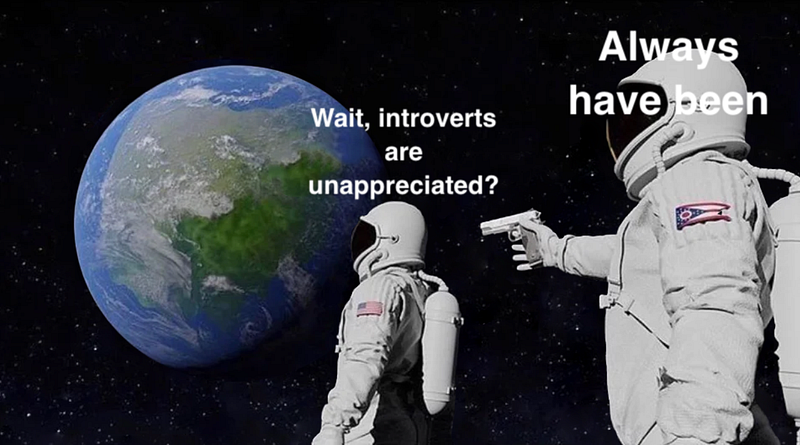
Always has been, Always will be.
You might think the current world should be much better for introverts—we don’t need to hunt anymore, after all. The truth is, the current world has indeed gotten better for everyone, introvert or extrovert. But the social gap between introverts and extroverts still exists. We still elect shady [extrovert] politicians who fool us well with their words, and we shy away from [introvert] CEOs who don’t electrify us with their presentations.
If anything, I’d argue that the world has become more cruel to introverts thanks to social media and the constant pressure to talk and network. Many introverts enjoy having a sense of full control on their job, only to realize that the world praises people not based on merits and outputs, but based on who knows you.
For success in any field—even academia, which is mostly introverts—networking and talking is necessary. I personally had to learn this lesson the hard way. For introverts, this is bad news because we tend to focus on the quality of our work, thinking that a good output speaks for itself. Wrong. The world demands everyone to express (and even exaggerate) their success, and it doesn’t matter if you’re an introvert or extrovert.
What should extroverts do?
Finally, this article might sound a bit hostile against extroverts, but that’s exactly the point. Introverts can’t expect a better world if the rules are written by those who don’t appreciate them. For many introverts, just the sheer joy of doing something awesome is motivating enough. But let’s face it: No one likes being sidetracked and neglected for their work. It’s high time extroverts give credit to where it’s due.
I leave you with a relevant movie recommendation! There’s a scene in For All Mankind (great TV show) where NASA operators argue about the fact that the death of one politician makes the news, but 11 dead engineers and mission control operators are easily ignored.
What do you think introverts can do to restore the balance?