
How We Should Think About Productivity And What Really Works?
Productivity is a topic where no one can agree with anybody else.

I used to work with a senior manager who reaches the office at 4 am. When he leaves at 4 pm, my day was half done. Clearly, what works for him doesn’t work for me. So, what really works for us?
As a way to build my case, we can type “Productivity” in any search engine.
A simple word search in Google will return a remarkable list of 476,000,000 results within 0.50 seconds.
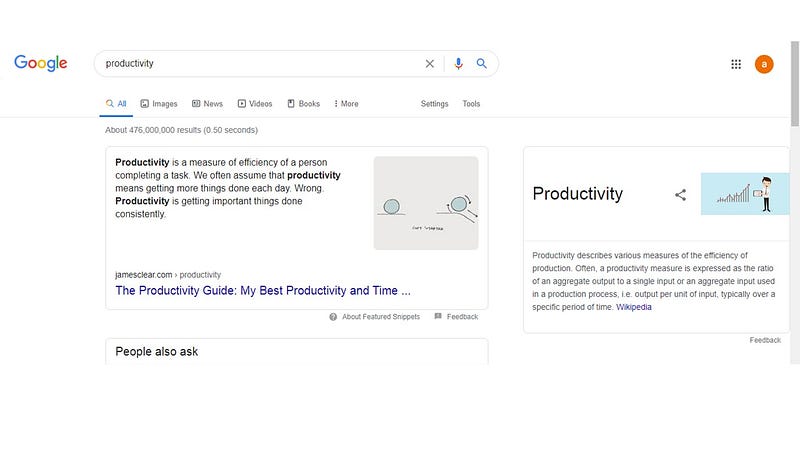
I am not sure about you, but in my opinion, there are simply more viewpoints than alignment. I believe the reason for this is productivity as a concept is deeply personal. Written in another way, it is more of an Art rather than Science.
Mark Hanson says it well “I believe productivity is a deeply personal thing. We all have different brains and, therefore, different preferences, perspectives, and situations where we feel most effective.”
This is one amazingly human viewpoint and one that I believe in. Simply because there is no debate required.
None.
We are different from each other, as we are shaped by a combination of our values, cultures, life-experiences accumulated and etc. Henceforth, there is no one single definition for productivity or maximum productivity for that matter.
In this article, I will share my viewpoints on 3 offshoot topics of Productivity and how they are not necessarily a better approach over the others.
The determination of what works (or not) for you boils down to one thing.
What you want to achieve.
And that is actually circumstantial/situational.
Multi-Tasking: Doing many things at any point in time.
Most people bash it. However, there is a time and place for multitasking. I don’t mean seeing, breathing, eating, walking, and texting at the same time.
Take for instance, when your hands and mind are not required to focus in unison. If endurance sport comes to your mind, you are spot-on.
There is no need to sacrifice a gym session just because of a late evening conference call with the U.S. If you are on an independent exercise regime, you can be on the spinning machine during the call. When it is your turn to speak, spin slower. When it is your turn to listen, spin faster.
And remember, mute your phone when it is not your turn to speak so the other parties won’t hear you panting.
The same goes for swimming and running. Or even a foot massage session. If you are in a mental block — say structuring a commercial proposal, crafting a keynote presentation draft and etc — you will be stuck in that instant no matter where you may be. Seated or moving.
Get moving. You can continue to engage your thoughts when you are swimming or jogging. The best part? You get fit and still progress with the task at hand.
Focus: Doing 1 thing at 1 time.
Focus is touted as the Holy Grail of maximum productivity. I am neutral on this viewpoint and also guilty due to a brilliant lack of it. As mentioned in # 1, there is a time and place for this approach.
When you are in a competition — our focus is everything. It is necessary for competitions of all categories. I cannot imagine any World Champion(s) not focusing during a competition.
There are simply too many moving parts and there is only one desired outcome (which is to win). The consequences could be dire and most important, unwarranted.
Even at a recreational level, I would say our focus is important when we engaged in sports requiring the use of a weapon. Somehow, the shuttlecock in a badminton game has evolved to develop an innate sixth sense to locate and destroy distracted players. Do not blame the shuttlecock should the mishap happens.
Another well-observed example is when the deadline(s) is close. Especially when it is so close that you can literally lick it. Exams, proposal submissions, the next big management meeting. What these have in common is the ability to narrow your band of vision only onto the task at hand.
I don’t know about you, but I cannot imagine the prospect of missing a proposal submission deadline.
No additional coffee is required during those days.
The Big Think — Surviving The Quality / Quantity Spectrum: What are we counting today?
Let’s face it. The biggest constraint we have on hand is time. At work, most of us want to be on time. Reaching office on time, clear all tasks in the email inbox and desk, and leave for home on time.
Deep down, most of us realize that the person with the highest rate of production may not be the MVP in the team. Is there really a value proposition to submitting 10 User Stories, having them developed with a ton of defects?
Yet if you measure productivity by the amount of work completed as a function of time — that person is likely to be rewarded with a higher incentive. And he goes home on time.
Feeling upset? I know that feeling.
If you are an independent thinker and you hate to be penalized when measured against those with seemingly high quantity-based production rates — do the study on existing documentation.
From there, you will be able to source templates for your work. Using templates have multiple advantages where: -
- You know what others are used to and not cause a big headache for your boss when he/she has to go through your brilliant papers with unique formats and structure.
- Reduce time spent on items (formatting, structure) that really don’t matter.
Ride the wave. Not fight it.
Make your contribution and time count.
These days, there are templates to Word Documents, Powerpoint, ideas, solutions, and even pantry advisory.
Don’t fret. Just use them.
A Simple Takeaway.
I do not endorse any particular approaches to Productivity because there are too many good things that we (as individuals) want to achieve in life. The important thing is that we achieve them before time expires on us.
The biggest measure is our life, and what we want from it. Measure your productivity against it. Work is a part of, not all of it. Different approaches are simply tools that we use for achieving what we want. Use these approaches concurrently, zipping in and out of different approaches given the hand you are dealt with.
Related Stories from the Author.
About the Author:
As a Consultant by training, I believe in making the complex simple.
Because simplicity adds value.
Simplicity helps us gain clarity, and clarity helps us to grow.
And if we are not growing, then what’s the point of anything else?
What do you think about the article? Comment Below!
This is more about me as a Content Contributor on Medium.
Do reach out and say hi on Linkedin!


