
How to Trade a Volatile or Down Stock Market
Caution: Rough times may be ahead

Following Wednesday’s CPI data, markets were down for a third straight day. No one is hitting the panic button yet, and there's likely isn't any reason to.
A 30% crash like the one we saw in March 2020 is extremely unlikely. But because of the great returns from the past year, the market is likely to be choppy for the foreseeable future.
Increased volatility, or even a market that is down for a prolonged duration, can be a way to make money if you know how to. If there’s a way to make money, wall street has a mechanism for it.
With the threat of increased inflation and a less smooth market, here are some ETFs to consider.
Inflation
First, some info on my new favorite subject, inflation.
Inflation has been in the news a lot lately, it seems almost every day you hear about it.
But for good reason. CPI data was released Wednesday (5/12) and it wasn't good. The Consumer Price Index was up 4.2% from a year ago, beating economists expectations of 3.6%, and was up 0.8% from last month, also beating expectations of 0.2%.
Core CPI, which excludes energy and food prices was up 3% year-over-year and 0.9% on a monthly basis.
This news, which confirmed investors' fears, sent stocks down Wednesday, adding to the negative days earlier in the week.
On Thursday (5/13), data for the Producer Price Index (PPI) was released. It was up 0.6% since March and 6.2% Year-over-Year, well above economists expectations of 0.3% and 3.8% increases.
Short ETFs
Short selling, per Investopedia's definition:
is an investment or trading strategy that speculates on the decline in a stock or other security’s price.
They also go on to explain its “an advanced strategy” only to be undertaken by experienced traders and investors. But it's 2021, all caution is thrown to the wind — you can’t become experienced without trying.
Essentially, shorting is hoping a stock, or index, goes down. If you shorted almost any tech stock on Wednesday, you would have made off pretty good.
Luckily there are a number of ETFs that short the market.
$SH, $SDS, and $SPXU are all ETFs from ProShares and short the S&P 500. The difference between the three is that $SDS provides 2x exposure and $SPXU provides 3x exposure. They are more levered. More risk, more reward. On Wednesday,
- $SH was up 2.25%
- $SDS was up 4.29%
- $SPXU was up 6.38%
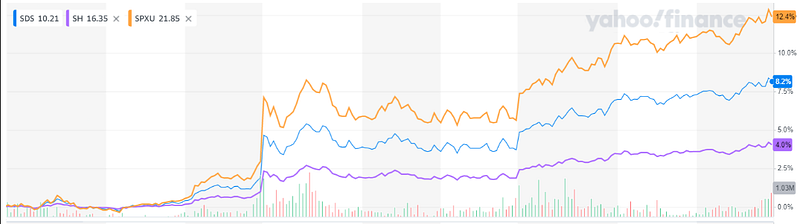
It is also worth noting that for the past six months $SPXU is down the most, followed by $SDS, and then $SH. Since the market was going up, the more levered ETFs were getting hit the hardest.
There are other ETFs that short the market, or certain niches of the market. For example, $DOG shorts the Dow Jones average instead of the S&P 500.
If you think the market is going to go down, it's worth considering buying a stake in an ETF that shorts the market. But you also have to consider rooting for the market to go down will cause you to lose money on the rest of your portfolio. Be careful what you wish for.
Volatility ETFs
If shorting isn’t your cup of tea, you can make money off increased volatility.
Volatility is a combination of the speed and magnitude at which prices change. When markets fall, they usually do so faster than they rise. So in down markets, volatility usually rises.
The Volatility Index is known as VIX. It can’t be directly traded itself (at least I don't think so), but there are many ETFs replicating it. Again these are levered and complicated investments so not normally recommended for inexperienced investors.
With that out of the way, here are some ETFs.
$VXX — iPath’s S&P 500 VIX short-term futures.
$VIXY — ProShares VIX short-term futures.
$VIXM — ProShares VIX medium-term futures.
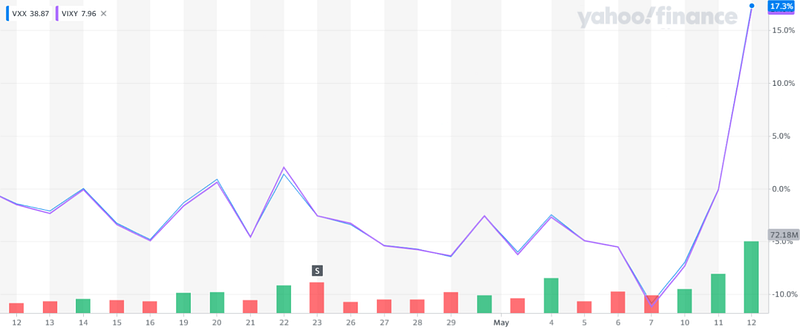
Believe it or not, there are two ETFs in this chart. Based on this chart, choosing between $VXX and $VIXY is just a matter of preference between ProShares and iPath.
VIX trades pretty volatile, which is ironic because it measures volatility.
There’s money to be made using trading positions for short or volatility-focused ETFs. But these trading opportunities can get real ugly, real fast — I unfortunately know from personal experience.
Final Thoughts
Bumpy roads may be ahead. A look at the S&P 500’s five-year chart gives a better view of how much the market has risen. There is a healthy downside risk to consider when investing.
One of the best quotes when it comes to investing, “staircase up and elevator down.” Meaning it takes years for sizeable gains, which can also be erased in a few bad weeks.
Since we experienced that last year, I believe it is unlikely to happen now. Any noticeable pullbacks can lead to good buying situations, for trades or long-term investment.
Safe sailing out there.


