
How to Overcome Your Brain’s Negativity Bias
Why the negative sticks and how to retain the positive instead

You need a lot of positive to balance out the negative. It’s a fact.
Imagine you went on a beautiful Mediterranean cruise for two weeks. You bathed in the Greek sunset, ate the heavenly tasty Italian food, danced on the Spanish beaches, drank yourself to sleep with Portuguese wine.
In a misfortune, sometime during this trip, your phone gets stolen, or you get sick for a couple of days.
What do you think you’ll remember most from this trip once you’re back home? The sunset, food, music, and wine? Or the unfortunate accident?
Most people will remember getting sick or having their belongings stolen because negative experiences affect them much more than positive ones. This is known as “negativity bias”.
Even when we are presented with occurrences of equal intensity, things of a negative nature will stick with us longer and will affect our psychology, behavior, and cognition to a greater extent.
5 facts about your brain’s ‘Negativity Bias’
Which one came first: The chicken or the egg?
I have another one: Which one came first: Gloomy news coverage or our pessimistic tendency?
Are we more negative because of what is reported to us? Or is our negativity as consumeristic behavior attracting bad news?
This bias is probably part of a survival extinct to dodge harm and danger. The brain evolved in a way that would recognize the threat to avoid it better.
Here is what scientists have uncovered about this phenomenon.
1. The brain reacts stronger to negative stimuli
Your brain is built — or develops and adapts — to be more sensitive to negative stimuli. The bias is so automatic that it has become an unconscious mechanism.
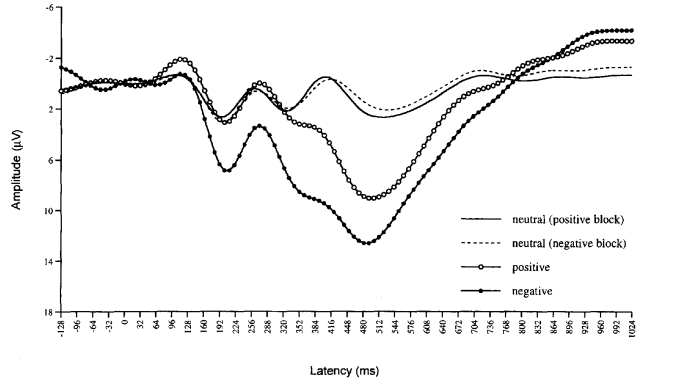
Early research dating back to 1998 recorded event-related brain potentials (ERPs) from participants viewing positive, negative, and neutral pictures. ERPs are measures of electrical brain responses resulting from a specific event¹.
The results revealed that the brain’s activity is more reactive and engaged when adverse events are presented.
2. The ratio is 5:1
According to relationship researcher John Gottman, who ran his experiments in the 1970s, the magic ratio is 5 to 1: “5 positive events to balance out 1 negative event”.

This means that for every negative interaction between partners, there must be five positive interactions. His predictions turned out to be right 90% of the time. Other researchers have found that this isn’t just true for couples, but can be applied to relationship equilibrium in general².
3. Negativity has the upper hand in impression-formation
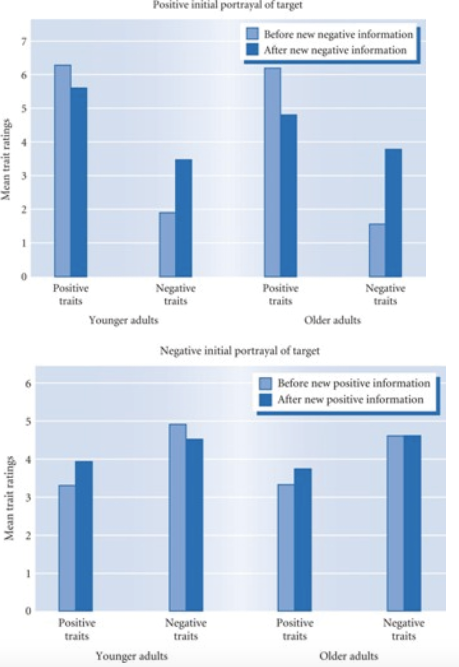
This bias is also evident in adults’ judgment and decision-making.
We consistently weight the negative aspects of a situation more heavily than the positive ones. This is especially true during impression-formation or social judgment of a person.
In this case, negative information weighs more heavily when people are asked to form an evaluation of another individual: the traits are neither “averaged” nor “summed”, and the disadvantageous traits disproportionately impact the final impression.
Older adults weigh negative traits more than young adults do in social judgment. They’re also more willing to change a positive impression to a negative one rather than the other way around³.
The evidence also suggests that even forming impressions of ourselves is surprisingly biased and shaped by trait differences in self-esteem and social anxiety.
4. Negativity is emotionally more intense
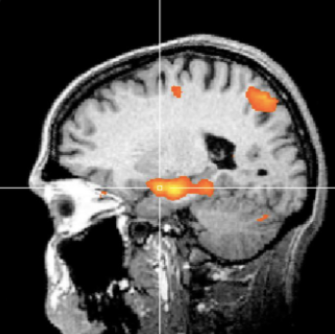
The Amygdala is a brain area involved in the experience of emotions. It’s the “alarm bell of the brain.”
Although the Amygdala is sensitive to both positive and negative stimuli, the relative changes in activity by the same intensity is more considerable in response to adverse stimuli⁴. The Amygdala will use 2/3 of its neurons in reaction to bad news. This seems to be a neurological encoding of the negativity bias. Other cognitive aspects that seem to be asymmetric include attention and memory. Indeed, harmful events and emotions are transferred to long-term memory much faster than any positive emotion.
5. It starts earlier than we think
All of this is great, but one question remains: Is our negativity bias innate? Or does it develop with age?
Do infants and children display a negativity bias in the emotional realm?
Babies learn by using emotional information they receive from their environment and their caregivers. Many of our everyday emotional responses are contagious, learned, and adapted.
The research around this question is a little scattered all over the place. The consensus is that negativity bias starts developing the second half of a baby’s first year, so around months 6 or 7 of our lives⁵.
Prior to that, scientists are positive that infants tend to show greater attention to positive facial expressions and tone of voice.
5 ways to overcome it
We need to be aware of our brain’s negativity bias and try to overcome it. Why?
Because unlike our ancestors, we do not need to be on life-saving high alert mode for most of our life. Focusing — even unconsciously — on the negative can have a wide variety of effects on how we think, respond, and feel, thus intervening in our relationships, decision-making, and the way we perceive ourselves and the people around us.
- Stop the negative self-talk
Notice the internal and negative self-dialogues. Start paying attention to your thoughts. This can be achieved through mindfulness and meditation.
Whenever you think “what an idiot I am”, or “I shouldn’t have done that”, or “this is terrible”, raise your negativity alarm. With time, you will be able to stop them as soon as they begin and replace or challenge them. This will allow you to cultivate a gentle and patient attitude with yourself. Learn to celebrate even the smallest of victories while knowing you will have your bad days.
2. Reconsider the situation
Perspective is key. Now that you know that your brain is over-reacting, it might be easier to stop and reframe the situation. You are focusing on the negative, and trying to interpret it based on flawed perception.
Make a conscious effort to re-examine the situation in a more positive light. It doesn’t mean you should ignore dangers; it’s more an attempt to refocusing your brain and giving fair and equal weights to all the events.
Try Albert Ellis’ (1957) ABC technique: Once you are aware of your Behavior and its Consequences (B and C ), then you can work backward to think about what led to them (A for Antecedents). What were you thinking before experiencing this surge of feelings? Was your negativity bias in action?
3. Scatter simple pleasures
Because it takes more positivity to reach an equilibrium, it doesn’t hurt to add a few pleasurable experiences throughout your day. These can be as simple and effortless as possible; a cup of coffee on the balcony in the morning, 30 min of reading something you enjoy, a nice bubble bath, fresh flowers for your desk, listening to the birds outside your window.
Small doses of positivity throughout the day will give your brain the needed boost to counteract the natural negativity. And when something sweet or even great happens, stop and take a moment to focus on it, savor it, and replay it in your memory.
4. Link both emotions
It’s important to remember that positivity and negativity aren’t mutually exclusive. You can do this by holding both emotions in your awareness while making sure the positive ones are more prominent.
For example, feel joy as you undertake a pleasant activity while keeping some apprehension in the back of your mind over something that keeps you anxious.
Similarly, practice finding the silver lining in any adverse event. Over time, this approach will guide you through optimism and resilience.
5. Practice realistic optimism
Read, document yourself, understand situations, their effects, their long-term impacts. The more knowledge you hold over a certain feeling, the less it will scare you and make you anxious.

There’s a spectrum to our thinking pattern, and every outcome you can think of lies on a range between two non-existent ideals: absolute failure (unrealistic pessimism) and absolute success (unrealistic success).
In reality, most of our life will lie somewhere in the middle of this spectrum, and it’s best to have a healthy equilibrium of both.
Realistic pessimism is crucial for risk-assessment in specific careers but tends to be an obstacle when it comes to personal growth.
In such cases, realistic optimism is a better approach. It promotes our beliefs in our capacity for growth by tapping into incredible potential. Realistic optimism helps us visualize what is possible (rather than impossible) to work hard towards making it a reality.
Both mindsets are self-fulfilling prophecies, so choose wisely.
We Can Complain Because Rose Bushes Have Thorns, or Rejoice Because Thorn Bushes Have Roses — Alphonse Karr
Our brain holds tricks of its own. We’re unaware of what’s happening up there, but it controls every single aspect of our life.
Now that we’re conscious of our negativity bias, it’s time to shift the mindset.
~Adriana~
Thank you for taking the time to read.
Sign up to BrainChronicles & stay updated with trending neuroscience and psychology news and research.
For more interesting facts and information about the human brain.
Why You and Your Brain Are Growing Years Apart
9 astonishing facts about your brain’s age
medium.com
Sources: ¹https://www.wisebrain.org/media/Papers/NegativeBiasInEaluativeCategories.pdf ²https://www.psychologytoday.com/gb/articles/200306/our-brains-negative-bias ³https://psycnet.apa.org/doiLanding?doi=10.1037%2F0022-3514.38.6.889 ⁴https://www.ncbi.nlm.nih.gov/pmc/articles/PMC3652533/#R124 ⁵https://www.ncbi.nlm.nih.gov/pmc/articles/PMC3652533/


