
Why You and Your Brain Are Growing Years Apart
9 astonishing facts about your brain’s age

I find myself inside an MRI scanner at least 3 times a year. It comes with the job: I have to support other researchers. So when someone asks me if they can scan my brain, they’re actually saying, “Okay, your turn.”
To make it more enjoyable, we usually play around with our own scans. I got a 3D print of my brain once.
But I also always ask for a copy of my scan and compare it to previous ones. I’m 25 years old, and soon enough, I’ll see my brain getting older.
Brain aging is inevitable; that’s a given. However, how it ages, why the aging process varies tremendously across people, and what can accelerate it or slow it down is still a mystery.
Achieving eternal youth is the ultimate dream, and slowing down or stopping the brain’s aging process would be the optimal elixir.
The brain is a beautifully mysterious organ, and we still know surprisingly little about it. This 3 pounds mass contains 100 billion neurons interconnected and communicating via complex mechanisms.
From the 3rd week of pregnancy and throughout one’s life, the brain is the organ that develops and changes most.
1 million new neural connections every second develops during the first years of life and reaches 90% of its volume by age 6. The brain then continues to mature until our mid-30s, with the frontal lobe — responsible for executive functions — developing last.
And then, begins the decline.
The truth about volume loss
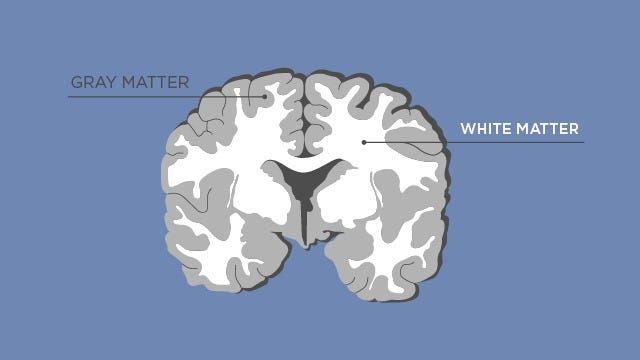
Let’s think of the brain, in simple terms, as a combination of grey matter (the neuronal cell bodies) and white matter (the fibers connecting the cells).
Grey matter can be superficial (cortical grey matter), or deep (subcortical grey matter).
The white matter, on the other hand, is responsible for signal transmission between the different areas of the brain.
Shrinkage starts around the ages of 30–40 and accelerates after our 60s.
Volume loss, however, isn’t uniform. And some areas shrink faster than others.
- In healthy brains, total grey matter volumes are in decline from a very early age. This process is initially called pruning¹: in a child’s brain, and for efficiency purposes, neurons and synaptic connections are eliminated. In later stages, the loss of neuronal mass is associated with aging.
- In healthy brains, total white matter volumes increase² until the ages of 30–40, then start declining rapidly.

Signal transmission efficiency drop
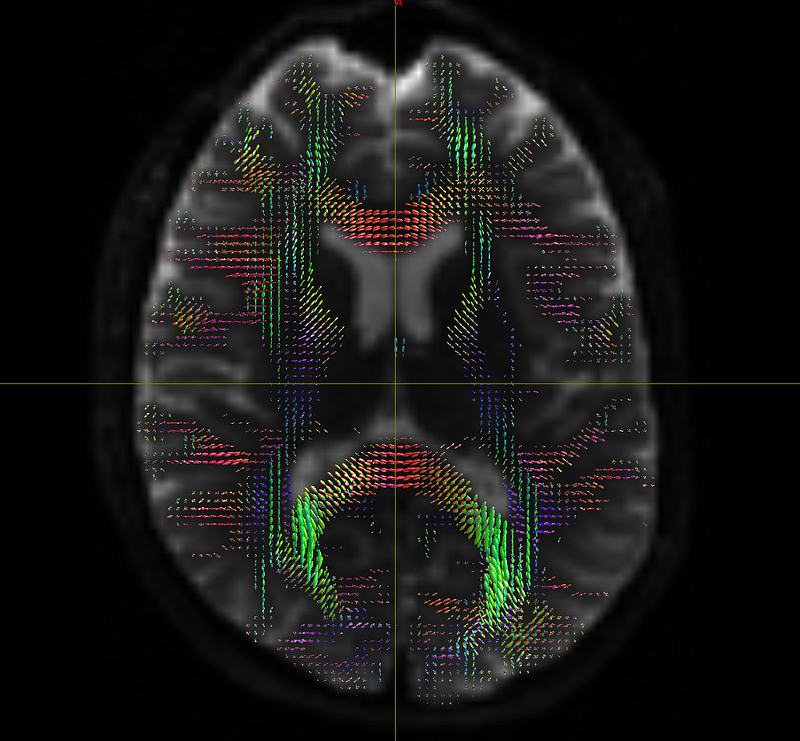
Diffusion Magnetic Resonance Imaging (MRI) is a non-invasive in-vivo tool that enables researchers to measure the water diffusion process in the brain and primarily white matter connections.
Remember: white matter is responsible for signal relay between different areas of the brain.
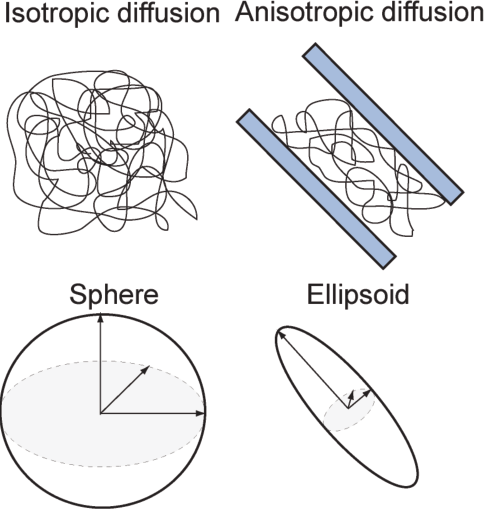
A high targeted (anisotropic)³ diffusion process means more efficient signal transmission.
When the white matter tissue is intact (well organized), the diffusion process becomes more structured.
A simple representation of the difference between isotropic and anisotropic is shown on the left.
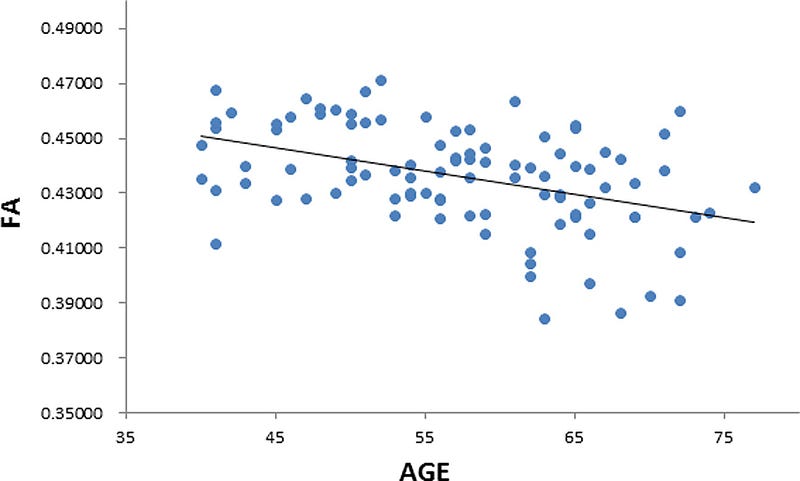
This being said, it makes sense that as the brain matures, so does the white matter structure, thus resulting in a higher fractional anisotropy (FA)⁴.
As the brain starts aging, white matter microstructure across brain tracts starts breaking down, which is related to a decrease in FA measures⁵.
Cognitive abilities in decline
The memory slips you have, the difficulty of learning a new language, your slower information processing: you do not imagine it, it’s happening.
Cognitive decline can start as early as 45⁶. Cognitive decline is characterized by lower performance on memory, reasoning, phonemic and semantic fluency, but not on vocabulary. The decline becomes faster and more pronounced with age.
The research found that the secret is not brain puzzle games. These have shown no association with cognitive decline, unlike what the multi-billion-dollar industry wants us to believe⁷.
What does save the brain, however, seems to be the learning of new skills or the performance of unfamiliar actions, both of which “oil” the brain and create new synaptic connections, thus counteracting the effects of healthy aging.
On a more positive note, not everything is in decline from the age of 30. Particular cognitive abilities seem to improve in middle age: a study showed that people performed better on tests of verbal skills, spatial reasoning, math, and abstract reasoning in middle age than they did when they were young adults.
Fewer great chemicals
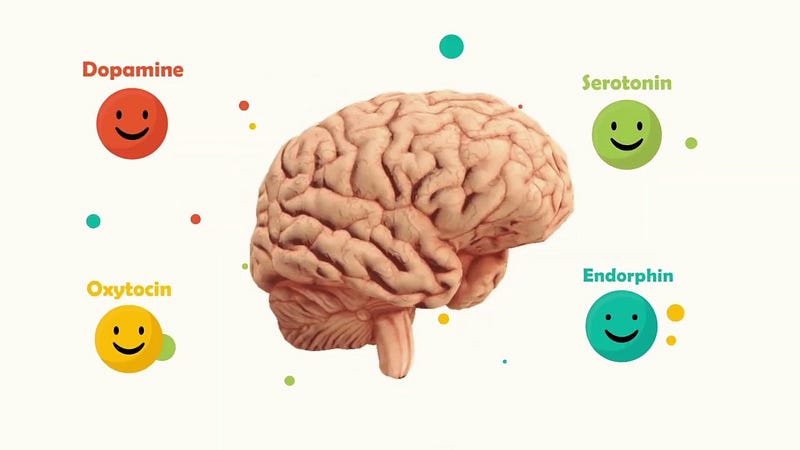
Neurotransmitters are chemicals responsible for signal transmission across the brain.
Dopamine and Serotonin are the neurotransmitters most often discussed in conjunction with brain aging.
Dopamine is involved in the feeling of pleasure. It also plays a role in different processes, such as movement, learning, mood, and motivation.
Serotonin is another neurotransmitter with a vast arsenal of effects on the body, mainly social behavior, eating behaviors, sleep, memory, and sexual desire.
With age, the brain generates fewer chemicals. The synthesis, as well as the target receptors, decreases.
A study showed a decline in serotonin levels in the brain of 60- and 70-year-olds with mild cognitive impairment.
Machine learning predicts brain age
Researchers have developed a new machine learning technique to predict an individual brain’s age based on their MRI scans.
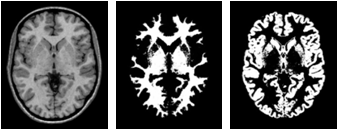
Of course, the model picks up only on structural changes in both gray and white matter volumes⁸.
To create this model that can pick up on the marker of brain aging, the researchers trained an algorithm on 2,001 brain scans of people aged between 18 and 90 years old.
Their test group consisted of the Lothian Birth Cohort, a group of 669 adults, all born in 1936.
If I now run my brain scan through this algorithm, it can give back a predicted age, independently of my real age.
Older brain? Younger brain? It’s not just a neat trick; this approach has many applications and advantages in the medical field.
One of them is the point below.
And brain age predicts mortality
In a study published in a prestigious journal, Molecular Psychiatry, the team behind the machine learning algorithm reported that their technique could potentially predict mortality in humans:
People with brains “older” than their chronological age have greater risk of dying before age 80. These people also showed lower performance on fitness measures, such as walking speed, lung function, and fluid intelligence.
According to the study, each extra year of brain age adds a 6% chance of dying before the age of 80.
Not all brains age at the same rate
All brains will eventually age, shrink, lose essential connections and neurotransmitters, but not every brain will age the same way or at the same rate.
An example is the differential brain aging process in men and women.
The brains of women looked on average 4 years younger than their male counterparts with the same year of birth⁹, although it is still unclear why or how this happens.
Another example would be what we call the super-agers, who seem to be escaping natural cognitive decline.
Research around super-aging now suggests the process — or lack of it — might be due to higher functional connectivity in specific brain networks. The anti-aging capacity seems to be related to activities that promote brain health in older adults.
Certain conditions can accelerate aging
Although I’m a neuroscientist, I am still a skeptic and consider every study with a grain of salt, until it's proven right by subsequent studies.
So proceed with caution.
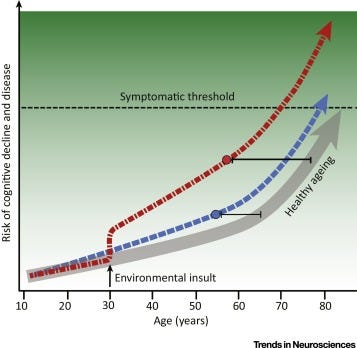
Some genetic and innate factors are linked to accelerated brain aging.
Similarly, acquired injuries or neurological changes can also speed the brain aging process.
Patients with Down Syndrome, known as Trisomie 21, have, on average, a brain+2.49 years older than their chronological age¹⁰.
Patients with Prader-Willi Syndrome, a genetic obesity syndrome, have, on average, a brain+7.24 years older than their chronological age¹¹.
Traumatic Brain Injury brains, which is an example of environmental insult or acquired injury, were estimated to be “older,” by, on average 4 to 6 years¹².
Equivalent studies were conducted in people with diagnosed HIV, multiple sclerosis, depression, and others.
Towards a predictive and preventive model

The research is expanding. Different models measuring brain age now include more clinical and physiological data points, including blood biomarkers, biological measurements, and cognitive performance, amongst others.
Cracking down the mechanism of brain aging, while working backward from pathological to healthy neurodegeneration is a way to predict and prevent abnormal cognitive decline.
All I can say is, treat your brain with the utmost respect.
Before wishing for youthful and perfect-looking skin, understand this is just secondary to what’s going on inside your head.
Challenge your brain, keep learning new skills, be adventurous, eat well, sleep well, don’t abuse substances, and understand the basics of neuroscience.
“The chief function of the body is to carry the brain around.” — Thomas A. Edison
A.
Sources: ¹ https://link.springer.com/referenceworkentry/10.1007%2F978-0-387-79061-9_2856 ² https://www.ncbi.nlm.nih.gov/pmc/articles/PMC3256931/ ³ https://en.wikipedia.org/wiki/Fractional_anisotropy ⁴ https://www.ncbi.nlm.nih.gov/pubmed/25791575 ⁵ https://www.ncbi.nlm.nih.gov/pmc/articles/PMC2826569/ ⁶ https://www.bmj.com/press-releases/2012/01/05/cognitive-decline-can-begin-early-age-45-warn-experts ⁷ https://www.cbc.ca/marketplace/episodes/2014-2015/brain-training-mind-games ⁸ https://www.ncbi.nlm.nih.gov/pubmed/29074032 ⁹ https://learningenglish.voanews.com/a/study-finds-some-brains-age-quicker-than-others/4809486.html ¹⁰ https://www.ncbi.nlm.nih.gov/pmc/articles/PMC5476346/ ¹¹ https://www.ncbi.nlm.nih.gov/pmc/articles/PMC5476346/ ¹² https://www.ncbi.nlm.nih.gov/pmc/articles/PMC4403966/


