
How To Make Money From A Day On The Beach
Coastline treasures that could earn you a small fortune
Wouldn’t it be great if we could turn that lazy day on the beach into a big cash earner?
The great news is that you can. Beachcombing is an activity where people search the shore line for treasures and items of interest.
Here are some of the more valuable items that you might stumble across during a day on the beach.
Ambergris (Whale Vomit)
Ambergris is a waxy substance which is produced in the digestive system of sperm whales. Once expelled by the whale, it is washed up on the coastline and is sometimes found by tourists and fishermen.
Ambergris is used by perfume makers to make the scent of perfume last longer, although its use today has mostly been replaced by synthetic substances. The substance has often been found accidentally and the largest finds can be valued at up to three million dollars. For this reason, some people refer to it as ‘floating gold’.
Dogs are often attracted to the scent of ambergris and some people even use dogs to help them locate the deposits. You should always be careful when allowing dogs to explore the coastline, however. There are some substances of similar appearance that can extremely harmful to an animal’s health such as palm oil deposits.
Collecting ambergris is totally legal in many parts of the world, but before doing so you should carefully check local laws. In some areas, possession and collection is banned.
Sinistral Shell
There are many types of shell that can be collected from the beach but one easily identifiable type is a sinistral shell.
Most shells are coiled clockwise, but sinistral shells are coiled anti-clockwise instead, causing some people to describe them as ‘left-handed’. When viewing one of these shells with the point of the shell upwards, the opening will be on the left hand side.
Sinistral shells are very rare ocurring in approximately and are considered sacred by certain religions. In some species, sinistral shells are only found in approximately 1 in 600,000 specimens, making them exceptionally valuable.
Semi-Precious Stones
Depending on your location, you might be able to find semi precious stones along the coastline, especially on those pebbly beaches. Finds can include different types of agate, jet, cornelian, onyx, serpentine and quartz. Classification of semi-precious stones can be complicated with some types overlapping.
The type of semi-precious stones that can be found will depend on your location and will vary widely. The best approach to take is to research which stones can be found on your particular beach and how to identify these.
Amber
Amber is a type of fossilised tree resin and ranges in colour from pale yellow to dark brown. Amber is not really a semi precious stone but is often considered to be one as it can be polished and used in the same way as gemstones.
In some specimens you can find the preserved remains of insects. This is of particular interest to scientists as it helps them to study extinct species.
The most prized form of amber is that which has a blue or green tint such a Dominican blue amber.
Fossils
Fossils are the remains or traces of any once living thing that have been preserved by natural processes. They can include animal skeletons, imprints of tracks, outlines of plants, petrified wood and shells.
Fossils can sometimes be tricky to find as they can be hidden within other plain looking rocks. Again, the types of fossils that can be found will vary depending where you are in the world, so it is best to do some local research.
From a safety point of view, you should never chip away at cliffs or large rock masses as they have been known to collapse causing injury or death to those underneath them.
Sea Glass
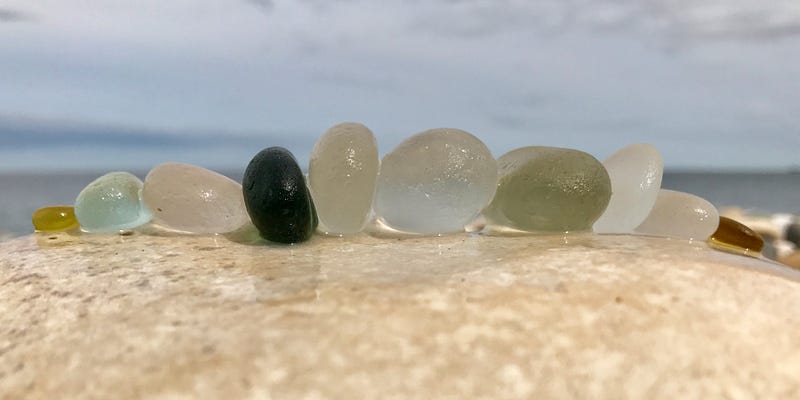
Sea glass is a form of beach rubbish that is formed from discarded glass waste. The waste is then tumbled by the waves, smoothing the sharp edges to form a smooth, gem like pebble.
Collected sea glass can be sold for decorative purposes or as materials for jewellery making for a reasonable profit. Some people who live in a suitable location have even turned their hobby into a small business venture.
The picture above shows just a few sea glass pebbles collected by my family on a trip to Seaham in England. These stones originate from an old glass factory that closed down around one hundred years ago. The stones are now displayed in decorative bottles in our home. However, we have made others into jewellery and sold these or gifted them to friends and family.
Other man made finds
Quite often, other treasures can be found washed up on a beach. Finds can include coins, jewellery, antique marbles, toys — just about anything in fact.
You can hunt for these items using the naked eye but sometimes they can be located more easily with the use of a metal detector. However, the use of metal detectors is banned in some areas and in other places you will need to obtain a special licence or permit. Also, be aware that ‘finders keepers’ is not a rule that applies in every set of circumstances.
Note of caution
Our coastlines are precious and you should never take anything from them that is likely to damage the environment or could impact on their natural beauty. Some countries and regions have laws in place prohibiting the collection of certain items.
With this in mind you should always check the local rules before taking part in any sort of beachcombing and also take into account any ethical or environmental considerations.
And as mentioned before, you should always consider any possible safety implications when beachcombing.
No amount of money is worth a risk to your life, health or our environment.
More from the same author: