
A Robot Wrote My Article. Here’s What I Found Out.
Should writers be concerned that they will soon be replaced?
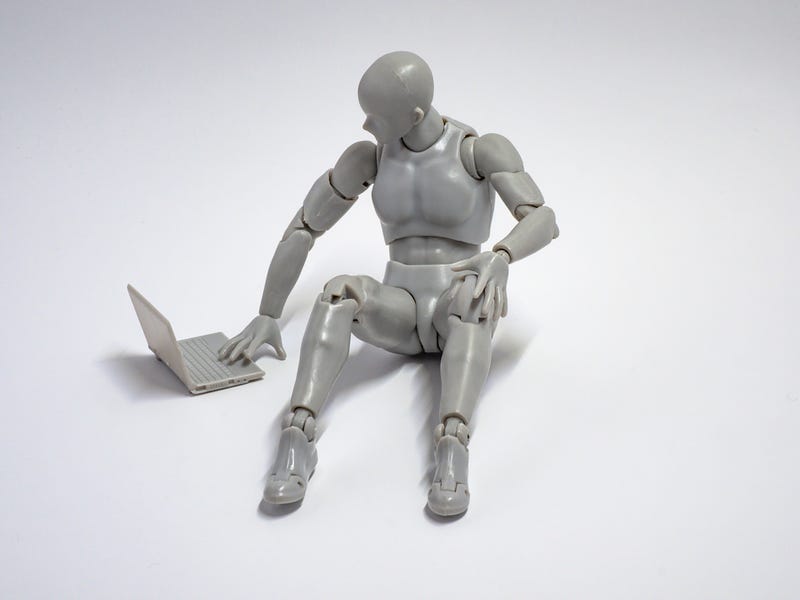
With the advancement of technology, we now have the option to use artificial intelligence (AI) instead of human writers. These ‘bots’ offer a range of services from social media posts, article writing, listicles, emails, copywriting, proofreading and editing.
For a writer, this is extremely concerning. We spend hours selecting the right words and refining our sentences to achieve the desired impact. We pour our hearts and souls into our work, agonising about whether it is good enough and meets the needs of the reader.
Could it be that a robot could complete this complex process in just seconds, rendering us ‘flesh-and-bone’ writers obsolete?
I reasoned that the only way to find out was to have a go at using artificial intelligence to produce some writing. That way, I could measure myself up against the competition.
Here’s what I discovered.
How easy is it to use AI for writing?
It was surprisingly easy.
A quick Google search revealed a large number of appropriate services, most of which offered free trials. Some of these did not even require you to enter credit card or payment details in order to access your first few pieces of writing. After that, access to the service is usually on a subscription or credits basis and is relatively low cost.
Once you’ve selected which AI service you want to use, it takes just a couple of minutes to enter your topic and a brief introduction (fewer than 150 characters). You are then offered a selection of outlines to choose from and the content is automatically generated for you.
You are then free to edit it, if you wish to do so, and download it.
The whole process took less than ten minutes and cost me absolutely nothing.
How good is the writing produced by an AI writing service?
I was surprised how authentic the finished piece was. There were a few errors with punctuation and some of the content was clumsily worded. However, there was an option to edit the final piece, so this could easily be rectified.
I could do a detailed analysis of the quality of the writing for you, but it would be from my perspective alone. A better approach would be for you to judge for yourselves.
I have copied examples of the writing below for you to have a look at yourselves. Before you do, though, please continue reading my thoughts about the topic so you can compare them with your own.
Is it just plagiarised or rehashed content?
I was interested in finding out whether the articles just re-ordered the same content in many different articles. To test this, I cut a few sentences out of the article, pasted them into Google and ran a quick search. I reasoned that if the writing was just the same content, mixed up into a different order, Google would be able to find the same sentences elsewhere.
It didn’t. None of the sentences that I pasted into a Google search came up with an exact match.
The next test that I carried out was to put the text through two different online plagiarism checkers to see if the content had been lifted from articles elsewhere.
Both tools reported that the content had an originality score of 100%.
From a writer’s perspective, I found this concerning. If it is so easy to produce authentic and original content, then maybe we should be worried.
What are the benefits of using such a service?
Despite my obvious bias, I will try my best to be objective here.
AI has clear limitations but I do admit that I see some value in using it, in limited circumstances.
For new writers, AI created content might provide a starting point to help them produce well-structured pieces. Sometimes, the hardest part of writing is coming up with a coherent structure. Once that is done, the rest often falls into place. Maybe AI could be used to take the pain out of this process.
In addition, AI content suggestions could be used to supplement a real writer’s ideas, or at least provide a starting point. I played around with several different topics and, for some of them, the bot suggested ideas that made sense, but that I had not thought of myself.
For people who are happy to produce high quantities of low level content, there are obvious benefits too. AI could be used to provide a constant drip feed of content to others, serving as a constant reminder of your existence.
For people writing in a second language, there are also potential benefits. We have all seen poorly written text that has been produced someone with a limited grasp of the intended language. Instruction booklets and product descriptions are obvious examples.
But even in these cases, surely a real human would still need to check over the content? It is easy to think how there could be serious implications if there is an error.
So, I can see a multitude of uses, including others not listed here, but I think they all have significant limitations.
So, should we be worried?
Impact on the jobs market
Increased use of AI might reduce the opportunities for freelance writers and could, therefore, impact on the jobs market with real employees being replaced by robots.
This might have one of two knock-on effects. Firstly, it could push genuine talent out of the market, limiting the number of people who seek to do writing as a career and therefore reducing the overall standard of writing.
On the other hand, something different might happen. Maybe, in an attempt to outclass the robots, writers will realise that they need to improve their game. People just wouldn’t pay for low quality content from human writers anymore.
Maybe, it could actually drive up the standard of writing.
What will happen to online writing platforms?
I worry that platforms (such as the one that this article is published on) could be swamped with people using AI to generate fast, low quality articles. This would impact on the overall quality of writing on the platform and might subsequently reduce the number of readers who would be willing to pay for a subscription. This would clearly have a negative impact on all of us.
Platforms can put rules in place to mitigate against this. However, they would need to be able to identify which pieces were produced by AI in order to do this. Presumably, they would need to use some sort of algorithm to identify when this had happened and then constantly keep up with improving technology that could bypass the original algorithm. It would be a case of the war of the robots.
Personally, I think that using AI to generate writing for such purposes is unethical. I just hope that others agree.
Could human writers be replaced altogether?
On balance, I don’t think so.
I believe that for writing to have real power, the author has to have a reasonable level of emotional intelligence. Writing is always done to fill some form of human need and the best way of doing this is to be a human.
Far too many variables come into play to allow a robot to replicate this successfully. Humans have the capacity to know how to adapt their words to be sensitive to the current needs of another. They can be immediately responsive to changing circumstances. They have the understanding that certain words can trigger certain emotional responses.
Robots simply can’t do this.
Not yet anyway.
Added to this, we should never underestimate the value that humans place on real relationships. In a business context, for example, a human writer can get to know the company’s aims and objective, can articulate ideas in a way that sounds like the CEO and can get to know the quirks of the clients that they serve. Plus the fact, they can chat about the football, show an interest in someone’s family and provide empathy where needed. Robots simply can’t replicate this.
Writing is a form of expression and robots have nothing to express.
At the moment, I am not losing any sleep over any of this.
The Writing Samples
Here are a couple of the pieces that were written by AI as part of my research for this article. It has taken every ounce of my willpower not to edit them, but that would defeat the purpose of this exercise.
Could we really be replaced by robots?
Judge for yourselves…
Blog Post — 10 Ways to Improve Your Writing
Everyone wants to be a writer these days but the competition can be intense. Here are a few ideas to put you ahead of the others.
Be honest and transparent
As a writer, you should always be 100 percent honest and transparent with your readers. Your goal should be to write about topics that are relevant to your readers and, as such, you need to be able to understand what they are thinking and feeling. Always write honestly. That’s how you put your readers at ease. Being honest helps when it comes to writing content for your blog and making sure that it is relevant to your readers. Keep on top of your grammar If you want your writing to be understood by the readers, then you should make sure that it is up to the same standards as your readers. If your grammar is poor, then your readers won’t be able to understand what you are saying. It’s as simple as that. You want to make sure that you are aware of the fact that your readers are reading.
Be concise
When you want to write quickly, writing with a lot of words can slow you down. You have to edit out all the extraneous words but this is hard to do when you are writing for the first time. There are several ways to shorten your writing: What you know your readers already understand. They have used that in their work. If you know the right words to use, you can create a summary that can serve as an overview. Use active voice When you write in the active voice, your words appear as you use them. So, for instance, instead of writing, “You need to learn what to do before you…” Use the past and present tenses. Use your readers’ knowledge When you know something you can use that information to build on it. You can improve on something by adding.
Be original
Be original not merely by writing your own stories but also by putting your own spin on your favorite stories and adding your own chapter to the classics. Use metaphors and similes Use metaphors and similes. Use the same metaphors and similes as your favorite authors do. Don’t fall for fancy words. They can make your writing sterile. Make the same mistakes as your favorite authors Make the same mistakes as your favorite authors. Most authors fall prey to the three P’s: Prepositions, Postpositions, and Propositions. Do you write good? Write good, then write better. Keep it simple Keep your writing simple. Clichés are annoying. Avoid trite words Avoid trite words. Don’t say “This is the kind of story that would make a great movie.” This isn’t a story about a movie.
Be consistent
When you post regularly, people will take notice and visit your website often. I know you want to develop something more unique, so creating a blog is the perfect platform to get more people to visit your site and like it. Mention people you’ve heard of I talk a lot about highlighting famous writers in my coaching work. When I mention them on my site, people will be more likely to go and read what I’ve written. Check on your form You know what you’re supposed to do to your work but it’s very easy to forget, which can result in your work looking sloppy. I suggest you practice your writing techniques every week and read it out loud so you can see where you could improve. It’s worth doing in private before posting.
Use appropriate vocabulary
Have you ever read through an essay written by someone who obviously doesn’t have a basic understanding of vocabulary? There’s nothing more disheartening than reading that “carpet” instead of carpeting, or “turning” instead of transitioning. This results in an inconsistent or confusing writing style. Use the words you know so you aren’t forced to look up unfamiliar words. If you can’t find the words in your current vocabulary, make sure you add them to your vocabulary list before attempting an essay. Make sure you spell your words right There are so many typos I’ve seen when writing. One particular favorite of mine is typing “was” instead of “were” — it always sounds clumsy. Before you write an essay or write a story, make sure you spell the words correctly.
Use descriptive language
This seems obvious. A big reason why some people write well is that they can use descriptive language. The narrative can be set in a single setting or can vary over time depending on who the characters are. You can start in the past or present and transition between times with each scene. You can change the location and timeframe to set a scene, highlight a character, or show an emotion. Using descriptive language can be a very effective writing technique. Avoid superfluous words Speak like a native when you’re writing, avoiding phrases that don’t contribute anything to the story. Pretentious phrases such as “I saw the expression on his face” or “He sat up and regarded me with cold, precise, assessing eyes.
Be clear
If you have a clear subject, topic or message, you should be able to write about it without worrying if your argument is clear. If you can’t come up with a clear story, perhaps your message is clear but the message isn’t clear enough. Tailor your words to suit your audience If you are writing for a general audience, rather than a niche market, you should remember that you are writing for people and that might mean a lot of stretching your writing in some areas to find a way to bring your message to a wider audience. Work at the pace of your audience Writers have different writing speeds.
Use emotion
Emotional writing is the most important kind of writing. In fact, it’s the only kind. Anything less is technically writing. Emotional writing is what you do when you can’t seem to stop crying. It’s the stuff that you’re made of when you’re in excruciating pain and you can’t make your legs do what you want them to do. When you can’t sleep, you sit there trying to convince yourself that you’ll sleep when you can’t stand it anymore. Emotional writing is what you’re born to do, or so I’ve been told. Emotional writing is what makes you human. So don’t be ashamed of it, because the writing gods know that you can do it. You’re the only one that’s talking in those pages. Now, emotion doesn’t just happen when you want it to. So if you’re feeling really inspired, write your first draft.
Clarity
Writing clarity is the most important thing. Don’t be afraid to use commas or full stops at the start of a sentence for clarity. These small tools will make your writing much easier to understand and much easier to edit later. Sentence Structure The sentence structure should be easy to follow but have a lot of content. Don’t rush your sentence but don’t make any awkward breaks either. Use sentences that have two or three or more clauses together in a short or simple statement. In fiction these will be some of the best in telling a story and so they can be seen as ways to help the writer be the best writer. Key Words Use the right key words. You can find good advice here but keep in mind that the best will always be different.
Conclusion
Writing is a difficult discipline. It takes time to master it but once you do, it will allow you to work for yourself rather than work for someone else. If you follow the writing tips in this article, you can become an expert writer who can land publishing contracts and success in writing. Do you think you have what it takes to be a successful writer? Or, are you concerned about getting your work published? Take our two-question quiz and find out how you measure up.
Social Media Posts — Advertising ghostwriting services
1. No one can keep up with the demand for content, which is why I offer a ghostwriting service to help with your brand.
2. If you’re looking for a ghostwriter to promote your business, I can help with any of the following:
- SEO marketing and branding
- Ghostwriting social media posts for your business
- Writing blog posts and articles about your
3. I can provide a ghostwriting service for anyone who wants to run their own social media account.
4. Increase your sales!
Need help reaching your target audience? I can help you write the perfect social media post to increase your sales. Contact me for a quote today.
Author’s final comments
(We’re back to the real human here, in case you are confused!)
I only tested a couple of different services. There are numerous available and it could well be that different tools have differing strengths and weaknesses. I do not claim that this is a comprehensive overview of the capabilities of artificial intelligence.
I intentionally did not use AI to write a piece about whether AI could replace real writers. Quite honestly, that sounds like the start of a sci-fi book and the thought just messes with my brain! The thoughts in this article are genuinely human.
I have not included the details of the services that I tested as I do not want to promote the use of these. They are easy enough to find with a simple Google search.
I recognise that AI will advance over time. In a few years, I might need to really rethink my position and possibly look for a new job.
In the meantime, I’ll just keep on writing.


