
How to Create Addictive Habits With 1 Simple Brain Hack
Smell as a behavioral reinforcement. It really works.

When my brain rebels — and it happens often — I try to trick it.
It worked when I cut back on coffee and started mixing caffeinated and decaffeinated every morning, slowly increasing the dose of the latter. It worked when I tried beating the jetlag or when I wanted to get over an irrational fear.
I was too distracted to make meditation and yoga recurring daily practices. I would do it once, at an odd hour of the day, then again a week or so later.
I was too lazy to dedicate my Saturdays to a full day of housework and cleaning, even though it transformed my following week for the better.
I was too bored to repeat my healthy hair routine weakly when I knew I’d be confined to my house for God knows how long.
If my disobedient brain refuses to comply with the habits I’ve wanted to adopt in my life, I’ll give it no choice but to go along.
The basics of smell
You’ve probably experienced a memory trigger because of a strong odor, a perfume, a place, a garden.
Smell is the most potent of senses; this is because it’s processed differently, and it’s directly associated with memory. With every other sense (hearing, sight, touch, or taste), the first relay of information is to an area of the brain called the thalamus. The thalamus is a relay center that receives sensory impulses from receptors and passes them on to the cerebral cortex where they can be integrated and interpreted.
Think of the thalamus as the gate to the conscious perception of senses.
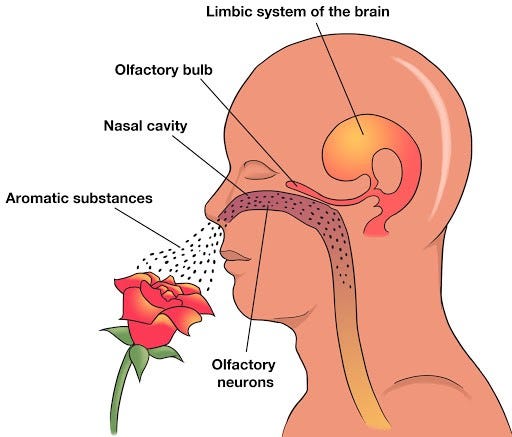
The whole process is very different when it comes to smell! Scents bypass the thalamus (unless they’re associated with other senses such as taste) and go straight to the brain’s olfactory lobe, which is connected to the amygdala and the hippocampus. The two structures are part of the limbic system, involved in memory, motivation, and emotion coding.
A study in 2014 showed that humans could discriminate up to 1 trillion different odors. It’s impossible to describe in words a trillion odors, so our conscious awareness of the different smells we experience every day is minimal.
There’s also a large body of evidence proving that emotions have a smell. Scientists go as far as to say that they might even be contagious.
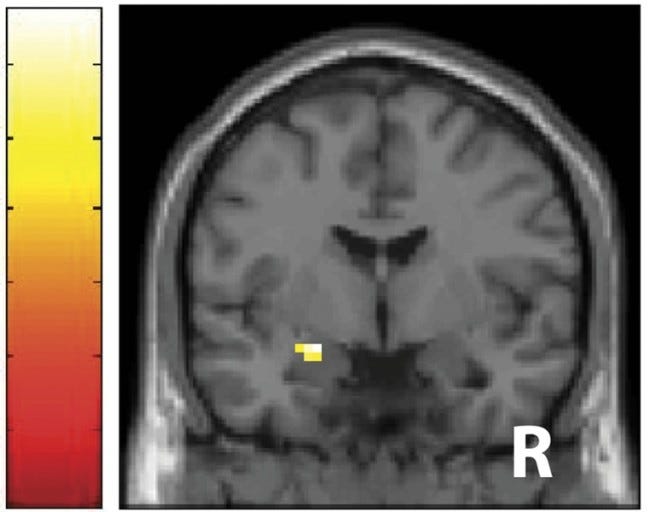
Love, motherhood, fear, anxiety, the list of emotions you can smell goes on, but you get the point.
With every whiff, there’s a cascade of chemical reactions in our brains. The limbic system is an amazing network of interconnected structures that work together and influence one another to affect behaviors, emotions, memory, and motivation.
This system is key to instinctive and automatic behaviors. It isn’t linked to any conscious processing and isn’t under our direct control.
But… Knowing all of this can help us hack into this primitive aspect of our brains. I think you see where I’m going with this.
How to use smell as a behavior reinforcement
Keep the science at the back of your mind, and let’s get back to our story.
Yes, there are ethical implications to using conditioning on humans, but I don’t think there’s any problem with using it on ourselves.
Conditioning is a broad term. Here, it refers to the pairing of different stimuli to promote learning leading to an intrinsic behavior.
In this case, a particular action is paired with an agreeable smell, only when the action is performed.
- Perform the action you want to adopt as an intrinsic behavior or habit
- Complete the action until you reach the reward stage
- Choose an agreeable smell you will only use for this purpose and nothing else
- Introduce the same smell every time the action is completed
- Watch this action become a habit over time
I use my aromatherapy during my yoga practice, light my scented candles and buy new flowers after a deep clean, spray some hair perfume once my hair care routine is complete.
For each one of these habits, the completion itself carries a reward, which makes the conditioning stronger and more effective: physical calm, clean space, positive body image.
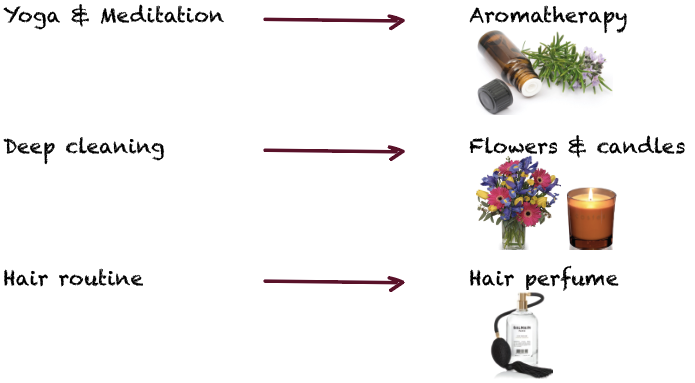
The key is to use these scents only when the action is performed as a reward.
I flattered myself thinking this genius trick was mine, but there has been some research backing up this claim of olfactive conditioning. It has been widely used in animal studies, but some scientists wanted to reproduce the findings in humans. The results?
“Odors can be used effectively in a classical conditioning paradigm to positively influence human behavior”
In this specific study, schoolchildren were given a paper-and-pencil task in the presence of an ambient odor (Strawberry and Peppermint). When this same odor was introduced again, performance on other tasks was superior to that of relevant control groups.
If negative conditioning works perfectly well in humans (like nausea-inducing smells due to previous experience), then why would positive conditioning be any different?
If you’re still skeptical, let’s get back to the science for a bit.
The brain’s reward system (the mesolimbic pathway, the one we mentioned earlier) is powerful, adaptive, and addictive. It regulates incentive salience, motivation, reinforcement learning, and fear, among other processes.
When exposed to a rewarding occurrence, the brain releases the neurotransmitter dopamine, transported from the VTA to the nucleus accumbens, amygdala, and hippocampus.
This will happen following an affirmative action (in response to physical activity, a pleasant living space, or a positive body image).
Enters olfactory reward. Your reward system is already active at this point, but let’s activate it some more to make sure your habit sticks. Ideally, we want to associate this pleasure with encoded positive memory.
Remember how scents can bypass the thalamus and go straight to the amygdala and the hippocampus? The two structures are part of the reward system. The amygdala is essential for input and processing of emotion, and the hippocampus is specialized for declarative or episodic memory.
This is an example of a system convergence between sensation and reward. There is some speculation that the neurobiology of olfaction and reward co-evolved for survival instincts. The potential co-dependence of these systems would have important implications for how sensory systems and reward systems operate.
We go through life oblivious to the fact that everything around us triggers volcanos inside of us. Odors are no different.
“Smells are the fallen angels of the senses” — Helen Keller
As I always say, your brain is a cave of wonders like no other! Don’t take it for granted. Get to know it, understand how it controls you to control it better — spoiler alert: it’s only possible to a minimal extent.
It doesn’t hurt to try using smell as positive behavior reinforcement. The key, as always, is consistency and dedication. Let me know if this works for you!
~Adriana~
Thank you for taking the time to read.
Sign up to BrainChronicles & stay updated with trending neuroscience and psychology news and research.
For more interesting facts and information about the human brain.


